The Battle Begins

The First Clash of Armies

Lanka's gates open and war erupts in all its terrible glory. Vanara and rakshasa armies clash as the greatest conflict of the age begins. Heroes emerge, champions fall, and the battlefield runs red with the first blood of many.

Dawn of War

The sun rises blood-red over Lanka, as if the sky itself knows what this day will bring.

From the vanara camp, war drums begin their thunder. Conch shells sound across the morning air - the ancient call to battle that has stirred warriors since time began. Rama stands before his assembled host, bow in hand, eyes fixed on the golden city.

"Today we fight not for glory," he addresses them, "not for conquest, not for plunder. We fight for dharma. We fight to free one innocent woman from unjust captivity. We fight because to do nothing would make us complicit in evil. Fight well. Fight honorably. And may the gods guide your arms."

A roar erupts from millions of throats. The vanara army surges forward toward Lanka's walls like a living tide.

Ravana's Response

Inside the city, Ravana has not been idle. His generals have prepared through the night. Troops have been positioned, weapons distributed, defenses reinforced. The demon king addresses his own forces from the highest tower.

"These monkeys think they can challenge Lanka? Show them their error. Show them what happens to those who oppose Ravana. Drive them into the sea from which they came!"

Lanka's main gates - massive structures of iron and enchanted bronze - swing open with a groan that echoes across the battlefield. From that darkness pour Ravana's armies. Rakshasas of every description - giants wielding clubs, warriors in gleaming armor, sorcerers crackling with dark energy, beasts bred for war. The ground shakes beneath their march.

The two armies meet in the field before Lanka's walls. The impact is like two oceans colliding.
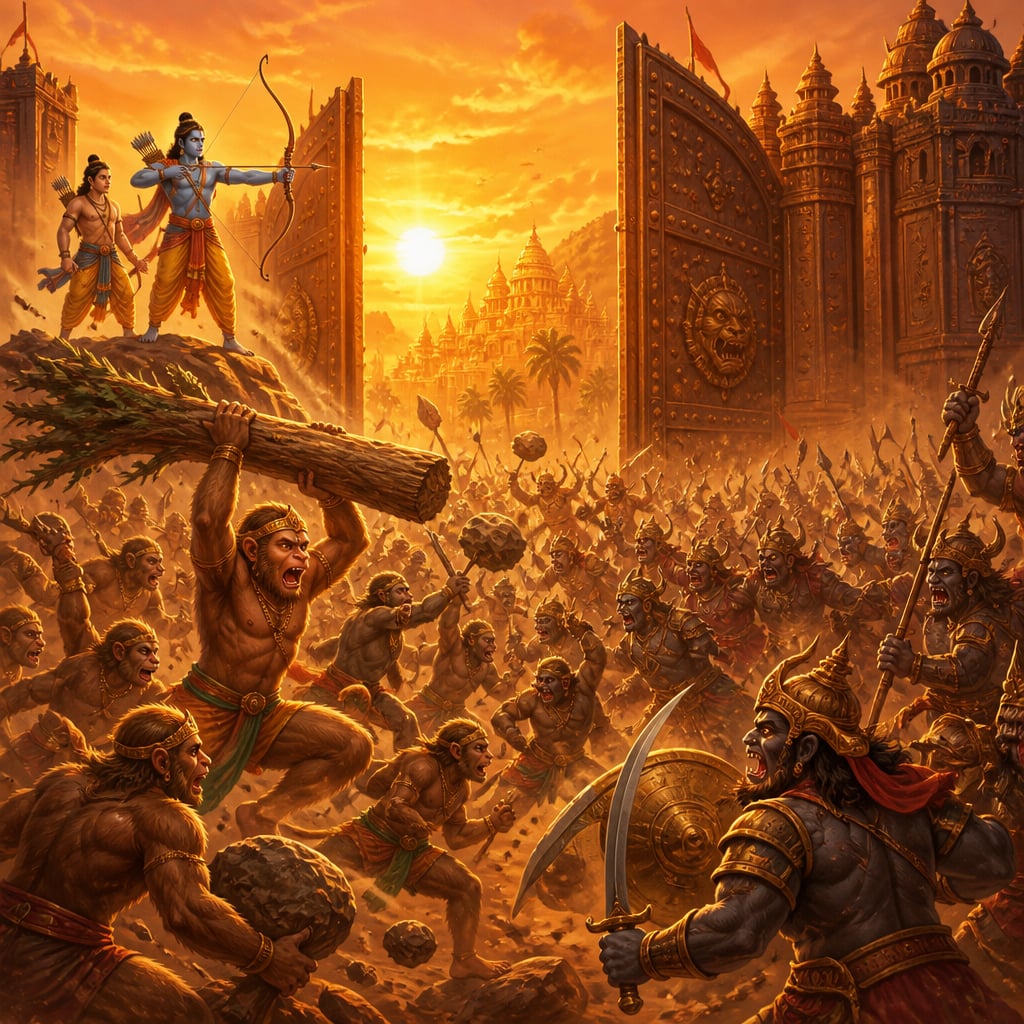
The iron gates of Lanka swing open at sunrise as the vanara host and the rakshasa army crash together on the open plain before the city walls.

The Chaos of Combat

Battle in the ancient world is nothing like later centuries will imagine. There is no clean line of engagement, no orderly advance and retreat. It is chaos - beautiful, terrible, absolute chaos.

Vanaras swing from improvised weapons - trees uprooted from the earth, boulders torn from the ground, their own fists and fangs. They fight with the ferocity of creatures defending their homes, their families, their sacred honor. Hanuman wades through rakshasa ranks like a storm through wheat, his roar alone enough to scatter lesser demons.

The rakshasas respond with magic and steel. Fire erupts from outstretched hands, consuming vanaras where they stand. Enchanted weapons seek targets with unnatural precision. Some demons shift forms mid-battle, becoming monstrous things that defy description.

Nila, the engineer who built the bridge, proves himself equally capable in war. He leads his division against a rakshasa phalanx, breaking their formation with strategic precision. The same mind that designed a bridge across the ocean now designs the destruction of enemy units.

Angada fights near the front, his youth no hindrance to his valor. He seeks out rakshasa champions, challenging them one by one, proving with each victory that Vali's blood runs true in his veins.

The Duel of Generals

As the day progresses, the battle evolves. Individual duels begin to punctuate the general melee - commanders seeking out their counterparts, champions testing themselves against worthy opponents.

Sugriva himself faces Ravana's general Mahodara, a rakshasa of immense size and legendary cruelty. The vanara king moves with a speed that belies his bulk, evading Mahodara's crushing blows while landing strikes of his own. The duel draws watchers from both sides.

Sugriva drives a killing blow through Mahodara

"You fight well for a monkey," Mahodara snarls.

"And you die well for a demon," Sugriva responds, driving a killing blow through the rakshasa's guard.

Mahodara falls. The vanara forces cheer. First blood of significance has been drawn.

But the rakshasas have their own victories. Dvivida, a mighty vanara warrior, falls to the spear of Vajradamstra. Sharabha, who once served Vali, meets his end against three rakshasa brothers fighting in concert. War takes from both sides without prejudice.

Rama and Lakshmana

From a slight elevation, Rama and Lakshmana direct the battle while also joining it. Their bows sing constantly, each arrow finding a rakshasa target with unerring precision.

Rama's arrows are works of art in destruction. They curve around obstacles, split into multiples mid-flight, burst into flame upon impact. Rakshasas learn quickly to fear the prince of Ayodhya - where his gaze falls, death follows.

Lakshmana guards his brother's flanks with equal skill. Any rakshasa who attempts to approach Rama from an angle meets Lakshmana's arrows first. The brothers fight as one being with two bodies, their movements synchronized by years of training and unbreakable love.

Vibhishana stays close to Rama, providing crucial intelligence. "That demon there - Akampana - he is vulnerable on his left side, an old injury. That formation uses an illusion; the real threat is twenty feet to the right."

His knowledge of Lanka's forces proves invaluable. Again and again, vanara commanders receive warnings about rakshasa tactics, allowing them to counter strategies that would otherwise succeed.

The Day's End

As the sun begins to set, both armies withdraw by unspoken agreement. Battle in darkness favors the rakshasas, who see better in shadow. The vanaras fall back to their camp; the demons retreat within Lanka's walls.

The battlefield between them is a testament to the day's fury. Bodies lie in heaps - vanara and rakshasa intermingled, all equally still. The wounded cry out for water, for help, for death's mercy. Healers from both sides venture out under truce to retrieve their fallen.

Rama walks among the vanara wounded that evening, offering words of comfort, touching brows with gentle hands. Many will not see tomorrow's sun. He owes them his presence at least.

"Was today a victory?" Angada asks Jambavan as they assess the day's toll.

The ancient bear considers. "Today was a battle. We held our ground. We killed more than we lost. But victory? Victory comes only when Sita is free and Ravana is dead. Until then, every day is just another step on the path."

Night Preparations

In Lanka, Ravana receives reports in his war council. The numbers are not pleasant. His forces held, but the vanaras proved more formidable than expected. Several generals are dead. Morale, while not broken, has been tested.

"We need new tactics," Ravana announces. "These monkeys fight without fear. Ordinary rakshasas cannot intimidate them. Tomorrow, I will send the Yatu clan - demons who fight only at night. Let Rama face enemies he cannot see."

His generals nod. Lanka has reserves yet uncommitted, warriors whose specialty requires darkness. Perhaps tomorrow will break the vanara spirit.

Across the field, Rama holds his own council. Vibhishana warns of night assault tactics, of rakshasa magic that thrives in shadow. Precautions are arranged - fires kept burning, sentries doubled, Hanuman himself patrolling the perimeter with tireless vigilance.

The first day of the great war is over. Neither side has won. Neither side has lost. But both sides understand now what they face - not a quick skirmish but a prolonged, brutal conflict.

Tomorrow will bring new horrors. Tomorrow will test them all again. But that is tomorrow. Tonight, the living rest, the dead are mourned, and prayers rise from bloody ground toward indifferent stars.

Living traditions

Military academies in India reference the Yuddha Kanda's strategic principles. The concept of dharma yuddha (righteous warfare) has influenced Indian military doctrine, including the emphasis on proportional response and protection of non-combatants. International humanitarian law scholars have noted parallels between ancient Indian war codes and modern Geneva Conventions.

Reflection

More in Yuddha Kanda

All lessons in Yuddha Kanda ยท The Ramayana course