The Aditya Hridayam
The Sun's Secret Power
Before the final battle, sage Agastya appears with a sacred gift - the Aditya Hridayam, a hymn containing the concentrated power of Surya, the Sun God. This prayer will give Rama the strength to accomplish what weapons alone cannot achieve.
The Night Before
Rama sleeps fitfully, his dreams troubled by the weight of tomorrow.
In those dreams, he sees Sita waiting in the Ashoka grove, counting the days until liberation. He sees his father Dasharatha looking down from the heavens, pride mixed with anxiety. He sees the faces of every vanara who has died in this war, their sacrifice demanding that he succeed.
He wakes before dawn, the stars still visible above the ocean. Around him, the army stirs - warriors preparing for what they sense will be the decisive day. The air itself feels charged with anticipation.
Rama walks to the shore to perform his morning prayers. The ocean that once blocked his path now reflects the pre-dawn sky like a mirror of stars. He begins the rituals taught to him by Vasishtha, seeking the calm center he will need for the battle ahead.
A presence appears behind him - ancient, radiant, unmistakably divine.
The Sage's Arrival
Agastya stands where a moment ago there was only sand.
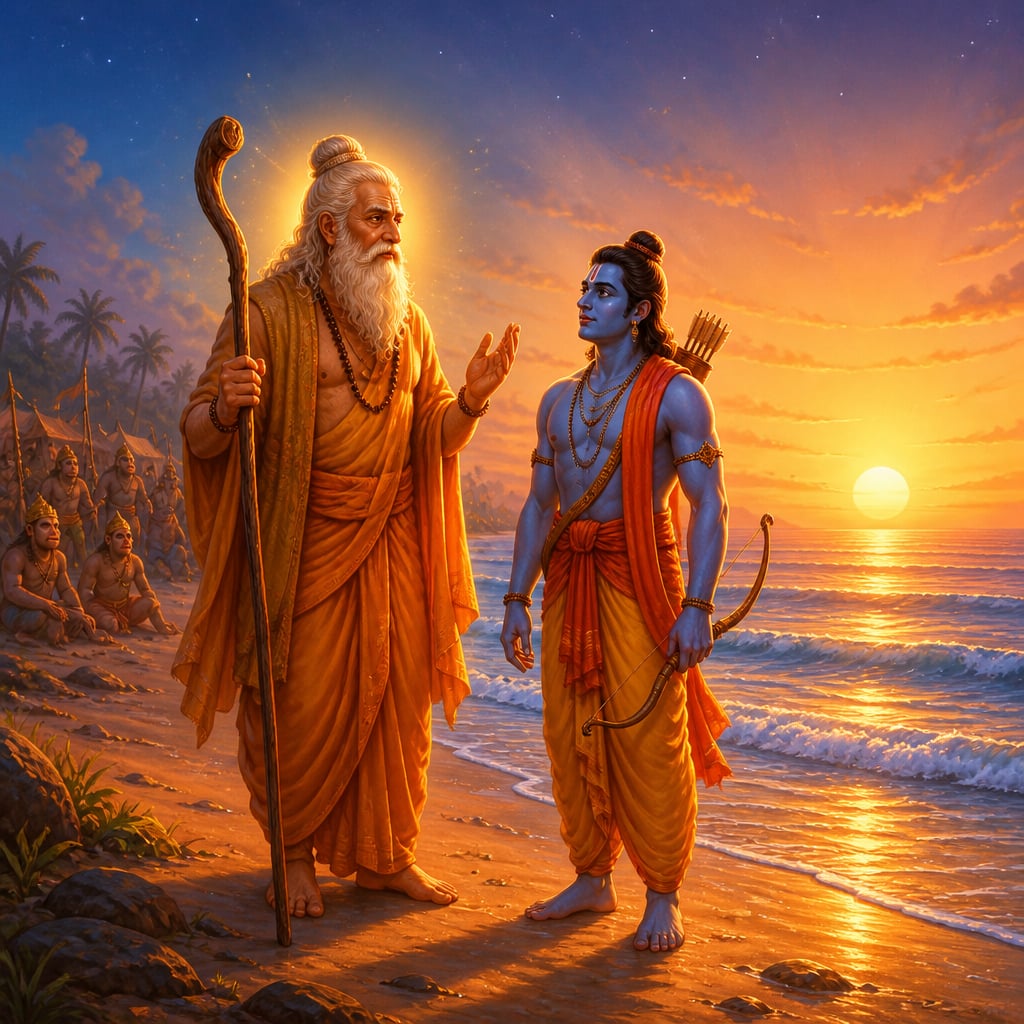
The legendary sage carries the weight of eons in his bearing. He is one of the Saptarishis, the seven great sages who maintain cosmic order. He drank the ocean to expose the demons hiding within it. He humbled the Vindhya mountains. He has been a guardian of dharma since before human memory began.
"Child of Raghu," Agastya speaks, his voice resonating with power beyond the physical. "I have watched your war with great interest. You fight well. But weapons alone will not defeat Ravana."
Rama bows deeply. "Great sage, what must I do? Ravana heals from every wound. His blessing protects him from death by god or demon. How can a mortal succeed where celestials have failed?"
Agastya smiles. "You ask the right question. The answer is simpler than you think, yet more powerful than any weapon in your arsenal."
The Sacred Hymn
The sage gestures toward the eastern horizon, where the first light of dawn begins to glow.
"You are of the Suryavansha - the Solar Dynasty. The Sun is your ancestor, your guardian, your source of power. Yet you have not fully tapped this inheritance. Today, I give you the means to do so."
He begins to teach Rama a hymn - the Aditya Hridayam, the Heart of the Sun. The verses are ancient beyond measure, containing not just words but concentrated cosmic energy.
"This is no ordinary prayer," Agastya explains as Rama absorbs each syllable. "It is a direct channel to Surya's power. When you recite it with full devotion, the Sun's strength becomes your strength. His light becomes your light. His fire burns through you."
The hymn praises Surya in all his aspects - as creator and destroyer, as the eye of Vishnu, as the source of all life on earth. It acknowledges his power over demons, over darkness, over death itself.
"Ravana's power comes from Brahma's blessing," Agastya continues. "But Brahma himself was born from the cosmic lotus, which grew from the energy of creation - energy that flows from the Sun. What Brahma gave, the Sun can reclaim."
The Meaning Within
Rama memorizes the hymn quickly - his training with Vishwamitra included similar practices. But Agastya cautions him against treating it as mere magic.
"The Aditya Hridayam works not through the words alone but through the devotion behind them. You must mean what you say. You must believe what you invoke. Empty recitation will give you nothing."
"I understand, sage."
"Do you? Then tell me - what does the Sun represent to you?"
Rama considers. The Sun - the one who rises every day without fail, who gives light without demanding payment, who sustains all life without discrimination. The Sun who is the same for king and beggar, for saint and sinner, for demon and god.
"Dharma," Rama answers finally. "The Sun represents dharma itself. He does his duty without attachment to results. He shines because shining is his nature. He has done so since creation and will continue until creation ends."
Agastya nods with approval. "Then you understand truly. You are not invoking the Sun's power to destroy your enemy. You are aligning yourself with cosmic dharma - becoming its instrument. Ravana stands against the natural order. When you channel that order through yourself, his resistance becomes meaningless."
The Sun Rises
As Rama completes learning the hymn, the sun breaks the horizon.
Golden light floods the battlefield, touching every tent, every warrior, every weapon. The vanaras stir with renewed energy. Even the wounded seem to draw strength from the rays.

Rama turns toward the east and begins reciting the Aditya Hridayam. His voice carries across the camp, and those who hear it fall silent, touched by something beyond ordinary prayer.
With each verse, Rama feels power building within him - not borrowed power, not external force, but his own heritage awakening. The blood of Surya flows in his veins. The light of Surya illuminates his mind. The fire of Surya fills his spirit.
By the time he finishes the final verse, Rama glows with an inner radiance that makes the watching vanaras step back in awe. He is still himself, still the prince they follow, but he is also something more - a vessel of cosmic purpose.
"You are ready," Agastya says. "Ravana awaits. End this war. Restore dharma. And then..." he pauses, a shadow crossing his face, "...there will be one more trial. One more test. Do not let victory make you forget justice."
Before Rama can ask what he means, the sage vanishes as suddenly as he appeared.
Into Battle
Rama mounts Indra's chariot, the Aditya Hridayam still resonating in his heart. Matali takes the reins. The divine horses paw the air, eager to fly.
Lakshmana approaches. "Brother, you look... different. What happened?"
"Agastya came to me. He gave me a prayer - a connection to our ancestor Surya. Today, I fight not as Rama alone but as the heir of the Sun."
Lakshmana touches his brother's hand. "Then Ravana should be very afraid."
From Lanka's towers, horns sound. Ravana's chariot rises into the sky. The demon king has recovered from yesterday's wounds, his blessing working through the night to restore his strength. He looks as formidable as ever.
But something has shifted. Rama feels it in his bones. The balance has tipped. The cosmic order has placed its weight on his side.
"Today," Rama says quietly, "it ends."
The chariot rises. Across the battlefield, Ravana sees him coming and roars his challenge. Two forces that have been building toward collision since Sita's abduction finally hurtle toward their meeting point.
The final battle begins.
Living traditions
The Aditya Hridayam is recited by Indian soldiers before battle - a tradition maintained by the Indian Army that traces directly to this lesson. ISRO's Aditya-L1 solar mission takes its name from this hymn. The prayer has been translated into dozens of languages and is practiced by Hindus worldwide as a morning meditation for energy and success.
- Aditya Hridayam Parayana: Daily or Sunday recitation of the Aditya Hridayam for health, victory over obstacles, and spiritual power. The practice continues exactly as Agastya instructed Rama - chanting with devotion before facing difficulties.
- Modhera Sun Temple: Built in 1026 CE, this temple was designed so that the Sun's first rays illuminate the inner sanctum during equinoxes. The Aditya Hridayam was traditionally recited here at dawn.
- Suryanar Kovil: One of the Navagraha temples, dedicated to Surya. The Aditya Hridayam is recited daily, and devotees believe visiting here invokes the same blessing Agastya gave Rama.
Reflection
- Have you ever discovered strength in your heritage that you hadn't previously claimed? What awakened that recognition?
- Why did Agastya say that Rama was aligning himself with cosmic dharma rather than just getting a new weapon? What's the difference?
- The Sun is the same for all beings, yet Rama could channel its power because of his lineage. What does this suggest about the relationship between universal truth and particular access?