The Fall of Ravana
Dharma's Ultimate Victory
The final confrontation between Rama and Ravana reaches its climax. Every weapon is unleashed, every power tested. And in the end, a single arrow - blessed by all the gods and powered by the Sun itself - brings down the lord of Lanka.
The Battle of Titans
The two chariots meet in the center of the sky with an impact that sends shockwaves across the battlefield.
Rama and Ravana exchange arrows in volleys so rapid that individual shafts cannot be distinguished - only streams of light and fire crisscrossing between them. Each warrior carries millennia of martial training. Each possesses divine weapons beyond mortal understanding. The duel is beautiful and terrible in equal measure.
Below, both armies have ceased fighting entirely. Rakshasa and vanara stand together in stunned silence, watching their champions decide the fate of the world. Even old hatreds are forgotten in the face of this spectacle.
Ravana fights with the fury of one who has nothing left to lose. His brother is dead. His son is dead. His kingdom crumbles. If he falls today, everything he built across ages will be for nothing. He hurls weapon after weapon - the Brahmastra, the Pashupatiastra, the Narayanastra - each capable of ending worlds.
Rama counters with equal power, but differently applied. He does not fight with rage. He fights with the calm certainty of one who knows his cause is just. The Aditya Hridayam's blessing flows through him, turning his arrows into extensions of cosmic will.
Heads Fall, Heads Rise
Rama's arrow severs one of Ravana's heads. The demon king staggers - but moments later, the head regenerates. Another head falls. It grows back. A third, a fourth, a fifth - each time the wound heals before Ravana can even feel true pain.
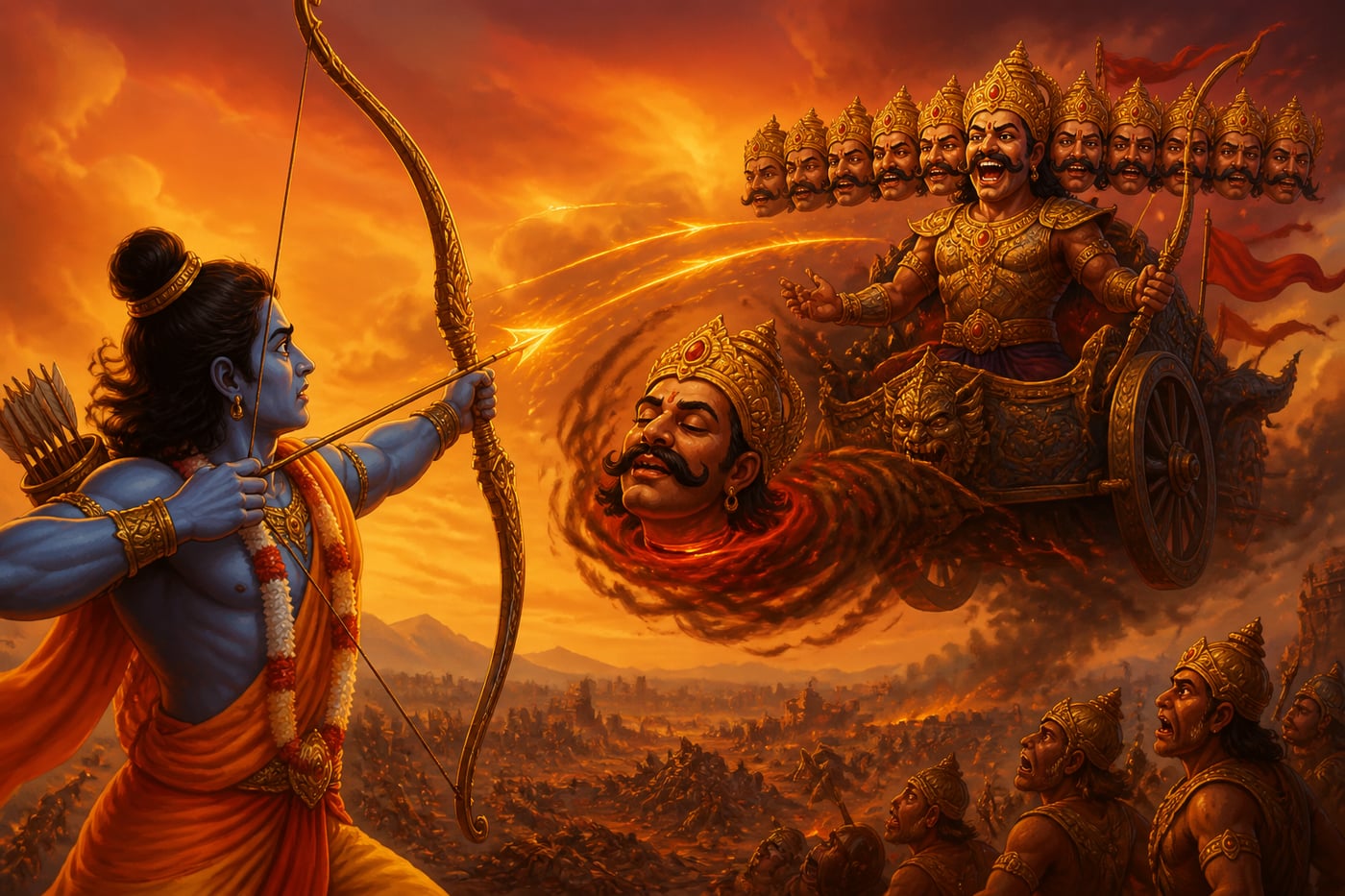
Matali observes grimly. "Brahma's blessing. As long as even one head remains, the others will regenerate. You cannot defeat him this way."
"Then I must find another way," Rama replies, never pausing his assault.
He remembers Agastya's words: the Sun's power can reclaim what Brahma gave. He remembers Vibhishana's intelligence: Ravana's heart contains a reservoir of amrit - divine nectar that sustains his immortality. He remembers his own training: victory comes not from destroying strength but from understanding weakness.
The weakness is not in Ravana's heads. The weakness is in what keeps him alive.
The Brahmastra's Gift
Rama reaches for a special arrow - one he has carried since Vishwamitra first trained him, one he has never used because its power frightened even him.
This arrow was forged by Brahma himself, infused with the essence of all creation. Its shaft contains wind from every direction. Its feathers carry fire from the three cosmic fires. Its head is tipped with the concentrated power of Vishnu's discus. And now, through Rama's connection to Surya, it carries the burning force of the Sun as well.
Everything the universe can bring to bear exists in this single shaft.
Rama notches the arrow. He chants mantras that activate its power - not just the technical invocations but prayers of genuine devotion. He sees Sita in his mind's eye, waiting. He sees dharma itself, wounded by Ravana's crimes, waiting to be healed.
"For Sita," he whispers. "For dharma. For all those who have suffered because this demon refused to let go of what was never his."
He draws the bow fully back. The arrow blazes with light that makes both armies shield their eyes.

He releases.
The Killing Blow
The arrow flies.
It does not simply travel through the air - it tears through reality itself, leaving a trail of golden fire. Ravana sees it coming and hurls every defensive weapon he possesses. The weapons evaporate before they can touch the shaft.
The arrow strikes Ravana's chest.
It does not merely wound. It penetrates directly to his heart, where the amrit reservoir sustains his immortality. The Sun's fire - older than Brahma's blessing, more fundamental than any boon - burns through the divine nectar.
Ravana screams.
It is a sound unlike any heard before - the cry of an ancient power finally meeting its end. His ten heads throw back in unison. His twenty arms go rigid. His mighty form begins to fall from the sky.

The chariot of Lanka's king descends in flames, crashing to earth with an impact that creates a crater visible for miles. The demon who conquered heaven, who terrorized the three worlds, who kidnapped Sita and started this war - Ravana lies still.
The Silence After
For a long moment, no one moves.
The rakshasa army stares at their fallen king in disbelief. He was supposed to be invincible. He had defeated gods. How could a mortal - however blessed - bring him down?
The vanara army stares in growing wonder. They had hoped for victory, fought for victory, but some part of them had not truly believed it possible. Now the impossible lies before them, still and silent on the battlefield.
Rama descends from his chariot. He walks slowly toward Ravana's body, his expression not triumphant but solemn. He has killed the demon who stole his wife, who caused so much suffering, who represented everything opposed to dharma.
He feels no joy. Only the weight of necessity fulfilled.
Honor for the Fallen
Vibhishana approaches, his own emotions complex beyond description. He kneels beside his brother's body.
"He was wrong," Vibhishana says softly. "He was wrong about so many things. But he was still my brother. He was still the one who protected me when we were young, who taught me to fight, who included me in his dreams of glory."
Rama places a hand on Vibhishana's shoulder. "Then honor him properly. Whatever his sins, he was a great warrior, a powerful king, a being of cosmic significance. His funeral should reflect that."
Vibhishana looks up in surprise. "You would permit this? After everything he did to you?"
"Dharma does not end with death. He was your brother and Lanka's king. Treat him with the respect those positions deserve, whatever my personal feelings."
The War Ends
Word spreads quickly across the battlefield. Ravana is dead. The war is over.
Rakshasa soldiers lay down their weapons. There is no point continuing - their king has fallen, their generals are dead or fled, their cause is lost. Many simply walk away, returning to their homes in Lanka to await whatever comes next.
Vanaras embrace each other, tears of relief mixing with tears of grief for fallen friends. They have won. Against all odds, against the greatest demon the world has ever known, they have won.
Hanuman finds Rama standing alone, still looking at Ravana's body.
"My lord," Hanuman says gently, "Sita awaits. Shall I bring her to you?"
Rama turns. His face shows exhaustion, relief, and something else - a hint of the pain Agastya warned about. The trial is not complete. One more test awaits.
"Yes," Rama says. "Bring her. Let her know that the demon who stole her is dead. Let her know that she can finally come home."
Hanuman bows and races toward the Ashoka grove. After months of captivity, Sita's freedom has arrived.
But freedom, Rama knows, is only the beginning. What comes next will test them all in ways the war never could.
Living traditions
Dussehra remains one of India's largest festivals, generating billions in economic activity. The message of dharma's victory over adharma is invoked in political speeches, business inaugurations, and personal resolutions. Ravana effigies now include contemporary figures representing current social evils - showing how the tradition adapts while maintaining its core meaning. The Indian military considers Vijayadashami auspicious for new initiatives.
- Ravana Dahan: The ritual burning of Ravana effigies, often with Kumbhakarna and Indrajit, commemorates this lesson's climax. Fireworks and celebrations follow as communities witness dharma's victory.
- Ramlila Maidan, Delhi: India's most famous site for Ravana Dahan. The effigies here reach over 100 feet tall. Dignitaries, including the Prime Minister, traditionally attend.
- Ramnagar Ramlila: The oldest and most traditional Ramlila, performed across the entire town for 31 days. UNESCO-recognized as Intangible Cultural Heritage. The final battle scene is performed with hundreds of participants.
Reflection
- Have you ever achieved a victory that felt hollow or heavy rather than joyful? What did that response reveal about the nature of the struggle?
- Why do you think Rama insisted on honoring Ravana with proper funeral rites? What was he protecting or demonstrating?
- Rama's arrow succeeded where all previous weapons failed because it targeted Ravana's source of immortality rather than his body. What does this suggest about finding solutions to seemingly insurmountable problems?