Victory's Crown

Vibhishana Ascends Lanka's Throne

With Ravana dead, the aftermath of war begins. The demon king receives funeral rites befitting his status, and Vibhishana is crowned as Lanka's new ruler. Peace settles over the island as both armies prepare for what comes next - the reunion of Rama and Sita.

The Demon King's Pyre

The funeral of Ravana is unlike anything Lanka has witnessed.

Vibhishana, now ruler in all but ceremony, directs the preparations with meticulous care. Rama's words echo in his mind - dharma does not end with death. Whatever Ravana's crimes, he was Lanka's king for ages uncounted. His departure from this world deserves acknowledgment.

The pyre is constructed from sandalwood and sacred herbs. Ravana's body is adorned in royal regalia - the crown he wore when he conquered heaven, the jewels he accumulated across millennia, the weapons that made him legend. His ten heads are arranged to face the sky, as if even in death he challenges the gods.
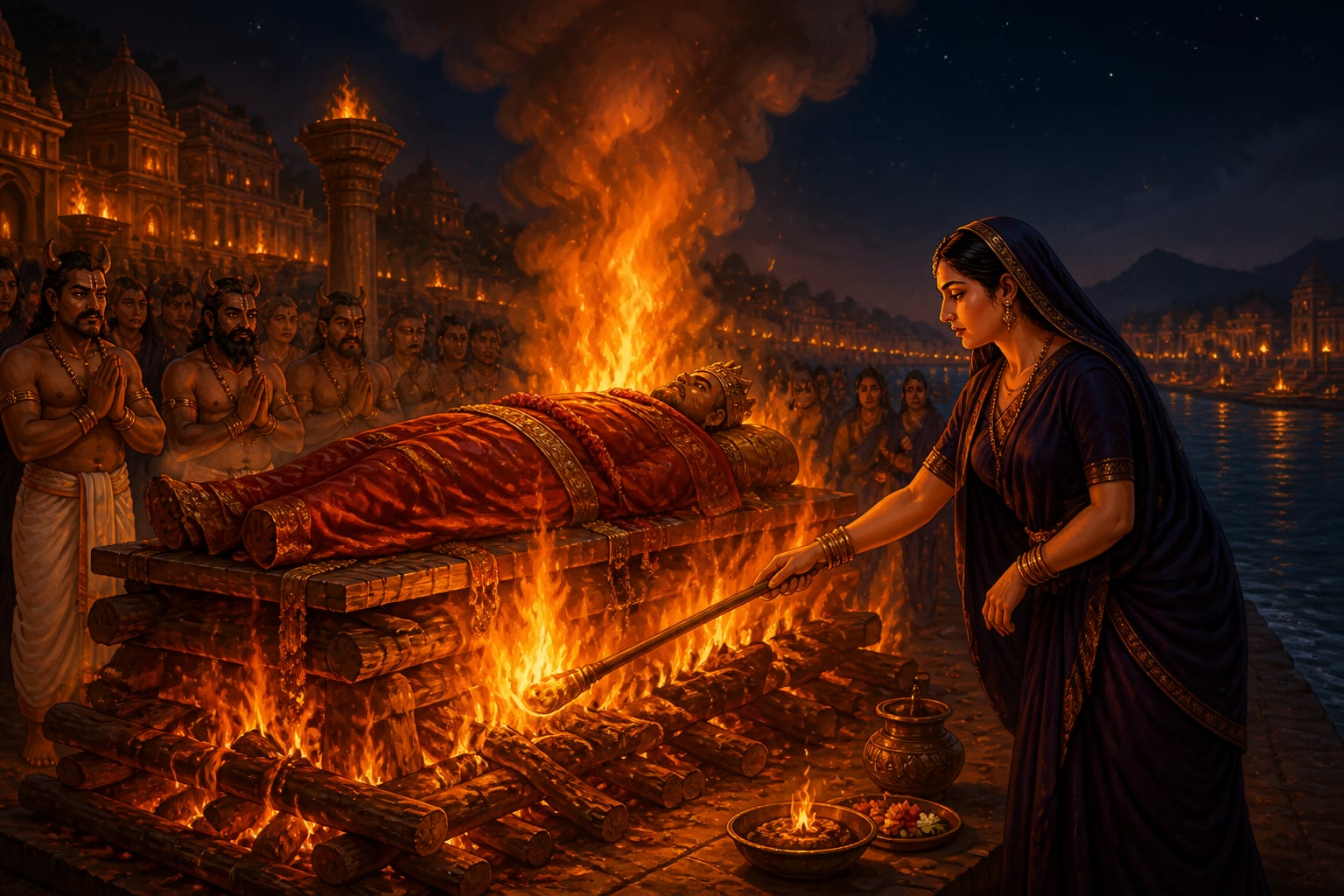
Mandodari lights Ravana's funeral pyre at the riverside ghat

Mandodari, his chief queen, leads the mourning. Her grief is genuine despite everything - she loved the man Ravana had been before pride consumed him. Other wives join her, their lamentations rising toward the smoke-stained sky.

The rakshasa priests perform the ancient rites. Fire consumes the demon king's mortal form, releasing his spirit to whatever fate awaits such beings. The flames burn for hours, their light visible throughout Lanka.

A Kingdom in Transition

With Ravana's funeral complete, attention turns to Lanka's future.

The island kingdom has been ruled by Ravana for so long that many rakshasas cannot imagine another sovereign. But the war has shattered the old order. Kumbhakarna is dead. Indrajit is dead. Most of the great generals have fallen. Only Vibhishana remains from the royal line, and he has already proven his leadership.

The coronation ceremony is hastily prepared but no less significant. Rama himself presides, placing the crown on Vibhishana's head in a gesture that legitimizes the new king before both armies.
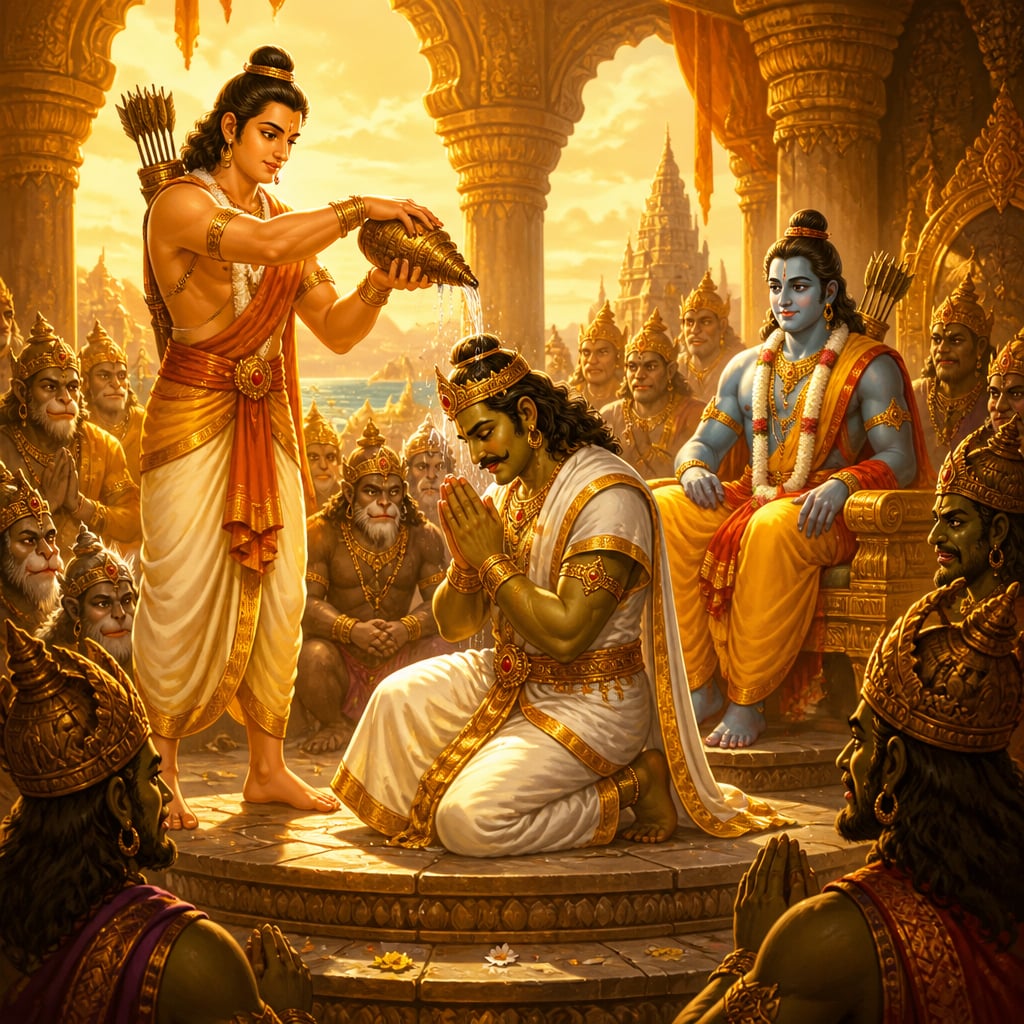
Vibhishana kneels on a carved stone dais inside Lanka's great hall at midday as Lakshmana pours sacred ocean water from a bronze conch over his bowed head, with Rama watching.

"Rule wisely," Rama tells him. "Be the king your brother could have been, had he chosen differently. Lanka deserves peace after so much war."

Vibhishana kneels to receive the blessing. "I will try to live up to your trust, Lord Rama. And I will never forget that my crown comes from your hand. Lanka and Ayodhya will be allies for all time."

The rakshasa people watch with mixed emotions. Their old king was terrible but familiar. This new king speaks of dharma and peace - strange concepts for a kingdom built on conquest. Yet perhaps, after so much destruction, strange concepts are exactly what they need.

The Vanara Victory

While Lanka mourns and rebuilds, the vanara army celebrates.

They have accomplished the impossible. They have crossed an ocean, besieged an impregnable fortress, defeated the conqueror of gods, and lived to tell the tale. Songs arise from the camp - celebrations that will become the stories told for generations.

Sugriva embraces his generals, tears of joy and relief flowing freely. "We did it! We actually did it!"

Jambavan, ancient and wise, simply smiles. He has seen much in his endless years, but this war will stand among his proudest memories.

Hanuman sits apart, his thoughts already racing ahead. The war is won, but the mission is not complete. Sita remains in the Ashoka grove. Until she is reunited with Rama, until she walks free, nothing is truly finished.

Healing and Counting

The days after battle are always strange mixtures of celebration and grief.

The vanara dead are honored with appropriate rites. Their names are recorded, their deeds recounted, their sacrifices acknowledged. Families will be told of their heroism. Children will grow up knowing their fathers died for dharma.

The wounded are tended by healers from both sides - rakshasa medicine and vanara remedies working together for the first time. Herbs from Dronagiri, brought by Hanuman, save many who would otherwise have died.

Engineers survey the damage to Lanka's walls and towers, making plans for reconstruction. Soldiers who fought each other yesterday now work side by side to clear debris and restore order. War's end transforms enemies into neighbors.

Rama walks among the camps, thanking vanaras for their service, expressing condolences for those lost. He is the picture of a gracious victor - humble, grateful, aware that victory came at tremendous cost.

But those who know him see something else in his eyes. An anticipation. A tension. The war may be over, but the hardest moment still waits.

Sita's Release

On the third day after Ravana's death, Hanuman goes to the Ashoka grove.

He finds Sita where she has been for months - beneath the same tree, wearing the same worn clothes, thinner and paler than when he first met her. But her eyes are alive with hope.

Hanuman kneels before Sita to deliver news of Ravana's death

"Hanuman," she breathes. "Tell me. Tell me everything."

"Ravana is dead," Hanuman says simply. "Killed by Lord Rama in single combat. Lanka has surrendered. You are free."

For a moment, Sita cannot speak. The words she has dreamed of hearing for so long have finally come. Tears stream down her face - tears of relief, of joy, of release from endless fear.

"Rama," she whispers. "Where is my Rama?"

"He waits for you. I am to escort you to him."

Sita rises on unsteady legs. The rakshasa guards who once watched her with suspicion now bow with respect. The demonesses who once tormented her scatter before her approach. She walks out of the grove that has been her prison, into the sunlight of a new day.

The Palanquin

A palanquin waits to carry Sita to Rama. It is adorned with flowers, draped in silk, as befitting a queen being restored to her king. Hanuman helps her inside, then takes his place alongside the bearers.

The procession moves through Lanka's streets. Rakshasa citizens line the roads, curious to see the woman their king died trying to keep. They expect to see a goddess, perhaps - someone whose beauty justified the destruction of their kingdom.

What they see is a woman. Beautiful, yes, but also exhausted. Noble, certainly, but also worn by months of captivity. Human in a way that makes Ravana's obsession seem even more tragic. All that death, all that destruction - for this?

But those with wisdom see something else. They see a dignity that captivity could not break. They see a faithfulness that Ravana's temptations could not corrupt. They see a spirit that remained undefeated even when her body was imprisoned.

This is what Ravana tried to possess and failed. This is what Rama crossed an ocean to reclaim. Not a trophy, not a prize, but a soul that matched his own in devotion and honor.

The Approach

The palanquin reaches the edge of Rama's camp. Hanuman goes ahead to announce Sita's arrival.

Rama stands waiting, surrounded by his generals and allies. His face is unreadable - a mask of kingly composure that hides whatever tumult lies beneath. Lakshmana stands beside him, worry etched on his features. Something feels wrong, though he cannot say what.

The palanquin arrives. Sita steps out, her eyes immediately finding Rama. After so long, after so much suffering, he stands before her - the husband she has not seen since that terrible day in Panchavati.

"Rama," she says, her voice carrying all the love and longing of their separation.

Rama looks at her. His expression does not soften. His arms do not open to embrace her.

"Sita," he replies, and his voice is formal, distant, cold.

The assembled armies fall silent. Something is wrong. Something is very, very wrong.

The reunion they expected will not happen. Instead, another trial begins.

Living traditions

Vibhishana's story has been invoked in whistleblower protection discussions in India. His example suggests that those who expose wrongdoing, even from within their own family or organization, may ultimately be honored rather than condemned. Sri Lanka has a complex relationship with the character - some see him as a traitor to his people, while others honor his dharmic choice.

Reflection

More in Yuddha Kanda

All lessons in Yuddha Kanda ยท The Ramayana course