The Man Who Faced East
U Kiang Nangbah, the Jaintia rising of 1860 to 1862, and a public hanging in the Jowai market
In 1860 the Bengal government put a house tax on the Jaintia hills, and then an income tax on people who handled almost no cash. A farmer of Jowai named U Kiang Nangbah was elected to lead the hills against it, and for fifteen months five to six thousand troops and police could not finish the job. Betrayed for a reward while ill, he was hanged in the Jowai market on 30 December 1862, and the hills have kept his last words as tradition ever since.
The Doctor on the Ridge
It is the morning of 11 March 1862. A twenty-eight-year-old army surgeon named James Howard Thornton is climbing a ravine in the Jaintia hills, somewhere above a village the British spell Ooksai. His regiment took the stockade there the day before by scrambling over nine-foot palisades. The jungle above him is thick and quiet.
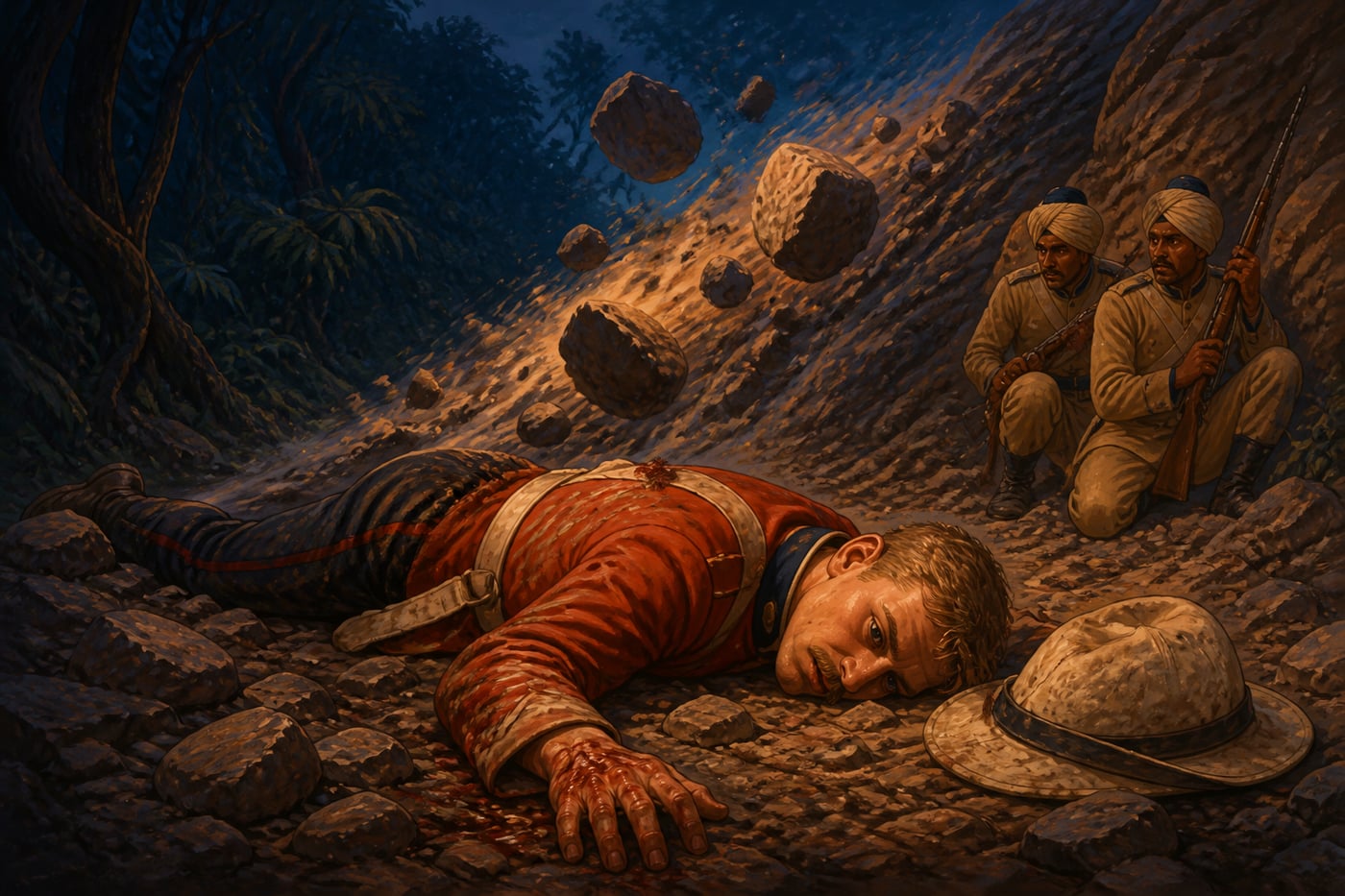
Then the quiet breaks. Thornton wrote later that "a crashing noise was heard in the jungle above, and the next instant some large masses of rock came down upon us." A fragment struck him senseless. His felt helmet was flattened flat. The last joint of his middle finger was crushed. He kept the helmet, and he kept a clear opinion about why he was on that hillside at all.
The rising, he wrote in his memoir thirty-three years later, "was mainly due to the ill-advised action of the Bengal Government in imposing the income-tax upon the simple inhabitants of the hills, who had no incomes in the proper sense." An army doctor of the Raj, writing for a British audience, blamed his own government. Before the campaign ended the Raj had put five to six thousand troops and police into these hills for fifteen months.
Thornton never names the man who organised the people rolling those rocks. His memoir does not carry the name once. That man was a farmer from Jowai called U Kiang Nangbah, and in nine months he would be hanged in the middle of his own marketplace.
What the Hills Had Been Asked to Pay
The Jaintia kingdom of the Pnar people had come under the Company in stages. On 15 March 1835 Lieutenant Frederick Lister took formal possession of Jaintiapur with two companies of the Sylhet Light Infantry. The last Syiem, Rajendra Singh, went to Sylhet on a pension. For twenty-five years after that the hills were governed lightly. Custom was left alone. The villages went on being run by their own chiefs, called Dolois, twelve of them across the twelve elakas or territories.