Sixty-Five Guns at Malerkotla
Ram Singh's boycott of the Raj, the cannon at Malerkotla on 17 and 18 January 1872, and an exile who died at Mergui
From the 1860s Satguru Ram Singh told the Namdharis to stop using the Raj's courts, schools, post office and mill cloth, which makes him the first organiser of non-cooperation in India. After a band of Kukas raided Malaudh and attacked Malerkotla in January 1872, Deputy Commissioner Cowan had forty-nine prisoners blown from guns without trial on 17 January and Commissioner Forsyth sixteen more the next day. Ram Singh was deported to Burma and died at Mergui in 1885.
The Parade Ground at Malerkotla
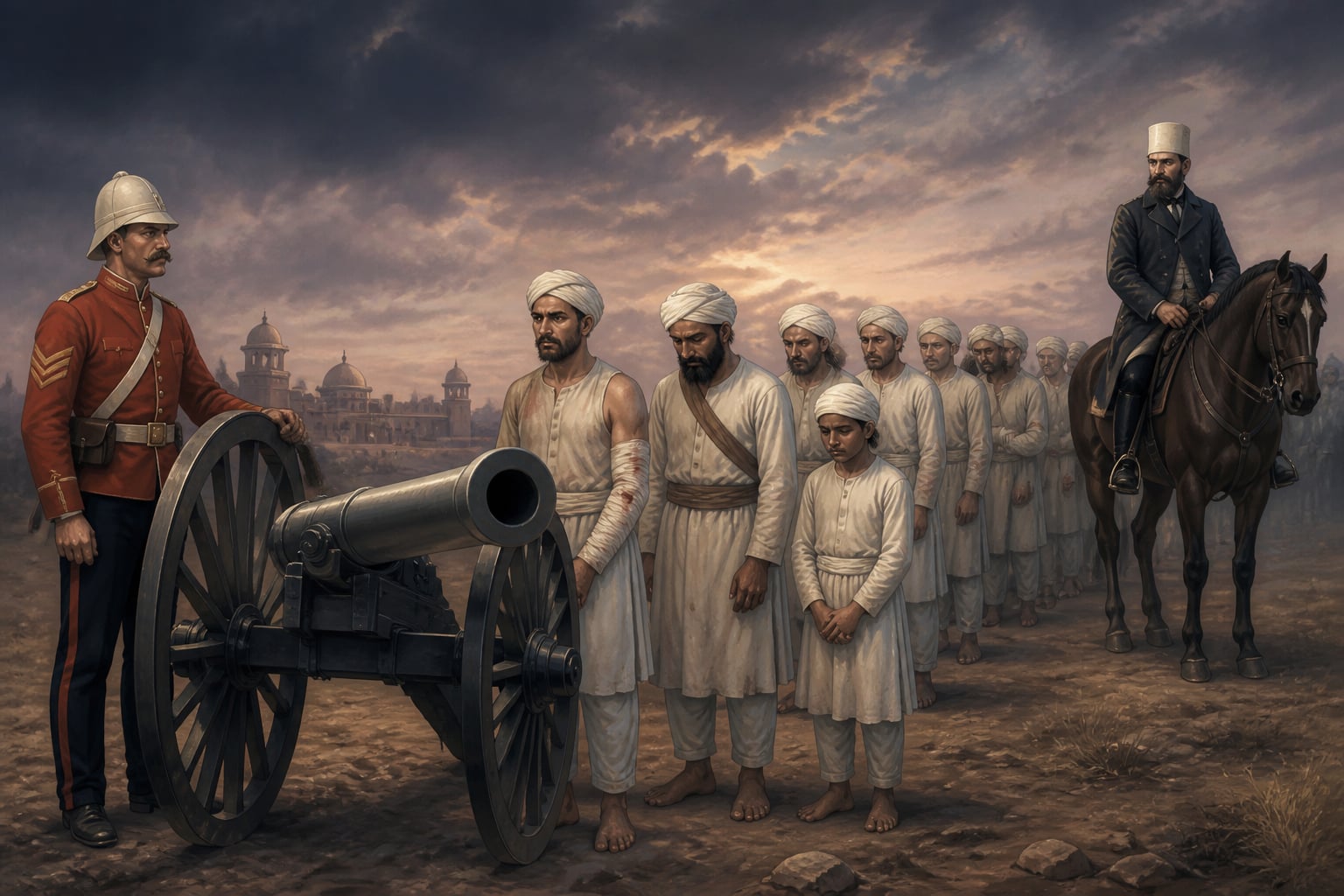
It is the afternoon of Wednesday, 17 January 1872, on open ground outside the town of Malerkotla in Punjab. A field gun stands loaded with powder and no shot. In front of it, a line of men in white waits to be called forward in batches. There are forty-nine of them. They are prisoners taken two days earlier, and some of them are still bleeding from wounds nobody has dressed.
The man giving the orders is John Lambert Cowan, Deputy Commissioner of Ludhiana. He has no death warrant, because there has been no trial. No court has heard a word of evidence. He has been told in writing, that same day, to hold the prisoners in custody until his superior arrives.
The prisoners are Namdharis, called Kukas by the British. They are followers of a man named Ram Singh, who is sitting under guard two districts away and had told them not to do what they did. In the line is a boy. His name is Bishan Singh and he is twelve years old.
Cowan orders the first batch tied to the muzzle. What happened over the next two days shocked the House of Commons and ended two British careers. One point is still not settled. Nobody agrees on how many people died.
The Man Who Boycotted the Raj Before Anyone Else
Ram Singh was born on 3 February 1816 at Bhaini, a village in Ludhiana district, into a family of carpenters. He spent twenty years in the family trade, then took service as a soldier in the Sikh army under Prince Naunihal Singh. That is where he met his teacher, Balak Singh, and that is where his life turned.
By 1849 the Sikh empire was gone and Punjab was British. Ram Singh went home to Bhaini and began building something that nobody in India had built before.