The Chieftainess Who Would Not Feed the Post
Ropuiliani of Denlung, the three durbars she would not attend, and the jail line marked 25 Political
After the Chin-Lushai Expedition of 1889 and 1890, every household in the Lushai hills owed the Raj a rupee, ten seers of rice and six days of unpaid labour. Ropuiliani, chieftainess of Denlung and eight other villages, refused all three and would not attend a single one of the three durbars called at Lungleh. Captain John Shakespear took her by surprise raid in August 1893, and she died a state prisoner at Rangamati on 3 January 1895, still refusing the deal that would have sent her home.
The Palanquin on the Lungleh Road
It is early August 1893, on a footpath in the south Lushai hills. Eighty riflemen are walking back to the British post at Lungleh. They are carrying guns they took that morning from a village called Denlung, and they are carrying a woman.
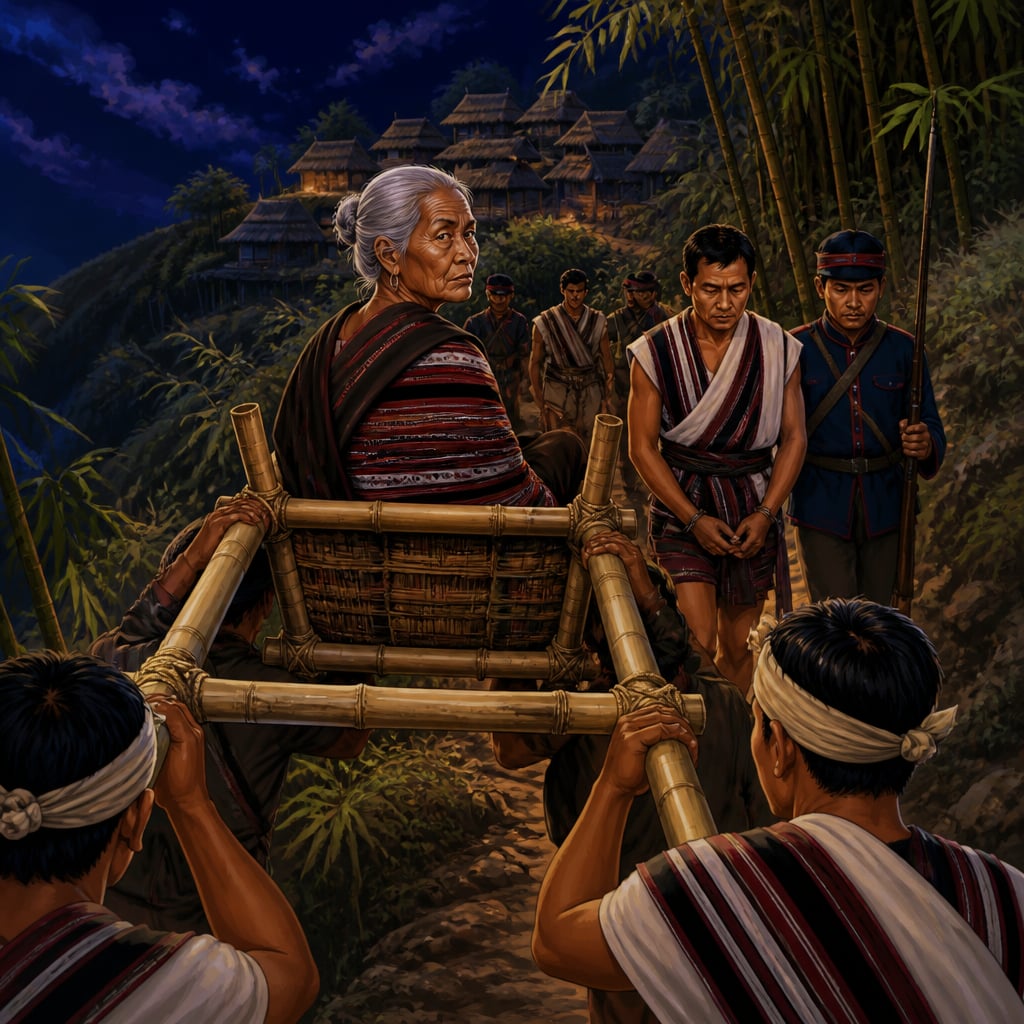
She refused to walk. When the party told her to come, she said she could not go on foot, so they had to find a palanquin and men to lift it. She is somewhere between sixty-five and eighty-seven years old, and nobody on that path knows which. She is sitting facing backwards, towards the village she is being taken from. The carriers keep having to adjust their grip.
Her name is Ropuiliani. She is the chieftainess of Denlung and eight other villages, the widow of the chief the British called their most consistent enemy in these hills. Her youngest son Lalthuama is walking under guard beside her.
The officer in charge is Captain John Shakespear, Superintendent of the South Lushai Hills. He has already written the sentence that explains why he is on this path at all. Her influence, he reported, was distinctly hostile, and everything difficult about her son came from her. He has spent four years trying to get her to a meeting.
She never came to one. That is the whole story, and it is stranger than a battle.
What the Hills Were Asked to Pay
The Chin-Lushai Expedition of 1889 and 1890 was the largest force the Raj had yet put into these hills. More than four thousand six hundred men came in three columns, out of Bengal, Assam and Burma. When it finished, the British stayed. They built a post at Lungleh and another at Darzo, and then they sent out the bill.
Every household in the hills was now to hand over three things every year: