Patriots' Day
Tikendrajit and Thangal General, the Anglo-Manipur War of 1891, and two hangings at the Imphal polo ground on 13 August
Manipur had never been conquered. After a palace revolt in September 1890, the Viceroy decided to recognise the new Maharaja and arrest the man who had made him, and the attempt on 24 March 1891 ended with five British officers dead and three British columns marching in. Tikendrajit, commander of Manipur's army, and the old soldier called Thangal General were tried by a special court and hanged in front of about eight thousand people at Pheidapung in Imphal on 13 August 1891. Manipur keeps the day as Patriots' Day and has renamed the ground, the airport and the fort.
Five O'Clock at the Polo Ground
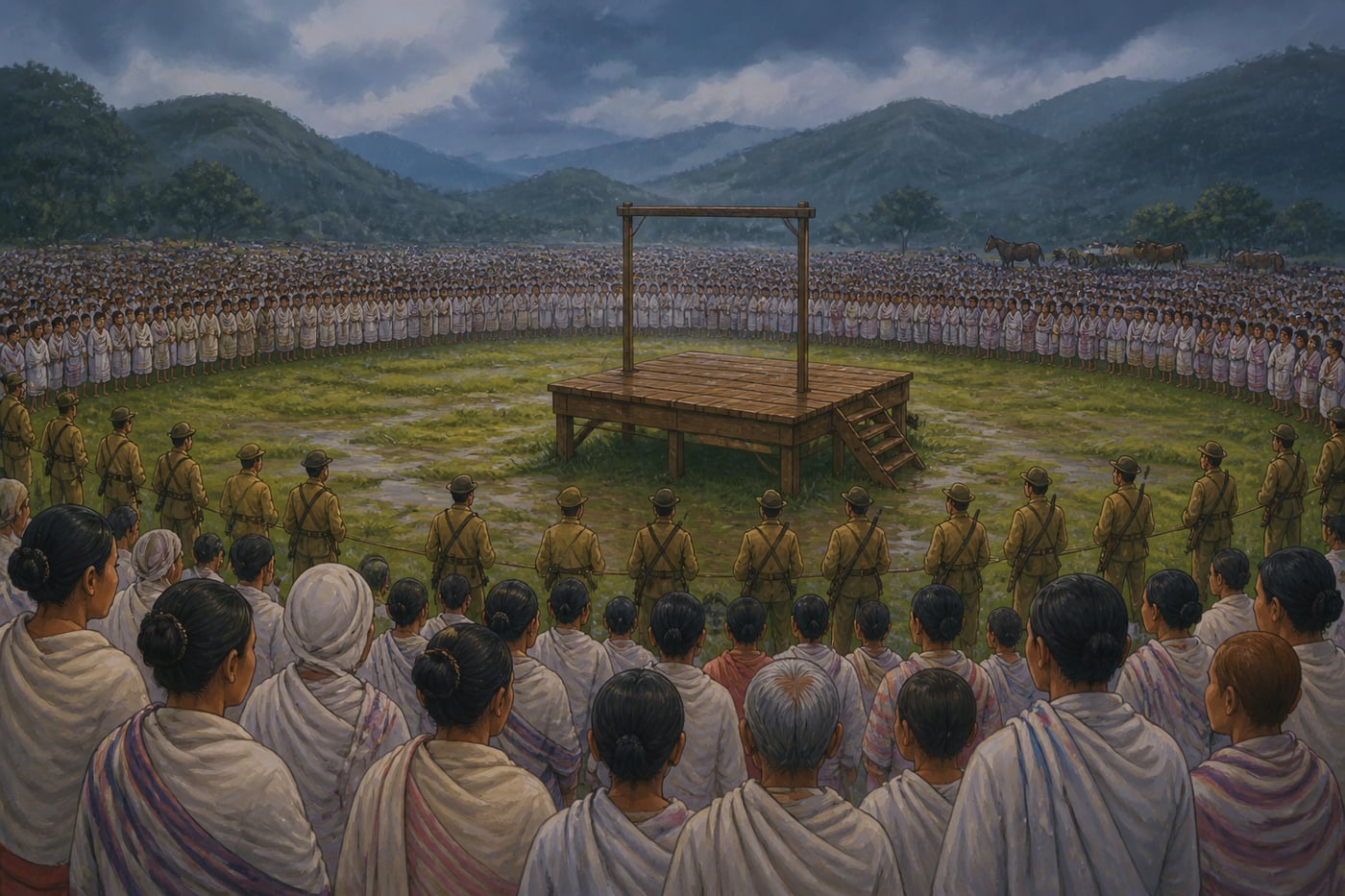
It is Thursday, 13 August 1891, five in the afternoon, at Pheidapung in Imphal. Pheidapung is a polo ground. Manipur invented the game on fields like this one, and on most evenings the grass here would be cut up by ponies. This evening it holds a scaffold and a crowd. British accounts of the day put about eight thousand Manipuris on the field, standing in the wet heat of an Imphal August, held back by Gurkha troops.
Two men are brought out. The first is Tikendrajit Singh, thirty-four years old, son of the late Maharaja Chandrakirti, commander of Manipur's army with the title Senapati. The second is the old soldier everyone in the valley calls Thangal General, who had been the strongest voice in Manipur's court since before Tikendrajit was born. They are hanged in front of the crowd, one after the other.
Four months earlier both men had been running a kingdom. Manipur had never been conquered by the British. It had fought beside them, signed with them, and kept its own king, its own court and its own army. The question worth asking is not how the Empire won. It had rifles, three columns and the whole of India behind it. The question is why the Empire, having won in April, needed these two men dead in August. And why a Queen in England tried to stop it and failed.
The Coup the British Accepted, Then Did Not
Start with what happened before any British soldier moved.
Maharaja Chandrakirti died in 1886. His son Surchandra took the throne. Manipur's court was split, and on 21 September 1890 Tikendrajit, who commanded the army, led a palace revolt. Surchandra gave up the throne and left for Cachar in British territory. Tikendrajit's half-brother Kulachandra became Maharaja. Tikendrajit kept the army and took the title of Jubraj, heir apparent.