The Prisoner's Wife
Nanibala Devi, the widow who wore vermilion for Jugantar and became the first woman Bengal held as a state prisoner
In 1915 a widow from Bali in Howrah put vermilion in her hair, walked into Presidency Jail as the wife of a man she had never married, and came out with the hiding place of a consignment of Mauser pistols. Nanibala Devi kept the safe houses at Rishra and Chandernagore that the Jugantar underground ran on, was arrested at Peshawar in 1917, tortured at Banaras, and held under Regulation III of 1818 as the first woman state prisoner in Bengal. She was released in 1919 into a family that would not have her, and died in poverty in 1967.
The Visitor at the Gate
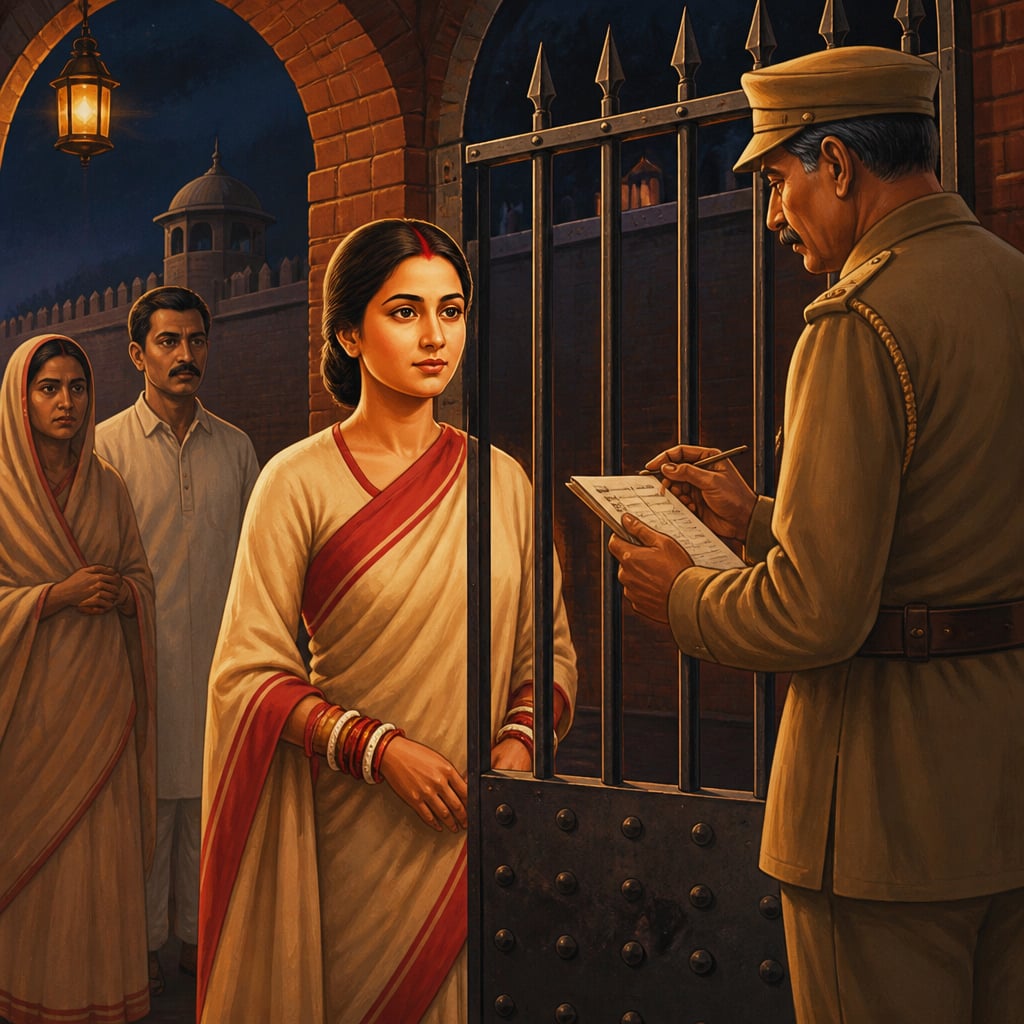
It is 1915, at the gate of Presidency Jail in Calcutta. A woman in her late twenties is waiting to be let in to see a prisoner. She has given his name at the desk and described herself as his wife.
Look at what she is wearing. There is vermilion in the parting of her hair, the mark of a married Hindu woman. She has worn bangles. For a woman in Bengal in 1915, these are not ornaments. They are a statement about who she is.
Every part of it is false, and the false part is not the danger. The danger is that she is a widow. She was married at eleven and widowed at sixteen. For fourteen years she has worn white, eaten one plain meal a day, and stayed out of sight. That is what her society expected of a widow. To put vermilion back in her hair is, in the eyes of her own family, a scandal worse than anything the police could charge her with. She has chosen it deliberately.
Her name is Nanibala Devi. The prisoner she has come to see is a Jugantar man named Ramchandra Majumdar. He is the only person alive who knows where a consignment of Mauser pistols is buried.
The question is not whether she will get past the warder. She will. The question is what a movement is willing to spend, and what she is willing to spend, to recover a box of guns.
The Widow at Bali
Nanibala Devi was born in 1888 at Bali, a town in Howrah district on the west bank of the Hooghly, a short ferry ride from Calcutta. Her father was Surya Kanta Banerjee. The family was not rich.
She was married at eleven. She was widowed at sixteen. In a Bengali household of that period, a widow's life was fixed from that day: white cloth, no ornaments, restricted food, and a place at the back of the house. She was educated, and she was bored, and she had roughly fifty years of that in front of her.