Berlin
Virendranath Chattopadhyaya, who ran the Berlin Committee, argued India's case at Stockholm, and was shot in Stalin's purge
In September 1914 a stateless Indian exile with no money sat down with the German Foreign Office and founded the Berlin Committee, the switchboard of the whole wartime underground. Virendranath Chattopadhyaya, called Chatto, was Sarojini Naidu's elder brother, and he had written himself out of a legal career with one letter to The Times in 1909. This lesson follows him from India House to Berlin to Stockholm to Leningrad, where the second empire he trusted shot him on 2 September 1937.
The Room on Wilhelmstrasse
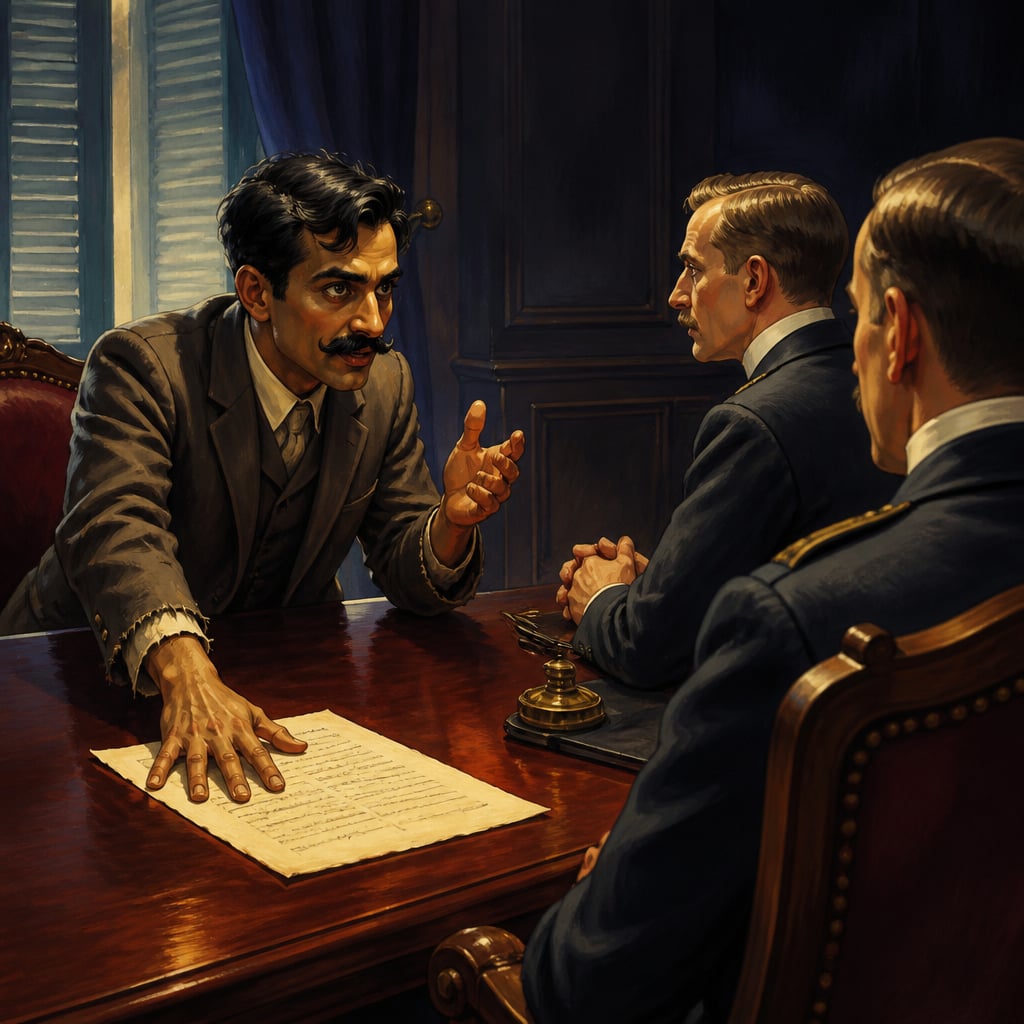
It is early September 1914. The war in Europe is five weeks old. In an office of the German Foreign Office on Wilhelmstrasse in Berlin, a thin Indian man of thirty-three sits across a table from German officials. He has a heavy moustache, a cheap suit and no money at all. He speaks to them in German, which he learned quickly, and he has already picked up French, Italian and Swedish on the way.
His name is Virendranath Chattopadhyaya. Everyone who knows him calls him Chatto. He is the son of the first principal of Nizam College in Hyderabad, and the elder brother of Sarojini Naidu. He has no passport that any country will honour. He has been struck off the rolls of an English law court. There is a warrant waiting for him in Britain.
What he has is a list. On it are the names of Indian students in German universities and Indian exiles in Paris and Geneva. It also has Indian sailors in European ports, and Indian soldiers who will soon be in British uniform on the Western Front. He is offering the German government a war behind the British war.
The Germans agree. Out of that room comes the Indian Independence Committee, which everybody called the Berlin Committee. For the next four years Chatto runs it. He will send men to Kabul, money to Bengal, and guns that never arrive. And twenty-three years later, in a country he helped nobody conquer, he will be taken out and shot by the side he chose.
The House That Made Him
The Chattopadhyay house in Hyderabad was called the Golden Threshold. Aghorenath Chattopadhyay, Chatto's father, was one of the first Indians to take a doctorate of science, at Edinburgh, and he came back to run the college that became Nizam College. The house filled up with argument: about marriage, about women's education, about what India was for.