Talapatram

The Seven Mothers Take the Field

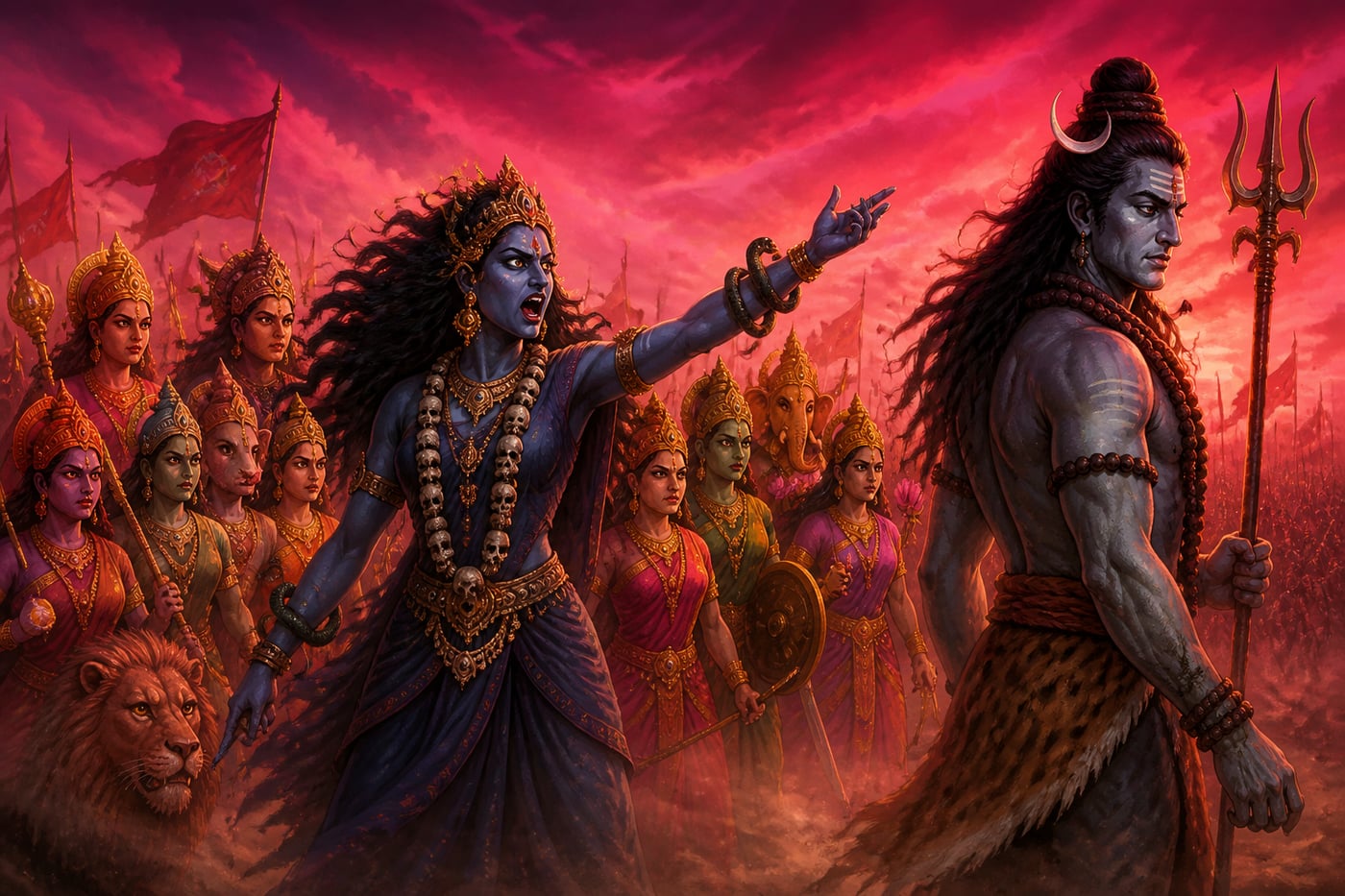
The Sapta-Matrikas, the Shaktis of the gods, join the battle. Every face of power arrayed at once.

The Sapta-Matrikas, the Shaktis of the gods, join the battle. Every face of power arrayed at once.

Seven Powers Stream onto the Field
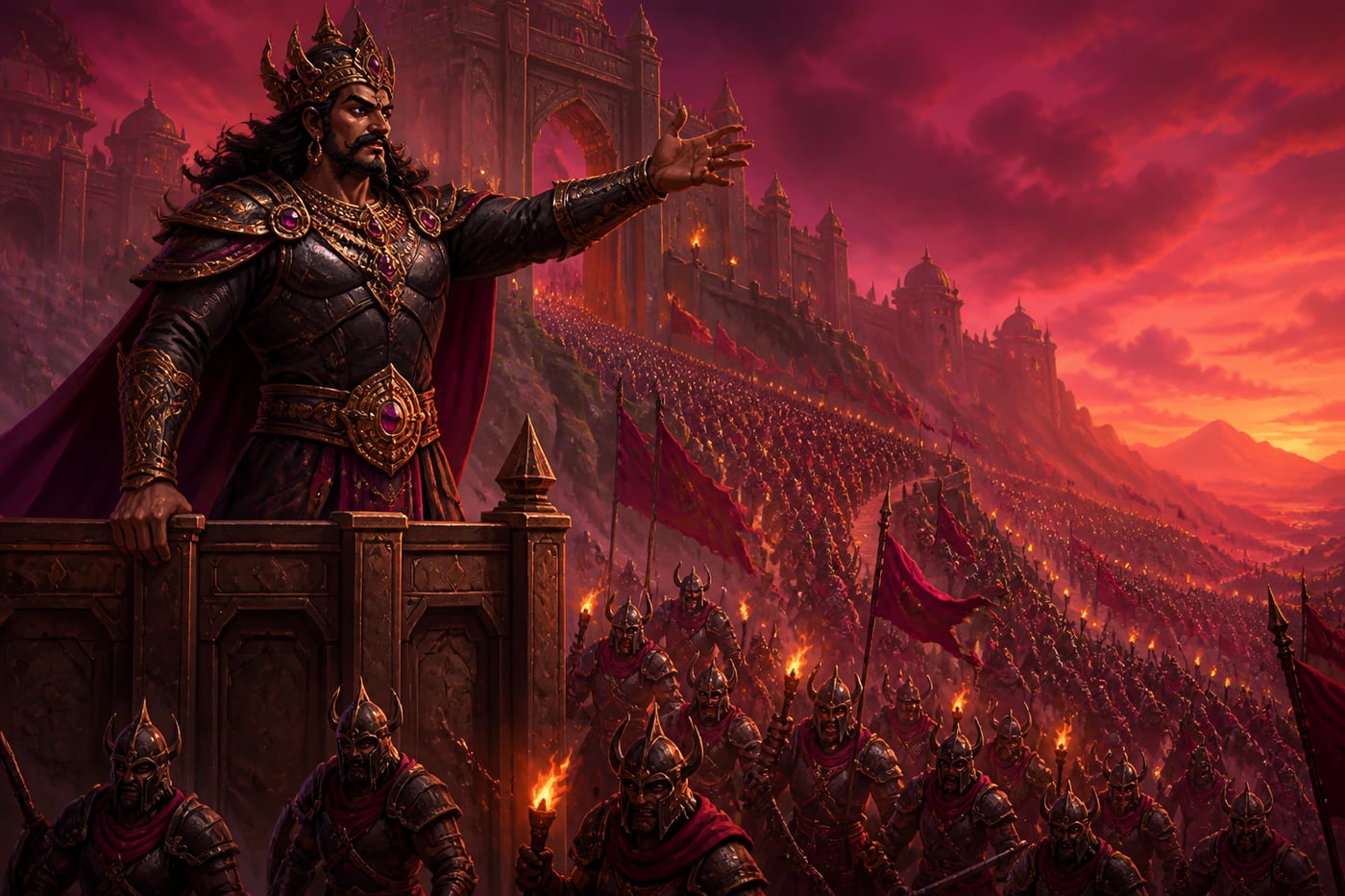
Shumbha summons endless legions from his kingdom

Chanda and Munda were dead, their army devoured, and still Shumbha would not stop. He emptied his kingdom, calling up demon clans by the thousand, whole hosts with fierce names, and sent them all at once to overwhelm the Goddess by sheer number. The mountain passes filled with them. And in answer, something happened on the Goddess's side that the text tells as a single astonishing image.

From the bodies of the great gods, their powers came out in visible form. Not the gods themselves, but their Shaktis, their energies, each one a Goddess shaped exactly like the god she came from, bearing his weapon, riding his mount, wearing his ornaments. They streamed onto the field beside the Goddess, and the tradition calls them the Sapta-Matrikas, the Seven Mothers.

Who the Mothers Are

Each Mother is the power of a god, made into a Goddess and sent to fight. The text names them, and each carries the unmistakable mark of her source:
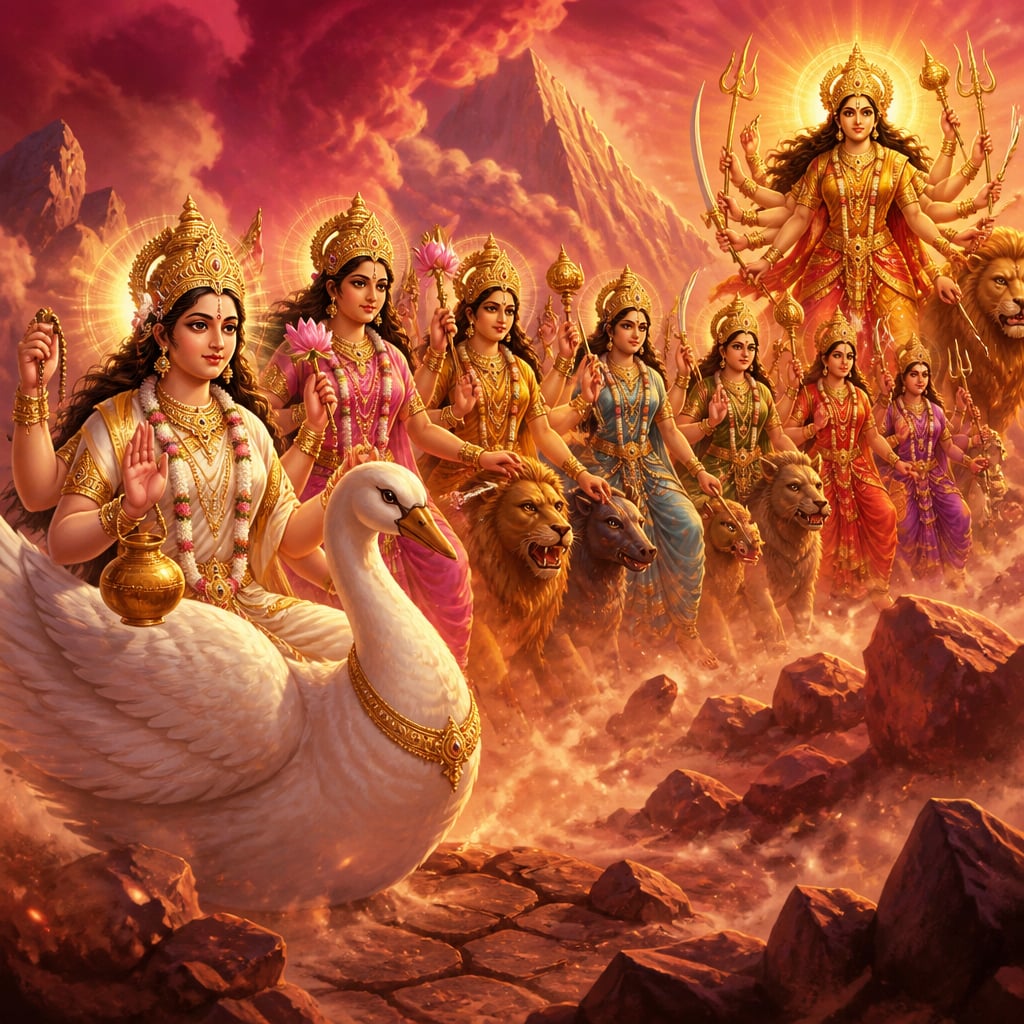
The Seven Mothers stream onto the battlefield

Shivaduti sends Shiva as her messenger

Seven forms, each the concentrated might of a god, all of them Goddesses, all of them faces of the one Goddess who stands at their center. Alongside them came a fierce companion, Shivaduti, and Kali, and the field that had held one radiant figure now blazed with the whole array of divine power at once.

या देवी सर्वभूतेषु मातृरूपेण संस्थिता। नमस्तस्यै नमस्तस्यै नमस्तस्यै नमो नमः॥

yā devī sarva-bhūteṣu mātṛ-rūpeṇa saṃsthitā | namas tasyai namas tasyai namas tasyai namo namaḥ ||

To the Goddess who dwells in all beings as the Mother, salutations to Her, salutations to Her, again and again salutations.

Devi Mahatmyam 5 (Ya Devi refrain, the mother aspect)

More Than You Knew Was There

The Goddess had faced demon after demon nearly alone. Now, at the moment of greatest pressure, when the enemy came not as one clever foe but as sheer overwhelming number, something new happened. She was suddenly not alone. The powers of every great god streamed onto the field beside her, a whole array of force that had not been there a moment before.

That timing is the teaching. The reserves arrived when the pressure was greatest, not before.

You know a smaller version of this. Under ordinary strain you use your two or three familiar strengths and no more. But there are moments, a real crisis, a genuine emergency, when you find yourself doing what you did not know you could do. A steadiness you had never shown. A resolve you did not know was in you. An endurance past anything you had been asked for before. The pressure did not empty you. It called up reserves you had never spent, and often help you did not know was coming.

There is something apt in the name the tradition gives these powers. A mother's fiercest strength is the kind no one, least of all herself, knew she had until the hour it was needed. Against an enemy of pure number, the Goddess does not answer with one power used harder. She reveals that she was never as alone, or as small, as the long fight had made her look. What you can draw on, the image quietly promises, is larger than what you have had to use so far.

One Goddess Wearing Seven Faces

There is a final quiet note in the image, and the last movement of the story will make it loud. The Seven Mothers look like seven separate Goddesses. They are not. Every one of them is the power of the single Goddess at the center, sent out to fight in many shapes.

या देवी सर्वभूतेषु जातिरूपेण संस्थिता। नमस्तस्यै नमस्तस्यै नमस्तस्यै नमो नमः॥

yā devī sarva-bhūteṣu jāti-rūpeṇa saṃsthitā | namas tasyai namas tasyai namas tasyai namo namaḥ ||

To the Goddess who dwells in all beings as the very principle of kind, salutations to Her, salutations to Her, again and again salutations.

Devi Mahatmyam 5 (Ya Devi refrain, the aspect of kind)

The tradition sees the Mothers as the jati, the generative kinds, the root-energies from which every sort of power springs, and all of them are hers. They came from her, they fight for her, and, as the coming battle will show, they will one day be drawn back into her, revealed as what they always were: not seven, but one.

That drawing-together begins with the strangest enemy of all, a demon who could not be killed by any wound, because every drop of his blood that fell became another of him. His name was Raktabija, and he is the next lesson.

Living traditions

The Sapta-Matrikas are among the oldest and most widely carved Goddess-groups in India, found on temple walls from Ellora to Bengal to the far south, usually seated together in a single row. Their enduring image keeps this lesson's teaching alive in stone: the powers of all the gods are finally the powers of the one Mother, arrayed side by side and serving a single center.

  • Sapta Matrika panels, Ellora and beyond: Among the rock-cut temples of Ellora and at countless shrines across India, the Seven Mothers are carved together in a single row, each with her god's weapon and mount, often flanked by Ganesha and a fierce guardian. These ancient panels bring this lesson's image directly to stone: every face of divine power seated side by side as one sacred set. (The Sthapatya and temple-art course explores such sculpture in depth.)

Reflection

  • The Goddess met an enemy of endless number by calling up every face of her power at once. What is a problem in your life that keeps returning in new forms, and which of your capacities have you been leaving off the field?
  • The Seven Mothers look separate but are all the one Goddess's power. Where do your own strengths feel like scattered, competing parts, and what would it mean to know them all as belonging to one center?
  • The fierce battle-Goddesses are called Mothers, their ferocity rooted in guarding their children. When you are fierce, is it the Mother's fierceness that protects, or the demon's that seizes?

More in The Two Ego-Traps

All lessons in The Two Ego-Traps · Durga: The Goddess Who Saves the World ebook course