The Brothers Who Conquered the Three Worlds
Shumbha and Nishumbha as the two ego-traps. Thinking too much of yourself and too little; both are ego.
The Two Brothers You Know
You have probably met both of these brothers already today, maybe before lunch. One is the voice that walked into a room this morning certain you were the sharpest person in it. The other is the voice that walked out of the same room certain you were a fraud who would soon be found out. They feel like opposites, the swagger and the sinking. This lesson is about the two demons who ruled the three worlds together, and about the tradition's claim that they are not opposites at all. They are brothers.
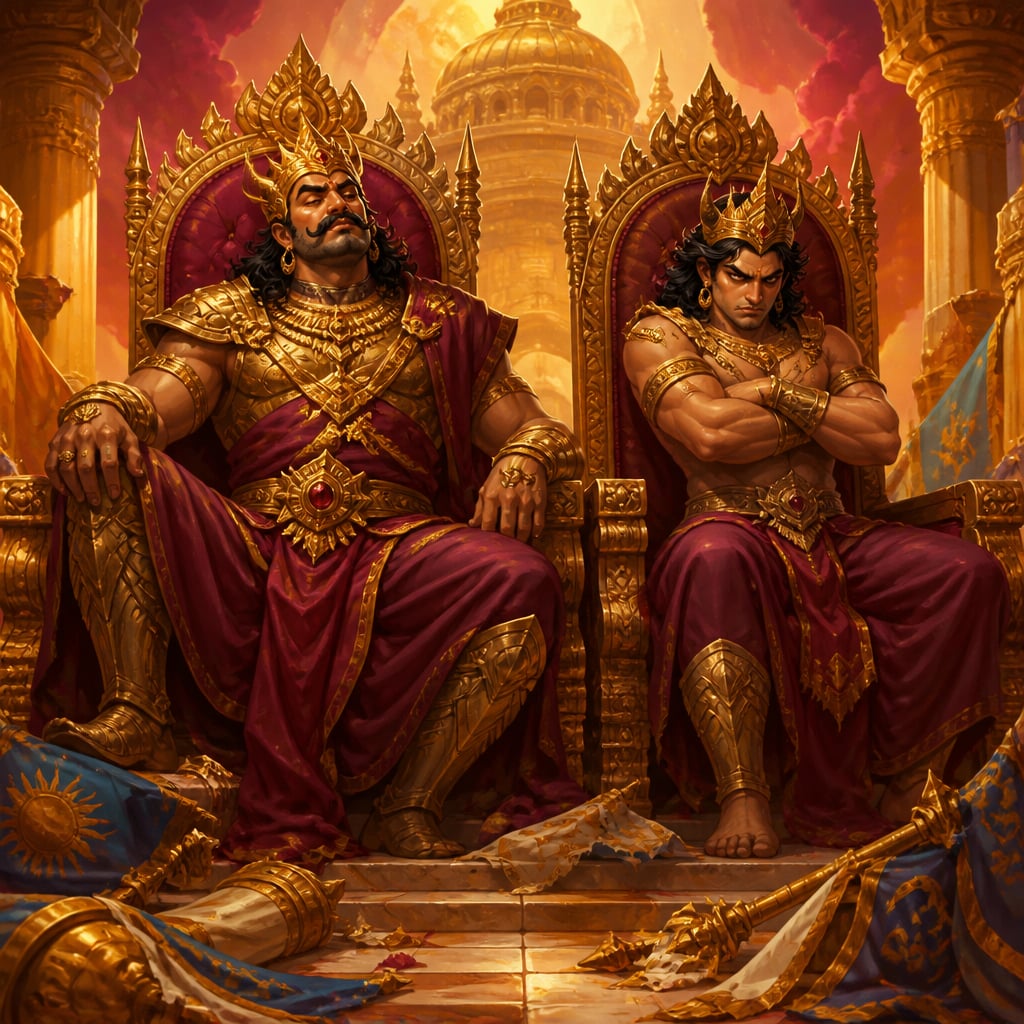
Their names are Shumbha and Nishumbha, and as the last and longest deed of the Devi Mahatmyam opens, they have taken heaven by force. They have beaten the gods in open war and seized the sun's right to shine and the wind's right to blow. Every offering meant for the gods now feeds the two brothers instead. The gods themselves have been driven out to wander the slopes of the Himalayas with nothing left but an old promise: that when the times grew dark and they called on her, the Goddess would come.
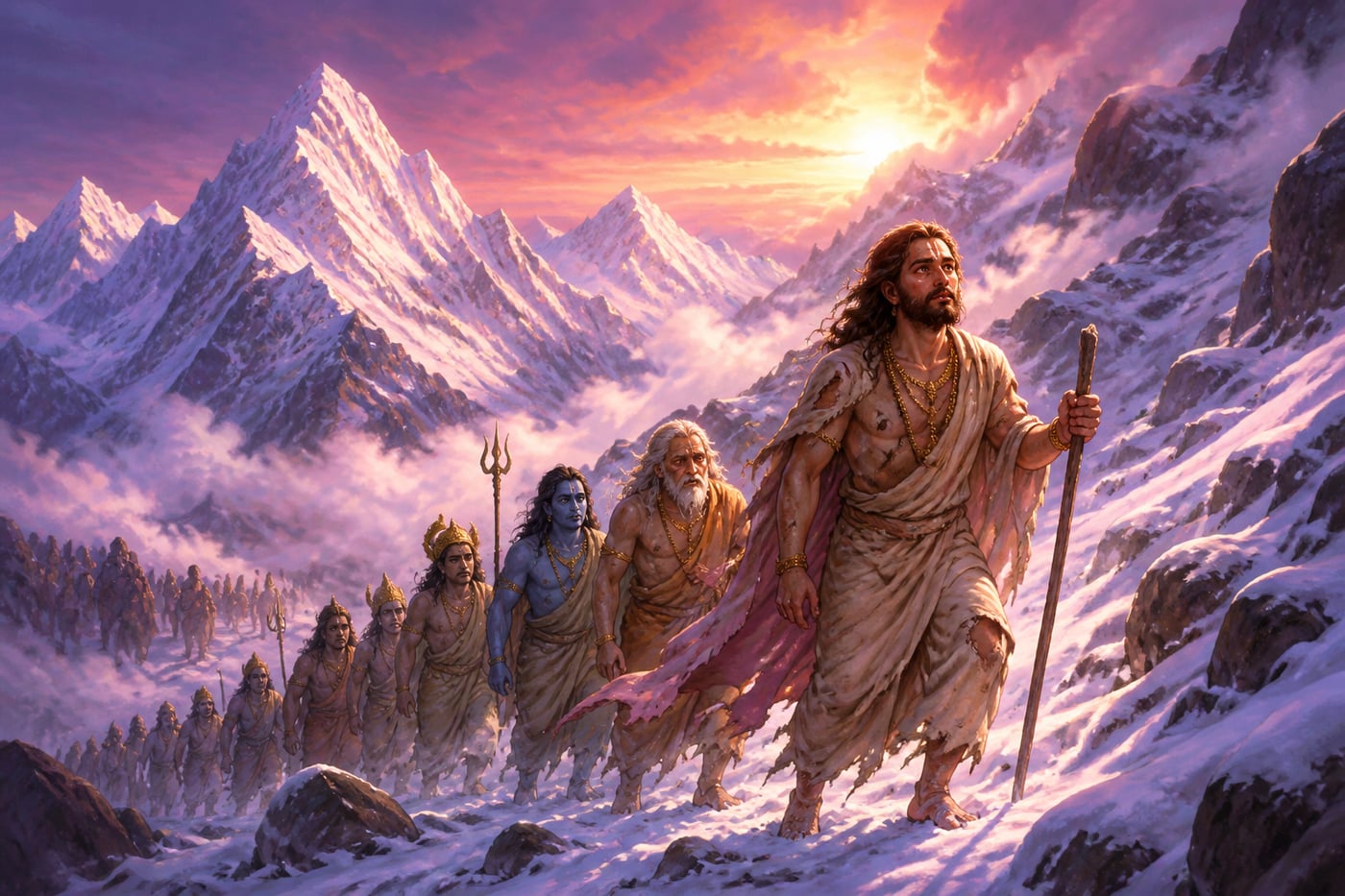
So they climbed the snow to call.
Before we follow them up the mountain, look hard at the two brothers, because the whole of this last and longest battle turns on who they are. The tradition does not read Shumbha and Nishumbha as two random tyrants. It reads them as a matched pair, and it reads the pair as the two faces of a single thing: ego.
Two Brothers, One Self
Shumbha is self-conceit, the ego swollen outward. His name is tied to shining and self-display, to the voice that says I am the greatest, the worlds are mine to take. He is pride in its open form, the arrogance that looks at heaven and assumes it is owed.
Nishumbha is his brother and his mirror. If Shumbha is the ego puffed up, Nishumbha is the ego turned inward. Here is the part most people miss:
- Thinking too much of yourself is ego.
- Thinking too little of yourself is also ego.
Both are the same self, curved back on itself. The braggart and the person drowning in self-doubt are not opposites. They are brothers. Both have made the small self the center of the whole world. One shouts that he is everything, the other whispers that he is nothing, and nothing and everything are both just the self refusing to get out of its own way.
That is why they rule together and cannot be beaten one at a time. You know this if you have ever watched yourself swing between the two of them in a single afternoon, sure and then unsure, inflated and then crushed, with nothing in the facts having changed. Same you. Same ego. Two brothers trading the throne.
या देवी सर्वभूतेषु बुद्धिरूपेण संस्थिता। नमस्तस्यै नमस्तस्यै नमस्तस्यै नमो नमः॥
yā devī sarva-bhūteṣu buddhi-rūpeṇa saṃsthitā | namas tasyai namas tasyai namas tasyai namo namaḥ ||
To the Goddess who dwells in all beings as intelligence, salutations to Her, salutations to Her, again and again salutations.
Devi Mahatmyam 5 (Ya Devi refrain, the intelligence aspect)
The gods sang this hymn, aspect by aspect, on the mountain. They did not ask the Goddess to make them strong enough to beat Shumbha. They praised her as the very power of discernment, the buddhi that already lives inside every being. That is the first hint of how this enemy is beaten. Not by force alone, but by the clear seeing that can tell the swollen self and the shrunken self apart from what you actually are.
Why This Enemy Is Placed Last
The course has climbed through harder and harder demons. Madhu and Kaitabha, the fog of confusion. Mahishasura, the shape-shifting ego that changes form the moment you corner it. Now, in the final movement, the enemy is ego stripped to its cleanest shape: two brothers, arrogance and self-doubt, ruling everything you have.
They are placed last on purpose. You can be brave, disciplined, even wise, and still be quietly ruled by these two. They are subtle. Shumbha rarely feels like a villain from the inside; he feels like confidence. Nishumbha rarely feels like a villain either; he feels like honesty, like humility, like just being realistic about myself. That is exactly the disguise that lets them keep the throne.
| Shumbha (ego swollen) | Nishumbha (ego shrunk) |
|---|---|
| I am the greatest | I am worthless |
| Craves praise and rank | Craves pity and retreat |
| Feels like confidence | Feels like humility |
| Refuses to be small | Refuses to be seen |
Look along the two columns and see the trick. The behaviours look opposite. The engine is identical: a self that cannot stop being the subject of every sentence.
What the Goddess Answers
The gods on the mountain did the one right thing. They did not try to fix themselves by swinging to the other brother, meeting arrogance with self-hatred or self-hatred with forced confidence. They called on something larger than the small self entirely.
There is a true humility that is nothing like Nishumbha. The tradition honours the Goddess as lajja, modesty, and the difference is worth seeing. Nishumbha's self-abasement is still about the self; I am worthless is a sentence with I at its center. Real modesty forgets the self and simply gives way to what is larger. One shrinks the self and stares at it; the other lets the self go quiet.
या देवी सर्वभूतेषु लज्जारूपेण संस्थिता। नमस्तस्यै नमस्तस्यै नमस्तस्यै नमो नमः॥
yā devī sarva-bhūteṣu lajjā-rūpeṇa saṃsthitā | namas tasyai namas tasyai namas tasyai namo namaḥ ||
To the Goddess who dwells in all beings as modesty, salutations to Her, salutations to Her, again and again salutations.
Devi Mahatmyam 5 (Ya Devi refrain, the modesty aspect)
They praised the Goddess as Mahamaya, the power in whom the small self is only a wave, and they waited for her to come. And she was about to arrive, in a form so luminous that the demons who saw her wanted, at once, to own her. That wanting is the next trap, and the next lesson.
Living traditions
The paired demons Shumbha and Nishumbha survive far beyond the text, in Navaratri recitations, in temple sculpture of the Goddess trampling twin foes, and in the everyday Shakta reading of them as the two ego-traps. To this day teachers use the brothers to explain that a swollen head and a sunk heart are one disease, and that the same Goddess dissolves both.
- Vindhyavasini Temple, Vindhyachal: One of the oldest and most revered Shakti sites, honouring the Goddess as she who dwells in the Vindhya mountains. In the Devi Mahatmyam the Goddess foretells that she will take birth to slay Shumbha and Nishumbha and will dwell in the Vindhyas, and this temple is worshipped as that abode. Pilgrims here connect directly to the arc of the Uttama Charita that this chapter begins. (The Shakti Peethas course maps the wider network of Goddess sites.)
Reflection
- In a single day you can feel like the smartest person in the room and then like a fraud. When did you last swing between Shumbha and Nishumbha, and what did the two moods have in common?
- Where in your life does self-doubt disguise itself as humility or as just being realistic? What would change if you saw it as the ego turned inward rather than as honesty?
- The gods answered their defeat not by fixing themselves but by calling on something larger than the small self. What is the larger thing you turn to when both pride and self-pity have failed you?