Talapatram

I Will Marry Only Who Defeats Me

The vow; the messengers' offer and threat. You cannot possess what you have not overcome in yourself.

The vow; the messengers' offer and threat. You cannot possess what you have not overcome in yourself.

The Offer on the Mountain

Shumbha sent a smooth-tongued envoy named Sugriva up the mountain, and the offer he carried was, by the demons' logic, generous. He stood before the radiant Goddess and delivered his master's words. Shumbha, lord of the three worlds, has heard of your beauty. Every treasure of heaven is now his: the jewels, the gold, the wish-granting gem. Choose him, or choose his brother Nishumbha, and all of it is yours. You will be the queen of everything.
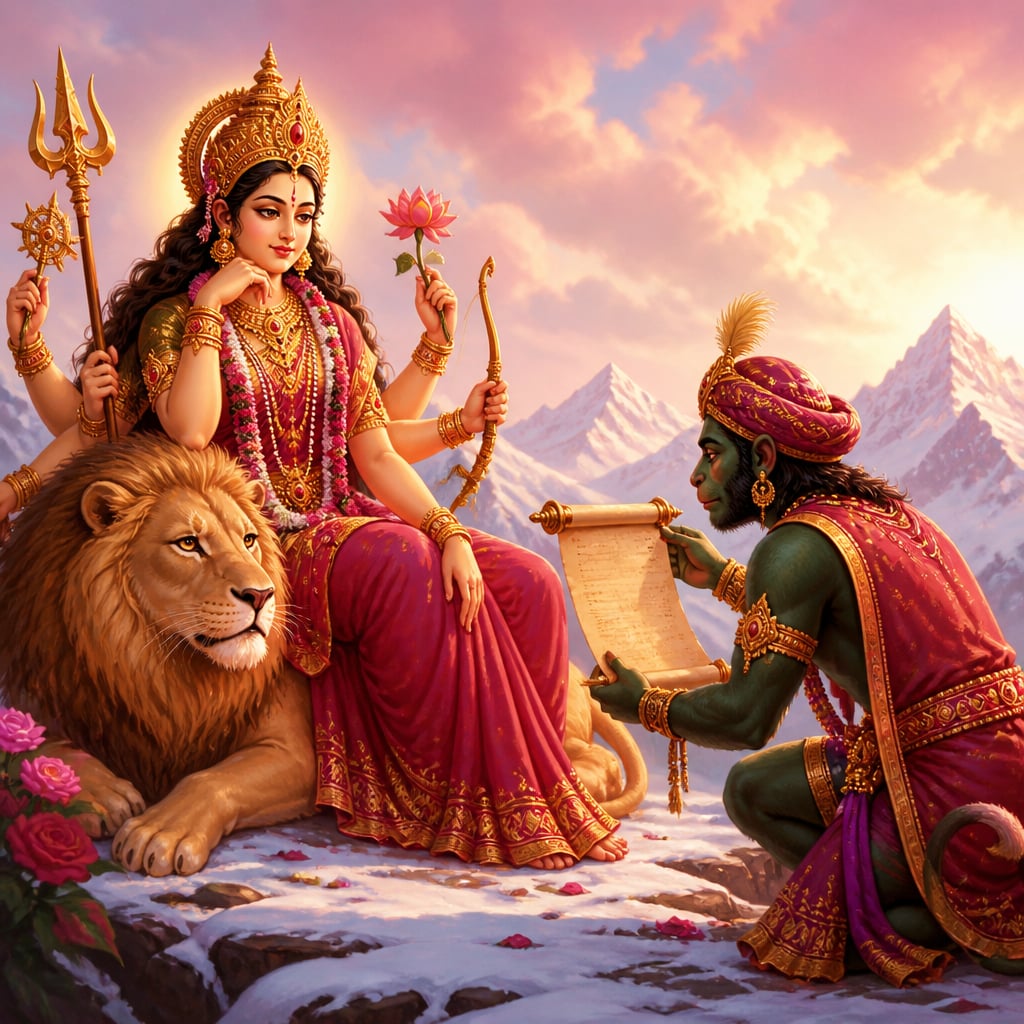
Ambika smiles as envoy Sugriva delivers his offer

The Goddess listened, and smiled. And then, still smiling, she said something the envoy was not prepared for. She did not refuse outright. She set a condition.

यो मां जयति संग्रामे यो मे दर्पं व्यपोहति। यो मे प्रतिबलो लोके स मे भर्ता भविष्यति॥

yo māṃ jayati saṃgrāme yo me darpaṃ vyapohati | yo me pratibalo loke sa me bhartā bhaviṣyati ||

He who conquers me in battle, who removes my pride, who is my equal in strength in the world, he alone shall be my husband.

Devi Mahatmyam 5.120

I made a vow long ago, she told the envoy. I will belong only to the one who defeats me in open battle, who breaks my pride, who is truly my equal in strength. Let your master come and win me, if he can. Those are my terms.

The envoy was baffled. It sounded almost like foolishness, a lone woman challenging the conqueror of the worlds. But the tradition reads this vow as one of the deepest things the Goddess says in the whole text.

You Cannot Possess What You Have Not Overcome

Look at what the condition actually demands. She will not be won by wealth, by rank, by an offer, or by force of arms brought from outside. She will belong only to the one who can defeat her pride in fair contest. And since she is the supreme power herself, that is a condition no demon of ego can ever meet. You cannot conquer the Goddess by wanting her. You can only be dissolved by her.

The mirror is exact: you cannot possess what you have not overcome in yourself.

Think of the things people try to own without first conquering the pride that reaches for them:

In each case the thing is reached for from the outside, as Shumbha reached for the Goddess, by a self that has not done the inner work the thing requires. And in each case the reaching fails, because what you are trying to hold can only be entered, not seized. The Goddess's vow states the law plainly: win the battle with your own pride first, and only then is union possible. Skip that battle, and no amount of wanting will get you past the door.

There is a second key word in her vow. She will be won only by one who removes her pride, her darpa. Read at the deepest level, the tradition says even the Goddess's play here points to the same truth for the seeker: what unites you with the highest is not the conquest of it but the surrender of your own conceit before it. The pride that has to be broken is finally your own.

The Threat Behind the Offer

Sugriva turns to threats after the goddess refuses

The envoy, recovering, did what grasping always does when it is refused. He turned the offer into a threat. Do you know who you are refusing? Shumbha's generals have dragged gods by the hair. Come willingly, or you will be seized by force and brought to him in disgrace. Choose.

The Goddess did not move. I know the strength of your master, she answered, and I know my vow. I cannot break it, even foolishly. Let him come and win me in battle. I will wait.

या देवी सर्वभूतेषु क्षान्तिरूपेण संस्थिता। नमस्तस्यै नमस्तस्यै नमस्तस्यै नमो नमः॥

yā devī sarva-bhūteṣu kṣānti-rūpeṇa saṃsthitā | namas tasyai namas tasyai namas tasyai namo namaḥ ||

To the Goddess who dwells in all beings as patient forbearance, salutations to Her, salutations to Her, again and again salutations.

Devi Mahatmyam 5 (Ya Devi refrain, the forbearance aspect)

Notice her kshanti, her patient forbearance. She does not strike the insolent envoy. She does not chase the fight. She states her terms once, clearly, and waits, unmoved, for the ego to bring its force to her rather than running after it. That stillness is not weakness. It is the composure of something that knows it cannot be taken, only met, and has all the time in the world.

Shumbha, of course, heard the refusal as an insult, and an insult to the ego demands force. He would send his generals to drag her down. Their names were Chanda and Munda, and what happened when force met the Goddess is the next lesson.

Living traditions

The Goddess's vow, that she can be won only by one who breaks her pride and is her true equal, echoes through the devotional traditions of Bengal and beyond, where the Mother is approached in surrender rather than conquest. Saints and singers have long read her impossible condition as the plain truth of the spiritual path: the union you seek is barred by your own conceit, and it opens only when that pride is set down.

  • Dakshineswar Kali Temple: A celebrated nineteenth-century temple to the Goddess as Bhavatarini, a form of Kali, made famous by the sage Ramakrishna who worshipped here. It is a fitting site for this lesson's teaching that the Goddess is not possessed but surrendered to: here the seeker's own pride is what he is asked to lay down before the Mother, not a prize he can carry off. (The Shakti Peethas course maps the wider network of Goddess sites.)

Reflection

  • The Goddess said she could be won only by one who first breaks her pride in fair battle. What is something you want that may be barred less by the world than by a pride in you that has not yet been overcome?
  • Sugriva turned from a sweet offer to a threat the moment he was refused. Where do you notice your own wanting doing the same, treating a no as an insult rather than an answer?
  • The Goddess states her terms once and waits, unmoved, rather than chasing the fight. Where would your life change if you answered provocation with that kind of forbearance instead of a quick reaction?

More in The Two Ego-Traps

All lessons in The Two Ego-Traps · Durga: The Goddess Who Saves the World ebook course