The Goddess from Parvati's Sheath
Kaushiki emerges, luminous; the demons' envoys report a beauty beyond the worlds. The sacred that desire immediately wants to own.
The Light That Stepped Out of Her
High on the Himalayas, where the Ganga runs cold and clear over stone, Parvati came down to bathe. The gods were there, hidden among the peaks, singing their hymn to the Goddess who had promised to return. Parvati heard the praise rising through the thin mountain air and asked a simple question: whom are you praising here?
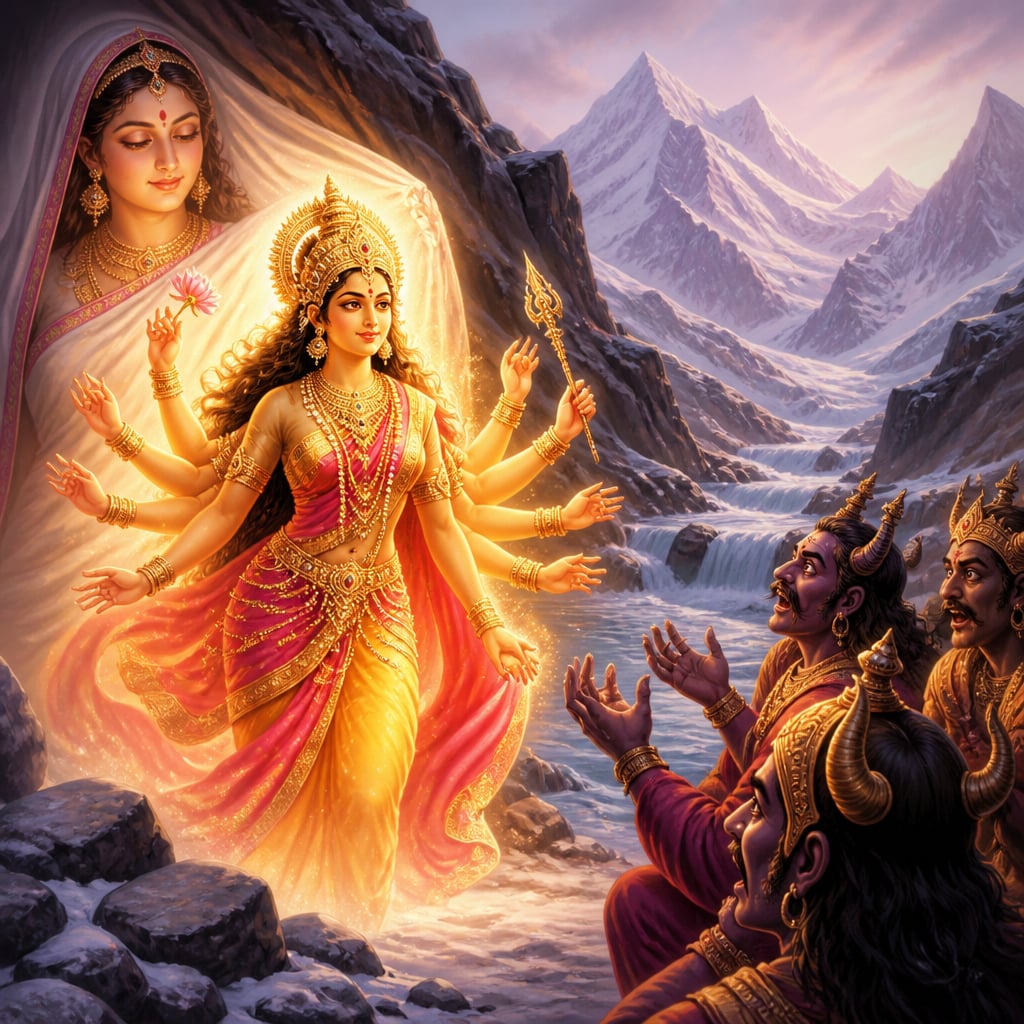
Before the answer could settle, something happened that the tradition tells with great care. From the sheath of Parvati's own body, from her very kosha, a second form stepped out, luminous and complete, a Goddess of such brightness that the snow seemed grey beside her. She was called Ambika, and because she came forth from the bodily sheath of Parvati, the worlds sang of her ever after as Kaushiki.
शरीरकोशाद्यत्तस्याः पार्वत्या निःसृताम्बिका। कौशिकीति समस्तेषु ततो लोकेषु गीयते॥
śarīra-kośād yat tasyāḥ pārvatyā niḥsṛtāmbikā | kauśikīti samasteṣu tato lokeṣu gīyate ||
Because Ambika came forth from the bodily sheath of Parvati, she is sung of in all the worlds as Kaushiki.
Devi Mahatmyam 5.87

And Parvati, now that the bright form had left her body, turned dark as the space between stars, and took the name Kalika. One Goddess had become two visible forms: the radiant Ambika stepping into the fight, and the dark form who would soon show what fierceness the fight would demand. Hold that image; the next lessons need it.
But the story does not linger on the mountain with the gods. It cuts at once to the enemy's side, because the moment such beauty appears in the world, something in the world reaches to grab it.
The Scouts Who Saw Her

Two of Shumbha's servants, Chanda and Munda, were roaming the slopes, and they saw her. What they saw undid them. Here was a woman more radiant than anything in the three worlds their masters had conquered, standing alone and unguarded on the snow. They did not stop to wonder what she was. They ran back to Shumbha with their report, and the report is the whole lesson.
They told him: Lord, you have seized every jewel of the three worlds. The finest elephants, the wish-granting gem, the horse of heaven, all are yours. But there is a woman on the mountain whose beauty has no equal in any world. Such a jewel should not stand outside your house. You who own everything, you must own her too.
Read that carefully. The demons do not say we have seen something holy. They say we have seen something we do not yet own. The sacred appears, and their first and only thought is possession. That is the trap this lesson is named for.
- The gods, seeing the Goddess, praised her.
- The demons, seeing the same Goddess, wanted to acquire her.
Same radiance. Two responses. And the difference between them is the whole difference between reverence and greed.
Wanting to Own What You Can Only Revere
There are things in a life that are meant to be revered, not possessed. A teaching. A person's trust. A moment of real beauty. The sacred, in whatever form it visits you. And the untrained self does to all of them exactly what Shumbha did to the Goddess: it tries to grab, to keep, to put its name on the thing and shut it in the house.
You have felt this. You meet something genuinely good: a friendship, a piece of art, a quiet hour on a mountain. Almost before you have taken it in, the grasping mind starts working. How do I keep this? How do I make it mine? How do I make sure it never leaves? The wanting arrives so fast it feels like love. It is not love. It is the reflex that mistakes reverence for a chance to acquire.
या देवी सर्वभूतेषु श्रद्धारूपेण संस्थिता। नमस्तस्यै नमस्तस्यै नमस्तस्यै नमो नमः॥
yā devī sarva-bhūteṣu śraddhā-rūpeṇa saṃsthitā | namas tasyai namas tasyai namas tasyai namo namaḥ ||
To the Goddess who dwells in all beings as reverent faith, salutations to Her, salutations to Her, again and again salutations.
Devi Mahatmyam 5 (Ya Devi refrain, the faith aspect)
The gods knew the Goddess as shraddha, reverent faith, the very capacity to stand before something greater and not reach for it. The demons had no shraddha. They had only appetite. And appetite, meeting the sacred, does the one thing that guarantees it will lose: it tries to own what it should only honour.
There is a quiet mercy in this, too. What tries to possess the sacred is not destroyed for wanting; it is undone by its own wanting, because the thing it reaches for cannot be held that way at all. Shumbha does not fail because the Goddess is cruel. He fails because you cannot cage light in a treasury.
Shumbha, hearing his scouts, felt that appetite catch fire. He did not go himself, not yet. He sent a messenger with an offer, sure that a jewel could be bought or, if not bought, taken. What the Goddess said back to that messenger is one of the strangest and most exacting vows in all the scriptures. We turn to it next.
Living traditions
The name Kaushiki and the many names of Ambika live on wherever the Goddess is worshipped as Amba or Ambika, from Gujarat's Ambaji to countless village shrines. The story of a beauty the demons wanted to own is retold each Navaratri as a caution still worth hearing: what is sacred is met with reverence, and grasping at it is the surest way to lose it.
- Ambaji Temple: A great temple to the Goddess as Amba or Ambika, one of the most visited Shakti shrines in western India. The name Ambika, the radiant Goddess of this lesson, is worshipped here in a form without an image, honoured through a sacred yantra. Pilgrims come to revere the Goddess, not to possess her, the very posture this lesson teaches. (The Shakti Peethas course maps the wider network of Goddess sites.)
Reflection
- The gods praised the Goddess; the demons wanted to own her. When something beautiful or sacred last appeared in your life, which of those two responses came first in you?
- Where have you tried to hold something so tightly, a person, a role, a good moment, that the holding began to damage it? What would revering it instead of owning it look like?
- The one Goddess showed a radiant form and a dark form for a single work. Where in yourself do a gentle side and a fierce side serve the same purpose rather than fight each other?