Talapatram

Kali Emerges from Her Brow

The fierce form born from Durga's anger; Chanda and Munda fall; she earns the name Chamunda. The controlled-fierce self summoned when calm method has failed.

The fierce form born from Durga's anger; Chanda and Munda fall; she earns the name Chamunda. The controlled-fierce self summoned when calm method has failed.

The Face That Came Out of Her Anger

Chanda and Munda gave the order, and their army surged up the last of the snow toward the Goddess. She watched them come. And then, for the first time in the whole story, her calm broke, not into fear, but into a wrath so total that it changed her face. Ambika's brow darkened and drew into a deep frown, and from the furrowed surface of that frown, from her very forehead, something leapt out into the world.

भ्रुकुटीकुटिलात्तस्या ललाटफलकाद्द्रुतम्। काली करालवदना विनिष्क्रान्तासिपाशिनी॥

bhrukuṭī-kuṭilāt tasyā lalāṭa-phalakād drutam | kālī karāla-vadanā viniṣkrāntāsi-pāśinī ||

From the furrowed surface of her frowning forehead sprang forth Kali at once, of terrible face, bearing sword and noose.

Devi Mahatmyam 7.6
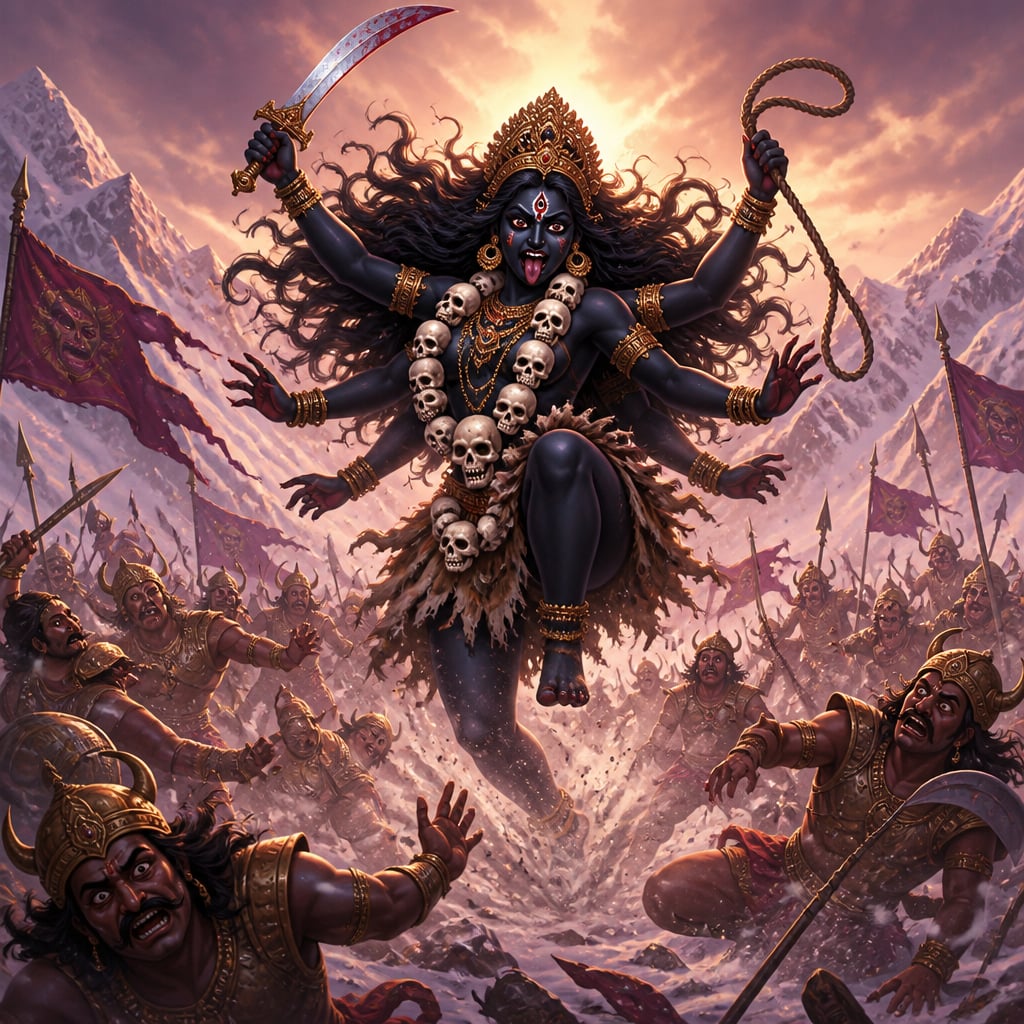
Kali descends fiercely amid the demon army

This was Kali. Gaunt and black, her eyes sunk and blazing, a garland of skulls at her neck and a tiger-skin at her waist, her mouth wide and her tongue lolling, a sword in one hand and a noose in the other. She filled the sky with a roar. She was not a new goddess arriving from somewhere else. She came out of Ambika's own forehead, out of the Goddess's own concentrated anger: the fierce form that the calm form holds in reserve for the moment calm is no longer enough.

What Kali Did

What followed the text tells without flinching. Kali fell on the demon army like a storm falling on a field. She caught war-elephants, riders and all, in her mouth and crushed them. She seized whole companies in her hands and ground them between her teeth. The great force that Chanda and Munda had led up the mountain, the weight of arms meant to drag the Goddess down, she scattered and devoured in moments. The army that trusted in force met a fierceness that force had no answer for.

Kali lays fallen generals' arms before Ambika

Then she came for the two generals themselves. She caught Chanda in one hand and Munda in the other, and struck the heads from both. She lifted the two heads, still dripping, and carried them to Ambika, the calm Goddess whose brow had borne her, and offered them like a gift.

Ambika, pleased, gave her a name that the worlds have used ever since.

यस्माच्चण्डं च मुण्डं च गृहीत्वा त्वमुपागता। चामुण्डेति ततो लोके ख्याता देवि भविष्यसि॥

yasmāc caṇḍaṃ ca muṇḍaṃ ca gṛhītvā tvam upāgatā | cāmuṇḍeti tato loke khyātā devi bhaviṣyasi ||

Because you have come bearing Chanda and Munda, you shall be known in the world, O Goddess, as Chamunda.

Devi Mahatmyam 7.27

Ambika names Kali as the goddess Chamunda

From the two demons' names, Chanda and Munda, came her name: Chamunda. The fierce mother who takes the heads of grasping turned to force.

Fierceness That Is Not Cruelty

It is easy to be frightened by Kali and to mistake her for something dark or demonic. She is not. Kali is the Goddess. She springs from Ambika's own brow, she acts under Ambika's own will, and she brings her victory back and lays it at the calm Goddess's feet like an obedient daughter. Her fierceness is not rage out of control. It is anger in the service of dharma, terrible to the demon and protective of everything the demon threatened.

That is the whole point of her. Consider the difference:

Demonic force (Chanda, Munda) Sacred fierceness (Kali)
Serves the grasping self Serves what is right
Reaches out to seize Rises up to protect
Loses control to appetite Holds control under a higher will
Ends in its own ruin Ends by laying victory at the Goddess's feet

The shapes can look alike from a distance, two fierce forces meeting on a battlefield. From inside, they are opposite. One is fury that has captured a self. The other is a self that has taken up fury as a tool and can set it down again.

The Fierce Self You Are Allowed to Summon

There are moments in a life when calm method has genuinely failed. You have reasoned, you have waited, you have been patient and fair, and the thing in front of you, an injustice, a violation, a force that respects only force, is still coming. The tradition does not tell you to keep smiling. It tells you that the Goddess herself, when patience had done its work and force still marched, summoned a fierce form from her own brow and used it.

The permission is real, and so is the discipline around it. Kali is fierceness summoned, not fierceness that seizes you. She comes out of Ambika and returns to Ambika. The fierce self you are allowed to call on is the one that rises for something beyond yourself and can be laid down again when the work is done, its heads carried back and offered up. It is not the rage that takes you over and keeps you. Summon Chamunda when calm has truly failed. Do not become Chanda.

Shumbha and Nishumbha still held the throne. And the Goddess was about to reveal that she had never been fighting alone. Seven Mothers were about to take the field, and that is the next lesson.

Living traditions

Kali and Chamunda are among the most powerfully worshipped forms of the Goddess across India, from the great Kali temples of Bengal to the hill shrines of Chamunda in Himachal and the guardian Chamunda of Mysuru. Wherever she is honoured, the teaching of this lesson lives on: her fierce face is not cruelty but the Mother's protection, summoned when gentleness alone can no longer hold the line.

  • Chamunda Nandikeshwar Dham, Kangra: An ancient and much-loved temple to the Goddess as Chamunda, the fierce mother named in this very lesson for slaying Chanda and Munda. Devotees revere her here as terrible to evil and tender to her children, the exact balance the lesson draws: fierceness in the service of dharma, not rage. (The Shakti Peethas course maps the wider network of Goddess sites.)

Reflection

  • Kali rose only when patience had done its work and force still marched. Is there a situation where you have kept smiling and accommodating long past the point where fierce refusal was the honest response?
  • Kali came out of Ambika and returned to her; Chanda's fury captured him and kept him. When you have been angry, was it fierceness you summoned and could lay down, or rage that took you over?
  • Kali laid her victory at the calm Goddess's feet like a gift. When you have had to be fierce, is there a calmer self you keep the fierceness answerable to, and do you return to it when the work is done?

More in The Two Ego-Traps

All lessons in The Two Ego-Traps · Durga: The Goddess Who Saves the World ebook course