Chanda and Munda
The generals sent to seize her by force. When grasping turns to force.
When the Offer Fails, the Fist Comes Out
Shumbha's face, when the envoy brought back the Goddess's answer, went from disbelief to fury. He had offered a woman the throne of the worlds, and she had told him to come and fight for her. A being that lives on self-conceit cannot absorb a refusal. It reads no as an attack. And when grasping is refused, it reaches for the only other thing it knows: force.
He first sent a general named Dhumralochana with a great host, ordering him to seize the Goddess and drag her back, killing anyone who stood in the way. The Goddess made a single sound of displeasure, and Dhumralochana was burned to ash where he stood. His army broke under her lion. So Shumbha, angrier still, called his two fiercest generals.
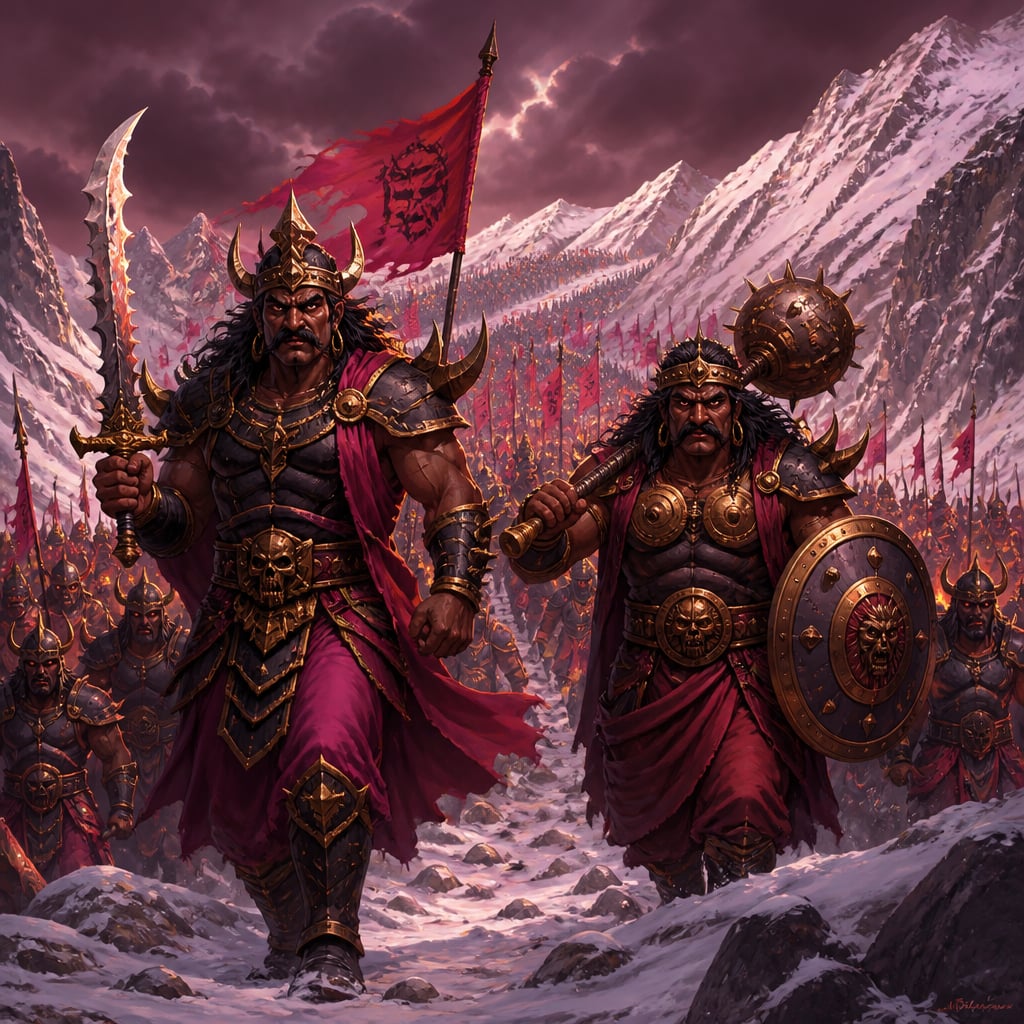
Their names were Chanda and Munda.
Two Generals and a Great Army
Chanda and Munda were not clumsy brutes. They were Shumbha's best, and he sent them with a vast force: cavalry and foot and war-elephants, climbing the mountain with a single order. Take her, by any means, and bring her down. If persuasion had failed, sheer weight of force would not.
Picture the scene the text builds. The Goddess sits alone on the high snow, on her lion, calm. Below her, filling the passes, comes an army raised for one purpose, to lay hands on her and drag her where she does not wish to go. The dust of it rises. The ground shakes. And she does not stand, does not arm herself, does not so much as change her expression. She watches the force of the whole demon world climb toward her, and waits.
The tradition wants you to sit with one thing: grasping that has turned to force.
The Nature of Force
When the untrained self wants something and is refused, it rarely stops wanting. It escalates. What began as a wish becomes a demand, and what began as a demand becomes force. We all know the shape of it:
- The desire that is told no and turns to pressure.
- The pressure that is resisted and turns to threat.
- The threat that fails and turns to raw force, the attempt to simply take by strength what could not be won by right.
Shumbha's march up the mountain is the last stage of a single motion that began with a scout saying you should own her. Appetite became offer, offer became threat, threat became an army. At no point did the demon ask whether the thing could rightly be his. He only asked how much force it would take. That is the signature of the cornered ego: it never questions the wanting, only raises the price it is willing to pay to satisfy it.
या देवी सर्वभूतेषु तृष्णारूपेण संस्थिता। नमस्तस्यै नमस्तस्यै नमस्तस्यै नमो नमः॥
yā devī sarva-bhūteṣu tṛṣṇā-rūpeṇa saṃsthitā | namas tasyai namas tasyai namas tasyai namo namaḥ ||
To the Goddess who dwells in all beings as thirst, salutations to Her, salutations to Her, again and again salutations.
Devi Mahatmyam 5 (Ya Devi refrain, the thirst aspect)
The tradition even honours the Goddess as trishna, thirst itself, because craving too is only her power, wrongly turned. The very thirst that drives Chanda and Munda up the mountain is, at root, a divine energy misdirected into grasping. Turned rightly, thirst becomes longing for the true; turned wrongly, it becomes an army sent to seize what can never be seized.
The Antidote She Embodies

Against that thirst, the Goddess sits in perfect tushti, contentment, wanting nothing, reaching for nothing, needing to take nothing from anyone. That is why the force climbing toward her is already doomed. Force works on things that can be moved by force. It has no purchase at all on something that wants nothing and cannot be threatened with loss.
या देवी सर्वभूतेषु तुष्टिरूपेण संस्थिता। नमस्तस्यै नमस्तस्यै नमस्तस्यै नमो नमः॥
yā devī sarva-bhūteṣu tuṣṭi-rūpeṇa saṃsthitā | namas tasyai namas tasyai namas tasyai namo namaḥ ||
To the Goddess who dwells in all beings as contentment, salutations to Her, salutations to Her, again and again salutations.
Devi Mahatmyam 5 (Ya Devi refrain, the contentment aspect)
See the two forces about to meet. On one side, thirst raised into an army, sure that enough force can take anything. On the other, contentment seated on a lion, needing nothing and so unmovable. The demons think they are climbing toward a prize. They are climbing toward the one thing their force cannot touch.
Chanda and Munda did not understand this. They saw a lone woman and a winnable prize. They ordered the charge. And what rose to meet them was not the calm, smiling Goddess they had been sent to seize, but something that came out of her anger with a face like the end of the world. Her name was Kali, and she is where we turn next.
Living traditions
The pattern this lesson names, grasping that escalates into force and shatters against a power that wants nothing, is retold every autumn wherever the Goddess's victory is celebrated. From the Dasara processions of Mysuru to village Navaratri plays, the demons who came to seize by force remain a standing image of appetite defeating only itself.
- Chamunda Devi Temple, Mysuru (Chamundi Hill): A famous hill temple to Chamundeshwari, the fierce Goddess who ends Chanda and Munda, watching over the city of Mysuru. Though the naming of Chamunda comes in the next lesson, the generals of this one give her that name. Standing here, above the plain, brings the whole confrontation to mind: force marching up a mountain toward a Goddess who does not stir. (The Shakti Peethas course maps the wider network of Goddess sites.)
Reflection
- Shumbha's want went from a glance to an offer to a threat to an army, never once questioning the wanting itself. Where in your life has a desire escalated like that, raising the force instead of asking whether you should want it at all?
- The Goddess is honoured even as thirst, because craving is divine energy wrongly turned. Where is a craving in you that, aimed differently, could become a worthy longing or a real effort?
- The seated Goddess cannot be moved because she wants nothing. Where does what you want from a person or situation give it power to push you around, and what would change if you needed nothing from it?