Youth Engagement & Diaspora Mobilization
Making Dharmic Identity Aspirational and Diaspora Philanthropy
A civilization survives not in textbooks but in living communities that transmit its values across generations. The Armenian diaspora, numbering barely 10 million worldwide, secured genocide recognition from 34 countries, built billion-dollar philanthropic institutions, and maintained cultural continuity across a century of dispersion. South Korea transformed its global identity from 'war-torn divided country' to the world's most exported culture through deliberate state-backed investment in cultural industries. Meanwhile, 4.4 million Indian-Americans, the wealthiest ethnic group in the United States, remain largely fragmented in civilizational mobilization. This lesson examines what works, what does not, and what India's youth and diaspora must build to make dharmic identity aspirational rather than defensive.
The Question That Defines This Lesson
In September 2021, over fifty universities across the United States, the United Kingdom, and Canada hosted an academic conference titled "Dismantling Global Hindutva." The conference brought together scholars, activists, and organizations united by a single objective: delegitimizing Hindu civilizational identity as a political ideology indistinguishable from fascism.
The response was unprecedented. Hindu student organizations across these campuses, many of them first-generation or second-generation Indian Americans who had never engaged in political activism before, organized counter-events, wrote open letters, and confronted the framing head-on. Over 1.5 million people signed petitions opposing the conference. Hindu American Foundation filed formal complaints. Students at Rutgers, Harvard, Columbia, and dozens of other campuses pushed back in ways that surprised both the conference organizers and themselves.
This was not an organized movement. It was a spontaneous awakening. And it revealed both the depth of the threat facing Hindu identity on Western campuses and the untapped potential of a diaspora that had, until that moment, largely chosen silence over engagement.
The question this lesson answers is not whether Hindus should engage. That question was settled in September 2021. The question is: how do you build a sustained civilizational mobilization that does not burn out after one crisis? How do you transform defensive reaction into proactive institution-building? And how do you make dharmic identity not just defensible, but aspirational?
Two civilizations have already answered these questions. Their models are available for study.
The Armenian Model: How 10 Million People Moved the World
The Armenian diaspora is the single most instructive model for Hindu civilizational mobilization. Not because Armenians and Hindus share identical challenges, but because the Armenian case proves what a small, determined, well-organized diaspora can achieve against seemingly impossible odds.
The numbers alone are striking. The global Armenian population is approximately 10 million, smaller than the population of Bangalore. Of these, roughly 7 million live outside Armenia. They are scattered across the United States (1.5 million), Russia (2.2 million), France (600,000), Lebanon, Syria, Iran, and dozens of other countries.
Despite this tiny population and extreme geographic dispersion, the Armenian diaspora has achieved results that dwarf its numbers.
The Genocide Recognition Campaign
In 1915, the Ottoman Empire systematically killed approximately 1.5 million Armenians. Turkey has denied this genocide for over a century. The Armenian diaspora made recognition of this genocide its civilizational mission.
The campaign took 106 years. It required sustained effort across multiple generations. Armenian community organizations in the United States, France, and elsewhere documented evidence, lobbied legislators, educated journalists, funded academic chairs, and built coalitions with other communities that had experienced genocide. The Armenian National Committee of America (ANCA), founded in 1941, became one of the most effective ethnic lobbying organizations in Washington. It operated on a fraction of the budget of larger lobbies but compensated with intensity, focus, and intergenerational commitment.
The results are documented. As of 2024, 34 countries officially recognize the Armenian genocide. The United States formally recognized it in 2019 through a Senate resolution and again in 2021 through a presidential statement by Joe Biden. France criminalized denial of the Armenian genocide in 2012. The European Parliament recognized it in 1987.
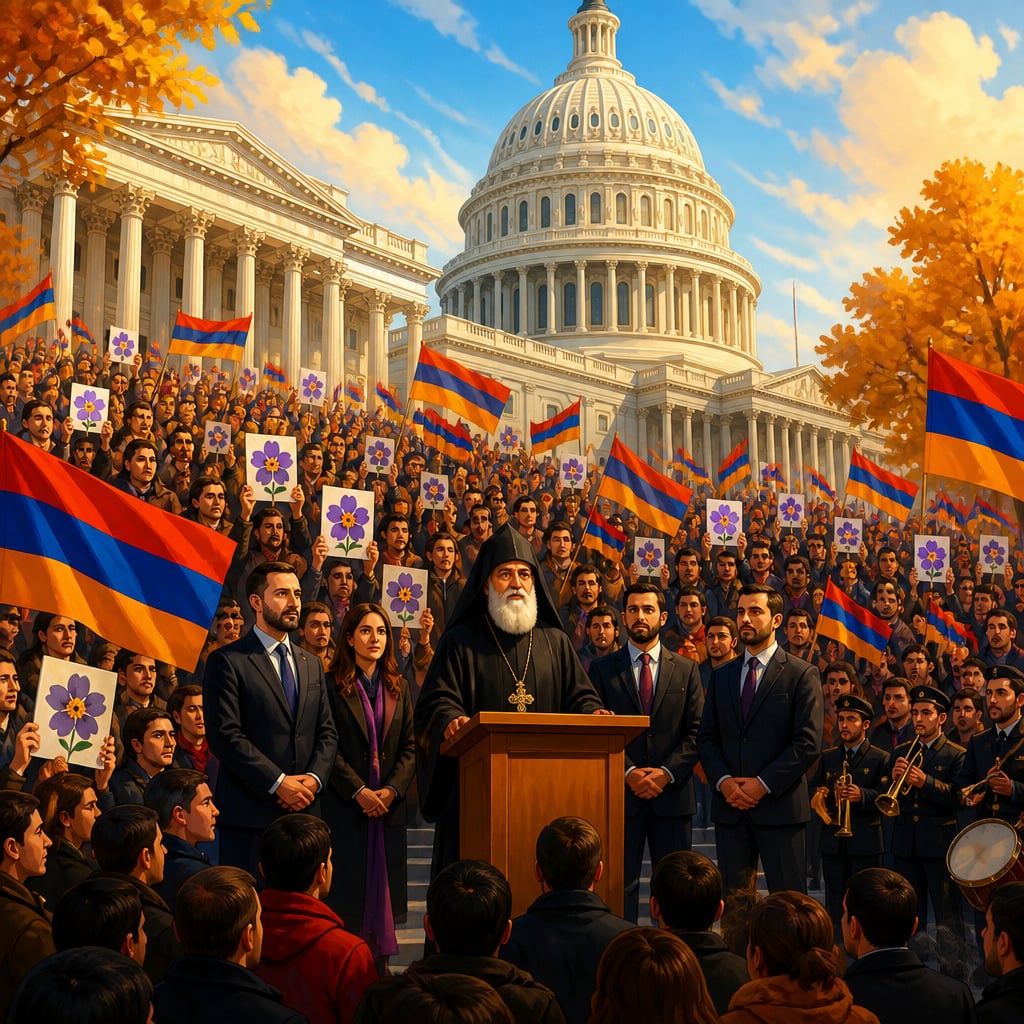
None of this happened because Armenia is a geopolitical superpower. Armenia's GDP is roughly $20 billion, smaller than the annual revenue of many individual corporations. This happened because a dispersed community of 10 million people organized, funded, and sustained a civilizational campaign across four generations.
The Philanthropy Machine
Armenian diaspora philanthropy operates with a discipline and focus that few communities match.
The Armenian General Benevolent Union (AGBU), founded in 1906 in Cairo, is the world's largest Armenian non-profit. It operates schools, cultural programs, and scholarships in 25 countries. Its total assets exceed $1 billion. Kirk Kerkorian, an Armenian-American businessman who built MGM and the largest hotels in Las Vegas, donated over $1 billion to Armenian causes during his lifetime, including $200 million to build roads, schools, and infrastructure in Armenia itself.
The Lincy Foundation, created by Kerkorian, spent $242 million on Armenian infrastructure between 2001 and 2011. This was not charity. This was civilizational investment by a diaspora member who understood that homeland strength and diaspora pride are connected.
The lesson for the Hindu diaspora is precise: Armenian philanthropy is not random generosity. It is strategic, institutional, and civilization-first. Every dollar is directed toward strengthening Armenian identity, whether through genocide education, cultural programming, or homeland development. There is no confusion about the mission.
Why It Works
Three structural features make Armenian diaspora mobilization effective.
First, identity clarity. Armenians know exactly who they are and why their civilization matters. The Armenian Apostolic Church provides institutional continuity. The genocide provides a shared narrative of survival. The alphabet, created by Mesrop Mashtots in 405 CE, provides a unique cultural marker. There is no confusion about Armenian identity, no apologizing for it, no hedging.
Second, institutional depth. Armenians do not rely on spontaneous mobilization. They build institutions that outlast individual leaders. ANCA has operated continuously since 1941. AGBU since 1906. The Armenian Assembly of America since 1972. These organizations train new generations of leaders, maintain lobbying relationships across political cycles, and provide infrastructure for sustained action.
Third, intergenerational transmission. Armenian families, churches, and community organizations transmit civilizational identity as a non-negotiable inheritance. Armenian Saturday schools teach language, history, and identity to diaspora children. The genocide is not just history. It is a living memory that connects every generation to a civilizational mission.
The Hindu diaspora has the numbers (4.4 million in the US alone, far larger than the Armenian community). It has the wealth (Indian Americans are the highest-earning ethnic group in the United States, with a median household income of $123,700 in 2021). What it lacks, and what the Armenian model demonstrates, is institutional depth, identity clarity, and intergenerational civilizational transmission.
The Korean Model: Making Identity Aspirational

If the Armenian model teaches institutional mobilization, the Korean model teaches something equally critical: how to transform civilizational identity from a source of shame into a source of global aspiration.
In the 1990s, South Korea was known internationally for three things: the Korean War, the 1997 Asian financial crisis, and cheap electronics. Korean immigrants in the United States often downplayed their heritage. Korean students abroad faced stereotypes. Korean culture was invisible on the global stage.
By 2024, South Korea had become the world's most successful cultural exporter relative to its size. BTS and BLACKPINK filled stadiums on every continent. Squid Game became Netflix's most-watched series globally. Korean beauty products outsold French luxury brands in key markets. Korean food, fashion, and cinema became aspirational worldwide.
This did not happen by accident.
The Hallyu Strategy
The Korean government identified cultural export as a national strategic priority in the late 1990s, directly in response to the Asian financial crisis. The logic was precise: a nation that exports culture exports identity. A nation whose culture is globally desired is a nation whose people are globally respected.
The Ministry of Culture established the Korean Creative Content Agency (KOCCA) and invested over $500 million in cultural industries between 2001 and 2020. This was not subsidy for entertainment. It was civilizational strategy. The government funded training programs for content creators, established export promotion offices for Korean media, and built infrastructure for the K-pop industry that would later produce global phenomena.
Critically, the Korean government did not dictate creative content. It built the ecosystem and let creators create. The state provided the infrastructure. Artists provided the magic. This public-private partnership model is precisely what distinguished Korea's approach from heavy-handed state propaganda.
The Identity Transformation
The results went far beyond economics. The Hallyu wave transformed how Korean youth related to their own identity.
Before Hallyu, Korean Americans often anglicized their names, avoided speaking Korean in public, and distanced themselves from traditional culture. After Hallyu, Korean became one of the fastest-growing languages on Duolingo. Non-Koreans were learning hanbok fashion, Korean cooking, and Korean history. Korean Americans began embracing their heritage as a source of social capital rather than a marker of otherness.
This is the transformation the Hindu diaspora needs. Currently, dharmic identity in the West is largely positioned as something to defend (against academic attacks, media misrepresentation, and campus hostility) rather than something to celebrate. The Korean model demonstrates that the most powerful defense is making your civilization's contributions so visible, so appealing, and so integrated into global culture that attacking it becomes socially costly.
India already possesses the raw materials for this transformation. Yoga is practiced by 300 million people worldwide. Ayurveda is a growing global industry. Indian cuisine is among the most popular on earth. Bollywood produces more films than Hollywood. Classical Indian dance, music, and art have global audiences. What is missing is the strategic investment, institutional coordination, and narrative framing that transforms scattered cultural exports into a coherent civilizational brand.
The Campus Frontline
For Hindu youth in the West, the most immediate arena of civilizational engagement is the university campus.
The Threat
Western universities have become the primary institutional space where Hindu civilizational identity is challenged, redefined, and often delegitimized. The mechanism operates through several channels.
Academic framing. South Asian Studies departments at major universities frequently frame Hinduism through the lens of caste oppression, Brahmanical patriarchy, and Hindu nationalism. Students entering these courses encounter their civilization presented as a system of hierarchical violence rather than a living philosophical tradition. The Dismantling Global Hindutva conference of 2021 was the most visible expression of this academic orientation, but it reflected a broader institutional pattern.
Institutional asymmetry. Muslim Student Associations, Jewish organizations (Hillel, Chabad), and Christian groups operate well-funded, professionally staffed campus organizations with decades of institutional experience. Hindu student organizations, by comparison, are often underfunded, volunteer-run, and lacking professional guidance. This asymmetry means Hindu students face organized opposition with ad-hoc defenses.
Social pressure. Hindu students report being asked to "account for" caste, Hindutva, or BJP policies in ways that no other religious or ethnic group faces. Jewish students are not asked to defend every Israeli government policy as a condition of social acceptance. Muslim students are not asked to account for Taliban governance. But Hindu students routinely face demands to denounce or apologize for a civilizational identity they are still learning to articulate.
The DGH Watershed
The September 2021 Dismantling Global Hindutva conference crystallized these dynamics. The conference, co-sponsored by departments at Harvard, Stanford, Princeton, Columbia, Berkeley, and over forty other universities, was presented as an academic exercise. Its actual effect was to legitimize the framing of Hindu identity as equivalent to fascism.
The Hindu student response, though largely spontaneous, revealed several important dynamics.
Scale of mobilization. Over 1.5 million people signed petitions opposing the conference. Hindu students at dozens of campuses organized counter-panels, teach-ins, and awareness campaigns. This demonstrated that the community had latent mobilization capacity far greater than anyone expected.
Generational shift. The students who organized the response were overwhelmingly millennials and Gen-Z Indian Americans. Many had limited exposure to Hindu advocacy organizations. Their response was native to their generation: social media campaigns, YouTube explainer videos, Twitter threads documenting the conference's anti-Hindu bias. This was a digitally native civilizational defense.
Institutional gaps exposed. Despite the massive grassroots response, there was no sustained institutional follow-through. After the immediate crisis passed, most counter-efforts dissipated. The conference organizers continued their academic careers. The institutional asymmetry remained. The episode demonstrated that spontaneous mobilization without institutional infrastructure is a spike, not a strategy.
Digital Engagement: The New Civilizational Battlefield
The DGH response demonstrated something else: digital platforms are now the primary arena of civilizational narrative warfare, especially for young people.
The generation currently in universities does not read academic journals. They consume content on YouTube, Instagram, Twitter, and podcasts. Whoever controls the narrative on these platforms shapes how millions understand Hinduism, India, and dharmic civilization.
What Is Working
A new generation of digital content creators is building the infrastructure of civilizational narrative from the ground up.
Podcasts like The Ranveer Show and Bharatvaarta are reaching millions with conversations about Indian history, philosophy, and civilization that would never appear in Western academic journals. YouTube channels focused on Indian history, Sanskrit, temple architecture, and dharmic philosophy are building audiences in the hundreds of thousands. Instagram accounts make Sanskrit, Ayurveda, and temple culture visually compelling to young audiences.
The significance of these efforts goes beyond content creation. They represent a shift from defensive response ("Hinduism is not what they say it is") to proactive construction ("Here is what our civilization actually offers"). This is the narrative equivalent of the Korean Hallyu shift: from explaining yourself to showcasing yourself.
What Is Missing
Three critical gaps remain in the digital civilizational ecosystem.
Production quality. Much dharmic content is produced on minimal budgets with amateur production values. Korean cultural content succeeded partly because the government invested in production infrastructure. The dharmic content ecosystem needs similar investment in professional-grade storytelling, cinematography, and production.
Institutional backing. Individual creators burn out. Channels go dormant. The most successful digital media ecosystems (Korean, Israeli, Jewish-American) have institutional backing that provides funding, training, legal support, and continuity. Individual passion without institutional support is a candle, not a furnace.
Strategic coordination. The dharmic digital ecosystem is fragmented. Creators work independently, often duplicating effort or leaving critical topics uncovered. A coordinated content strategy, like what KOCCA provides for Korean cultural export, would multiply the impact of existing creators.
Diaspora Philanthropy: From Charity to Civilizational Investment
The Indian diaspora is the wealthiest immigrant community in the United States. Indian Americans' collective wealth runs into hundreds of billions of dollars. Yet diaspora philanthropy toward civilizational causes remains a fraction of what comparable communities invest.
Compare the numbers. Kirk Kerkorian alone donated over $1 billion to Armenian causes. The Armenian community in the US numbers 1.5 million. The Indian-American community numbers 4.4 million, nearly three times larger, and is collectively far wealthier. Yet there is no Indian-American equivalent of Kirk Kerkorian's civilizational investment.
This is not because Indian Americans are ungenerous. Many donate lavishly to their alma maters, to hospitals, and to mainstream American causes. The gap is specifically in civilizational philanthropy: giving directed at strengthening dharmic identity, building Hindu institutions, funding civilizational scholarship, and investing in the homeland's cultural infrastructure.
What Exists
Several organizations demonstrate what diaspora civilizational philanthropy can achieve.
Ekal Vidyalaya runs over 100,000 single-teacher schools in tribal and rural India, largely funded by diaspora donations. The model is lean: one teacher per village, teaching basic literacy, numeracy, and cultural values. The cost is approximately $1 per child per day. The result is millions of children in India's most underserved communities receiving education that connects them to civilizational heritage.
The Hindu American Foundation (HAF) operates as the primary Hindu advocacy organization in the United States, conducting Congressional briefings, textbook advocacy, and public education. HAF's annual budget is modest compared to analogous organizations in other communities, yet it punches above its weight through focused strategy and dedicated volunteers.
Temple building represents the most visible form of diaspora civilizational investment. The BAPS Swaminarayan Mandir in Robbinsville, New Jersey, the Malibu Hindu Temple, and dozens of other major temples across North America serve as community anchors, cultural transmission centers, and visible declarations of civilizational presence.
What Is Needed
The gap between what exists and what is needed is significant.
Endowed chairs and academic programs. Jewish and Armenian communities have endowed dozens of chairs at major universities to ensure their civilizational narratives are represented in academia. Hindu studies at most universities are housed within South Asian Studies departments that frame Hinduism through colonial and post-colonial theory. Endowing chairs specifically in Hindu philosophy, Sanskrit studies, and Indian civilizational history would create institutional counterweights to hostile academic framing.
Professional advocacy infrastructure. ANCA operates with full-time professional staff, lobbying budgets, and multi-year strategic plans. Hindu advocacy organizations need similar professionalization: full-time staff, legal teams, media operations, and political engagement capacity that does not depend on volunteer energy alone.
Youth pipeline programs. Birthright Israel sends over 50,000 young Jewish adults to Israel annually, funded by diaspora philanthropy. The program costs approximately $3,500 per participant and has been credited with dramatically strengthening Jewish identity among diaspora youth. A comparable program for young Indian Americans, connecting them to India's civilizational heritage through immersive experiences, does not yet exist at scale.
Civilizational media investment. The most effective diaspora mobilization requires media infrastructure. Armenian, Jewish, and Korean communities all invest in media (newspapers, digital platforms, content studios) that serve their community. The Hindu diaspora has no equivalent of The Forward (Jewish), Asbarez (Armenian), or Arirang (Korean).
The Identity Shift: From Defensive to Aspirational
All of the institutional, digital, and philanthropic strategies discussed above serve a single underlying objective: making dharmic identity aspirational rather than defensive.
This is the most important shift. A community that spends all its energy defending itself against accusations is a community defined by its attackers. A community that showcases its civilizational contributions, builds institutions of excellence, and creates cultural products that the world desires is a community that defines itself.
The Korean model proves this works. Before Hallyu, Korea was defined by war and poverty. After Hallyu, Korea is defined by creativity, beauty, and cultural sophistication. The transformation was not achieved by writing rebuttals to Western stereotypes. It was achieved by creating things so compelling that the stereotypes became irrelevant.
India and its diaspora have every ingredient for this transformation. A philosophical tradition that the world is already drawn to (yoga, meditation, Vedanta). An aesthetic tradition that is visually spectacular (temple architecture, classical dance, textile arts). A culinary tradition that is globally beloved. A startup ecosystem that is reshaping global technology. A space program that reaches Mars on its first attempt.
The task is not to create these assets. They already exist. The task is to invest in the institutional and narrative infrastructure that transforms scattered excellence into a coherent civilizational brand, one that makes young Indians proud to claim their heritage rather than anxious about defending it.
The Blueprint
Drawing from the Armenian, Korean, and emerging Indian models, the youth engagement and diaspora mobilization blueprint has five pillars.
Pillar 1: Institutional Depth. Build organizations that outlast individual leaders. Endow them. Professionalize them. Give them multi-decade mandates. The Armenian model shows that a 1906 organization (AGBU) is still operating in 2026 because it was built to endure.
Pillar 2: Identity Clarity. Articulate what dharmic civilization is, not just what it is not. Develop a positive, compelling, intellectually rigorous civilizational narrative that young people can embrace with pride. This requires investment in scholarship, storytelling, and cultural production.
Pillar 3: Digital Infrastructure. Fund professional-grade content creation. Build platforms. Support creators. Coordinate strategy. The Korean model shows that state investment in cultural infrastructure multiplied creative output by orders of magnitude.
Pillar 4: Strategic Philanthropy. Shift from charity to civilizational investment. Endow academic chairs. Fund youth immersion programs. Build media infrastructure. Every dollar spent on civilizational capacity is a dollar that compounds across generations.
Pillar 5: Campus Ecosystem. Build a professional Hindu campus organization with full-time staff, legal support, intellectual resources, and a presence on every major university campus. The Hillel model (900+ campuses) shows what this looks like at scale. Hindu students should never again face an organized academic assault with ad-hoc defenses.
The Armenians built their mobilization with 10 million people. The Koreans built their cultural transformation with 50 million. The Hindu civilizational community, counting India and its global diaspora, numbers over 1.2 billion. The resources, the talent, and the cultural assets exist. What remains is the decision to invest in civilizational infrastructure with the same seriousness that other civilizations have demonstrated.
The shift from defensive to aspirational is not a mood. It is a strategy. And it begins with the generation now coming of age.
Case studies
The Armenian Diaspora: How 10 Million People Moved the World
After the 1915 genocide that killed approximately 1.5 million Armenians, the surviving diaspora scattered across dozens of countries with a total global population of roughly 10 million, smaller than the population of Bangalore. Turkey denied the genocide for over a century. Armenia itself had a GDP of roughly $20 billion, smaller than the annual revenue of many individual corporations. Yet the Armenian diaspora built an institutional ecosystem of remarkable effectiveness: the Armenian National Committee of America (ANCA, founded 1941) became one of Washington's most effective ethnic lobbies. The Armenian General Benevolent Union (AGBU, founded 1906) accumulated assets exceeding $1 billion, operating schools, cultural programs, and scholarships in 25 countries. Kirk Kerkorian donated over $1 billion to Armenian causes, including $200 million in direct infrastructure investment in Armenia. Armenian Saturday schools in Los Angeles, Paris, and Beirut transmitted language, history, and identity to children who had never seen Armenia.
The Armenian model is a masterclass in parampara (intergenerational transmission) and sanghatan (organized collective action). The Rig Veda's Samjnana Sukta commands: 'Sam gacchadhvam, sam vadadhvam, sam vo manamsi janatam' (Move together, speak together, let your minds be in accord). The Armenian diaspora achieved all three: coordinated lobbying across countries (sam gacchadhvam), a unified genocide recognition narrative (sam vadadhvam), and shared civilizational mission across four generations (sam vo manamsi). Their success was not resources but sanghatan: institutions built to outlast individual leaders, transmitting civilizational identity as a non-negotiable inheritance.
As of 2024, 34 countries officially recognize the Armenian genocide. The United States formally recognized it in 2019 (Senate resolution) and 2021 (presidential statement). France criminalized genocide denial in 2012. The European Parliament recognized it in 1987. Armenian cultural continuity, measured by language retention, community cohesion, and institutional depth, remains strong even 109 years after the genocide. The campaign took four generations of sustained effort.
Institutional depth, identity clarity, and intergenerational transmission matter more than population size or economic power. A dispersed community of 10 million achieved what larger, wealthier communities have not because they built organizations designed to outlast individual leaders and transmit civilizational identity as a non-negotiable inheritance.
The Indian-American community (4.4 million, median household income $123,700) is nearly three times larger and collectively far wealthier than the Armenian-American community (1.5 million). Yet there is no Indian-American equivalent of Kirk Kerkorian's civilizational investment, no equivalent of ANCA's lobbying infrastructure, and no equivalent of Armenian Saturday schools for civilizational identity transmission. The gap is not resources. It is sanghatan.
Kirk Kerkorian's Lincy Foundation spent $242 million on Armenian infrastructure between 2001 and 2011. By comparison, no single Indian-American philanthropist has directed a comparable sum specifically toward civilizational causes (dharmic education, Hindu institutional infrastructure, or civilizational scholarship), despite Indian Americans collectively possessing hundreds of billions in wealth.
South Korea's Hallyu Wave: From War-Torn Nation to Global Cultural Power
In the 1990s, South Korea was known internationally for the Korean War, the 1997 Asian financial crisis, and cheap electronics. Korean immigrants in the West often downplayed their heritage. Korean students abroad faced stereotypes. Korean culture was invisible on the global stage. The 1997 financial crisis became the catalyst for transformation. The Korean government identified cultural export as a national strategic priority, creating the Korean Creative Content Agency (KOCCA) and investing over $500 million in cultural industries between 2001 and 2020. The government did not dictate creative content. It built the ecosystem: training programs for content creators, export promotion offices, and infrastructure for the K-pop industry. Artists provided the magic within a state-built framework.
The Hallyu strategy is a modern demonstration of the shreshtha principle from Bhagavad Gita 3.21: 'Whatever the greatest among us do, the rest of the world follows.' South Korea produced shreshtha figures (BTS, Bong Joon-ho, Korean chefs, K-beauty innovators) whose excellence made Korean identity globally aspirational. The identity transformation was not achieved by writing rebuttals to Western stereotypes. It was achieved by creating things so compelling that the stereotypes became irrelevant. This is Kautilyan statecraft applied to culture: building the ecosystem (sam) that generates natural influence, rather than fighting battles (danda) one by one.
By 2024, BTS and BLACKPINK filled stadiums on every continent. Squid Game became Netflix's most-watched series globally. Korean beauty products outsold French luxury brands in key markets. Korean became one of the fastest-growing languages on Duolingo. Korean Americans shifted from hiding their heritage to embracing it as a source of social capital. South Korea's cultural exports generated an estimated $12.4 billion in 2022. The transformation took approximately 25 years of sustained strategic investment.
The most powerful defense of civilizational identity is making it aspirational rather than defensive. A community that showcases its contributions through cultural excellence transforms how the world perceives it. This requires strategic investment in cultural infrastructure, not just spontaneous creativity.
India already possesses the raw materials for a comparable transformation: yoga (300 million practitioners worldwide), Ayurveda (growing global industry), Indian cuisine (among the most popular on earth), Bollywood (more films than Hollywood), classical arts (global audiences). What is missing is the strategic investment, institutional coordination, and narrative framing that Korea deployed through KOCCA. The dharmic content ecosystem remains fragmented, underfunded, and amateur in production quality compared to what Korean cultural industries produce.
South Korea invested over $500 million in cultural industries through KOCCA between 2001 and 2020. The return was $12.4 billion in cultural exports by 2022, a roughly 25x return on civilizational investment. No comparable institutional investment exists for dharmic cultural export.
Dismantling Global Hindutva 2021: The Campus Awakening
In September 2021, an academic conference titled 'Dismantling Global Hindutva' was co-sponsored by departments at over fifty universities including Harvard, Stanford, Princeton, Columbia, and Berkeley. The conference framed Hindu civilizational identity as a political ideology equivalent to fascism, bringing together scholars and activists united by this framing. The conference was presented as academic inquiry, but its operational effect was to legitimize the equation of Hindu identity with violent authoritarianism within the institutional framework of the West's most prestigious universities. Hindu student organizations across these campuses, many consisting of first-generation or second-generation Indian Americans who had never engaged in political activism, organized counter-events, wrote open letters, launched social media campaigns, and confronted the framing directly.
The DGH episode illustrates the difference between spontaneous response and true sanghatan (organized collective action). The initial mobilization demonstrated viveka (discernment): Hindu students recognized the attack for what it was and refused to accept the framing. But viveka without sanghatan produces a spike, not a strategy. The Arthashastra teaches that defense requires not just awareness of the threat but institutional infrastructure to sustain the response. The Armenians understood this. ANCA was not created in response to a single crisis. It was built in 1941 as permanent institutional infrastructure. The DGH response, brilliant in its spontaneity, lacked equivalent institutional backing.
Over 1.5 million people signed petitions opposing the conference. Hindu students at dozens of campuses organized counter-panels, teach-ins, and awareness campaigns. The Hindu American Foundation filed formal complaints. The response was overwhelmingly digital: social media campaigns, YouTube explainer videos, and Twitter threads documenting the conference's anti-Hindu bias. This was a digitally native civilizational defense by millennials and Gen-Z Indian Americans. However, after the immediate crisis passed, most counter-efforts dissipated. The conference organizers continued their academic careers. The institutional asymmetry on campuses remained unchanged.
Spontaneous mobilization without institutional infrastructure is a spike, not a strategy. The DGH response proved the Hindu diaspora has massive latent mobilization capacity. What it lacks is the institutional sanghatan to channel that energy into sustained, multi-year civilizational defense and construction.
The DGH conference was not an isolated event. It reflected a broader pattern in Western academia where Hindu civilizational identity is systematically reframed through the lens of caste oppression and fascism. Hindu students on campuses face this framing daily, not just during conferences. Without professional Hindu campus organizations comparable to Hillel (900+ campuses) or Chabad, Hindu students will continue to face organized institutional challenges with ad-hoc, volunteer-driven responses.
Hillel International operates on over 900 college campuses with professional staff, legal support, and annual budgets in the hundreds of millions. No Hindu campus organization operates at even 10% of this scale, despite the Indian-American community being the wealthiest ethnic group in the United States.
Reflection
- Think about the last time your dharmic or Indian identity came up in a social, professional, or academic setting. Did you find yourself explaining, defending, or apologizing for aspects of your heritage? Or did you find yourself showcasing it with confidence? What determined which mode you defaulted to?
- The Indian-American community is 4.4 million strong, the wealthiest ethnic group in the United States, and produces a disproportionate share of American CEOs, doctors, and engineers. Yet it has not built institutional infrastructure comparable to what the Armenian diaspora (1.5 million, far less wealthy) built over the past century. What cultural, structural, or psychological factors explain this gap?
- South Korea's Hallyu strategy involved deliberate government investment in cultural industries to shape global perception of Korean identity. Can civilizational identity be both authentic and strategically promoted? Or does the act of strategic promotion inevitably turn living culture into manufactured propaganda? Where is the line between cultural confidence and cultural nationalism?