The Unbreaking Is Complete
Grand Synthesis, The Six Systems Restored, and Individual Action
The grand finale synthesizes 65 lessons into one truth: India survived as a network of six systems, and restoration happens when individuals nourish those systems. From Ram Mandir to Shankaracharya's blueprint, this lesson equips you to take Indian civilization from surviving to thriving.
See It Today: A Civilization Comes Home
On January 22, 2024, something happened in Ayodhya that no academic journal could adequately explain and no news anchor could fully contain. The Ram Mandir Prana Pratishtha was not merely the consecration of a temple. It was the visible restoration of an entire civilizational network, all six systems firing simultaneously in a single moment.
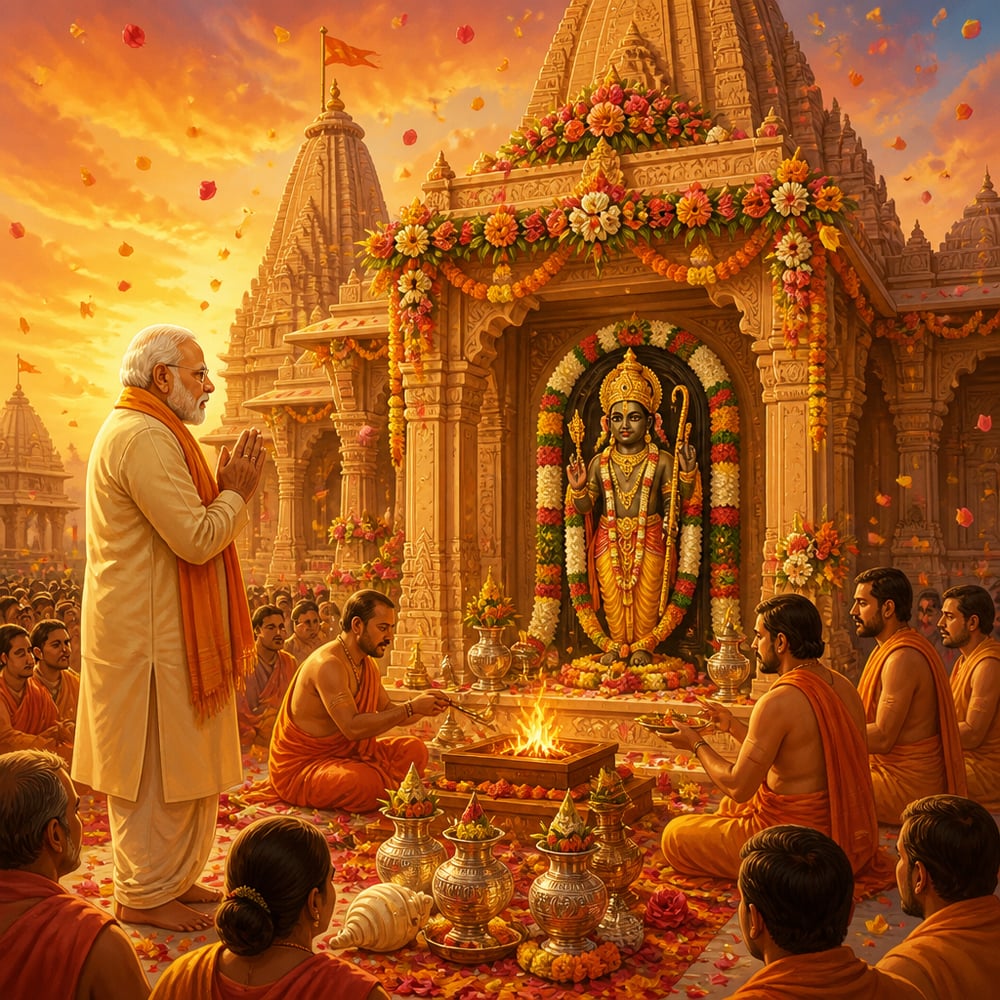
Consider what converged on that day.
Dharma returned to its seat. A temple to Shri Rama, central figure of the epic that has served as India's civilizational operating system for millennia, rose on the exact spot where tradition holds he was born. The ethical and philosophical framework that holds Indian civilization together received its most visible reaffirmation in modern history.
Sacred geography was reclaimed. Ayodhya, one of the seven Mokshapuris, among the holiest cities of the Hindu world, was restored to its civilizational function. The Sarayu river, the ancient mandirs, the city's soil carry millennia of accumulated memory. That memory was reconnected to the living present.
Knowledge systems were deployed at full depth. The temple was designed using traditional Nagara architecture and Vastu Shastra principles, constructed with Bansi Paharpur sandstone without structural steel, employing Agama Shastra prescriptions for the consecration ceremony. Ancient knowledge was not merely referenced. It was applied.
Temple institutions reclaimed their civilizational role. The Ram Mandir is designed as a functioning ecosystem: a center of worship, education, cultural preservation, and community gathering, drawing directly from what temples were before colonial intervention stripped them of their social functions.
Cultural festivals unified the nation. On consecration day, celebrations erupted spontaneously across India and the global diaspora. A civilization-wide festival emerged, not mandated by any authority but arising from civilizational memory itself.
Philosophical pluralism was honored through process. The temple's legal resolution came through India's Supreme Court after decades of democratic deliberation, archaeological evidence, and constitutional reasoning. The civilization chose the path of law and evidence, not conquest.
All six systems. One moment. This is what civilizational restoration looks like when the network fires together.
The Mechanism: The Six Systems Restored
Across nine chapters and sixty-four preceding lessons, this course has traced a precise arc. We diagnosed how civilizations are broken (Chapter 1). We examined what makes India's civilizational architecture uniquely resilient (Chapter 2). We traced how colonialism wounded each system (Chapter 3). We spent five chapters mapping every active faultline: the academic-missionary nexus (Chapter 4), caste weaponization (Chapter 5), separatist engineering (Chapter 6), Islamist faultlines (Chapter 7), and institutional capture (Chapter 8). Then we turned from diagnosis to prescription: epistemic sovereignty, education revolution, knowledge revival, institution building, temple restoration, sacred geography, arts and festival revival, cultural memory (Chapter 9), followed by economic self-reliance, digital infrastructure, community harmony, strategic communication, geopolitical alliances, and civilizational vision for the world (Chapter 10).
Now we synthesize.
The central insight of this entire course is structural. India survived 800 years of invasion, 200 years of colonialism, and 75 years of post-colonial ideological assault not because it had a strong central state, but because it was a civilizational network. When kingdoms fell, the network continued through temples, festivals, pilgrimages, guru-shishya parampara, philosophical traditions, and sacred geography. The civilization was distributed, redundant, and self-healing.
The Breaking India forces understood this. That is why they attacked the network's nodes. Dismantle temples (Chapter 8). Sever sacred geography from consciousness (Chapter 3). Weaponize caste to fragment social bonds (Chapter 5). Colonize knowledge systems (Chapters 3 and 4). Capture institutions (Chapter 8). Each attack targeted a different node of the civilizational network.
Restoration, therefore, must also be networked. No single act, policy, or institution can repair India. The restoration must happen across all six systems simultaneously, driven not by any central authority but by millions of individuals acting with civilizational consciousness.
The Six Systems: A Status Report
1. Dharma (The Operating System). Recovering. The philosophical framework is being reclaimed through decolonized scholarship, popular education platforms, and a growing generation that understands dharma not as mere religion but as civilizational ethics. The gap: making dharmic literacy universal, not the preserve of the already-convinced.
2. Sacred Geography (The Physical Network). Active restoration. Kashi Vishwanath Corridor, Mahakal Lok, Kedarnath reconstruction, Ram Mandir. The physical infrastructure of civilizational memory is being rebuilt. The gap: connecting restored sites to living educational and cultural functions rather than reducing them to tourist destinations.
3. Knowledge Systems (The Intellectual Foundation). Mixed. Sanskrit revival movements, NEP 2020's provisions for Indian knowledge systems, growing academic interest in Nyaya, Vedanta, Ayurveda. But the academy remains largely dominated by colonial frameworks, and indigenous knowledge systems lack the institutional infrastructure of Western academia. The gap: building world-class institutions rooted in Indian epistemology.
4. Temple Institutions (The Social Infrastructure). Contested. Temple liberation from government control remains incomplete. But where temples operate freely, they demonstrate their civilizational function. Tirumala Tirupati Devasthanams runs schools, hospitals, and feeding programs. BAPS and ISKCON demonstrate the temple-as-institution model globally. The gap: freeing the estimated four lakh temples under state control.
5. Cultural Festivals (The Unity Network). Strong revival. Kumbh Mela attracts over 200 million pilgrims. Regional celebrations and diaspora observances are stronger than at any point since independence. The gap: preserving meaning against commercialization, ensuring festivals serve their civilizational function beyond entertainment.
6. Philosophical Pluralism (The Immune System). Strengthening. The tradition of internal debate is being revived through intellectual movements, online discourse, and renewed engagement with India's philosophical diversity. The gap: maintaining openness while defending against those who exploit pluralism to fragment.
The Compound Effect. These six systems reinforce each other. When temples are restored, sacred geography comes alive. When knowledge systems revive, dharmic literacy spreads. When festivals unite communities, philosophical traditions gain new practitioners. When dharma is understood, institutions are built with civilizational purpose.
This compound effect works in reverse too, which is why Breaking India forces attack multiple systems simultaneously. But it also means that restoration in any one system accelerates restoration across all others. Every Sanskrit class taught, every temple freed, every pilgrimage undertaken, every dharmic text studied adds to the momentum.
The civilizational network is not a machine that can be designed from the top. It is a living system that grows when nourished. Your role is not to control it. Your role is to nourish the node closest to you.
The Pattern: Shankaracharya's Blueprint
If you doubt that civilizational restoration is possible, study the life of Adi Shankaracharya.
In the 8th century CE, Indian civilization faced a crisis parallel to the modern one. Buddhism had declined but left intellectual vacuums. Vedic ritualism had become rigid and disconnected from philosophical inquiry. Regional traditions were fragmenting. There was no unified intellectual framework holding the civilizational network together. The nodes were weakening and the connections between them were fraying.
Into this crisis walked a young Brahmin from Kaladi in Kerala who would become the most consequential individual in Indian civilizational history.
Shankaracharya's response was not a military campaign or a political movement. It was a systematic restoration of the entire civilizational network, executed through three interconnected strategies.
First, intellectual sovereignty through debate. Shankaracharya traveled the length and breadth of India engaging every philosophical school in shastrartha. He debated Mimamsa scholars, Buddhist logicians, Jain thinkers, Shaiva and Vaishnava theologians. He did not suppress other views. He engaged them. His Advaita Vedanta provided a unifying philosophical framework that could accommodate diversity within coherence. He restored Knowledge Systems and Philosophical Pluralism simultaneously.
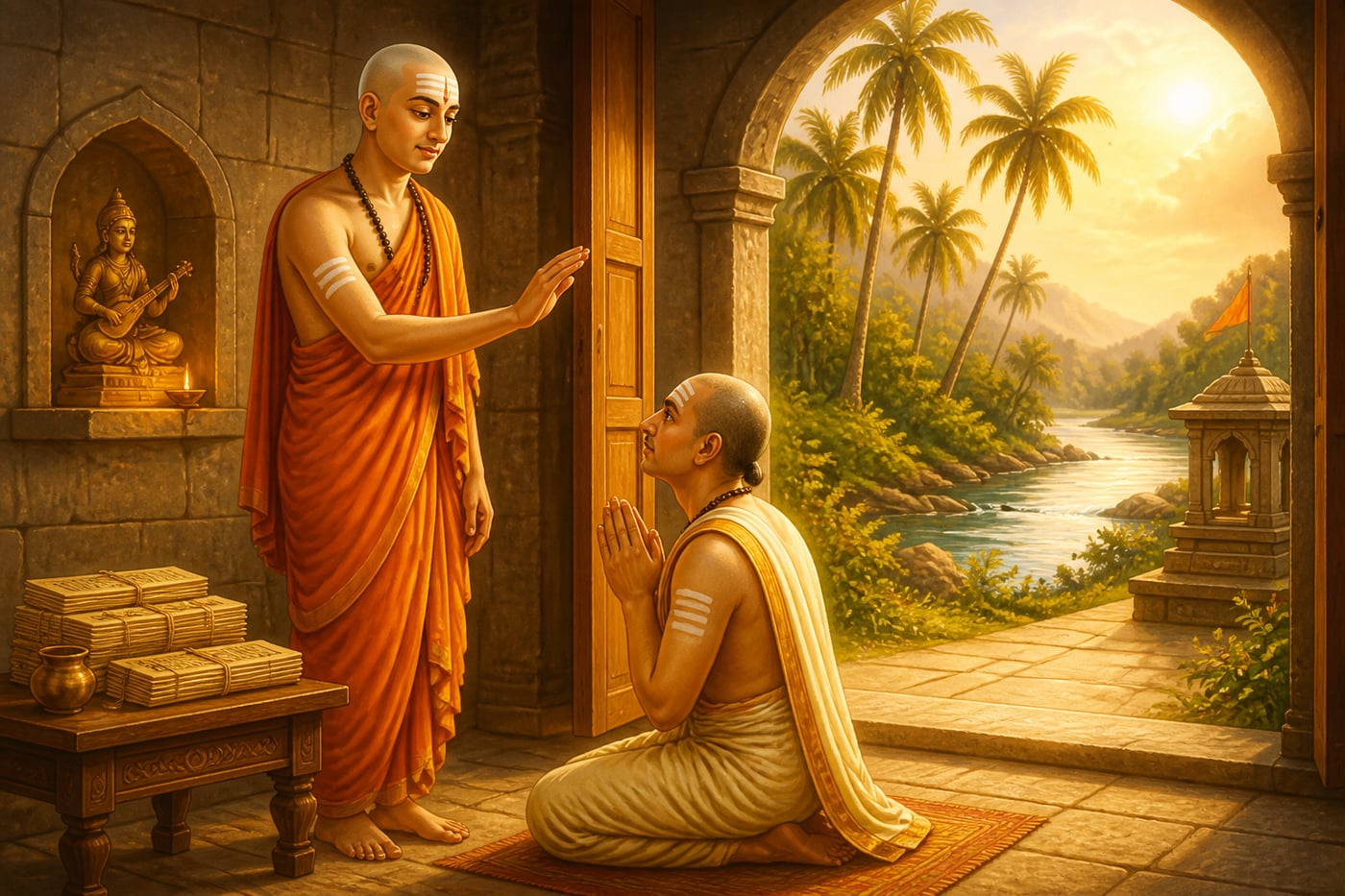
Second, institutional infrastructure. He established four mathas at India's geographic extremities: Sringeri in the south, Dwarka in the west, Puri in the east, and Jyotirmath in the north. These were not merely monasteries. They were civilizational command centers: educational institutions, philosophical academies, pilgrimage nodes, and governance structures for dharmic community life. He restored Temple Institutions and created new Sacred Geography connections.
Third, cultural and devotional revival. Shankaracharya composed stotras that made profound philosophy accessible to ordinary people. The Bhaja Govindam, the Soundarya Lahari, the Vivekachudamani brought Vedantic wisdom from the debating hall to the village temple. He revived and systematized worship practices, connecting philosophical depth to living devotion. He restored Dharma as a living framework and re-energized Cultural Festivals and practices.
One individual. All six systems. In a single lifetime of reportedly just thirty-two years.
The pattern is unmistakable. Civilizational restoration is not a government program. It is a civilizational movement, often ignited by individuals who see the whole board and act across all fronts simultaneously. Shankaracharya was the original Intellectual Kshatriya, defending civilization through knowledge, institution-building, and cultural revival.
What Shankaracharya accomplished in the 8th century, the current generation must accomplish for the 21st.
Dharmic Wisdom: The Eternal Renewal
The Bhagavad Gita's most famous promise is not about individual salvation. It is about civilizational renewal.
Yada yada hi dharmasya glanir bhavati bharata, abhyutthanam adharmasya tadatmanam srijamyaham. (BG 4.7)
Whenever dharma declines and adharma rises, I manifest myself.
This verse is commonly understood as a promise of divine intervention. But read through the lens of civilizational analysis, it reveals something deeper. The pattern of decline and restoration is woven into the very fabric of dharmic civilization. Decline is not permanent. It is a phase in a cycle. And restoration comes not through passive waiting but through individuals who embody the civilizational will to recover.
Shankaracharya was such an individual. The Swadeshi entrepreneurs were such individuals. The temple builders, the Sanskrit teachers, the civilizational scholars of today are such individuals. The divine promise manifests through human agency.
The Arthashastra offers the strategic complement. Kautilya's concept of Yogakshema, the dual responsibility of acquiring what you lack and protecting what you possess, maps precisely onto this course's structure. Chapters 4 through 8 were about understanding what threatens what we have (kshema). Chapters 9 and 10 are about building what we need (yoga). Both are essential. Defense without construction is mere survival. Construction without defense is naivety.
The Mahabharata provides the ethical frame. In the Shanti Parva, Bhishma teaches Yudhishthira that a kingdom's strength lies not in its king alone but in the collective dharmic consciousness of its people. When individuals understand their duty and act upon it, the state becomes strong. When they abandon their duty, no amount of military power can save the kingdom.
This is the deepest teaching of this entire course. Civilizational strength is not a policy outcome. It is the aggregate of millions of individual choices made with dharmic awareness. Every person who learns their civilization's history, defends its institutions, transmits its knowledge, and builds its future is performing an act of civilizational restoration.
The Defense: You Are the Seventh System
Every lesson in this course has ended with a Defense section offering specific actions. This final Defense synthesizes them all into a single truth.
You are the seventh system.
The six civilizational systems, Dharma, Sacred Geography, Knowledge Systems, Temple Institutions, Cultural Festivals, and Philosophical Pluralism, are the civilizational architecture. But architecture without inhabitants is ruins. The seventh system is the community of civilizationally conscious individuals who maintain, defend, and transmit all six.
If you doubt that individuals can make a difference at civilizational scale, consider Samskrita Bharati.
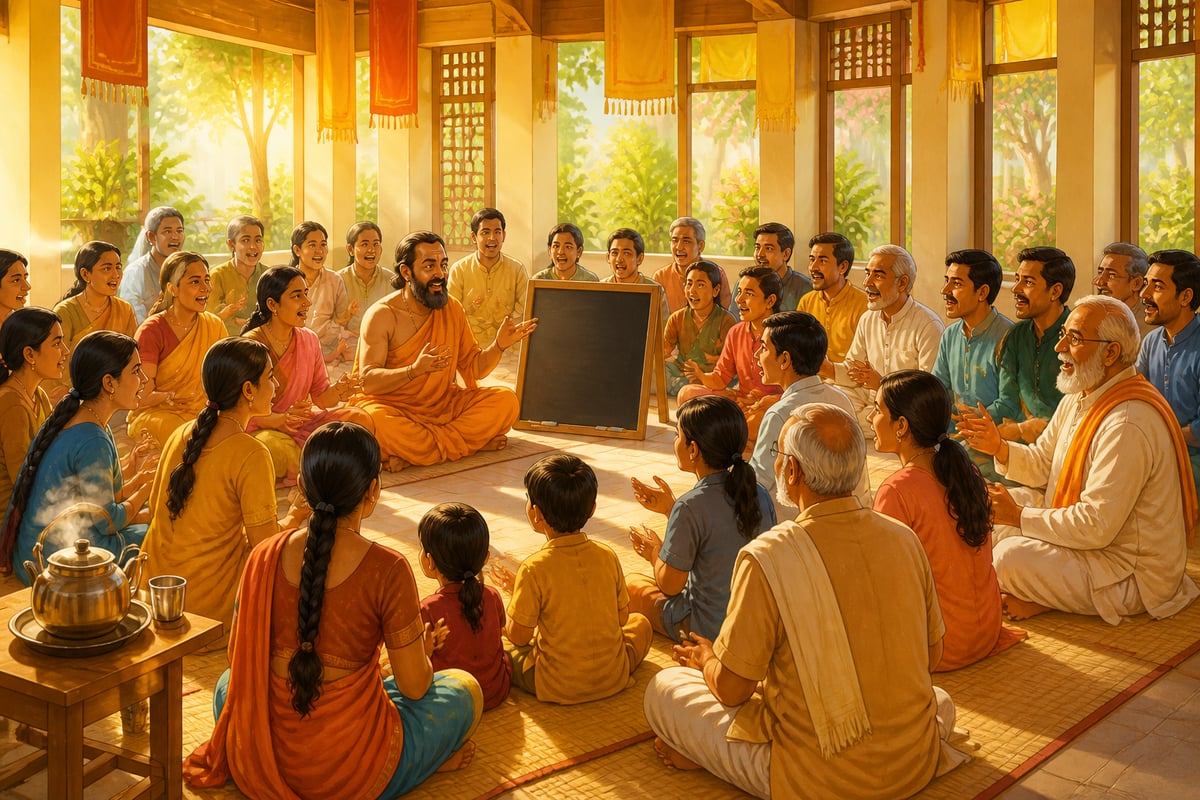
Founded in 1981 by Chamu Krishna Shastry in Bangalore, Samskrita Bharati set itself an audacious goal: revive Sanskrit as a spoken, living language. Not an academic exercise. Not a museum project. A grassroots movement to put Sanskrit back into daily conversation.
Their method was brilliantly simple. Ten-day free spoken Sanskrit camps, taught by volunteers, open to anyone. No entrance requirements. No fees. No institutional gatekeeping. Just ordinary Indians learning to speak the language that carries their civilizational knowledge.
The results defy every "Sanskrit is dead" dismissal. Over ten million people have attended these camps. Thousands of families now conduct daily life in Sanskrit. The organization operates across more than twenty countries. Villages in Karnataka and Madhya Pradesh use Sanskrit as a daily language of communication. All of this built by a grassroots movement with no government mandate and no massive endowment. Just civilizational commitment expressed through sustained, decentralized action.
Samskrita Bharati is proof of the principle that animates this entire course. Civilizational restoration does not require permission. It requires individuals who care enough to act.
Your Civilizational Action Plan
Based on everything you have learned across sixty-five lessons, here is your personal framework.
1. Know Your Civilization (Lessons 1-14). Read one primary text per quarter. Not secondary commentary, not Wikipedia summaries. Primary texts: Arthashastra, Bhagavad Gita, Yoga Sutras, Thirukkural, Panchatantra. Build your own civilizational literacy from the source.
2. See the Faultlines (Lessons 15-43). When you encounter a narrative about India in media, academia, or social media, ask: which faultline is this exploiting? Caste? Religion? Language? Region? The ability to identify the mechanism is your first line of defense.
3. Nourish One System (Lessons 44-65). Choose one of the six civilizational systems and commit to strengthening it. Teach Sanskrit. Support temple liberation. Organize a festival with meaning. Fund indigenous scholarship. Build a digital platform for civilizational knowledge. You cannot do everything. But you must do something.
4. Build Networks, Not Monuments. The civilizational network model means your individual action multiplies when connected to others. Join organizations. Create study groups. Support existing institutions. The civilization survived because it was distributed. Your contribution is most powerful when it connects to the larger network.
5. Move from Defense to Civilization-Building. The ultimate goal is not merely to defend against Breaking India forces. It is to build such a thriving, confident, creative civilization that these forces become irrelevant. A civilization that produces its own knowledge, builds its own institutions, tells its own stories, and offers its wisdom to the world is beyond breaking.
The unbreaking is complete. Not because every wound is healed, but because you now understand the entire board. You see the faultlines. You know the mechanisms. You have the antidotes. You carry the civilizational memory.
The question was never whether India's civilization would survive. Six thousand years of history answer that. The question is whether your generation will be the one that takes it from surviving to thriving.
That answer is yours to write.
Case studies
Ram Mandir Prana Pratishtha: Six Systems in One Moment
On January 22, 2024, the Ram Mandir in Ayodhya was consecrated after a journey spanning over five centuries. The temple was built using traditional Nagara architecture and Vastu Shastra principles, with Bansi Paharpur sandstone and no structural steel, following Agama Shastra prescriptions for the Prana Pratishtha ceremony. The Supreme Court's 2019 unanimous verdict resolved the dispute through archaeological evidence and constitutional reasoning. On consecration day, celebrations erupted spontaneously across India and the global diaspora, with homes, businesses, and public spaces lit up in a Diwali-like celebration in January. The temple is designed not merely as a place of worship but as an ecosystem for education, cultural preservation, and community gathering.
The Ram Mandir represents the six civilizational systems converging in a single event. Dharma (the temple's philosophical foundation), Sacred Geography (Ayodhya as Mokshapuri restored), Knowledge Systems (traditional architecture and ritual science applied, not merely referenced), Temple Institutions (a functioning civilizational ecosystem, not a museum), Cultural Festivals (spontaneous national celebration arising from civilizational memory), and Philosophical Pluralism (resolution through democratic and legal process). The Arthashastra's four-fold framework applies: what was lost was acquired (alabdha-labha), what was obtained is being preserved (labdha-parirakshana), what is preserved is being augmented through education and culture (rakshita-vivardhana), and the meaning is being distributed to the next generation (vrddhasya pratipādana).
The consecration was watched by an estimated 200+ million viewers. The event catalyzed a visible shift in civilizational confidence, with public discourse openly engaging with concepts of sacred geography, temple architecture, and dharmic revival that had been confined to academic circles. Ayodhya's transformation into a major pilgrimage and cultural destination is reshaping urban planning and heritage policy across India.
Civilizational restoration is most powerful when multiple systems activate simultaneously. The Ram Mandir succeeded not as an isolated religious act but because it touched all six nodes of the civilizational network, creating a compound effect where each system reinforced the others.
The Ram Mandir's construction using traditional Nagara architecture and Agama Shastra principles, without structural steel, demonstrated that India's pre-industrial engineering knowledge systems remain functional. This has inspired renewed interest in applying traditional architectural principles to modern temple and cultural building projects across the country.
The temple was constructed using zero steel in its structural core, relying entirely on traditional stone interlocking techniques from Nagara architectural traditions, making it one of the largest modern structures built using pre-industrial engineering principles.
Shankaracharya's Dig Vijaya: One Life, Six Systems Restored
In the 8th century CE, Indian civilization was fragmenting. Buddhism had declined but left intellectual vacuums. Vedic ritualism had ossified into formalism without philosophical depth. Regional traditions operated in isolation with no unifying framework. Adi Shankaracharya, born in Kaladi, Kerala, around 788 CE, responded with a three-pronged civilizational restoration executed within roughly thirty-two years. He traveled the entire subcontinent engaging every philosophical school in shastrartha (formal debate), defeating Mimamsa, Buddhist, Jain, and sectarian scholars while synthesizing their valid insights into Advaita Vedanta. He established four mathas at India's geographic extremities: Sringeri (south), Dwarka (west), Puri (east), and Jyotirmath (north). He composed devotional stotras like Bhaja Govindam and Soundarya Lahari that made dense philosophical concepts accessible to ordinary people through beautiful verse.
Shankaracharya's strategy maps precisely onto the six-system framework of this course. His debates restored Knowledge Systems and Philosophical Pluralism. His mathas created new Temple Institutions and reconnected Sacred Geography by linking India's four corners through institutional ties. His stotras revived Dharma as a living practice and energized Cultural Festivals through devotional poetry that entered temple worship. His approach was quintessentially dharmic: he did not destroy rival traditions but absorbed their valid insights, debated their errors, and produced a synthesis that was stronger than any individual school. His BG 4.8 mission of dharma-samsthapana was achieved not through force but through intellectual sovereignty, institutional infrastructure, and cultural creativity.
The four mathas Shankaracharya established continue to function as centers of learning and dharmic authority over 1,200 years later. Advaita Vedanta became the dominant philosophical framework of Hindu civilization, providing intellectual unity while allowing sectarian diversity. His stotras are still sung daily in millions of temples. No military conquest in Indian history produced such enduring civilizational impact.
Civilizational restoration does not require armies or political power. It requires an individual who sees the whole board and acts simultaneously across all civilizational systems. One lifetime of focused, strategically executed civilizational action can reshape a civilization for a millennium.
Shankaracharya's model of one individual activating all civilizational systems simultaneously is the template that modern dharmic leaders study. His four-matha institutional network, still operational after 1,200 years, proves that civilizational restoration does not require state power if the institutional design is self-sustaining.
Shankaracharya's four mathas have maintained unbroken lineages of succession for over 1,200 years, making them among the oldest continuously operating institutions in the world.
Samskrita Bharati: Grassroots Proof That Civilizations Revive
In 1981, Chamu Krishna Shastry founded Samskrita Bharati in Bangalore with a goal that experts dismissed as quixotic: revive Sanskrit as a spoken, living language. The prevailing academic consensus was that Sanskrit was irreversibly dead as a vernacular. Shastry's method was deceptively simple: free ten-day spoken Sanskrit camps (Sambhashana Shibiram) taught by volunteers, open to anyone regardless of background, education, or caste. No entrance requirements. No fees. No institutional gatekeeping. The camps taught conversational Sanskrit through immersive practice, not grammar-first pedagogy. Volunteers who completed camps became teachers for new camps, creating a self-replicating model that required no central funding or infrastructure.
Samskrita Bharati embodies the civilizational network principle at the heart of this course. Like India's civilization itself, the movement is distributed rather than centralized, self-replicating rather than dependent on a single institution, and grows through voluntary transmission rather than mandated compliance. Kautilya's four-fold framework operates here: Sanskrit knowledge that had been lost to ordinary people was acquired (alabdha-labha), families who learned it preserved it through daily use (parirakshana), communities augmented it by producing new Sanskrit literature and media (vivardhana), and volunteers distributed it to new learners in an expanding network (pratipādana). The movement also demonstrates the guru-shishya parampara principle: every student becomes a potential teacher, ensuring knowledge transmission without institutional bottlenecks.
Over ten million people have attended Samskrita Bharati camps. Thousands of families conduct daily life in Sanskrit. The organization operates in more than twenty countries. Villages in Karnataka and Madhya Pradesh use Sanskrit as a daily communication language. The movement has produced Sanskrit newspapers, children's literature, and digital content. All of this without government mandate, without large-scale institutional funding, built entirely through voluntary civilizational commitment.
Civilizational restoration does not require permission, government programs, or billion-dollar budgets. It requires individuals who identify their kartavya (civilizational duty), design a replicable model, and act with sustained commitment. If one man with no institutional backing can revive a language that the entire world declared dead, no aspect of civilizational restoration is beyond reach.
Samskrita Bharati's volunteer-driven, self-replicating model has inspired similar grassroots movements for other Indian languages and knowledge systems. Its proof of concept that civilizational revival does not require government programs or massive budgets challenges the assumption that only state-led initiatives can operate at scale.
Samskrita Bharati's self-replicating volunteer model means the organization's teacher base grows exponentially: each ten-day camp produces potential teachers who can run future camps, achieving scale without proportional increases in organizational overhead.
Reflection
- Of the six civilizational systems (Dharma, Sacred Geography, Knowledge Systems, Temple Institutions, Cultural Festivals, Philosophical Pluralism), which one are you best positioned to strengthen right now, and what is one concrete action you could take in the next thirty days?
- Why do you think Shankaracharya chose to debate rival philosophies rather than simply ignore or suppress them? What does his method reveal about how civilizations are truly restored?
- The Bhagavad Gita promises that dharma will be re-established whenever it declines. If this renewal happens through human agency rather than divine intervention alone, what does that suggest about the relationship between individual duty and civilizational destiny?