Geopolitical Alliance Building
Quad, I2U2, Cultural Diplomacy, and Dharmic Statecraft
No civilization thrives in isolation. This lesson traces the dharmic foundations of geopolitical alliance building, from Kautilya's Mandala theory and the Chandragupta-Seleucus alliance that secured India's western frontier twenty-three centuries ago, to the Quad, I2U2, and Vaccine Maitri initiatives that define India's modern multi-alignment strategy. It reveals how India is recovering the ancient science of civilizational statecraft to build alliances that solve problems rather than merely counter adversaries.
Geopolitical Alliance Building: Quad, I2U2, Cultural Diplomacy, and Dharmic Statecraft
The Sixth Pillar
Economic sovereignty, digital infrastructure, cultural revival, strategic communication. Each pillar we have studied in this chapter strengthens India from within. But no civilization thrives in isolation. The sixth pillar is outward-facing: the art of building alliances that protect and project civilizational interests on the world stage.
This is not about joining blocs or picking sides in someone else's contest. It is about something far older and far more sophisticated. India's civilizational history contains one of the world's most developed traditions of strategic alliance-building, codified millennia before modern international relations theory existed. The question before us is whether contemporary India can recover that tradition, adapt it to 21st-century realities, and deploy it with the confidence of a civilization that once shaped the geopolitical order of all Asia.
The Breaking India forces we have studied throughout this course do not operate within India alone. They are networked globally, funded internationally, and coordinated across borders. Countering them requires an equally sophisticated, equally global response. Alliance-building is not optional. It is a civilizational imperative.
The Ancient Science: Kautilya's Alliance Framework
Long before Kissinger or Brzezinski theorized about balance-of-power politics, Kautilya's Arthashastra laid out a comprehensive framework for interstate relations that remains startlingly relevant. At its center sits the Mandala theory, a model of concentric circles of allies, adversaries, and neutral states radiating outward from any given kingdom.
The genius of the Mandala system is its recognition that alliances are not static. They are dynamic, contextual, and multi-layered. Your neighbor's neighbor is your natural ally. A distant power can be a friend precisely because geography prevents friction. Interests shift, and strategy must shift with them.
Kautilya's Shadgunya, the six-fold policy framework, gave rulers a precise toolkit: peace (sandhi), war (vigraha), neutrality (asana), marching forth (yana), seeking shelter (samshraya), and the dual policy of making peace with one while waging war against another (dvaidhibhava). This is not cynical realpolitik. It is strategic realism grounded in dharmic principles. The Arthashastra is explicit that the ultimate purpose of statecraft is yogakshema, the welfare and security of the people. Power is not an end. It is the instrument through which a ruler fulfills dharmic obligations to the governed.
This is what we mean by dharmic statecraft: strategic thinking that is clear-eyed about power but anchored in civilizational values. It neither romanticizes weakness nor worships force. It treats alliance-building as a science with ethical foundations.
The Wound: Two Centuries Without a Voice
For roughly two hundred years, India had no foreign policy because India had no sovereignty. The colonial period did not merely extract wealth and disrupt social structures. It erased India from the map of strategic actors entirely. Decisions about the subcontinent's external relations were made in London, calibrated to serve British imperial interests across the globe. Indian soldiers fought in wars from Burma to Flanders, not for Indian strategic objectives, but for the Crown.
When independence came in 1947, the new republic faced a world already carved into spheres of influence by the Cold War superpowers. Nehru's Non-Aligned Movement was a creative response to an impossible situation: a newly independent, economically fragile nation refusing to become a client state of either bloc. It deserves credit for that ambition. India maintained strategic autonomy during a period when most post-colonial states were pulled into one orbit or another.
But Non-Alignment also carried costs. It sometimes became an ideology rather than a strategy, a posture rather than a policy. India's reluctance to build deep strategic partnerships left it without reliable allies during critical moments. The 1962 war with China exposed the gap between rhetoric and preparedness. The tilt toward the Soviet Union, while pragmatically necessary, limited India's options in other directions. Most importantly, Non-Alignment did not adequately account for the asymmetric threats we have studied in this course: the ideological, institutional, and cultural offensives that do not arrive as armies but as NGOs, academic frameworks, and media narratives.
The 21st century demands a different approach. Not the abandonment of strategic autonomy, but its evolution into something more active, more networked, and more rooted in civilizational confidence.
The New Architecture: India's Alliance Network
The shift from non-alignment to multi-alignment represents one of the most significant strategic pivots in India's post-independence history. Rather than avoiding deep partnerships, India now cultivates them simultaneously across multiple axes. This is, whether consciously or not, a return to Kautilyan thinking: engage in multiple directions, calibrate each relationship to specific strategic needs, and never become so dependent on one partner that you lose freedom of action.
The Quad: Securing the Indo-Pacific
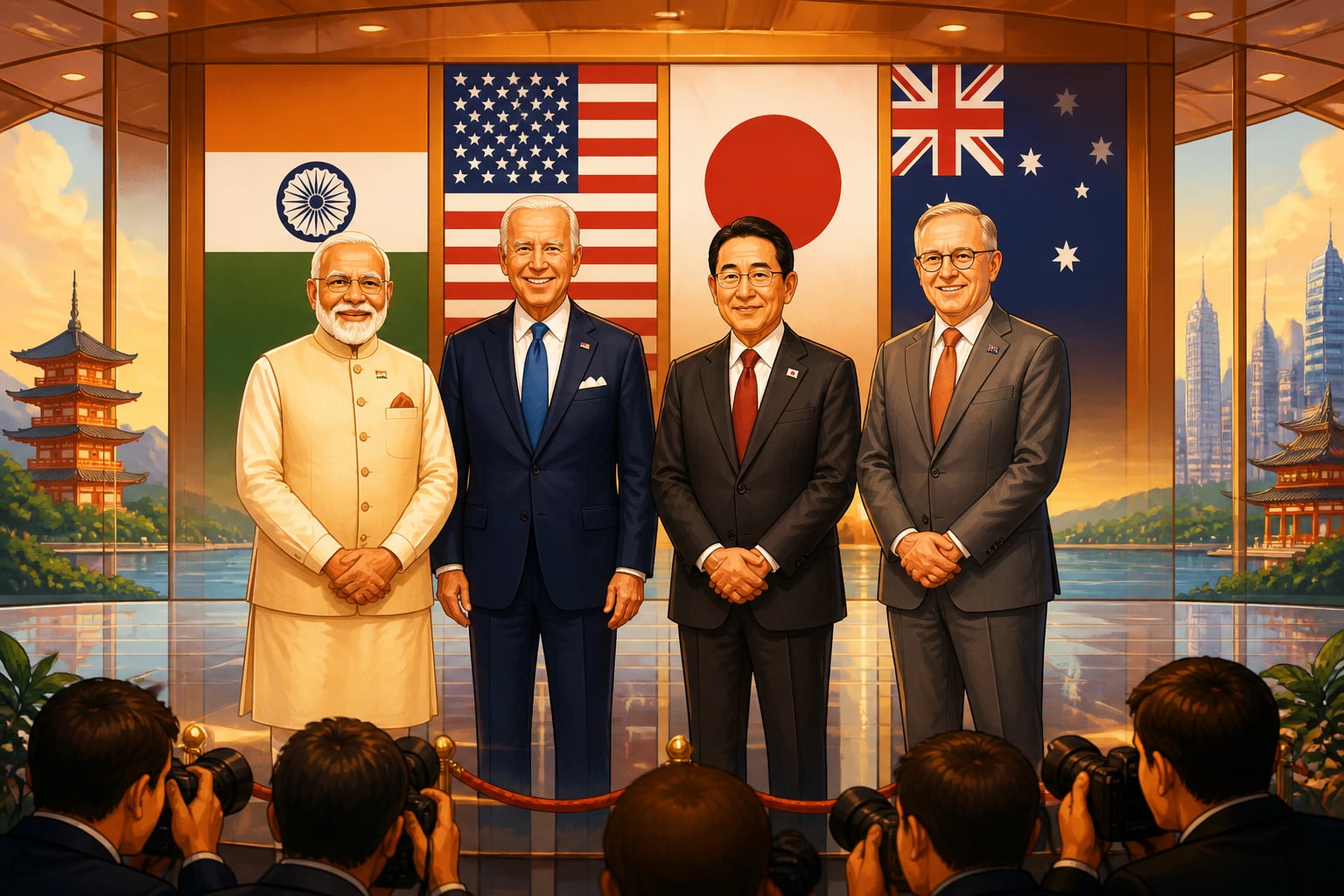
The Quadrilateral Security Dialogue between India, the United States, Japan, and Australia has evolved from a tentative diplomatic experiment into a substantive strategic framework. Its significance goes beyond military coordination in the Indo-Pacific. The Quad represents India's willingness to be an active architect of regional security architecture rather than a passive beneficiary of someone else's order.
What makes the Quad distinctive is its focus on providing public goods: vaccine distribution, climate resilience, critical technology cooperation, infrastructure investment. This is not a military alliance in the NATO mold. It is a partnership of democratic states offering an alternative model of regional engagement, one that does not require smaller nations to surrender sovereignty in exchange for investment. For India, the Quad serves a dual purpose. It addresses the strategic challenge posed by an assertive China in the Indo-Pacific while positioning India as a security provider rather than merely a security consumer. This is a role India has not played since the Chola navy projected power across the Indian Ocean a millennium ago.
I2U2: The Civilizational States Compact
If the Quad is primarily a security and technology framework, the I2U2 grouping of India, Israel, the UAE, and the United States represents something more unusual: a compact between civilizational states with complementary capabilities. Israel brings cutting-edge agricultural and water technology. The UAE provides capital and logistics infrastructure. The US offers market access and advanced technology platforms. India contributes scale, talent, and a massive domestic market.
The strategic logic is compelling. These four nations share interests in food security, energy transition, and technology development. But beneath the economic rationale lies a deeper alignment. Each of these states, in different ways, has grappled with the challenge of maintaining civilizational identity while engaging with modernity. Each has faced external narratives that sought to delegitimize its foundational identity. The I2U2 framework, still in its early stages, has the potential to evolve into a model of civilizational cooperation that transcends the old categories of East/West or North/South.
BRICS and Global South Leadership
India's simultaneous engagement with BRICS (Brazil, Russia, India, China, South Africa) and its expanded membership demonstrates the multi-alignment principle in action. While the Quad addresses Indo-Pacific security and I2U2 focuses on technology and investment, BRICS provides a platform for reforming global governance structures that still reflect the post-1945 power distribution.
India's leadership within the Global South, articulated through initiatives like the Voice of the Global South Summit, positions the country as a bridge between the developed and developing worlds. This is not a return to the rhetoric of Non-Alignment. It is an active bid for leadership, backed by the economic and demographic weight to make it credible.
Cultural Diplomacy as Strategic Soft Power
Hard alliances and economic partnerships form the visible architecture of India's global engagement. But beneath and around them operates a softer, often more durable form of influence: cultural diplomacy. India possesses an extraordinary, largely underleveraged advantage in this domain.
Yoga, Buddhism, and Civilizational Outreach
When 177 nations co-sponsored India's UN resolution declaring June 21 as International Yoga Day, it was more than a feel-good moment. It demonstrated something remarkable: India's civilizational heritage commands global resonance in a way that no amount of conventional diplomacy could manufacture. You cannot buy 177 co-sponsors. That number reflects genuine, organic global interest in what Indian civilization offers.
Buddhist diplomacy represents another powerful channel. India is the sacred geography of Buddhism. Bodh Gaya, Sarnath, Kushinagar, Nalanda: these are not merely tourist destinations but pilgrimage sites for hundreds of millions across East and Southeast Asia. India's engagement with Buddhist-majority nations through shared heritage creates bonds that operate on a civilizational frequency, deeper and more enduring than transactional diplomacy. Prime ministerial visits to Buddhist sites across Asia, the restoration and development of Buddhist circuits within India, and scholarly exchanges centered on Buddhist heritage all serve strategic purposes while remaining authentically rooted in shared civilizational memory.
This is not "soft power" as a Western political scientist might define it. It is civilizational resonance. The distinction matters. Soft power, as typically theorized, is about making others want what you want. Civilizational resonance is about shared recognition, the acknowledgment that certain values, practices, and insights belong to a common human heritage that India has been central in developing.
Vaccine Maitri: Dharmic Statecraft in Action
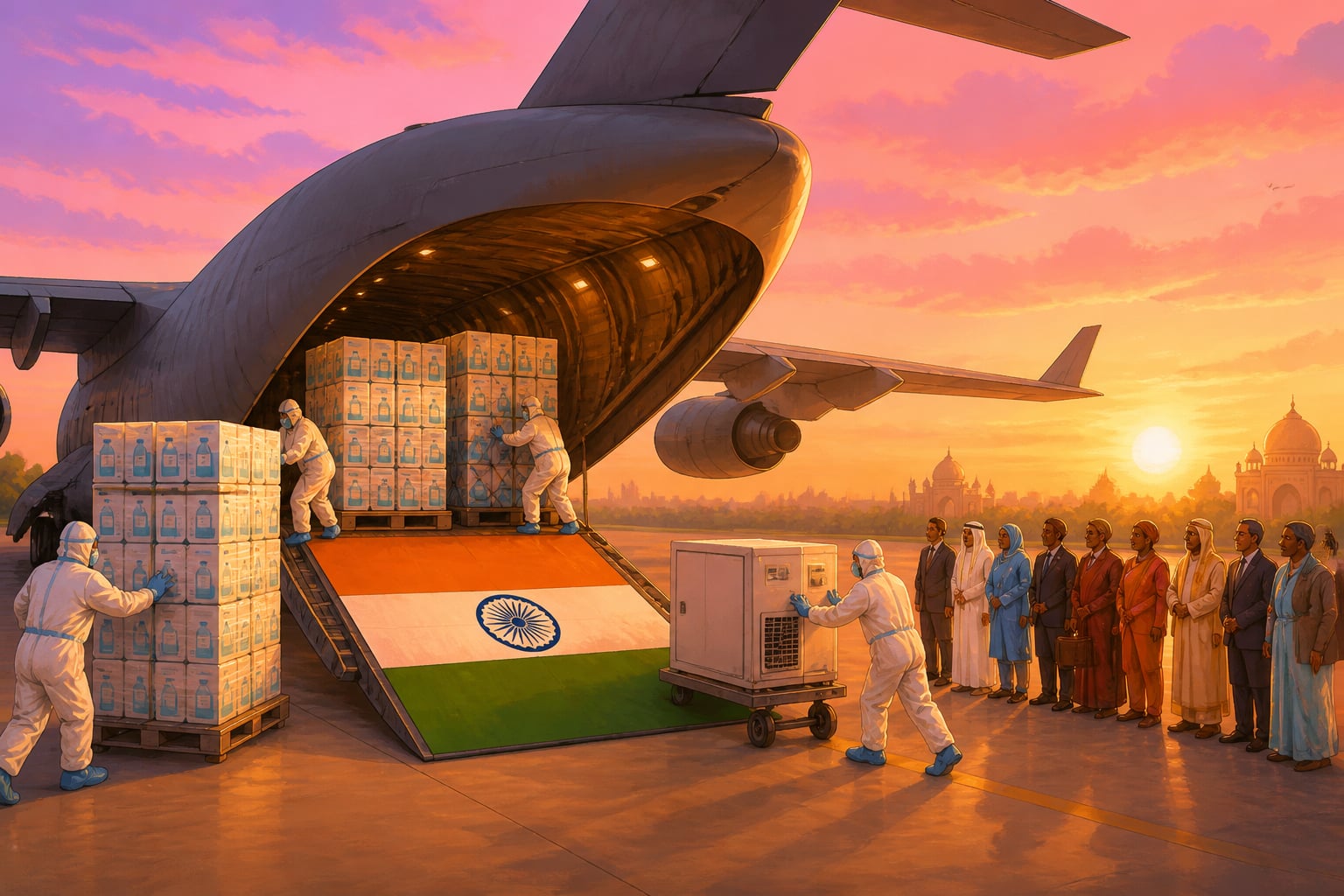
When India launched its Vaccine Maitri initiative during the COVID-19 pandemic, supplying vaccines to over 100 countries across six continents, it demonstrated what dharmic statecraft looks like in practice. This was not charity. It was strategic generosity, an investment in global goodwill that yielded diplomatic returns far exceeding its cost.
Vaccine Maitri embodied several principles simultaneously. It showcased India's pharmaceutical manufacturing capability. It built goodwill in regions where China's Belt and Road Initiative had been making inroads. It reinforced India's credentials as a responsible global power. And it did all of this in a register that felt authentically Indian rather than imitative of Western aid models. The very name, "Maitri" (friendship), signals a different relationship than donor-recipient. It suggests partnership, shared vulnerability, mutual care.
Critics will note that Vaccine Maitri was disrupted when India's own devastating second wave forced a redirection of supplies domestically. This is true, and the disruption carried diplomatic costs. But the underlying model remains sound. Strategic generosity rooted in genuine capability is one of India's most potent tools.
The Diaspora Advantage
India's 32-million-strong diaspora is a strategic asset without parallel. Indian-origin professionals lead major corporations, shape policy debates, drive innovation ecosystems, and maintain living cultural connections to the homeland. This is not an accident. It is the product of a civilization that has historically engaged with the world through trade, scholarship, and cultural exchange rather than conquest.
The challenge is converting this dispersed advantage into coordinated strategic influence. Diaspora engagement programs, Overseas Citizen of India frameworks, and cultural organizations all contribute. But the deepest asset is the civilizational pride that the diaspora carries: the sense that Indian heritage offers something genuinely valuable to the world, not as nostalgia, but as living wisdom.
The Dharmic Difference
What distinguishes India's emerging alliance architecture from the standard great-power playbook? Three principles set it apart.
Multi-directional engagement. India maintains partnerships with the US and Russia, with Israel and the Arab states, with Japan and with ASEAN, with the Global North and the Global South. This is not inconsistency. It is the Kautilyan principle of calibrated engagement, taken to its logical conclusion in a multipolar world. No single relationship defines or constrains the others.
Values over ideology. India does not demand that its partners adopt a particular political system or economic model. The Quad includes democracies but does not function as a "democracy club." I2U2 includes monarchies and republics. BRICS spans the ideological spectrum. What holds these partnerships together is not shared ideology but shared interests and, in the best cases, shared civilizational respect. This is inherently dharmic. Dharma recognizes multiple valid paths (the concept of adhikara-bheda) rather than insisting on a single universal model.
Civilizational confidence without supremacism. India's cultural diplomacy works precisely because it does not seek to convert or dominate. Yoga Day does not ask anyone to become Hindu. Buddhist diplomacy does not demand theological conformity. Vaccine Maitri did not attach ideological conditions. This posture of generous engagement, offering without demanding submission, is rooted in a civilizational worldview that recognizes the validity of diverse traditions while maintaining confidence in its own.
This is the essence of Civilizational Statecraft, Antidote Category #15 in our framework. It counters the Breaking India forces not by mimicking their methods but by demonstrating a fundamentally different model of global engagement, one that is strategic without being predatory, confident without being aggressive, rooted without being rigid.
The Road Ahead
The architecture is taking shape, but the construction is far from complete. Several challenges demand honest acknowledgment.
Strategic depth remains thin. India's alliance network is broad but often shallow. The Quad lacks a binding treaty framework. I2U2 is still more concept than institution. BRICS is internally divided. Converting frameworks into durable institutions requires sustained diplomatic investment over decades, not just summit-level photo opportunities.
The China challenge is structural. No amount of alliance-building eliminates the fundamental challenge posed by a neighbor that is simultaneously India's largest trading partner, its most significant security threat, and a civilizational rival with its own global ambitions. Managing this relationship while building alternatives requires extraordinary strategic sophistication.
Narrative sovereignty is incomplete. India has made progress in projecting its civilizational story, but the global information ecosystem remains dominated by frameworks that are, at best, indifferent to Indian civilizational perspectives and, at worst, actively hostile. Strategic communication (the subject of our previous lesson) must work hand-in-hand with alliance-building.
Internal coherence is essential. India cannot project civilizational confidence abroad while its domestic discourse is fractured by the very fault lines that Breaking India forces exploit. The pillars we studied earlier in this chapter, from economic self-reliance to inter-community harmony, are preconditions for effective external engagement, not separate tracks.
The civilizational vision that animates this work is not about restoring a mythologized past. It is about building a future in which India engages the world as a confident civilization-state: secure in its identity, generous in its partnerships, strategic in its calculations, and grounded in the dharmic principle that true strength serves the welfare of all. Chandragupta did not defeat Seleucus and then subjugate him. He made him an ally, sealed the partnership through marriage, and exchanged ambassadors. Twenty-three centuries later, that instinct for turning rivals into partners through strength tempered by wisdom remains India's most distinctive contribution to the science of statecraft.
The alliances India builds today will determine whether the civilizational renaissance we have traced through this chapter becomes a reality or remains an aspiration. The tools exist. The frameworks are emerging. The question is whether India will wield them with the strategic clarity and civilizational depth that the moment demands.
Case studies
Chandragupta-Seleucus Alliance: Converting Enemies into Strategic Partners
Around 305 BCE, Seleucus Nicator, heir to Alexander's eastern territories, marched into the Indian subcontinent to reclaim lands lost to Chandragupta Maurya. The two forces clashed along the Indus frontier, and Chandragupta's battle-hardened army decisively defeated the Seleucid forces. What followed was a masterclass in Kautilyan statecraft. Rather than pursuing total destruction, Chandragupta negotiated a comprehensive peace treaty. Seleucus ceded vast territories spanning modern Afghanistan, Balochistan, and parts of Persia. A marriage alliance was sealed, with Seleucus sending a daughter or female relative to the Mauryan court. Megasthenes was dispatched as a permanent ambassador to Pataliputra, producing the earliest Greek account of Indian governance. In return, Chandragupta gifted 500 war elephants. This exchange was far from charity. Those elephants proved decisive when Seleucus deployed them at the Battle of Ipsus in 301 BCE, crushing Antigonus and reshaping the Hellenistic world. Chandragupta had effectively exported military power westward while securing his own frontier.
This alliance is the Arthashastra's Mandala theory brought to life. Kautilya classifies six measures of foreign policy, and sandhi (treaty-making) ranks among the most important. The text explicitly states that a wise king should pursue peace with a defeated enemy when continued warfare yields diminishing returns. By converting Seleucus from a hostile neighbor into a treaty-bound ally, Chandragupta neutralized his western frontier entirely. This freed Mauryan military resources to consolidate control over the Deccan and eastern India. The marriage alliance created personal bonds between courts, while the elephant gift ensured Seleucus remained invested in maintaining friendly relations. Kautilya's genius was recognizing that a stable western border was worth more than any conquered Greek territory.
The treaty secured the Mauryan Empire's western frontier for generations. Chandragupta absorbed territories stretching from Kandahar to Balochistan, creating a strategic buffer zone. The ambassador Megasthenes documented Pataliputra as one of the ancient world's greatest cities, establishing India's prestige across the Mediterranean. Seleucus, strengthened by the 500 war elephants, won the Battle of Ipsus in 301 BCE and became the dominant power in western Asia. Both empires benefited. The Mauryan dynasty went on to produce Ashoka, whose empire covered nearly the entire subcontinent. Trade routes between India and the Hellenistic world flourished, with Greek artisans and Indian goods flowing in both directions for over a century.
A defeated enemy converted into an ally through strategic generosity yields far greater long-term returns than perpetual hostility. The cost of 500 elephants bought decades of frontier security and continental consolidation.
The Chandragupta-Seleucus model of converting a defeated adversary into an ally through strategic generosity prefigures India's modern diplomacy with neighbors like Bangladesh and Sri Lanka, where infrastructure investment and humanitarian assistance build lasting partnerships more effectively than military posturing.
The 500 war elephants Chandragupta gifted to Seleucus became the decisive factor at the Battle of Ipsus (301 BCE), where they shattered Antigonus's cavalry and reshaped the entire Hellenistic world order.
I2U2: India's Multi-Alignment Across Civilizational Divides
In July 2022, leaders of India, Israel, the UAE, and the United States formally launched the I2U2 grouping during a virtual summit. The acronym itself signals a new geopolitical grammar. India simultaneously deepened partnerships with Israel (a country most Arab states historically boycotted) and the UAE (a leading Arab power), while anchoring the arrangement with US technological backing. The group's initial focus areas included food security, energy, transportation, and climate action. At its inaugural summit, the UAE committed $2 billion to develop integrated food parks across India, combining Israeli drip-irrigation and agri-tech expertise with India's massive farming scale and US technological platforms. A separate joint project explored renewable energy cooperation, with Indian solar manufacturing paired with Gulf capital and Israeli innovation. What makes I2U2 historically significant is that it defies Cold War-era bloc logic entirely. India maintained its decades-old defense relationship with Israel (worth $1 billion annually) while simultaneously being one of the largest buyers of UAE and Saudi crude oil, managing relationships that traditional diplomatic theory considered incompatible.
Kautilya's concept of Dvaidhibhava (dual or multiple policy) describes the strategy of maintaining productive relationships with states that are themselves in tension. The Arthashastra advises a king to assess each relationship on its own merits rather than being locked into rigid alliance blocs. India's I2U2 diplomacy exemplifies this principle. New Delhi treats its Israel relationship (defense, technology, agriculture) as independent from its Gulf relationships (energy, investment, diaspora). Rather than choosing sides in Middle Eastern rivalries, India positioned itself as the connecting node, the state that makes cooperation between former adversaries possible. The Abraham Accords of 2020 between Israel and the UAE created the opening, but India's willingness to act as a bridge partner gave the grouping strategic substance.
The UAE's $2 billion food park investment targets building integrated agricultural infrastructure across Indian states, aiming to reduce food waste and increase processing capacity. Israel's agri-tech companies gained access to Indian farming at scale, with drip irrigation partnerships expanding to cover hundreds of thousands of hectares. India's bilateral trade with the UAE reached $85 billion in 2022-23, making the UAE India's third-largest trading partner. India-Israel defense trade has exceeded $1 billion annually. The I2U2 framework demonstrated that India could operate as a multi-aligned power, drawing investment and technology from partners across traditional geopolitical fault lines without being forced into exclusive commitments to any single bloc.
Multi-alignment across civilizational and geopolitical divides creates compounding strategic value. The state that connects otherwise disconnected partners becomes indispensable to all of them.
I2U2 demonstrates that India's multi-alignment strategy allows it to partner simultaneously with nations that are themselves rivals. This Kautilyan approach to alliance-building positions India as an indispensable connector in a fragmenting world order, a role no other major democracy currently fills.
India simultaneously maintained $85 billion in annual trade with the UAE and over $1 billion in annual defense trade with Israel, proving that relationships across historic Middle Eastern fault lines can be complementary rather than contradictory.
Vaccine Maitri: Strategic Generosity as Civilizational Statecraft
In January 2021, as COVID-19 vaccines became available, India launched 'Vaccine Maitri' (Vaccine Friendship), shipping millions of doses to countries across South Asia, Africa, Latin America, and the Caribbean. The Serum Institute of India, the world's largest vaccine manufacturer by volume, produced the Oxford-AstraZeneca vaccine (branded Covishield) at unprecedented scale and cost efficiency. Within the first three months, India supplied over 66 million vaccine doses to nearly 100 countries, often as outright grants rather than commercial sales. Many recipient nations received their very first vaccine shipments from India, not from wealthier Western nations or China. Critically, India dispatched these doses while its own domestic vaccination campaign was still in early stages, a calculated risk that prioritized global goodwill over domestic speed. The initiative directly countered China's parallel vaccine diplomacy, which frequently came with political conditions and infrastructure debt arrangements. India's approach carried no strings attached, echoing a civilizational tradition of unconditional giving. Countries like Bangladesh, Nepal, Myanmar, Bhutan, Mauritius, and several African and Caribbean nations received early priority shipments.
The Arthashastra identifies dana (strategic giving) as one of the four instruments of statecraft alongside sama (negotiation), bheda (division), and danda (force). Dana is not mere charity. It is the deliberate creation of obligation and goodwill that translates into strategic partnerships. Vaccine Maitri embodied this principle at civilizational scale. By giving before securing its own needs, India demonstrated a capacity for generosity that smaller nations remembered when votes came due at the UN, when military basing rights were discussed, or when telecom infrastructure contracts were awarded. The Arthashastra also emphasizes self-reliance (swavalamban) as the foundation of strategic giving. India could only conduct Vaccine Maitri because decades of investment in pharmaceutical manufacturing had created indigenous capacity.
India supplied over 66 million doses to approximately 100 countries in the program's first phase. Several nations, including Dominica, Barbados, and Nepal, received their entire initial vaccine supply from India. The initiative generated significant diplomatic goodwill, with multiple nations publicly thanking India at the UN General Assembly. India's pharmaceutical exports surged, with the country earning the informal title 'pharmacy of the world.' The strategic contrast with China's conditional aid was noted across Africa and Southeast Asia. However, the devastating second wave in April-May 2021 forced India to pause exports and redirect supply domestically, revealing the risk of overextending generosity. The program resumed later, but the pause underscored the tension between strategic giving and domestic preparedness.
Strategic generosity rooted in indigenous manufacturing capability converts industrial self-reliance into lasting geopolitical influence. But the giver must calibrate scale carefully, because overextension can undermine the very capacity that makes generosity possible.
Vaccine Maitri's combination of indigenous manufacturing capability and strategic generosity is now being replicated in India's approach to solar energy technology sharing and digital public infrastructure (UPI, Aadhaar) exports to developing nations.
India shipped over 66 million vaccine doses to nearly 100 countries in the first three months of Vaccine Maitri, making it the single largest source of early COVID-19 vaccines for the developing world.
Living traditions
The strategic principles discussed in this lesson are alive in India's 21st-century foreign policy. The Quad partnership with the US, Japan, and Australia operationalizes the Mandala concept of building alliances with nations that share concerns about a common neighbor's expansion. I2U2, linking India with Israel, the UAE, and the US, mirrors the Arthashastra's principle of forging ties based on complementary strengths rather than ideological alignment alone. Cultural diplomacy thrives through institutions like the Indian Council for Cultural Relations (ICCR), which runs cultural centers in dozens of countries, and through initiatives like International Yoga Day, which turned an ancient practice into a global diplomatic asset. India's multi-alignment strategy, maintaining relationships with Russia, the West, and the Gulf states simultaneously, reflects the Shadgunya framework's emphasis on flexible, situation-dependent statecraft rather than rigid bloc politics. The 32-million-strong Indian diaspora, particularly influential in the US, UK, and Gulf countries, serves as a living bridge of cultural and economic diplomacy that Kautilya himself would have recognized as a strategic resource.
- Kumhrar Archaeological Site (Ancient Pataliputra): This excavated site preserves the remains of the great Mauryan assembly hall where Chandragupta and later Ashoka held court and received foreign ambassadors, including Megasthenes from the Seleucid Empire. The ruins of an 80-pillar hall speak to the grandeur that impressed Greek visitors and became the setting for some of history's earliest recorded diplomatic exchanges. Walking through these remains connects you directly to the era when Kautilya's Mandala theory was not just philosophy but active foreign policy. The site stands as physical evidence that India's tradition of strategic alliance-building stretches back over two millennia.
- Sarnath (Ashoka Pillar and Dhamek Stupa): Sarnath is where Emperor Ashoka erected his famous lion-capital pillar, whose four-lion design became independent India's national emblem and appears on every Indian currency note. This site represents the pinnacle of dharmic diplomacy: Ashoka sent Buddhist missionaries across Asia, forging cultural alliances that lasted centuries without military conquest. The Dhamek Stupa and surrounding monasteries attracted scholars from China, Southeast Asia, and Central Asia, making Sarnath an ancient hub of civilizational exchange. Visiting here, you can trace a direct line from Ashoka's soft-power strategy to modern India's Buddhist diplomacy initiatives across East and Southeast Asia.
Reflection
- Think about your own network of relationships, whether family, friends, or professional contacts. How do you practice 'multi-alignment,' maintaining meaningful connections with people or groups that may have conflicting interests with each other?
- Ashoka chose to project power through Dhamma missions and cultural exchange rather than military conquest after Kalinga. What does it mean for strength to express itself through generosity rather than domination?
- Kautilya's Arthashastra is often called India's answer to Machiavelli's 'The Prince,' yet Kautilya explicitly grounds statecraft in Dharma. Can realpolitik and dharmic ethics truly coexist, or must one eventually compromise the other?