India's Civilizational Vision for the World
Vasudhaiva Kutumbakam, Yoga, Ayurveda, and Ecological Wisdom
India's civilizational contributions, from yoga and Ayurveda to Vedantic pluralism and ecological wisdom, have already been adopted by hundreds of millions worldwide. This lesson traces the mechanism by which Indian knowledge systems become global contributions, examines the historical pattern of civilizational influence without conquest across Southeast Asia, and shows how India's G20 presidency transformed an ancient Upanishadic concept into a framework for 21st-century global governance.
See It Today: When an Ancient Sanskrit Phrase Framed a Global Summit
On September 9, 2023, something unprecedented happened in global diplomacy. The G20 summit in New Delhi, representing 85% of global GDP, 75% of international trade, and two-thirds of the world's population, adopted its theme from a Sanskrit phrase first recorded in the Maha Upanishad over two thousand years ago: Vasudhaiva Kutumbakam. "One Earth, One Family, One Future."
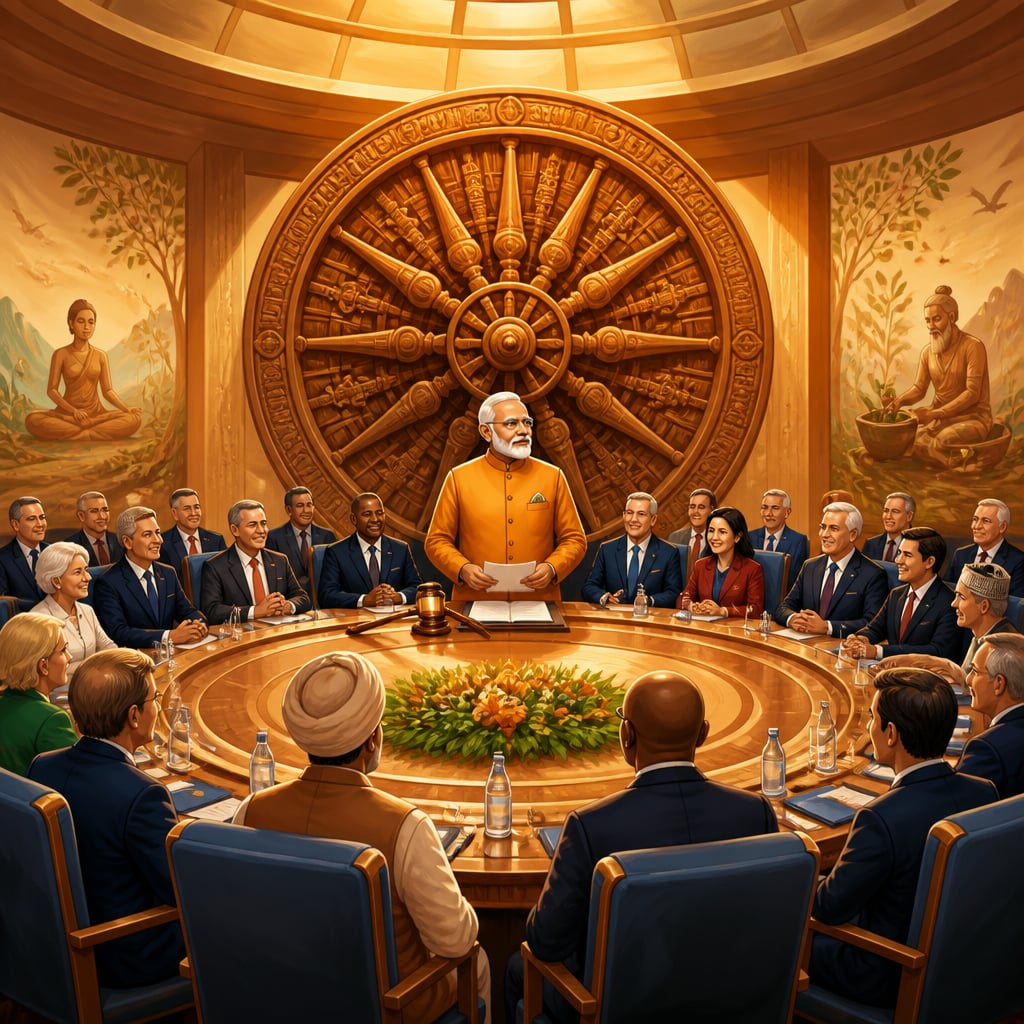
This was not decorative. The phrase anchored the Delhi Declaration, endorsed by all member nations including the United States, China, and the European Union. For the first time in G20 history, a non-Western civilizational concept provided the intellectual framework for a major multilateral summit. The declaration's consensus on climate finance, digital public infrastructure, and Global South representation was negotiated under a philosophical umbrella that originated not in Enlightenment liberalism or Marxist internationalism, but in Vedantic thought.
The symbolism ran deeper than a tagline. India used its presidency to push the African Union's permanent G20 membership, champion digital public goods like UPI (which processed 12.02 billion transactions in October 2023 alone), and advocate for climate justice rooted in differentiated responsibility. Each initiative carried a civilizational signature: technology as shared commons, development as collective uplift, diplomacy as dharmic obligation rather than transactional calculation.
Critics dismissed it as branding. But branding that 177 nations sign onto is no longer branding. It is agenda-setting. And the agenda being set was distinctly Indian: a pluralistic, non-zero-sum vision of global order rooted in civilizational principles that predate the Westphalian nation-state by millennia.
The question this lesson addresses is not whether India has something to offer the world. That question was settled long ago. The question is: what is the mechanism by which civilizational wisdom becomes global contribution? And how can India do this systematically rather than episodically?
The Mechanism: How Civilizational Wisdom Becomes Global Contribution
India's civilizational contributions do not spread the way Western ideas historically did. There is no Indian East India Company. No Indian missionaries offering rice in exchange for philosophical conversion. No Indian military bases enforcing cultural compliance. The mechanism is fundamentally different, and understanding it reveals why India's model offers the world something no other civilization currently can.
The Four-Stage Pipeline
Indian civilizational knowledge follows a consistent pathway from indigenous practice to global adoption. The pattern, visible across yoga, Ayurveda, Vedanta, and ecological thought, operates through four stages.
Stage 1: Deep indigenous development. Centuries or millennia of rigorous internal development, documentation, debate, and refinement. Patanjali's Yoga Sutras were not a weekend workshop. They represented the distillation of generations of contemplative inquiry into 196 precise aphorisms. Charaka and Sushruta's medical treatises catalogued over 1,100 diseases, 700 medicinal plants, and detailed surgical procedures including rhinoplasty and cataract surgery. This knowledge base was not folk wisdom. It was systematic, debated, and continuously refined through the shastrartha tradition.
Stage 2: Bridge figures who translate without diluting. Every successful civilizational export had bridge figures. Swami Vivekananda introduced Vedanta at the 1893 Parliament of Religions. B.K.S. Iyengar and K. Pattabhi Jois made yoga physically accessible to Western bodies without abandoning its philosophical core. Maharishi Mahesh Yogi brought meditation into mainstream Western consciousness. These were not salesmen. They were translators who made sophisticated knowledge systems legible across cultural boundaries while preserving their essential integrity.
Stage 3: Evidence-based validation in global frameworks. This is where most civilizational contributions either succeed or stall. Yoga crossed the threshold when Harvard Medical School, the Mayo Clinic, and the National Institutes of Health began publishing peer-reviewed studies on its therapeutic effects. Over 3,000 published clinical trials now document yoga's efficacy for conditions ranging from chronic pain to PTSD. Similarly, Ayurveda gained institutional traction when the WHO included it in its Traditional Medicine Strategy (2014-2023), and when compounds like curcumin (from turmeric) and withaferin A (from ashwagandha) began appearing in pharmacological research published in journals like The Lancet and JAMA.

The numbers tell the story. The global yoga industry exceeds $80 billion annually, with over 300 million practitioners in 190 countries. The global Ayurveda market is projected to reach $14.9 billion by 2026. India's International Day of Yoga resolution at the United Nations in 2014 was co-sponsored by 177 nations, the highest number of co-sponsors for any UN General Assembly resolution of its kind.
Stage 4: Institutional embedding. The final stage is when civilizational contributions become embedded in global institutional architecture. The International Solar Alliance, headquartered in Gurugram and co-founded by India in 2015, now has 120+ member countries. It operationalizes an ecological principle that Indian civilization has practiced for millennia: that humanity's relationship with nature must be symbiotic, not extractive. India's push for millets (declared the International Year of Millets by the UN in 2023 at India's initiative) revives indigenous agricultural knowledge that addresses both nutrition and climate resilience.
Why This Mechanism is Unique
The critical distinction is between civilizational contribution and civilizational imposition. The Abrahamic missionary model says: "We have the truth. You must accept it." The colonial model says: "We have the power. You must submit to it." The Indian civilizational model says: "We have developed something useful. Take what serves you."
This is not passive. It is strategically generous. India's civilizational exports succeed precisely because they do not demand conversion. A Japanese CEO can practice yoga without becoming Hindu. A Brazilian researcher can study Ayurvedic pharmacology without abandoning Western medicine. A German philosopher can engage with Advaita Vedanta without renouncing Christianity. The universality of Indian contributions lies in their non-exclusivity.
Vedanta's core insight, that reality is one though wise people describe it differently (Ekam sat viprah bahudha vadanti), is not merely a theological position. It is the operating principle of India's civilizational contribution model. Knowledge is offered freely, adapted locally, and enriched through cross-cultural encounter.
The Pattern: Civilization Without Conquest
The G20 presidency is not India's first civilizational contribution to the world. It is the latest expression of a pattern that spans two millennia.
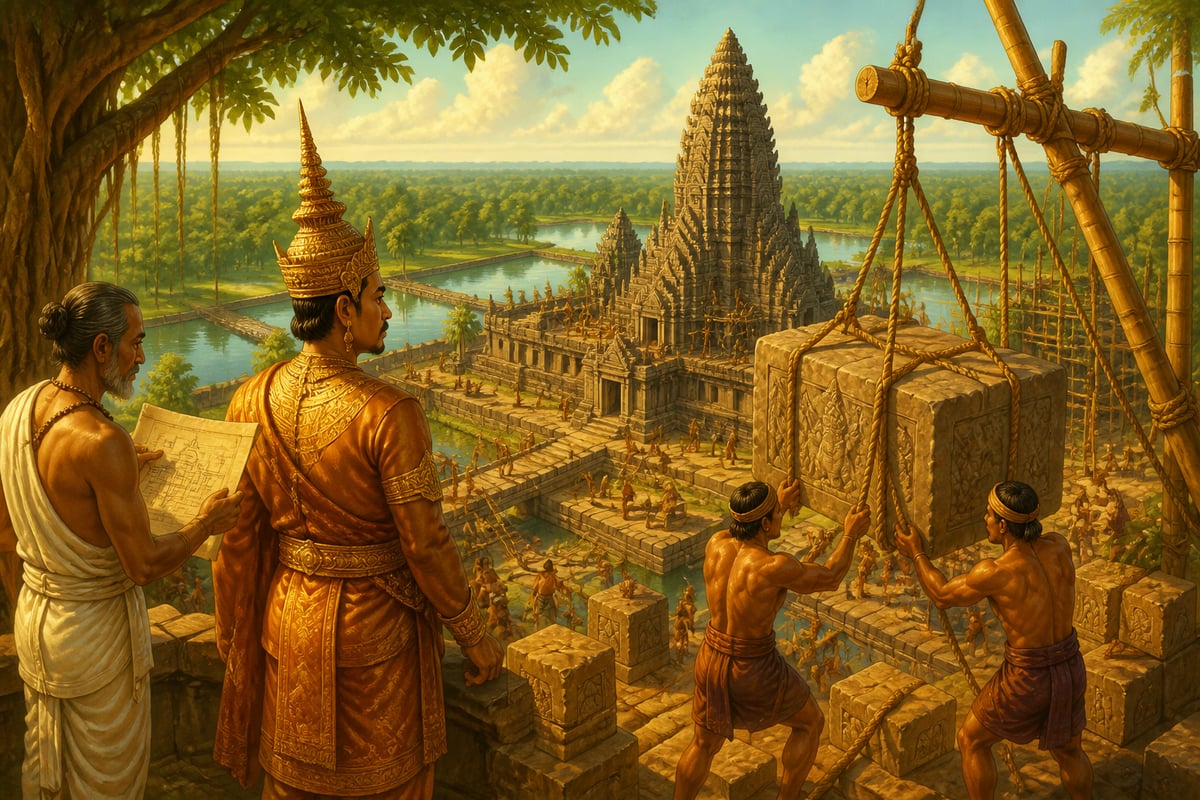
Between the 1st and 13th centuries CE, Indian civilization spread across Southeast Asia on a scale that transformed the entire region. The evidence stands in stone. Angkor Wat in Cambodia, built in the 12th century by King Suryavarman II, is the largest religious structure on earth: a Hindu temple dedicated to Vishnu, covering 162.6 hectares. Borobudur in Java, constructed in the 9th century, is the world's largest Buddhist monument, with 2,672 relief panels depicting Jataka tales and Buddhist cosmology. Prambanan, also in Java, is a 9th-century Hindu temple complex with 240 structures dedicated to the Trimurti.
These were not colonial outposts. No Indian army conquered Cambodia, Java, or Sumatra. No Indian governor administered these territories. The kingdoms of Funan, Champa, Srivijaya, and Majapahit adopted Indian political concepts (rajya, dharma, mandala), literary traditions (Ramayana adaptations exist in Thai, Javanese, Balinese, and Khmer versions), artistic styles, and religious philosophies through trade, scholarly exchange, and cultural attraction.
The mechanism was remarkably consistent. Indian merchants established trading posts. Brahmana scholars were invited (not sent) by local rulers seeking to legitimize and organize their kingdoms. Sanskrit served as the language of administration, law, and literature. Local cultures did not disappear. They absorbed Indian civilizational elements and synthesized them with indigenous traditions, creating something new and distinct.
Consider Bali today. In a nation of 275 million people that is 87% Muslim, Bali's 4.2 million inhabitants practice a form of Hinduism that has been continuously maintained for over a thousand years. Balinese Hinduism is not imported Hinduism. It is a living synthesis of Shaivite, Buddhist, and indigenous Balinese traditions. The fact that it thrives in the world's largest Muslim-majority nation, without conflict or coercion, is itself a civilizational achievement.
The contrast with other civilizational spread models is instructive. European civilization spread through military conquest, colonial administration, and forced conversion. The Spanish destroyed Aztec and Inca civilizations to build their own. The British imposed English law, English education, and English religion on a quarter of the globe. India's civilizational spread offers a third model: influence through attraction. No civilization destroyed. No indigenous culture erased. No conversion demanded. The Ramayana is performed in Thailand not because an Indian army forced it, but because the story was compelling enough to be adopted, adapted, and treasured as Thailand's own.
This historical pattern is not nostalgia. It is a strategic asset. In a 21st century exhausted by both Western liberal universalism and authoritarian alternatives, India's demonstrated capacity for civilizational contribution without civilizational imposition offers something genuinely new.
Dharmic Wisdom: The World as One Family
The philosophical foundation for India's civilizational vision is not a political slogan invented for diplomatic convenience. It is rooted in some of the oldest and most rigorously argued philosophical traditions in human history.
Vasudhaiva Kutumbakam, from the Maha Upanishad (6.72), declares the world to be one family. But this is not sentimental universalism. In its original context, the verse distinguishes between the narrow-minded (who divide the world into "mine" and "not mine") and the large-hearted (who see all beings as kin). It is a statement about the maturity of consciousness, not about erasing differences.
This connects to a deeper Vedantic principle: Ekam sat viprah bahudha vadanti (Rig Veda 1.164.46). Truth is one; the wise describe it in many ways. This is not relativism. It does not say all descriptions are equally accurate. It says that reality is rich enough to be approached from multiple valid directions. This philosophical position makes genuine pluralism possible. Not the Western liberal version that "tolerates" difference while assuming its own framework is universal, but a pluralism that genuinely accepts multiple frameworks as legitimate approaches to truth.
The practical implication is profound. A civilization built on this philosophical foundation can engage with the world without the compulsion to convert. It can share yoga without demanding that practitioners abandon their own spiritual traditions. It can offer Ayurvedic insights without claiming that Western medicine is invalid. It can propose Vasudhaiva Kutumbakam at the G20 without insisting that all nations adopt Indian governance models.
This is India's civilizational competitive advantage in the 21st century. In a world fractured by competing universalisms (each claiming to be the only valid framework for human flourishing), India offers the possibility of a pluralistic global order where multiple civilizational models coexist, contribute, and learn from each other.
The Defense: From Civilizational Contribution to Civilizational Leadership
India's civilizational gifts are already global. The task now is to move from episodic contribution to systematic civilizational leadership. This requires specific institutional and individual actions.
Protect civilizational intellectual property. India's 2005 Traditional Knowledge Digital Library (TKDL) successfully challenged 36 patent applications at the European Patent Office that attempted to patent traditional Indian knowledge (including turmeric for wound healing and neem as pesticide). This model must be expanded. Every traditional knowledge system, from Ayurveda to metallurgy to textile techniques, needs documentation and legal protection before it is appropriated without attribution.
Build global institutional infrastructure. The International Solar Alliance and the Coalition for Disaster Resilient Infrastructure (CDRI) demonstrate that India can create multilateral institutions rooted in its civilizational values. More are needed: a global Ayurveda research consortium, an international Sanskrit computational linguistics center, a Vedantic ethics institute that engages with global bioethics, AI ethics, and environmental ethics debates.
Standardize without sterilizing. Yoga's global spread has been accompanied by dilution. "Beer yoga," "goat yoga," and "rage yoga" strip the practice of its philosophical depth. India must establish quality frameworks (as the AYUSH Ministry has begun doing) that set standards for authentic practice without being so rigid that adaptation becomes impossible. The Yoga Certification Board, established in 2018, certifies yoga professionals globally. This model needs expansion and enforcement.
Create civilizational ambassadors. Every Indian student studying abroad, every professional in the diaspora, every tourist visiting India is a potential civilizational ambassador. But ambassadorship requires knowledge. Most educated Indians today can explain Western philosophy better than they can explain Nyaya logic or Samkhya metaphysics. The civilizational literacy discussed in Lesson 09_02 is the prerequisite for civilizational leadership.
Individual action. Learn one Indian knowledge system deeply enough to teach it. Practice and embody the principles you advocate. When someone asks about yoga, explain its philosophical foundations, not just its physical postures. When Vasudhaiva Kutumbakam is dismissed as a slogan, explain the Upanishadic context. Civilizational leadership begins with civilizational competence.
India does not need to convince the world that it has something to offer. Yoga, Ayurveda, meditation, and Vedantic pluralism have already been adopted by hundreds of millions of people across every continent. The task is to ensure that these contributions are understood in their full civilizational depth, protected from appropriation without attribution, and deployed as the foundation for a genuinely pluralistic global order.
Case studies
India's G20 Presidency: Vasudhaiva Kutumbakam on the World Stage
In 2023, India held the G20 presidency under the theme 'One Earth, One Family, One Future,' directly translating the Upanishadic concept of Vasudhaiva Kutumbakam. The G20 represents 85% of global GDP, 75% of international trade, and two-thirds of the world's population. India used its presidency to push the African Union's permanent G20 membership, showcase digital public infrastructure like UPI (which processed 12.02 billion transactions in October 2023 alone), and advocate for climate justice rooted in differentiated responsibility. The Delhi Declaration was endorsed by all member nations, including competing powers like the United States and China.
The G20 presidency embodied the Vedantic principle that leadership means service (lokasangraha), not domination. By framing a global summit through an ancient Indian philosophical concept rather than Western liberal internationalism or realpolitik, India demonstrated that civilizational wisdom can provide practical frameworks for contemporary governance. The approach mirrored the historical Indian model: offering a framework for adoption rather than imposing it through coercion.
The Delhi Declaration achieved consensus where previous presidencies had failed on key issues. The African Union gained permanent G20 membership. India's UPI system attracted global interest as a model for digital public goods. For the first time, a non-Western civilizational concept framed a major multilateral summit's intellectual architecture.
Civilizational soft power is not decoration. When an ancient Upanishadic concept can frame the agenda of the world's most powerful economic forum and achieve consensus, it proves that India's civilizational vision has practical, not merely aspirational, relevance.
The G20 presidency established India as a civilizational thought leader, not just an economic power, and demonstrated that Indian philosophical frameworks can structure global governance in the 21st century.
India's G20 presidency was the most inclusive in history, with over 200 meetings across 60 Indian cities involving more than 100,000 delegates from 125 countries.
Civilization Without Conquest: India's Southeast Asian Legacy
Between the 1st and 13th centuries CE, Indian civilization spread across Southeast Asia on a scale that transformed the entire region. Angkor Wat in Cambodia (12th century, dedicated to Vishnu, 162.6 hectares) became the largest religious structure on earth. Borobudur in Java (9th century) became the world's largest Buddhist monument with 2,672 relief panels. The kingdoms of Funan, Champa, Srivijaya, and Majapahit adopted Indian political concepts, literary traditions (Ramayana adaptations exist in Thai, Javanese, Balinese, and Khmer versions), artistic styles, and religious philosophies. No Indian army conquered these territories. No Indian governor administered them.
The Southeast Asian spread followed the dharmic model of influence through attraction (ahimsa at the civilizational scale). Indian merchants established trading posts. Brahmana scholars were invited by local rulers seeking to organize their kingdoms. Sanskrit served as the language of administration and literature. Local cultures absorbed Indian civilizational elements and synthesized them with indigenous traditions, creating something new. This is the opposite of colonial erasure: the host culture was enriched, not destroyed.
Bali today, with 4.2 million inhabitants, maintains Hindu culture continuously for over a thousand years within the world's largest Muslim-majority nation (275 million people). Thailand performs the Ramayana (Ramakien) as national heritage. Cambodia's national symbol is Angkor Wat. Indian civilizational influence endures precisely because it was adopted voluntarily, not imposed by force.
Civilizational influence achieved through attraction endures for millennia. Civilizational influence imposed through conquest breeds resentment and eventually collapses. India's historical model proves that the most durable soft power comes from offering knowledge worth adopting.
In a 21st century exhausted by both Western liberal universalism and authoritarian alternatives, India's demonstrated capacity for civilizational contribution without civilizational imposition offers a genuinely different model for global engagement.
Over 300 versions of the Ramayana exist across Southeast Asia, each adapted to local culture. The Thai Ramakien, Javanese Kakawin Ramayana, Cambodian Reamker, and Burmese Yama Zatdaw are all living literary traditions, not museum pieces.
Ayurveda's Global Recognition: From Patent Battles to WHO Validation
In 1995, the US Patent Office granted a patent on the use of turmeric for wound healing to the University of Mississippi Medical Center. India's Council of Scientific and Industrial Research (CSIR) challenged it, presenting ancient Sanskrit texts documenting turmeric's medicinal use for centuries. The patent was revoked in 1997. This battle catalyzed the creation of India's Traditional Knowledge Digital Library (TKDL), which has since successfully challenged 36 patent applications at the European Patent Office. Meanwhile, Ayurveda has gained institutional validation: the WHO included it in its Traditional Medicine Strategy (2014-2023), the global Ayurveda market is projected to reach $14.9 billion by 2026, and compounds like curcumin and ashwagandha (withaferin A) now appear in research published in journals including The Lancet and JAMA.
Ayurveda represents the full four-stage pipeline of civilizational contribution. Stage 1 (deep indigenous development): Charaka and Sushruta documented over 1,100 diseases and 700 medicinal plants millennia ago. Stage 2 (bridge figures): AYUSH Ministry and research institutions translate traditional knowledge into globally legible formats. Stage 3 (evidence-based validation): peer-reviewed clinical trials validate specific compounds and practices. Stage 4 (institutional embedding): WHO recognition and global market adoption.
India successfully defended its traditional knowledge from biopiracy, built institutional infrastructure (TKDL, AYUSH Ministry, Yoga Certification Board), and achieved global recognition without abandoning the knowledge system's integrity. Ayurveda is now studied at universities in over 30 countries.
Civilizational contributions must be both shared and protected. India's experience with turmeric patents shows that without documentation and legal defense, traditional knowledge can be appropriated without attribution. The TKDL model is a template for protecting any civilization's intellectual heritage.
The Ayurveda case demonstrates that India's civilizational contributions can gain global recognition through evidence-based validation rather than cultural assertion, while simultaneous legal protection prevents appropriation.
India's TKDL contains 2.1 lakh formulations from Ayurveda, Unani, Siddha, and Yoga texts, documented in five international languages to make them searchable by patent examiners worldwide.
Reflection
- Which Indian knowledge system (yoga, Ayurveda, Vedanta, classical arts, or another) do you know well enough to explain its philosophical depth to someone unfamiliar with Indian civilization? If the answer is none, which one would you choose to learn first?
- Why did Indian civilization spread across Southeast Asia without military conquest, while other civilizations historically relied on force? What does this tell us about the nature of Indian civilizational influence?
- Can a civilization built on genuine pluralism ('truth is one, the wise describe it in many ways') effectively compete in a world dominated by civilizations built on exclusive truth claims? Is pluralism a strategic advantage or a vulnerability?