Traditional Economy Revival
Artisan Economy, Cultural Guilds, and Village Knowledge Economy
India once possessed the world's largest manufacturing economy, built on three pillars: self-governing artisan guilds (Shrenis) that regulated production and quality, self-sufficient village economies that distributed knowledge and wealth locally, and temple economies that functioned as banks, employers, and redistributors of community wealth. The British systematically destroyed this system through tariff warfare and de-industrialization, reducing India's share of world manufacturing from 25% to under 2% in 150 years. The Dhaka muslin, once the finest textile ever produced, was extinguished entirely. Wootz steel, the secret behind legendary Damascus swords, was nearly lost. But revival is underway. From Pochampally's Ikat weavers organizing into cooperatives to GI tags protecting over 400 traditional products, India's artisan economy is rebuilding on the same principles that sustained it for millennia: self-governance, quality control, knowledge transmission, and community wealth.
The Economy That Built the World
Before the British arrived, India was not a "developing country." It was the world's largest economy.
For most of recorded history, India and China together produced over half of global GDP. India's share alone was approximately 24.4% in 1700, larger than all of Europe combined. This was not an accident of population. It was the product of a sophisticated economic system built on three pillars: the Shreni (guild) system that organized artisan production, the self-governing village economy that distributed wealth locally, and the temple economy that functioned as community bank, employer, and economic engine.
Understanding what this economy looked like is essential. You cannot revive what you do not remember.
The Shreni: India's Guild System
The Shreni (श्रेणि) was India's answer to economic organization, and it was remarkably advanced.
Kautilya's Arthashastra (c. 3rd century BCE) describes Shrenis as autonomous economic bodies with their own governance, rules of conduct, dispute resolution, quality standards, and financial instruments. They were not just trade associations. They were self-governing economic republics.
Self-Governance: Each Shreni elected its own Shreshthi (president) and council. The guild set its own prices, quality standards, and training requirements. The state recognized guild law as binding, meaning disputes within a guild were settled by the guild itself, not by royal courts. Kautilya explicitly instructed the king not to interfere with guild regulations unless they harmed the public interest.
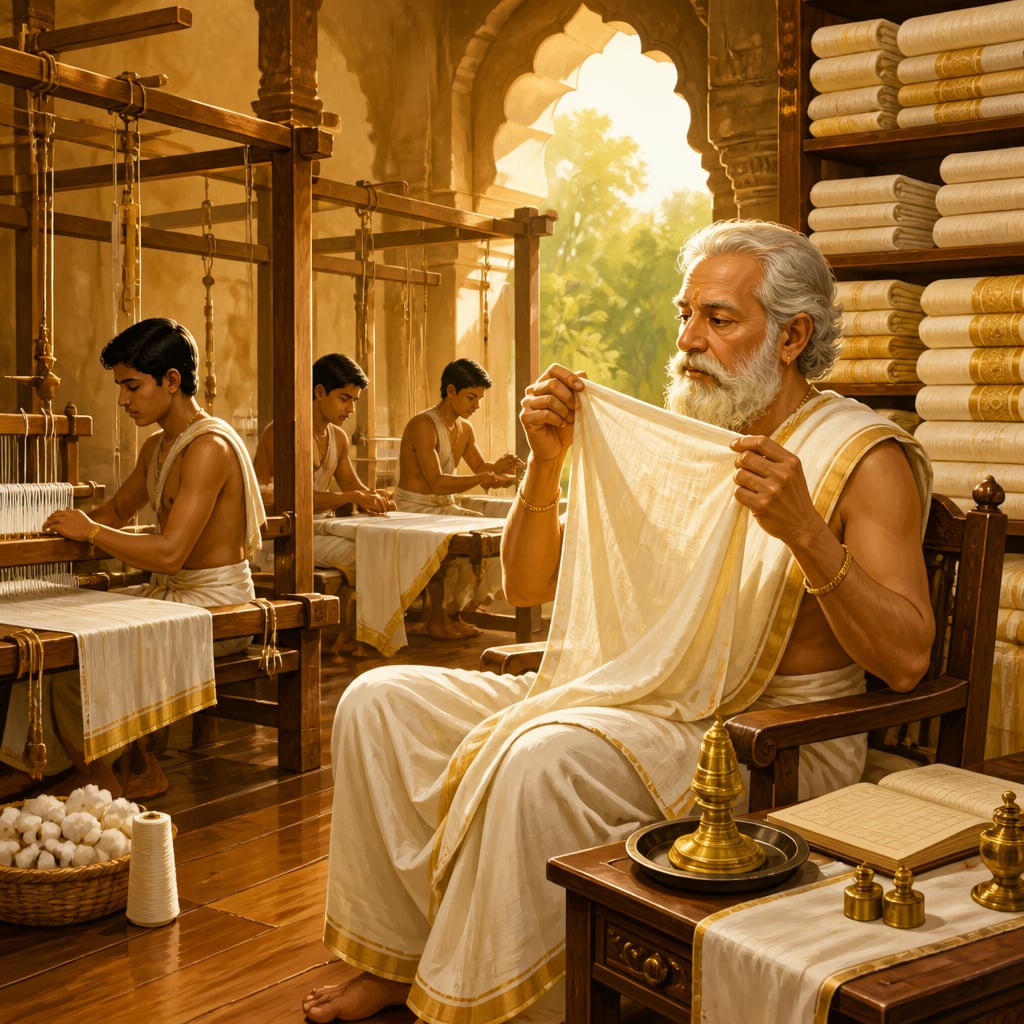
Financial Innovation: Shrenis accepted deposits from the public and paid interest on them, functioning as banks. Temple inscriptions from the Gupta period (4th-6th century CE) record perpetual endowments deposited with guilds, earning interest that funded temple maintenance, charitable feeding, and lamp oil. This is proto-banking, centuries before European banking houses emerged.
Quality Control: Guild marks on products served as a guarantee of quality, an ancient equivalent of branding and certification. A silk from Varanasi or a steel blade from South India carried the guild's reputation. Counterfeiting guild marks was a punishable offense under the Arthashastra.
Training Pipeline: Apprenticeship systems ensured knowledge transfer across generations. A weaver's son did not automatically inherit guild membership. He earned it through years of apprenticeship, examination, and demonstrated skill. The guild was a meritocratic institution within its craft domain.
Social Safety Net: Guilds provided for their members in times of illness, disability, and old age. They funded community infrastructure, temples, and festivals. They were economic institutions with social responsibility built into their charter.
The Shreni system endured for over 1,500 years. Inscriptions from the Satavahana, Gupta, Chalukya, and Chola periods all reference active guilds. The Mandsaur inscription (5th century CE) describes a guild of silk weavers from Lata (Gujarat) who migrated to Dashapura (Mandsaur, MP) and diversified into soldiering, astronomy, and poetry while maintaining their weaving guild identity. These were not narrow tradespeople. They were complete communities.
The Village Economy: Self-Sufficiency as Design
The Indian village was not a primitive subsistence unit. It was a deliberately designed self-sufficient economic system.
Each village contained a complete ecosystem of producers: the weaver, the potter, the blacksmith, the carpenter, the oil presser, the washerman, the barber, the accountant, and the headman. They operated through a system of mutual exchange called Jajmani, where services were exchanged within the village without dependence on distant markets or centralized institutions.
The village economy had two critical strengths:
Resilience: Because each village was largely self-sufficient, economic shocks in distant markets did not cascade through the system. A famine in one region did not automatically cause unemployment in another, because the village economy was not dependent on long supply chains. Compare this to modern global supply chains, where a factory shutdown in one country can halt production worldwide.
Knowledge Distribution: Every village was a knowledge center. The weaver knew dyeing chemistry. The blacksmith understood metallurgy. The potter mastered kiln engineering. The farmer knew hydrology, seed science, and soil management. Knowledge was distributed across the population, not concentrated in a few institutions. This meant that destroying any single center of learning could not eliminate the civilization's knowledge base.
Sir Charles Metcalfe, a British administrator, wrote in 1832: "The village communities are little republics, having nearly everything they can want within themselves... They seem to last where nothing else lasts. Dynasty after dynasty tumbles down. Revolution succeeds revolution... but the village community remains the same."
He admired them. The system that followed him destroyed them.
The Temple Economy: Engine of Community Wealth
The temple was not merely a place of worship. It was an economic institution of extraordinary scope.
Major temples in pre-colonial India functioned as:
Employers: The Brihadeshwara Temple in Thanjavur (11th century) employed over 600 people, including priests, musicians, dancers, gardeners, accountants, security guards, and craftsmen. The temple was the largest employer in the region.
Banks: Temples accepted deposits, made loans, and managed perpetual endowments (akshaya nidhi). Inscriptions at the Chola temples record interest rates, loan terms, and default procedures with the precision of modern financial documents.
Redistributors: Temple festivals involved massive public feeding (annadana), distribution of clothing, and community celebration. The economic impact of a major temple festival in a Chola-era town was comparable to a modern economic stimulus program.
Patrons of Arts: Temple commissions drove innovation in sculpture, architecture, music, dance, and textile arts. The artisan economy existed in large part because temples provided steady, high-value demand for their products.
Knowledge Centers: Temples maintained libraries (saraswati bhandaras), ran schools (pathshalas), and hosted scholars. The temple at Sringeri maintained a library of manuscripts on philosophy, astronomy, medicine, and mathematics.
The temple economy created a self-reinforcing cycle: temple patronage funded artisan production, artisan guilds deposited wealth back into temple endowments, temple festivals redistributed wealth to the community, and the community's prosperity sustained the temple. It was an indigenous economic flywheel that operated for centuries without external inputs.
How Everything Was Destroyed
The British did not stumble into destroying India's economy. It was systematic.
Phase 1: Extraction (1757-1813). The East India Company extracted raw materials and tax revenue. Bengal's treasury was emptied after Plassey. The "drain of wealth," a term coined by Dadabhai Naoroji, began. India funded Britain's Industrial Revolution with its own capital.
Phase 2: Tariff Warfare (1813-1850). Britain imposed tariffs of 70-80% on Indian textile imports to England, while Indian markets were forced open to British machine-made cloth at minimal tariffs. This was not free trade. It was one-way protectionism designed to protect nascent British industry while destroying established Indian industry.
Phase 3: De-industrialization (1850-1900). Indian artisans, unable to compete with subsidized British factory goods sold at artificially low prices, were pushed out of their livelihoods en masse. India went from the world's largest textile exporter to an importer of British cotton cloth. The Shreni system collapsed. Village economies were forcibly integrated into colonial supply chains as raw material providers.
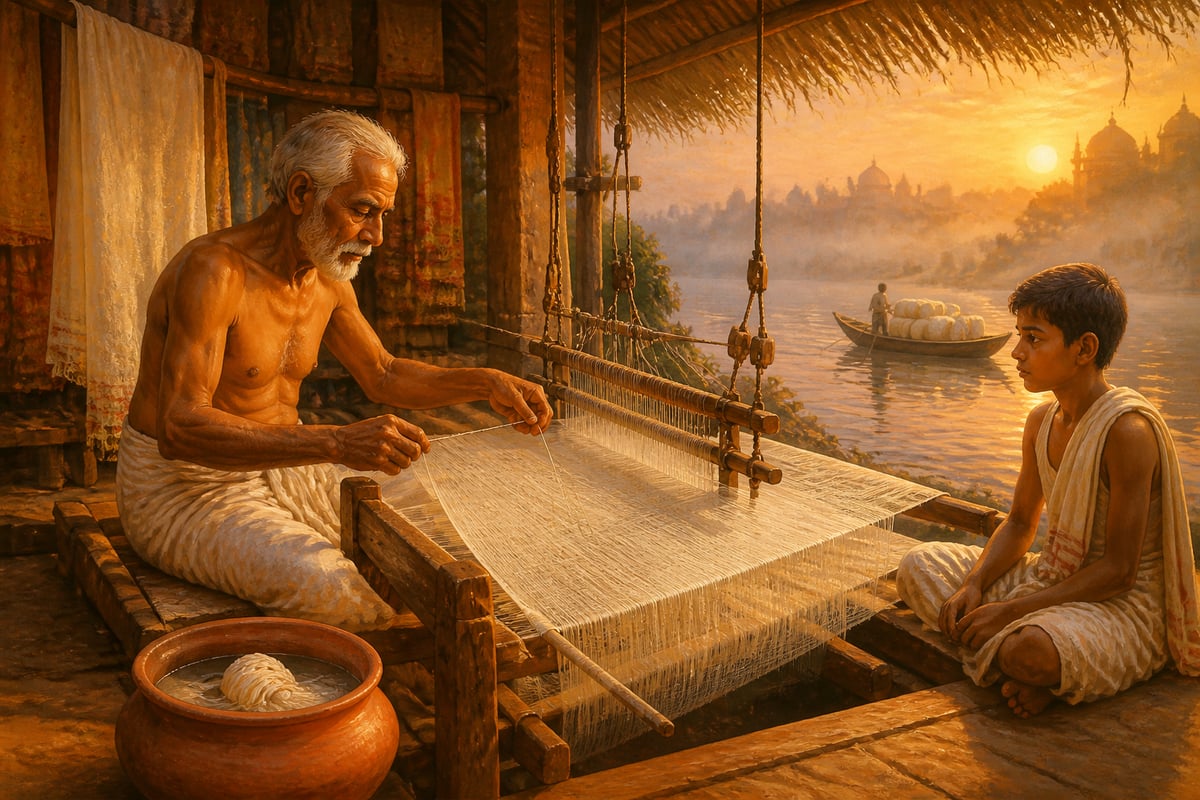
The Dhaka muslin story is the most painful example of this destruction, and it is explored in detail in this lesson's case study. But it was not alone.
Wootz Steel: Indian crucible steel, known as Wootz or Ukku, was the finest steel in the pre-modern world. It was the secret behind the legendary Damascus swords that Crusaders both feared and coveted. European metallurgists spent centuries trying to replicate it. Michael Faraday himself studied Wootz steel in the 1820s, attempting to unlock its secrets. Tipu Sultan used this steel to build the Mysorean rockets, the world's first iron-cased rockets, which outperformed anything in the European arsenal of that era. British colonial policy destroyed the Indian iron and steel industry through tariffs and forced imports. The knowledge of making Wootz steel was nearly lost entirely.
Shipbuilding: Indian shipyards, particularly in Surat and on the Malabar coast, built ships so durable that the British East India Company itself commissioned vessels from Indian builders. Indian teak ships lasted twice as long as European oak ships. The HMS Cornwallis, built in Mumbai's Wadia shipyard, carried the British delegation that signed the Treaty of Nanking with China in 1842. A ship built by Indian craftsmen carried British imperial power across the world. The Navigation Acts and subsequent colonial restrictions destroyed Indian shipbuilding. A country with 7,500 km of coastline and millennia of maritime tradition was reduced to a nation that imported its ships.
The scale of destruction is captured in a single statistic: India's share of world manufacturing output fell from approximately 25% in 1750 to under 2% by 1900. This is the largest de-industrialization in human history.
Revival: What Is Working
The good news is that revival is not theoretical. It is happening.
Across India, traditional economies are being revived through a combination of cooperative organization, intellectual property protection (GI tags), direct market access, and renewed cultural pride in traditional craftsmanship.
The Geographical Indication (GI) tag has become a critical tool. Over 400 Indian products now hold GI tags, protecting Banarasi silk, Darjeeling tea, Mysore sandalwood, Pochampally Ikat, and hundreds of other traditional products from counterfeiting and cultural appropriation. The GI tag does for modern artisans what the guild mark did for Shreni members: it certifies origin, guarantees quality, and protects the community's intellectual property.
The cooperative model, proven at scale by Amul in dairy and Lijjat Papad in food processing, is being adapted for artisan communities. Weaver cooperatives in Pochampally, brass workers in Moradabad, and wood carvers in Saharanpur are organizing into self-governing bodies that echo the ancient Shreni structure. The cooperative is the Shreni's modern descendant.
The village knowledge economy is experiencing a technology-enabled revival. E-commerce platforms connect village artisans directly to global consumers, cutting out the middlemen who historically extracted most of the value. Government initiatives like PM Vishwakarma (launched 2023) provide training, tools, credit, and market access to traditional craftspeople across 18 trades.
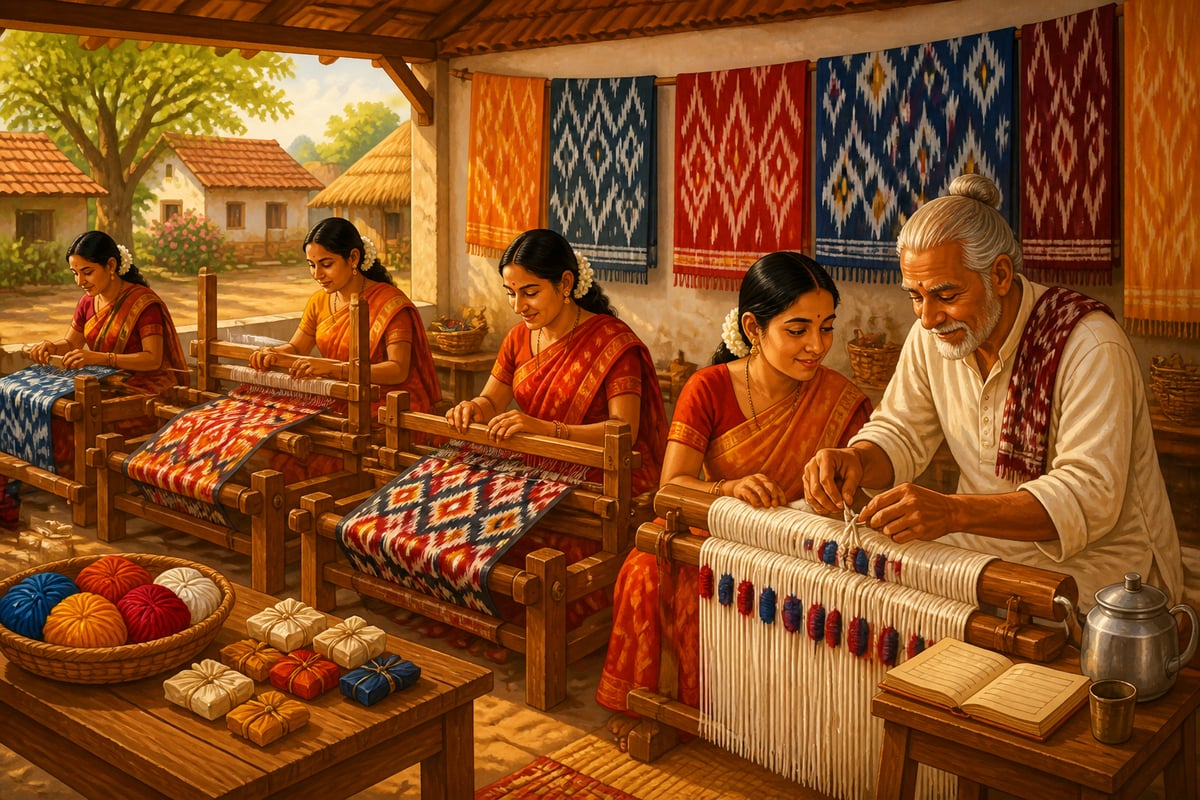
The Pochampally Ikat story, explored in this lesson's second case study, is perhaps the most complete model of what revival looks like: cooperative organization, GI protection, government support, direct market access, and cultural pride working together to transform a dying village into a globally recognized center of traditional craft.
The Path Forward: From Nostalgia to Strategy
Traditional economy revival is not about recreating the past. It is about applying timeless economic principles to modern contexts.
The principles are clear:
Self-governance: Artisan communities must control their own production, pricing, and quality standards, exactly as the ancient Shrenis did. External control, whether by colonial administrators or modern middlemen, extracts value instead of creating it.
Knowledge sovereignty: Traditional knowledge must be protected, documented, and transmitted. The GI tag is a start, but deeper work is needed: apprenticeship programs, living archives of craft techniques, and academic recognition of traditional knowledge systems.
Temple economy revival: Temples freed from state control can once again function as economic engines for their communities, commissioning traditional arts, funding education, and redistributing wealth through festivals and annadana.
Cooperative structure: The ancient Shreni was a cooperative. The modern cooperative (Amul, Lijjat, weaver cooperatives) is its direct descendant. This model works because it keeps value within the community rather than extracting it to distant shareholders.
Technology as amplifier: Traditional does not mean anti-technology. Pochampally weavers use e-commerce. Brass workers use modern finishing tools alongside traditional casting methods. The goal is technology that amplifies traditional skill, not technology that replaces it.
The Arthashastra's vision of economic organization was not primitive. It was decentralized, self-governing, quality-controlled, and community-sustaining. Revival means recognizing that these principles are not antiquated. They are advanced.
The Bhagavad Gita teaches that all beings are nourished by right action, by the cycle of offering and receiving that sustains community. The traditional economy was built on this principle. The industrial economy that replaced it was built on extraction. The choice between these two models is not merely economic. It is dharmic.
A civilization that cannot feed, clothe, and employ its own people through its own economic traditions is economically colonized, regardless of its GDP figures. Traditional economy revival is not nostalgia. It is sovereignty.
Case studies
The Death of Dhaka Muslin: Civilizational De-Industrialization
For centuries, Dhaka muslin was the pinnacle of human textile achievement. European traders called it 'woven air' and 'running water' because a full sari could be drawn through a finger ring. Bengal's weavers produced cloth so fine that Mughal emperors paid fortunes for it, and it commanded premium prices across Rome, Persia, and Southeast Asia. Bengal alone anchored India's position as the source of roughly 25% of global manufacturing output in 1750. Then came the East India Company. Britain imposed import tariffs of 70-80% on Indian textiles entering British markets, while simultaneously forcing open Indian markets to British mill-produced cloth at negligible tariffs. This was not free trade. It was a deliberate policy of asymmetric protectionism designed to kill a rival industry. The weaver communities of Dhaka, denied both their export markets and their domestic customers, collapsed within decades. Dhaka's population plummeted from roughly 200,000 to just 20,000 during the 19th century. By 1900, India's share of world manufacturing had fallen to under 2%. The muslin-making knowledge, passed through generations of master weavers in an unbroken apprenticeship chain, was completely lost. For over 200 years, no one on earth could reproduce what Bengal's weavers once made routinely.
Kautilya's Arthashastra treats the protection of Shrenis (artisan guilds) as a core duty of the state. Book 2 prescribes that the king must regulate trade to ensure indigenous industries are not undercut by foreign competition. He mandates state support for craft communities, quality standards enforced through guild self-governance, and tariff structures that protect domestic producers. The British colonial regime violated every one of these principles systematically. Where Kautilya demanded that the ruler nurture productive communities as the foundation of state wealth, the British treated Indian artisans as competitors to be eliminated. Where the Arthashastra prescribed that trade regulation must serve the welfare of producers and consumers within the kingdom, colonial policy served only the mills of Manchester. The destruction of Dhaka muslin was not an accident of market forces. It was a case study in what happens when a civilization's economic governance principles are overridden by an extractive foreign power with no stake in the prosperity of the people it rules.
India was transformed from the world's leading manufacturing economy into a raw-material colony within a single century. The knowledge systems that produced Dhaka muslin, requiring specific cotton varieties (Phuti karpas), spinning techniques passed through family lineages, and water conditions unique to the Dhaka region, were extinguished entirely. In 2021, a team of Bangladeshi researchers and weavers attempted to revive the craft, managing to produce a limited quantity of near-authentic muslin after years of effort. They had to rediscover the extinct cotton variety, reverse-engineer spinning techniques from museum samples, and reconstruct a knowledge chain that colonialism had severed completely.
When you destroy an artisan community, you do not merely eliminate jobs. You erase irreplaceable knowledge systems built over centuries. Economic warfare against indigenous industries is civilizational warfare. The Arthashastra understood this. Protecting productive communities is not protectionism. It is civilizational self-preservation.
The destruction of Dhaka muslin parallels the modern threat to India's handloom sector from fast fashion imports. The lesson holds: when indigenous craft ecosystems are undercut by subsidized foreign competition without state protection, irreplaceable knowledge systems are lost permanently.
India's share of world manufacturing output collapsed from approximately 25% in 1750 to under 2% by 1900, while Britain's rose from 2% to over 20% during the same period, largely by capturing markets that Indian artisans once dominated.
Pochampally Ikat: A Village Weaves Its Way Back
By the early 2000s, the village of Pochampally in Telangana's Nalgonda district was dying the same slow death that had claimed thousands of Indian craft villages. Weavers who had practiced the intricate ikat tie-dye technique for generations were abandoning their looms. Youth were migrating to Hyderabad for construction work and driving jobs. Middlemen captured most of the value, paying weavers a pittance while selling the finished saris at large markups in city showrooms. The ancient art of Pochampally ikat, which involves tying and dyeing individual warp and weft threads before weaving to create geometric patterns of extraordinary precision, was heading toward the same extinction that claimed Dhaka muslin. Then a multi-pronged revival began. Weaver cooperatives reorganized along collective lines, cutting out exploitative middlemen. In 2005, Pochampally ikat received a Geographical Indication (GI) tag, legally protecting the craft's identity and preventing imitations. The Pochampally Handloom Park was established, providing shared infrastructure and workspace. E-commerce platforms gave weavers direct access to consumers across India and internationally. Government schemes provided subsidized yarn, upgraded looms, and design training. In 2023, Pochampally was recognized by UNESCO as a Creative City of Crafts and Folk Art.
Pochampally's revival is, in essence, a modern reconstruction of the Shreni system that Kautilya described in the Arthashastra. The weaver cooperatives function as guilds with collective bargaining power, shared quality standards, and internal governance. The GI tag serves the same function as the guild marks and quality seals that Kautilya prescribed for trade goods: it authenticates origin, guarantees quality, and prevents fraud. The apprenticeship system, where master weavers train younger family members in the precise mathematics of ikat pattern calculation and the chemistry of natural dyes, mirrors the knowledge transmission model that sustained Indian crafts for millennia. Most critically, the cooperative structure restores what colonialism destroyed: the artisan's dignity and economic self-determination. Kautilya wrote that the state must ensure artisans receive fair value for their labor. The cooperatives achieve exactly this by eliminating parasitic intermediaries and connecting producers directly to markets.
Today, the Pochampally cluster supports approximately 5,000 weaver families across Pochampally and surrounding villages. Annual production runs into hundreds of crores of rupees. Young weavers who might have left for city labor now earn competitive incomes while preserving their ancestral craft. The UNESCO Creative City designation has brought international visibility and craft tourism. Pochampally saris are now sold on platforms like Amazon, Flipkart, and dedicated handloom portals, giving weavers market access that would have been unimaginable a generation ago. The village has become a model for other dying craft clusters across India.
Revival is possible when you reconstruct the institutional ecosystem, not just the craft technique. Pochampally succeeded because it restored the full Shreni model: collective organization, quality authentication, knowledge transmission, and fair market access. The ancient guild system was not primitive. It was a sophisticated economic institution whose principles remain valid today.
Pochampally's GI-tag-plus-cooperative model is now being replicated across India's craft clusters, from Chanderi silk to Banarasi weaving. The proven formula of collective organization, quality authentication, and direct market access offers a scalable alternative to corporate mass production.
Pochampally's weaver cluster supports roughly 5,000 families and was one of only a handful of Indian villages to receive UNESCO Creative City recognition, placing it alongside cities like Florence and Kanazawa as a global center of craft excellence.
Living traditions
India's traditional artisan economy is experiencing a documented revival. Over 400 products now hold Geographical Indication (GI) tags, protecting traditional crafts like Pochampally Ikat, Banarasi silk, Thanjavur paintings, and Moradabad metalware from imitation. The PM Vishwakarma scheme, launched in September 2023, provides traditional artisans with collateral-free loans up to Rs 3 lakh, skill training, and digital marketplace access, directly investing in 18 traditional trades. India's handloom sector employs 35 million people, making it the second-largest employer after agriculture. The cooperative model pioneered in places like Pochampally and Chanderi has been replicated across hundreds of craft clusters. Temple economies are being studied as alternative economic models, with institutions like the Tirumala Tirupati Devasthanam operating annual budgets exceeding Rs 3,000 crore while maintaining free services. The One District One Product (ODOP) initiative maps traditional crafts to their districts of origin, reviving local artisan economies across 761 districts.
- Handloom Weaving: India's handloom tradition is one of the oldest continuous craft practices in the world, with over 35 million weavers still working across the country. Techniques like Ikat (tie-dye resist), Jamdani (supplementary weft), Patola (double Ikat), and Banarasi (zari brocade) survive in weaver communities that have practiced these crafts for generations. Each region has its own signature weave. In Pochampally, weavers tie-dye individual threads before weaving them into geometric patterns. In Varanasi, families pass down the art of silk brocade with gold and silver zari. The handloom sector remains India's second-largest employer after agriculture, a living testament to the Shreni (guild) system that once organized these crafts.
- Temple Annadana: The ancient tradition of temples providing free food to all visitors regardless of caste, creed, or economic status continues on a massive scale across India. The Tirumala Tirupati Devasthanam feeds over 100,000 people daily through its Annaprasadam program, operating one of the world's largest free kitchens. The Golden Temple's Langar in Amritsar serves 75,000 to 100,000 meals daily using a volunteer-driven model. Dharmasthala in Karnataka feeds 30,000 daily. Sree Siddaganga Matha in Tumkur has run a free kitchen for over a century. These are not charity programs in the Western sense. They are expressions of the temple economy model where wealth flows from the institution back to the community.
- Pochampally Village (Bhoodan Pochampally): Pochampally is the heart of India's Ikat weaving revival and was designated a UNESCO Creative City in 2023. Nearly every household in this village of 5,000 families is involved in some stage of weaving. Visitors can walk through the village and watch the entire Ikat process: yarn winding, pattern tying, dyeing in natural colors, and weaving on pit looms. The Pochampally Handloom Park offers guided tours and live demonstrations. You can buy sarees, dupattas, and fabric directly from weavers at prices far below retail. The village is a living example of the cooperative model that revived a dying craft.
- National Handicrafts and Handlooms Museum (Crafts Museum): India's largest crafts museum houses over 35,000 artifacts representing traditional crafts from every state. What makes this museum exceptional is its living craft program: master artisans from across India are invited for month-long residencies where they demonstrate their craft in open-air workshops. On any given day, visitors might watch a Madhubani painter from Bihar, a Bidriware metalsmith from Karnataka, or a Chikankari embroiderer from Lucknow at work. The museum's village complex recreates traditional dwelling styles from different regions. The textile gallery traces the history of Indian weaving from Indus Valley fragments to contemporary handlooms. A craft bazaar allows visitors to purchase directly from artisans.
- Brihadeshwara Temple (Peruvudaiyar Kovil): Built by Raja Raja Chola I around 1010 CE, the Brihadeshwara Temple is not just an architectural marvel but a documented example of the temple economy in action. Stone inscriptions on its walls record in extraordinary detail how the temple functioned as a complete economic institution. It employed over 600 people, including priests, musicians, dancers (devadasis), accountants, guards, gardeners, cooks, and cleaners. The inscriptions record guild deposits (similar to fixed deposits) where merchant guilds deposited gold with the temple and the interest funded temple operations and community welfare. Interest rates, land grants, tax exemptions, and salary structures are all carved in stone. The temple owned villages whose agricultural output funded its operations. It maintained hospitals, schools, and feeding programs. This is the clearest surviving evidence of how Indian temples were not merely places of worship but functioned as banks, employers, welfare institutions, and economic anchors for entire regions.
Reflection
- Think about the products you use daily, from the clothes you wear to the utensils in your kitchen. Do you know who made them, or where they came from? Have you ever bought something directly from an artisan or a local craftsperson? How does that experience differ from buying mass-produced goods, and what would it take to shift even a small portion of your consumption toward artisan-made products?
- When the British destroyed Dhaka's muslin weavers or dismantled India's shipbuilding traditions, what was truly lost beyond the economic output? What happens to a community's identity, its accumulated knowledge, and its social fabric when the livelihood that held it together for centuries is deliberately erased? How does the temple economy's model of Dāna and redistribution compare to what replaced it?
- Is the vision of a self-sufficient village economy a romantic impossibility in a globalized world, or does it contain principles of resilience, distributed knowledge, and local self-governance that modern economics is only now beginning to appreciate? Can traditional economic models like the Shreni system coexist with, or even outperform, industrial mass production in certain domains?