Legal and Policy Frameworks
FCRA Reform, Anti-Conversion Law, Temple Liberation, and UCC
Four legal pillars are rebuilding India's civilizational sovereignty: FCRA reform, anti-conversion laws, temple liberation, and Uniform Civil Code. From Odisha 1967 to Uttarakhand 2024, the Renaissance in law is not aspiration. It is legislation on the books.
See It Today: Uttarakhand's Historic Vote
On February 7, 2024, the Uttarakhand Assembly passed the Uniform Civil Code Bill, making it the first Indian state since independence to implement a comprehensive UCC. The law brings marriage, divorce, inheritance, and live-in relationships under a single legal framework for all citizens regardless of religion. One state legislature, one vote, and a 74-year constitutional directive in Article 44 moved from aspiration to legislation.
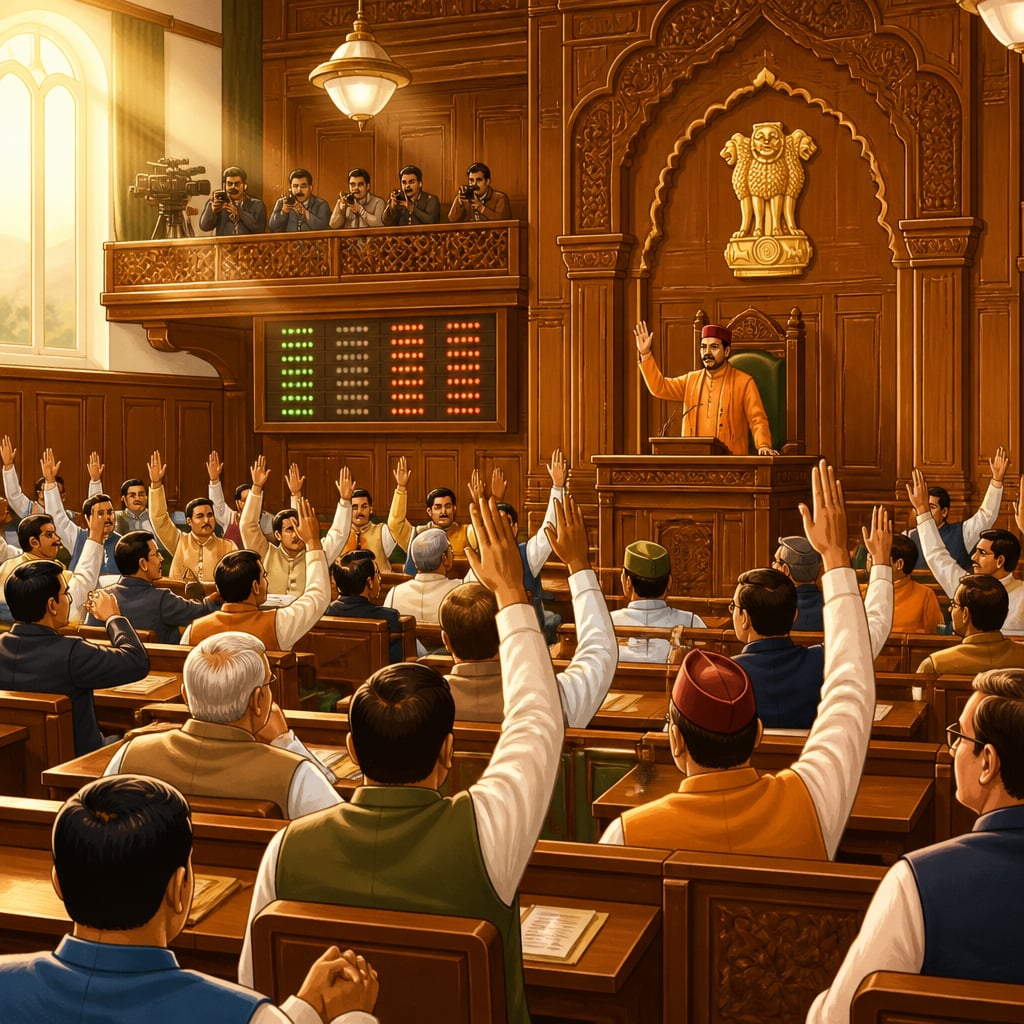
This was not an isolated event. In the preceding four years, India's legal landscape shifted on multiple fronts simultaneously. The FCRA Amendment Act of 2020 tightened regulations on foreign-funded NGOs, resulting in a 66% drop in foreign contributions: from Rs 18,065 crore in 2018-19 to approximately Rs 6,060 crore in 2022-23. Over 20,000 organizations lost their FCRA registration. Multiple states passed or strengthened anti-conversion laws. Karnataka, Madhya Pradesh, Uttar Pradesh, and Haryana joined states like Odisha, Arunachal Pradesh, and Gujarat in legislating against fraudulent religious conversions. The demand for temple liberation from government control gained mainstream political traction.
Each of these represents a different dimension of the same civilizational project: using legal and policy frameworks to close the structural vulnerabilities that this course has identified across its previous chapters. FCRA reform targets the funding pipeline. Anti-conversion laws address predatory conversion machinery. Temple liberation aims to restore Hindu institutional autonomy. UCC establishes legal equality that fragmented personal law systems denied.
These are not aspirational proposals. They are laws either passed or in advanced legislative stages. The Renaissance, at least in the legal domain, is not a future hope. It is legislation on the books.
The Mechanism: How Legal Frameworks Rebuild Civilizational Sovereignty
Legal reform works as civilizational defense when it addresses three structural problems simultaneously: asymmetric regulation, foreign dependency, and institutional capture.
Pillar 1: FCRA Reform. Severing the Funding Pipeline
The original Foreign Contribution Regulation Act (1976) was enacted during the Emergency to regulate foreign donations to Indian organizations. For decades, enforcement remained lax. By the 2010s, India had become the world's largest recipient of foreign NGO funding. Rajiv Malhotra's Breaking India documented how portions of this funding fed academic, activist, and religious conversion ecosystems that mapped directly onto the faultlines analyzed in this course.
The FCRA Amendment Act 2020 introduced several structural mechanisms. First, a sub-granting prohibition: organizations receiving foreign funds could no longer transfer them to smaller NGOs, breaking the cascading distribution model where a few gateway organizations funded thousands of grassroots operatives. Second, an administrative expense cap of 20%, preventing organizations from using the bulk of donations on salaries and overhead while claiming charitable status. Third, all foreign contributions must be received through a designated State Bank of India account in New Delhi, creating a single monitoring chokepoint. Fourth, office bearers must provide Aadhaar numbers, connecting organizational registration to individual accountability.
The result was not a blanket ban but a transparency mechanism. Organizations doing genuine charitable work continued to operate. Those dependent on opaque foreign funding structures lost their operational model.
Pillar 2: Anti-Conversion Laws. Closing the Conversion Pipeline
Anti-conversion laws, formally called Freedom of Religion Acts, address a specific vulnerability: the use of inducements (material benefits, educational access, medical treatment) to convert economically vulnerable populations. These laws do not target genuine spiritual choice. They target transactions disguised as faith.
The mechanism varies by state but follows common principles. The burden of proof falls on the converter: the person or organization facilitating conversion must demonstrate that no inducement, force, or fraud was involved. Prior notice requirements create a paper trail, allowing authorities to investigate patterns of mass conversion in specific areas. Enhanced penalties apply for converting minors, women, SC/ST communities, and those in medical distress.
The strategic logic is precise. These laws do not ban conversion. They ban predatory conversion by creating accountability mechanisms. A person who genuinely chooses a different spiritual path faces no legal barrier. An organization running a conversion operation funded by foreign money through inducements to vulnerable populations now faces legal scrutiny.
Pillar 3: Temple Liberation. Restoring Institutional Autonomy
India's legal framework contains a structural asymmetry that no other major democracy replicates. Hindu temples are controlled by state governments through acts like the Hindu Religious and Charitable Endowments (HRCE) Act, while churches, mosques, and gurudwaras manage their own affairs independently.
The mechanism of control works through state-appointed administrators who manage temple finances, maintenance, and operations. Revenue generated by temples is collected by the state and often redirected to the general treasury. In Tamil Nadu alone, the government administers approximately 44,000 temples. The annual revenue of just the top 50 temples runs into thousands of crores.
Temple liberation as a policy framework demands equal treatment under Articles 25 and 26 of the Constitution: either all religious institutions face government oversight, or none do. The current selective application targeting only Hindu institutions violates constitutional equality. The model proposed involves autonomous temple boards elected by devotees, similar to how church dioceses and mosque waqf boards operate, with temple income ring-fenced exclusively for temple maintenance, Hindu educational institutions, and community welfare.
The civilizational stakes are high. Temples historically served as nodes in India's distributed civilizational network: centers of education, arts, community gathering, and economic activity. Government control severed temples from this civilizational function, reducing them to revenue sources and tourist destinations.
Pillar 4: Uniform Civil Code. Equalizing the Legal Playing Field
The UCC addresses a structural anomaly where different religious communities are governed by different personal laws on matters of marriage, divorce, inheritance, and adoption. Article 44 of the Indian Constitution directs the state to "endeavour to secure for citizens a uniform civil code throughout the territory of India." Seventy-five years later, Uttarakhand became the first state to act on this directive.
The mechanism of UCC is not religious homogenization but legal equalization. One law for marriage and divorce replaces community-specific provisions with uniform rights. Equal inheritance rights become particularly significant for women, who face different inheritance rules under different personal law systems. Registration requirements for all marriages and divorces create legal visibility for unions that previously existed outside the state's awareness.
The strategic logic: civilizational coherence requires a legal framework where all citizens share equal rights and obligations. When different communities operate under different legal systems, the legal framework itself becomes a faultline.
The Pattern: From Odisha 1967 to Uttarakhand 2024
India's legal civilizational defense did not begin in 2020. It began in 1967, when Odisha became the first Indian state to pass a Freedom of Religion Act.
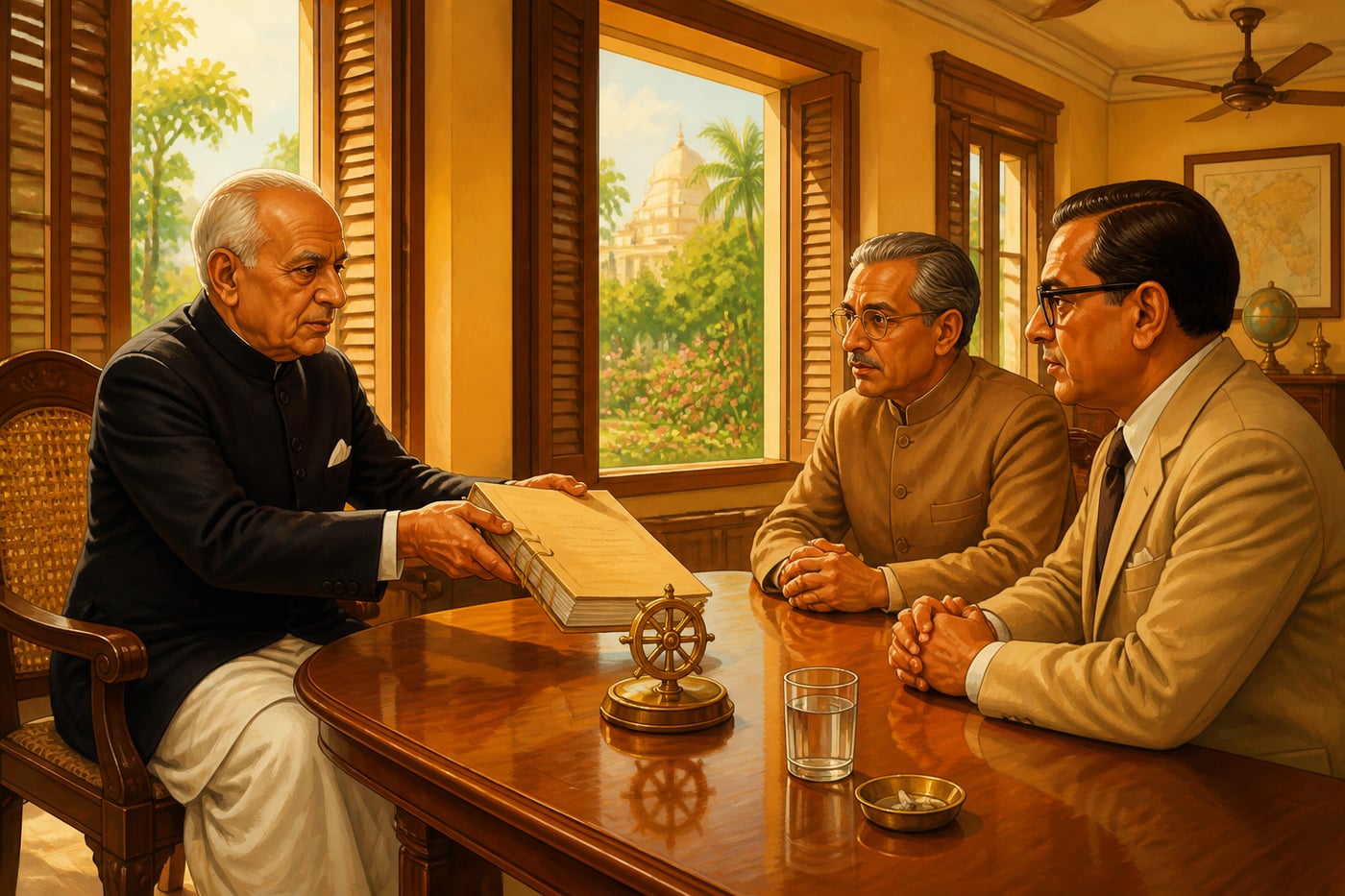
The Odisha legislation was a direct response to the Niyogi Committee Report (1956), which documented systematic conversion operations in central India's tribal belts. The committee, headed by retired Chief Justice Bhawani Shankar Niyogi, spent two years investigating conversion activities in Madhya Pradesh. Its findings were devastating: foreign-funded missions were using schools, hospitals, and famine relief as conversion machinery, targeting Adivasi communities with material inducements.
The Niyogi Report recommended restrictions on foreign missionary funding and legislation against conversion by force, fraud, or inducement. Odisha acted in 1967. Madhya Pradesh followed in 1968. Then decades of legislative silence.
The pattern reveals how legal reform in India moves: initial legislation triggers legal challenges. The Supreme Court upheld the Odisha and MP laws in Rev. Stainislaus v. State of Madhya Pradesh (1977), ruling that Article 25 protects the freedom to practice and propagate religion, but not the right to convert another person. This landmark ruling established the constitutional legitimacy of anti-conversion legislation.
But the political cost of implementation discouraged other states for decades. Gujarat passed its Freedom of Religion Act in 2003. Then a long gap until a cascade of state laws between 2017 and 2024: Jharkhand, Uttarakhand, Himachal Pradesh, Uttar Pradesh, Karnataka, Madhya Pradesh (strengthened), and Haryana.
The FCRA followed a similar trajectory. The original 1976 Act was a blunt instrument of the Emergency era. The 2010 amendments began tightening. The 2020 amendment represented a structural overhaul. Each iteration was more precise, more targeted, and more effective.

Japan's experience with shrine liberation offers a parallel from another civilizational context. Under the State Shinto system (1868-1945), the Japanese government controlled Shinto shrines as instruments of state ideology. The Shinto Directive of December 1945 ordered the separation of Shinto from the state. The Religious Corporations Ordinance of 1945, later formalized as the Religious Juridical Persons Law of 1951, gave shrines legal autonomy as independent religious corporations.
The mechanism was specific: shrines received the legal status of independent juridical persons, allowed to own property, manage their own finances, and govern themselves through boards of trustees. The Association of Shinto Shrines (Jinja Honcho) was established in 1946 as a voluntary coordinating body, not a government agency.
The result: Japanese Shinto shrines today are financially independent, culturally vibrant, and central to Japanese civilizational identity. They maintain traditions, generate revenue, and serve as community nodes. This is precisely the model that temple liberation advocates envision for Indian temples.
The pattern across all four legal pillars is consistent: initial legislation, legal challenge, judicial validation, political hesitation, and then a cascade of implementation once political will materializes. India in 2024 is in the cascade phase.
Dharmic Wisdom: Rajadharma and Institutional Sovereignty
The Arthashastra grounds institutional sovereignty in a clear principle: the ruler's primary duty is to maintain Yogakshema, the welfare and security of the people. This is not abstract benevolence. It is a structural obligation. When institutions that serve civilizational functions (temples, educational centers, cultural bodies) are captured or weakened, the state fails its dharmic obligation.
Kautilya is explicit: the ruler must maintain a Devatadhyaksha (superintendent of temples and religious affairs) not as an instrument of state control but as a protector of institutional autonomy. The Arthashastra distinguishes between protecting institutions and capturing them. The modern Indian state collapsed this distinction, becoming not the protector but the controller of Hindu religious institutions.
The Mahabharata reinforces this through Bhishma's Shanti Parva discourse on Rajadharma. When Yudhishthira asks what constitutes righteous governance, Bhishma lists Dharma-Samsthapana (establishment and maintenance of dharma) as the ruler's foremost duty. This includes ensuring that the legal framework supports rather than undermines civilizational institutions.
The concept of Samanya Dharma (universal principles applicable to all) from the Dharmashastra tradition provides philosophical grounding for UCC. While Vishesha Dharma (specific duties based on one's role and context) allows for diversity of practice, Samanya Dharma establishes a shared ethical and legal foundation. UCC is the modern legislative expression of Samanya Dharma: a common framework of rights and obligations that all citizens share, within which diverse practices can flourish.
Vidura's counsel captures the urgency: a ruler who allows adharmic structures to persist because dismantling them is politically inconvenient is complicit in the damage they cause. Every year of delayed temple liberation, every year of asymmetric personal law, every year of unregulated foreign funding is a year where the legal framework itself serves as a faultline rather than a defense.
The Defense: Building Legal Civilizational Infrastructure
Individual level: Become legally literate.
The first defense is knowledge. Every citizen should understand how FCRA regulates foreign funding and how to identify organizations operating in violation. They should know what anti-conversion laws actually say, not what media characterizations claim. They should understand the constitutional basis for temple liberation under Articles 14, 25, and 26. They should know what UCC means in practice: Goa has operated under one for over sixty years.
Legal literacy is civilizational armor. When media frames FCRA reform as "authoritarian suppression of civil society" or UCC as "attack on minority rights," the legally literate citizen can evaluate these claims against actual legislative text.
Community level: Support legal reform movements.
Temple liberation, UCC implementation, and anti-conversion enforcement require sustained civic pressure, not one-time social media outrage. Concrete actions include filing RTIs on temple revenue usage and government diversion, supporting legal challenges to discriminatory temple control (multiple cases are ongoing in various High Courts), participating in public consultations on state-level UCC implementation, and documenting and reporting fraudulent conversion activities through proper legal channels.
Japan's shrine liberation succeeded because citizens organized sustained advocacy through the Association of Shinto Shrines. India's temple liberation movement needs equivalent institutional backing.
Institutional level: Build legal infrastructure.
The most enduring reform happens through institutions. Legal think tanks that draft model legislation, file PILs, and provide research backing for reform are essential. Pro-bono legal networks that take temple liberation and anti-conversion cases extend the reach of reform. Data infrastructure tracking foreign funding patterns, conversion statistics, and temple revenue diversion makes the case for reform with evidence, not rhetoric.
The lesson from all four pillars is the same: legal reform is not a single legislative event. It is an ecosystem. The FCRA Amendment needed enforcement infrastructure. Anti-conversion laws need district-level monitoring. Temple liberation needs alternative management models ready before government control is removed. UCC needs implementation machinery.
Civilizational renaissance through law is the most durable form of defense. Narratives change, media ecosystems shift, academic fashions evolve. But laws, once enacted and validated by courts, create structural change that persists. The four legal pillars discussed in this lesson are not the complete legal infrastructure India needs. But they address four of the most critical vulnerabilities identified in this course. They are the foundation on which further institutional rebuilding rests.
Case studies
India's FCRA 2020 Amendment: Choking the Funding Pipeline
By 2019, India was the world's largest recipient of foreign NGO funding. Thousands of organizations received foreign contributions with minimal accountability. The cascading sub-granting model allowed a handful of gateway organizations to distribute funds to thousands of grassroots operatives, making it nearly impossible to trace how money was spent. In September 2020, Parliament passed the FCRA Amendment Act, introducing four structural changes: a prohibition on sub-granting, a 20% cap on administrative expenses, mandatory receipt of all foreign funds through a single State Bank of India account in New Delhi, and Aadhaar-linked registration for all office bearers.
Kautilya's Arthashastra prescribes Dandaniti (the science of governance through law) as the mechanism for protecting civilizational order. The FCRA Amendment embodies a core Arthashastra principle: you do not need to ban a threat outright when you can make its operational model structurally unviable. The sub-granting prohibition is classic Kautilyan strategy. Rather than targeting individual NGOs (whack-a-mole), the amendment dismantled the distribution architecture that enabled the entire ecosystem to function. Kautilya would recognize this as attacking the adversary's supply lines rather than fighting individual soldiers.
Foreign contributions to Indian NGOs dropped from Rs 18,065 crore in 2018-19 to approximately Rs 6,060 crore by 2022-23, a 66% decline. Compassion International, which had been channeling approximately $45 million annually into India, had its FCRA registration cancelled. Over 20,000 organizations lost their FCRA licenses between 2017 and 2023. Organizations doing genuine charitable work adapted to the new framework. Those dependent on opaque foreign funding structures could not.
Legal reform is most effective when it targets systemic architecture rather than individual actors. The FCRA Amendment did not ban foreign funding. It made the opaque distribution model that enabled civilizational interference structurally impossible.
India's FCRA reform parallels similar legislation worldwide. The United States' FARA (1938), Israel's NGO Transparency Law (2016), and Hungary's Transparency Act (2017) all address the same structural problem: foreign funding of domestic advocacy organizations operating without transparency.
Between 2017 and 2023, the number of FCRA-registered organizations in India dropped from approximately 33,000 to under 16,000. The single SBI account requirement created a monitoring chokepoint that replaced an enforcement system previously spread across hundreds of bank branches nationwide.
Japan's Shrine Liberation: From State Control to Civilizational Vitality
From 1868 to 1945, the Japanese government controlled Shinto shrines under the State Shinto system. Shrines were classified as government institutions, priests became state employees, and shrine finances were managed by the bureaucracy. The system served state ideology but severed shrines from their organic community function. After Japan's defeat in World War II, the Allied occupation's Shinto Directive of December 15, 1945 ordered the complete separation of Shinto from the state. The Religious Corporations Ordinance of 1945, later formalized as the Religious Juridical Persons Law of 1951, gave every shrine the legal status of an independent juridical person with the right to own property, manage finances, and govern itself through elected trustees.
Kautilya's Arthashastra distinguishes between the state as protector of religious institutions (Devatadhyaksha) and the state as controller. Japan's State Shinto system replicated exactly the distortion that modern India faces: when the state becomes the operator rather than the guardian of sacred institutions, those institutions lose their civilizational function and become instruments of administrative convenience. Japan's liberation model restored the Arthashastra's original design: institutional autonomy protected by, not subordinated to, state authority.
The Association of Shinto Shrines (Jinja Honcho), established in 1946 as a voluntary coordinating body, today oversees approximately 80,000 shrines across Japan. Shrines generate their own revenue through offerings, festivals, and cultural activities. They maintain priests, preserve traditions, and serve as community centers. Japanese New Year shrine visits (Hatsumode) draw over 80 million visitors annually. Shrines are financially independent, culturally vibrant, and central to Japanese civilizational identity.
Temple liberation requires three elements: legal personhood for religious institutions, autonomous governance through devotee-elected bodies, and a voluntary coordinating association (not a government agency). Japan proved this model works at the scale of 80,000 shrines.
India's temple liberation movement faces the same structural challenge Japan solved in 1945-1951. The HRCE model in Tamil Nadu (government controlling approximately 44,000 temples) mirrors Japan's pre-1945 State Shinto system. Japan's solution offers a tested blueprint: legal autonomy, elected boards, and a voluntary coordinating body.
Japan's approximately 80,000 Shinto shrines transitioned from state-controlled institutions to independent juridical persons within six years (1945-1951). Hatsumode (New Year shrine visits) draws over 80 million visitors annually, demonstrating that autonomous shrines became more, not less, relevant to civilizational life after liberation from state control.
From Odisha 1967 to Karnataka 2022: The Anti-Conversion Legislative Arc
In 1954, the Madhya Pradesh government appointed a committee under retired Chief Justice Bhawani Shankar Niyogi to investigate complaints of mass conversions in tribal areas. Over two years, the committee documented foreign-funded missions using schools, hospitals, and famine relief as conversion machinery targeting Adivasi communities. The Niyogi Report (1956) recommended legislation against conversion by force, fraud, or inducement. Odisha passed India's first Freedom of Religion Act in 1967. Madhya Pradesh followed in 1968. Then decades of silence. Gujarat acted in 2003. The Supreme Court validated the constitutional basis in Rev. Stainislaus v. State of Madhya Pradesh (1977), ruling that Article 25 does not include the right to convert another person. A cascade of state laws followed between 2017 and 2024: Jharkhand, Uttarakhand, Himachal Pradesh, Uttar Pradesh, Karnataka, Madhya Pradesh (strengthened), and Haryana.
The Arthashastra treats the protection of Svadharma (each community's right to practice its own tradition) as a function of Rajadharma. Kautilya's framework does not oppose religious diversity. It opposes the weaponization of economic vulnerability to alter the religious landscape by coercion. Anti-conversion laws are the modern legislative expression of this principle: protecting Svadharma by ensuring that changes of faith occur through genuine conviction, not through the Arthashastra's Dana (inducements) being deployed as a tool of civilizational warfare.
By 2024, twelve Indian states have Freedom of Religion Acts in various forms. The Supreme Court's 1977 ruling in Rev. Stainislaus established durable constitutional legitimacy. States with active enforcement report reduced incidents of organized mass conversion activities. The legislative momentum shifted from isolated state action to a recognized policy pattern, with newer laws incorporating lessons from earlier implementations: stricter penalties, broader definitions of inducement, and dedicated enforcement mechanisms.
Legal reform in democratic societies moves through five stages: documentation (Niyogi Committee), initial legislation (Odisha 1967), judicial validation (SC 1977), political hesitation (1977-2017), and cascade (2017-2024). Understanding this arc prevents both impatience and defeatism.
The anti-conversion legislative arc demonstrates that civilizational legal defense is a multi-generational project. The FCRA and UCC reforms are in earlier stages of the same five-stage pattern. Understanding where each reform sits in its arc helps calibrate expectations and strategy.
It took 57 years from the Niyogi Report (1967) to reach the cascade phase where multiple states adopted anti-conversion legislation within a few years. The gap between the second state law (MP 1968) and the third (Gujarat 2003) was 35 years. The gap between recent state laws averages less than 2 years.
Reflection
- The next time you encounter a news article or social media post characterizing FCRA reform as 'authoritarian,' anti-conversion laws as 'anti-minority,' or UCC as 'Hindu imposition,' what specific steps would you take to evaluate the claim against the actual legislative text?
- If a civilization's members are governed by different legal systems based on religious identity, does that legal fragmentation eventually deepen civilizational faultlines, or can legal pluralism coexist with civilizational unity?
- Manusmriti declares that 'the wise know Danda to be Dharma itself.' Can law truly embody dharma, or is law always a blunt instrument that can at best create conditions for dharmic life without being dharmic in itself?