Economic Self-Reliance
Swadeshi, Indigenous Entrepreneurship, and Economic Power
A civilization that cannot produce for itself cannot think for itself. This lesson traces the deliberate destruction of India's once-dominant economic capacity under colonialism, the Swadeshi movement's revolutionary response through indigenous entrepreneurship, and India's modern defense indigenization as proof that economic self-reliance is the foundation upon which the entire Indian Renaissance must be built.
Economic Self-Reliance: Swadeshi, Indigenous Entrepreneurship, and Economic Power
The First Principle
Every civilization rests on an economic foundation. Strip away a people's ability to produce their own steel, weave their own cloth, grow their own food, and build their own weapons, and you have not just impoverished them. You have made them permanently dependent. You have broken their spine.
This is not abstract theory. It is precisely what happened to India.
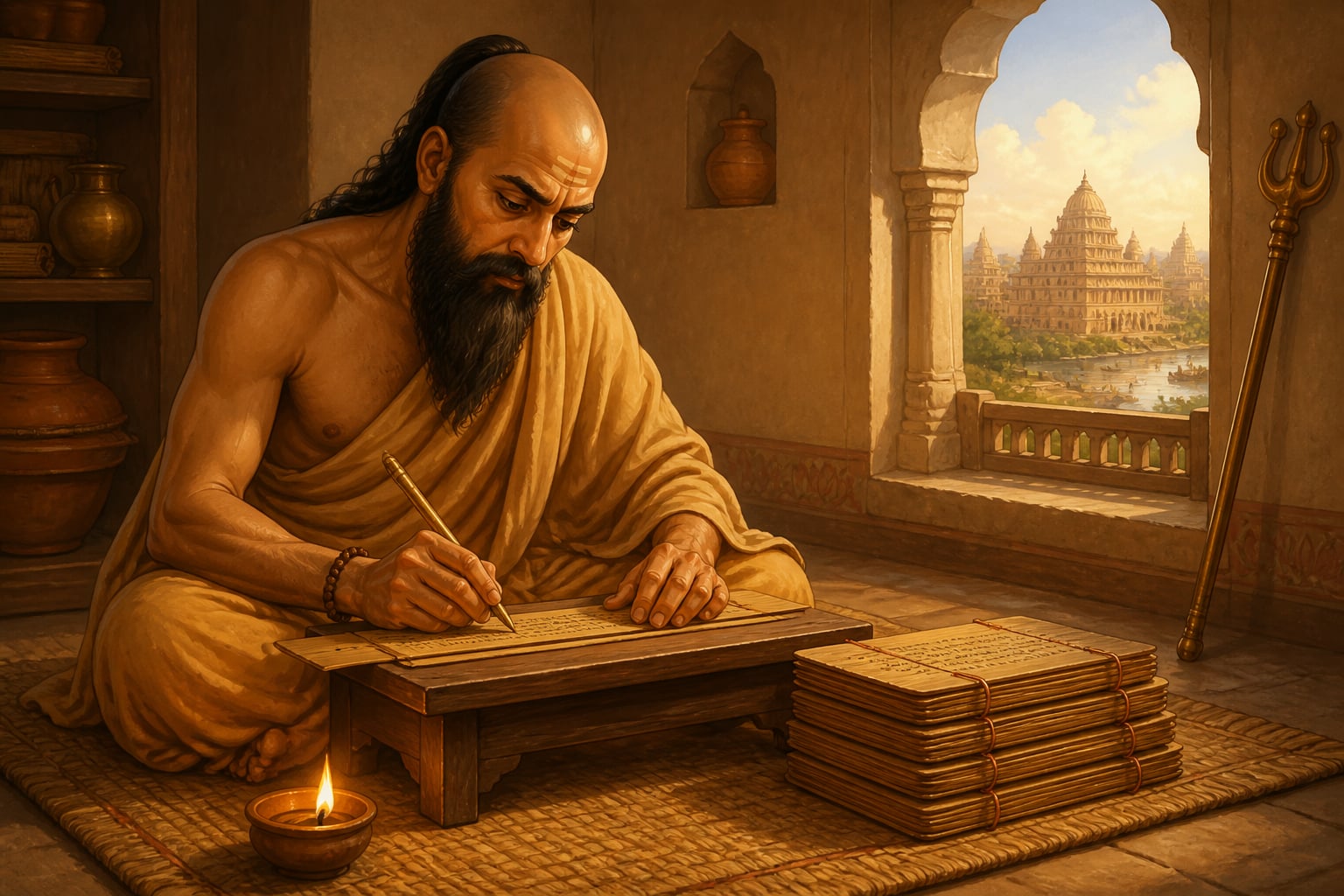
Kautilya understood this over two thousand years ago. In the Arthashastra, he placed artha (material prosperity) as the foundation upon which all other civilizational achievements rest. Without economic strength, there can be no military defense, no cultural flourishing, no dharmic institutions, no education, no justice. A civilization that cannot sustain itself economically is a civilization living on borrowed time.
The lesson of Chapter 10 begins here: the Indian Renaissance is impossible without economic self-reliance. Every other civilizational repair we have discussed, from reclaiming narratives to rebuilding institutions, requires an economic engine powerful enough to sustain it.
The Wound: How India's Economic Spine Was Broken
Before we discuss rebuilding, we must understand what was destroyed and how.
In 1700, India accounted for roughly 24.4% of global GDP, making it the world's largest economy alongside China. Indian textiles were so superior that British manufacturers could not compete. Wootz steel from South India was sought after across the ancient world. Indian shipyards built vessels that European traders marveled at. The subcontinent was not just wealthy. It was an industrial powerhouse.
The British did not simply extract wealth. They systematically dismantled India's productive capacity. The mechanism was precise.
De-industrialization by design. British policy imposed tariffs of 70-80% on Indian textiles entering Britain while allowing British machine-made cloth into India duty-free. Bengal's weavers, who had clothed the world, were reduced to penury. An entire industry was strangled by policy, not by market competition.
The Drain of Wealth. Dadabhai Naoroji, in his landmark work Poverty and Un-British Rule in India (1901), documented how Britain extracted wealth from India through rigged trade, excessive taxation, and remittances by colonial administrators. His calculations showed an annual drain of 200-300 million pounds, a staggering sum that funded Britain's industrial revolution while starving India's own development.
Destruction of indigenous institutions. Pre-colonial India had a sophisticated economic ecosystem: guilds (shreni), village councils managing local economies, temple networks serving as financial institutions, and trade routes connecting India to Southeast Asia, the Middle East, and beyond. Colonial administration systematically replaced these with centralized, extractive structures designed to serve London, not Lucknow.
By 1947, India's share of global GDP had plummeted to less than 4%. A civilization that had been the world's workshop was now among its poorest nations.
The First Counter-Attack: Swadeshi as Civilizational Weapon
The first organized Indian response to economic colonialism came not from politicians alone but from ordinary people who understood a fundamental truth: political freedom without economic independence is meaningless.
The Spark: Bengal Partition (1905)
When Lord Curzon partitioned Bengal in 1905, ostensibly for "administrative efficiency" but transparently to divide Hindu-majority western Bengal from Muslim-majority eastern Bengal, the Indian response was immediate and innovative. Rather than merely protesting politically, leaders like Bal Gangadhar Tilak, Bipin Chandra Pal, and Lala Lajpat Rai called for something revolutionary: Swadeshi.
Swadeshi meant two things simultaneously:
- Boycott: Refuse to buy British manufactured goods
- Build: Create indigenous alternatives
This was not mere economic protest. It was a civilizational declaration of independence.
The Builders
The Swadeshi movement gave birth to India's first generation of indigenous entrepreneurs who saw business not as personal enrichment but as national service.
Jamsetji Tata had already laid the groundwork. His vision for an Indian steel plant, conceived in the 1880s, was driven by the conviction that India could never be truly free while importing steel from its colonizer. The Tata Iron and Steel Company, established in Jamshedpur in 1907, was not just a business venture. It was an act of civilizational defiance. When British experts said Indians could not manufacture quality steel, Tata proved them wrong. By World War I, Tata Steel was supplying rails for the British war effort, a supreme irony that demonstrated the power of indigenous capability.
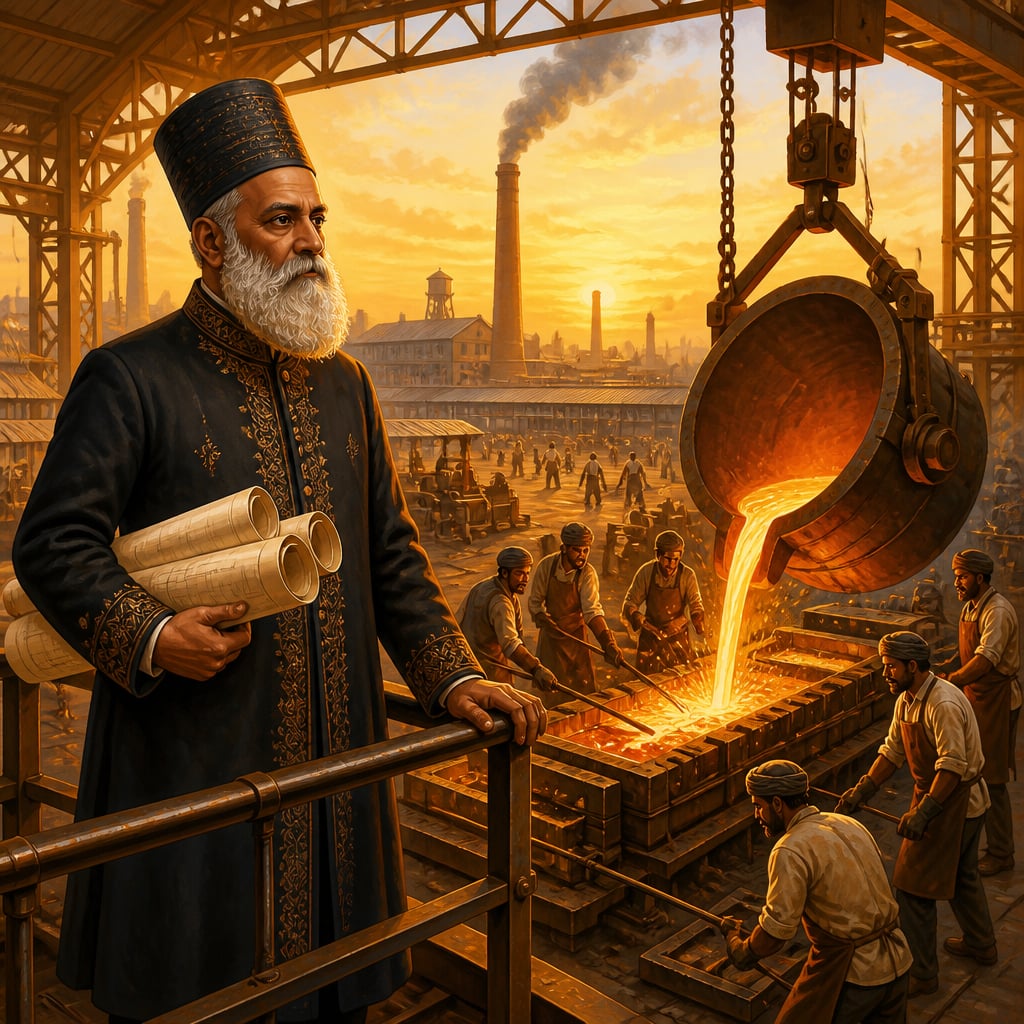
Prafulla Chandra Ray founded Bengal Chemical and Pharmaceutical Works in 1901, India's first pharmaceutical company. A brilliant chemist trained in Edinburgh, Ray returned to India and channeled his expertise into building indigenous scientific and industrial capacity. His work was animated by a simple question: why should India import chemicals and medicines it could produce itself?
The movement spawned banks, insurance companies, educational institutions (the National Council of Education, which later became Jadavpur University), and textile mills. Each was a brick in the wall of economic self-reliance.
The Philosophy Behind the Movement
What made Swadeshi different from ordinary economic nationalism was its dharmic foundation. The movement was not driven by hatred of the foreign, but by love of the indigenous. The Sanskrit root makes this clear: sva (one's own) + desh (country). It was about affirming what is one's own, not merely rejecting what is foreign.
This distinction matters enormously. Pure protectionism breeds insularity and stagnation. Swadeshi, properly understood, breeds creativity and self-confidence. It says: we will master the knowledge, build the institutions, and create the products ourselves. Not because foreign goods are inherently bad, but because a civilization that cannot produce for itself cannot think for itself.
See It Today: India's Defense Indigenization
If Swadeshi was the philosophy, India's modern defense indigenization program is its most dramatic 21st-century expression.
For decades after independence, India was the world's largest arms importer. The dependency was staggering: fighter jets from Russia, submarines from France, artillery from Sweden, rifles from Belgium. Every weapons system imported meant billions of dollars flowing out and, more critically, strategic decisions remaining dependent on foreign suppliers. A nation that cannot build its own weapons cannot make independent foreign policy choices.
During the 1999 Kargil War, India discovered this painful truth when GPS access was denied at a critical moment, leading directly to the development of India's own NavIC satellite navigation system.
The Turnaround
Over the past two decades, India has systematically built indigenous defense capability across every domain.
HAL Tejas Light Combat Aircraft. India's indigenous single-engine multirole fighter, developed by DRDO and Hindustan Aeronautics Limited. While the program faced delays and criticism, the Tejas Mark 1A now rolling off production lines represents something no amount of imported fighters can provide: the institutional knowledge to design, test, and manufacture a modern combat aircraft. This knowledge compounds. Each generation of engineers trains the next. The capability, once built, can never be sanctioned away.
BrahMos Supersonic Cruise Missile. A joint India-Russia venture that produced the world's fastest cruise missile in active service. Travelling at Mach 2.8, BrahMos is now being exported to the Philippines and other nations. India has moved from buyer to seller.
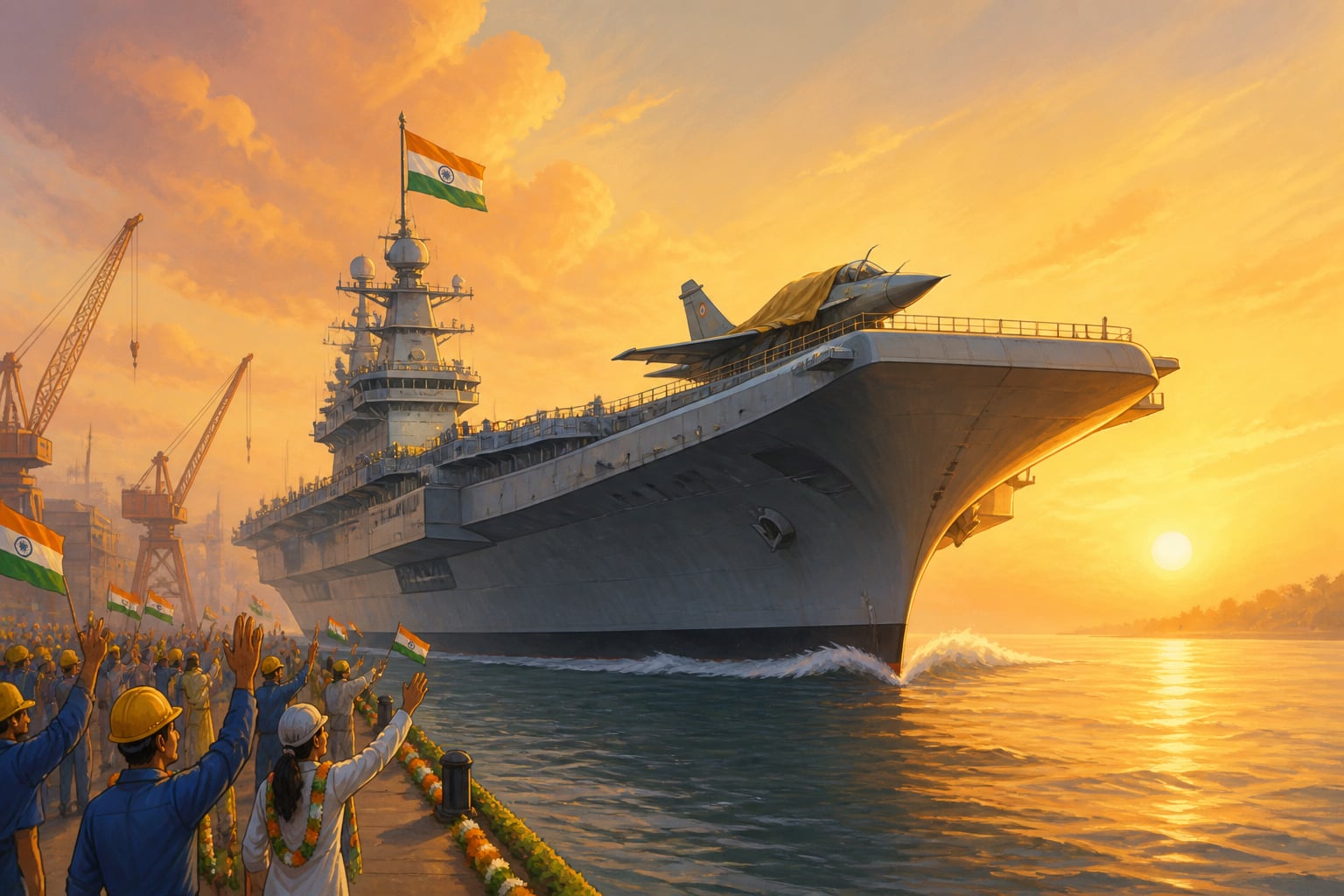
INS Vikrant. India's first indigenously designed and built aircraft carrier, commissioned in 2022. Building a 45,000-ton aircraft carrier requires mastering hundreds of technologies: naval architecture, propulsion, aviation systems, electronics, steel fabrication. INS Vikrant was built at Cochin Shipyard using 76% indigenous content. Only five nations in the world can build aircraft carriers. India is now one of them.
The Mechanism: How Economic Self-Reliance Works
These are not isolated achievements. They represent a deliberate civilizational strategy operating through clear steps:
- Identify the dependency. Which critical capability are we importing? Where is the leash?
- Build the knowledge base. Invest in education, research institutions, and laboratories. The IITs, DRDO labs, and ISRO centers are the modern gurukuls of technical capability.
- Create institutional infrastructure. Establish organizations that can absorb, develop, and scale knowledge. HAL, BEL, BDL, and hundreds of defense PSUs and private sector partners form this ecosystem.
- Accept short-term inefficiency for long-term independence. Indigenous systems cost more initially and take longer. The Tejas program took decades. But imported alternatives come with strings attached forever.
- Scale through policy. The 2020 defense import ban on 411 items forced the ecosystem to mature. Make in India is not a slogan. It is a forcing function.
- Export to build strategic influence. BrahMos exports to Southeast Asia create defense partnerships that no amount of diplomacy alone could achieve.
This mechanism applies identically to pharmaceuticals, semiconductors, space technology, digital payments, and every other strategic domain.
The Civilizational Dimension
Economic self-reliance is not simply about GDP growth or trade balances. It is about something far deeper: the ability of a civilization to make its own choices.
A nation dependent on foreign arms cannot conduct independent foreign policy. A nation dependent on foreign technology cannot control its own data. A nation dependent on foreign pharmaceuticals cannot respond to a pandemic on its own terms. A nation dependent on foreign media cannot tell its own story.
Each dependency is a leash. Each indigenous capability is a freed hand.
This is why Kautilya placed artha at the center of statecraft, not out of materialism but out of realism. Material strength is the prerequisite for everything else: cultural expression, educational excellence, spiritual flourishing, and the ability to defend dharmic institutions from those who would destroy them.
The Breaking India forces documented throughout this course, from missionary networks to academic Indology to geopolitical maneuvering, all ultimately depend on India's economic weakness for their leverage. A strong, self-reliant India is not merely harder to break. It is a civilizational beacon for the rest of the world.
The Road Ahead
India's journey toward economic self-reliance is incomplete. Critical dependencies remain: 85% of crude oil is imported, semiconductor manufacturing is in its infancy, and high-end machine tools still come largely from abroad. The agricultural sector, which supports nearly half the population, needs modernization rooted in indigenous knowledge rather than imported models.
But the direction is clear, and the mechanism is proven. From Jamsetji Tata's steel plant to HAL's Tejas assembly line, from Prafulla Chandra Ray's laboratory to ISRO's launch pads, the thread is the same: Indians building for India, mastering knowledge that no sanction can take away, creating capability that compounds across generations.
The Swadeshi spirit is not nostalgia. It is strategy. And it is the economic foundation upon which the entire Indian Renaissance must be built.
Case studies
The Swadeshi Movement: India's First Economic Counter-Attack
In July 1905, Lord Curzon partitioned Bengal, splitting the prosperous province along religious lines. The real target was Bengal's growing nationalist movement. The Indian response was unprecedented. On August 7, 1905, at a massive gathering at Calcutta's Town Hall, leaders declared a boycott of all British manufactured goods. Bonfires of British cloth lit up streets across Bengal. But the movement went far beyond boycott. Jamsetji Tata's sons established the Tata Iron and Steel Company in 1907, producing the first Indian-made steel at Jamshedpur by 1912. Prafulla Chandra Ray's Bengal Chemical expanded its pharmaceutical production. The National Council of Education was founded in 1906 to replace British-controlled universities. Indigenous banks, insurance companies, and shipping lines emerged. Within five years, imports of British cotton cloth to Bengal dropped by 25%. The movement proved that economic resistance was not just symbolic protest but a viable path to building civilizational capability.
Kautilya's Arthashastra teaches that a kingdom's strength begins with its productive capacity: agriculture, manufacturing, and trade. The British colonial system violated every Kautilyan principle by extracting wealth without reinvestment, destroying indigenous industries to create captive markets, and dismantling the institutional infrastructure (guilds, village councils, temple economies) that sustained India's economic ecosystem. The Swadeshi response was, whether its leaders knew it or not, a return to Kautilyan economics: rebuild the kosha (treasury) by rebuilding productive capacity. The boycott was the shield; indigenous enterprise was the sword.
The Swadeshi movement catalyzed India's first wave of indigenous industrialization. Tata Steel became one of the world's largest steel producers. Bengal Chemical laid the foundation for India's pharmaceutical industry. The National Council of Education evolved into Jadavpur University. Though the movement was eventually suppressed by British authorities through sedition charges and deportations, it established a permanent template: economic self-reliance as civilizational weapon. Every subsequent Indian movement, from Gandhi's khadi campaign to today's Make in India, traces its intellectual DNA to Swadeshi.
Boycott without building is just protest. Building without boycott is just business. The Swadeshi movement combined both into a civilizational strategy: simultaneously refuse dependency and create alternatives. This dual approach remains the template for any civilization seeking economic sovereignty.
India's Swadeshi principle is alive in the 2020s 'Make in India' and 'Atmanirbhar Bharat' campaigns. The same dual strategy of refusing dependency while building indigenous alternatives now drives semiconductor fabrication, defense manufacturing, and renewable energy policy.
Imports of British cotton cloth into Bengal fell by 25% within five years of the Swadeshi declaration, while indigenous textile production surged, demonstrating that economic resistance could produce measurable results even against the world's largest empire.
India's Defense Indigenization: From Largest Importer to Indigenous Arsenal
In 1999, during the Kargil War, the United States denied India access to GPS signals at a critical operational moment, exposing a devastating strategic vulnerability. India's military was fighting a war with weapons, navigation systems, and communication equipment largely imported from foreign nations whose cooperation could not be guaranteed. The wake-up call was brutal: a nation that imports its defense capability imports its foreign policy too. Over the next two decades, India launched the most ambitious defense indigenization program in its history. DRDO and HAL developed the Tejas Light Combat Aircraft despite decades of skepticism. The BrahMos joint venture produced the world's fastest cruise missile in active service. Cochin Shipyard built INS Vikrant, India's first indigenous aircraft carrier, using 76% domestic content. In 2020, the government banned imports of 411 defense items, forcing the ecosystem to mature. By 2023, India's defense exports had crossed $2.5 billion, up from nearly zero a decade earlier.
Kautilya's dictum 'kośa-mūlo daṇḍaḥ' (military power is rooted in the treasury) contains a deeper truth the Arthashastra makes explicit: a state that depends on external sources for its military capability is a state whose sovereignty is conditional. The GPS denial during Kargil was a modern demonstration of what Kautilya warned against: allowing critical state functions to depend on external actors whose interests may not align with yours. India's response, building indigenous navigation (NavIC), missiles (BrahMos), aircraft (Tejas), and naval platforms (Vikrant), follows the Arthashastra's prescription precisely: build the capability yourself, accept short-term cost, and eliminate the dependency.
India has transformed from the world's largest arms importer to a growing defense exporter. BrahMos missiles are now exported to the Philippines and other nations. The Tejas fighter is being offered to countries seeking affordable combat aircraft. INS Vikrant placed India among the five nations capable of building aircraft carriers. Defense exports crossed $2.5 billion in 2023. More importantly, India can now make foreign policy decisions without checking whether its weapons suppliers will continue to provide spare parts.
Strategic self-reliance demands accepting decades of costly, imperfect indigenous development over the convenience of ready-made imports. The Tejas took 30 years. But an imported fighter comes with permanent strings attached. The lesson: short-term inefficiency in pursuit of long-term sovereignty is not waste. It is investment in civilizational freedom.
India's response to the 1999 GPS denial mirrors its 2020s push for indigenous semiconductor manufacturing. The pattern is consistent: technology denial by Western powers triggers a decade-long indigenous development cycle that ultimately produces sovereign capability and export potential.
India's defense exports grew from under $200 million in 2014 to over $2.5 billion by 2023, a twelve-fold increase driven almost entirely by indigenous platforms and systems that did not exist a generation earlier.
Living traditions
The Swadeshi spirit lives on through multiple institutional expressions. The Make in India initiative, launched in 2014, directly echoes the Swadeshi call to build indigenous manufacturing capability. Two defense industrial corridors in Uttar Pradesh and Tamil Nadu are creating concentrated ecosystems of indigenous defense production. India's UPI digital payments system, processing more transactions than Visa and Mastercard combined, demonstrates technology self-reliance in financial infrastructure. The Startup India program has created one of the world's largest startup ecosystems, producing over 100 unicorn companies. ISRO's space program, which now launches satellites for other nations, shows how indigenous capability can become an export strength. Each of these represents the same Swadeshi principle at work: build the capability yourself, and the world will come to you.
- Tata Steel Works and Jubilee Park, Jamshedpur: The birthplace of India's industrial self-reliance. The Tata Steel plant, established in 1907, was India's first indigenous steel plant and the foundation of the Swadeshi industrial movement. The adjacent Jubilee Park and the Tata Steel Zoological Park commemorate the vision of Jamsetji Tata. The planned city of Jamshedpur itself, built by the Tatas with worker housing, schools, and hospitals, demonstrates the dharmic business model of industry serving community.
- HAL Heritage Centre and Aerospace Museum: India's premier aerospace museum, showcasing the journey of Hindustan Aeronautics Limited from its founding in 1940 to its role as the backbone of India's defense indigenization. Exhibits include decommissioned aircraft, helicopter prototypes, and the story of the Tejas program. The museum provides a vivid chronicle of how India built its indigenous aerospace capability from scratch, including mock-ups, engine displays, and interactive exhibits on aircraft design and manufacturing.
Reflection
- How do your daily economic choices, from the products you buy to the platforms you use, either strengthen or weaken indigenous capability in your own country?
- Why did Kautilya place artha as the foundation of dharma rather than treating material wealth as spiritually inferior? What does this tell us about the relationship between economic power and civilizational values?
- At what point does strategic self-reliance become counterproductive isolationism? How should a civilization determine which capabilities it must build indigenously and which it can safely import?