Inter-Community Harmony
Dharma-Based Social Ethics and Shared Identity Beyond Caste
A civilization divided against itself does not need external enemies. This lesson exposes how colonial census-making and post-independence identity politics turned India's natural diversity into weaponized divisions, then recovers the dharmic framework for inter-community harmony: Chhatrapati Shivaji's merit-based state that united communities through shared purpose rather than enforced sameness, and the Ekal Vidyalaya movement's 100,000 grassroots schools bridging the tribal-mainstream divide today. The mechanism is specific and proven: shared enterprise over shared identity, material grievances addressed first, local cultures respected within a larger civilizational identity, and institutional infrastructure that makes harmony structural rather than sentimental.
Inter-Community Harmony: Dharma-Based Social Ethics and Shared Identity Beyond Caste
The Civilizational Imperative
A civilization divided against itself does not need external enemies. It will destroy itself.
This is not sentimentality. It is strategic reality. Every faultline documented in this course, from the caste weaponization of Chapter 5 to the separatist movements of Chapter 6, depends on one precondition: Indians who see themselves as members of competing groups rather than a shared civilization. The missionary who converts a Dalit community, the academic who frames tribal identity as non-Hindu, the separatist who demands a linguistic homeland, all operate through the same mechanism. They exploit real grievances to fracture shared identity.
The antidote is not denial that grievances exist. They do. The antidote is a framework powerful enough to address those grievances while building shared civilizational identity. That framework already exists within dharmic tradition. It does not need to be invented. It needs to be recovered, articulated, and deployed.
The Wound: How Shared Identity Was Fractured
India has never been a monoculture. Its genius has always been unity in diversity: thousands of jatis, hundreds of languages, dozens of regional traditions, all held together by shared civilizational threads. Pilgrimage networks, festival cycles, epic narratives, philosophical frameworks, and a common understanding of dharma created a web of belonging that could accommodate extraordinary difference.
Colonial administration turned this diversity into division. The census, introduced in 1871, forced fluid social categories into rigid, enumerated boxes. Communities that had defined themselves by occupation, region, or sect were now permanently classified by "caste." The colonial ethnographer Herbert Risley explicitly stated his goal: to create a "scientific" racial hierarchy that would make Indian society legible to British administrators and, crucially, divisible.
The damage was profound. Categories that had been contextual became constitutional. Identities that had been one dimension of a person's social existence became the primary marker around which political mobilization, resource allocation, and social status were organized. Post-independence India, despite its best intentions, inherited and in some cases deepened these categorical divisions through reservation politics and caste-based enumeration.
The Breaking India forces documented in this course exploit these divisions with precision. But the divisions themselves are real, felt, and consequential. Any serious framework for inter-community harmony must begin by acknowledging this.
The Dharmic Framework: Beyond Tolerance to Shared Ethics
Western approaches to social harmony typically operate through two models: the liberal "tolerance" model (live and let live) and the social justice model (redistribute power between identity groups). Neither has produced lasting inter-community harmony anywhere in the world. The tolerance model produces polite indifference that collapses under stress. The social justice model often deepens the very divisions it claims to address by organizing society permanently around grievance categories.
Dharmic civilization offers a fundamentally different framework, one tested over millennia.
The Principle of Shared Dharma
The Mahabharata's Shanti Parva contains a remarkable passage where Bhishma teaches Yudhishthira that the dharma of a ruler is to ensure that all communities within the kingdom can fulfill their own dharma. This is not tolerance. It is active stewardship. The king does not merely permit diversity. He enables the flourishing of every community under a shared ethical framework.
This principle operates at multiple levels:
Sadharana Dharma (Universal Ethics). Truthfulness, non-violence, compassion, self-discipline. These values apply to every human being regardless of birth, occupation, or community. They create a shared ethical floor that transcends all social categories. You may be a Brahmin or a Chandala, a merchant or a farmer, but sadharana dharma applies equally.
Svadharma (Individual Purpose). Each person has their own path, their own contribution to make. This is not a prescription for hierarchy. It is a recognition that a healthy society needs diverse contributions: the teacher's wisdom, the warrior's courage, the merchant's enterprise, the artisan's skill. When every contribution is valued as essential, social harmony follows naturally.
Raj Dharma (Governance Ethics). The ruler's duty is not to favor one community over others but to create conditions where all can thrive. This is the principle Chhatrapati Shivaji Maharaj would later embody with extraordinary precision.
The Critical Distinction
The dharmic framework differs from Western models in one crucial respect: it does not require everyone to become the same. It does not demand that communities abandon their distinct identities, traditions, or practices. Instead, it creates a shared civilizational identity layer that sits above community identity, not replacing it but encompassing it.
A Tamil Shaiva and a Bengali Vaishnava worship differently, eat differently, speak differently. But they share the Ramayana, the Mahabharata, the concept of dharma, the practice of pilgrimage, the festival calendar, and a civilizational memory stretching back thousands of years. Their diversity is not a defect. It is a design feature. The shared civilizational identity makes that diversity cohesive rather than fragmentary.
The Historical Model: Shivaji's Merit-Based State
If the dharmic framework is the theory, Chhatrapati Shivaji Maharaj's state-building is the most compelling historical demonstration that it works in practice.
The Context
Seventeenth-century Maharashtra was a society stratified by caste, fragmented by regional loyalties, and subjugated by Mughal imperial power. The prevailing assumption, shared by both Mughal administrators and many Hindu elites, was that a Maratha of modest origin could not build a sovereign state. Shivaji proved this assumption catastrophically wrong, and the way he did it offers a template for inter-community harmony that remains relevant today.
The Method: Merit Over Birth
Shivaji's genius was not merely military. It was organizational. He built a state that systematically prioritized capability over caste, creating a shared Maratha identity that united diverse communities against external domination.
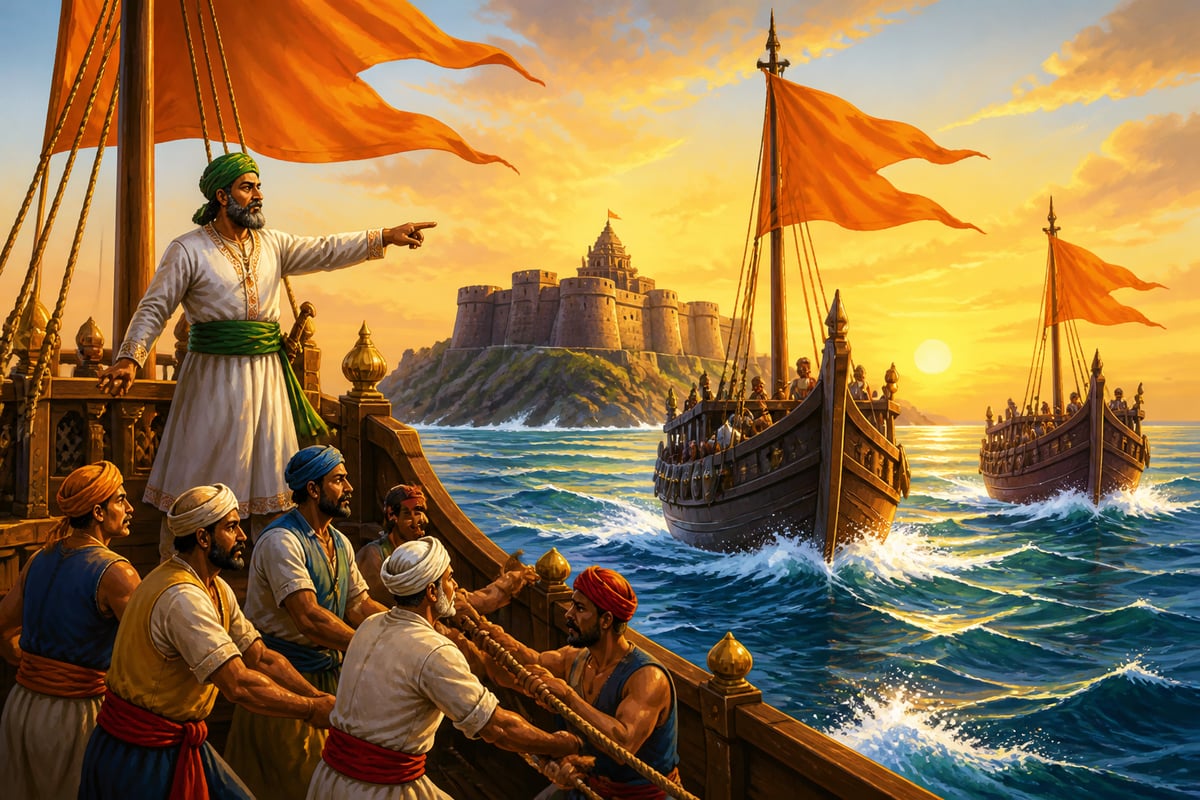
Military appointments by merit. Shivaji's navy, a revolutionary innovation for a land-based Maratha power, was commanded by admirals chosen for their seafaring skill, not their birth. His infantry and cavalry drew from Marathas, Kunbis, Dhangars, Mahars, and other communities. Military rank was earned through demonstrated courage and competence. This was not modern egalitarianism imposed from above. It was Kautilyan statecraft: the best person for each role, because the survival of the state depended on it.
Administrative inclusivity. His Ashtapradhan (council of eight ministers) included members from diverse backgrounds. His revenue system, adapted from earlier Deccan models, was designed to be fair to cultivators regardless of caste. Revenue collectors were rotated to prevent local power consolidation that might harden along caste lines.
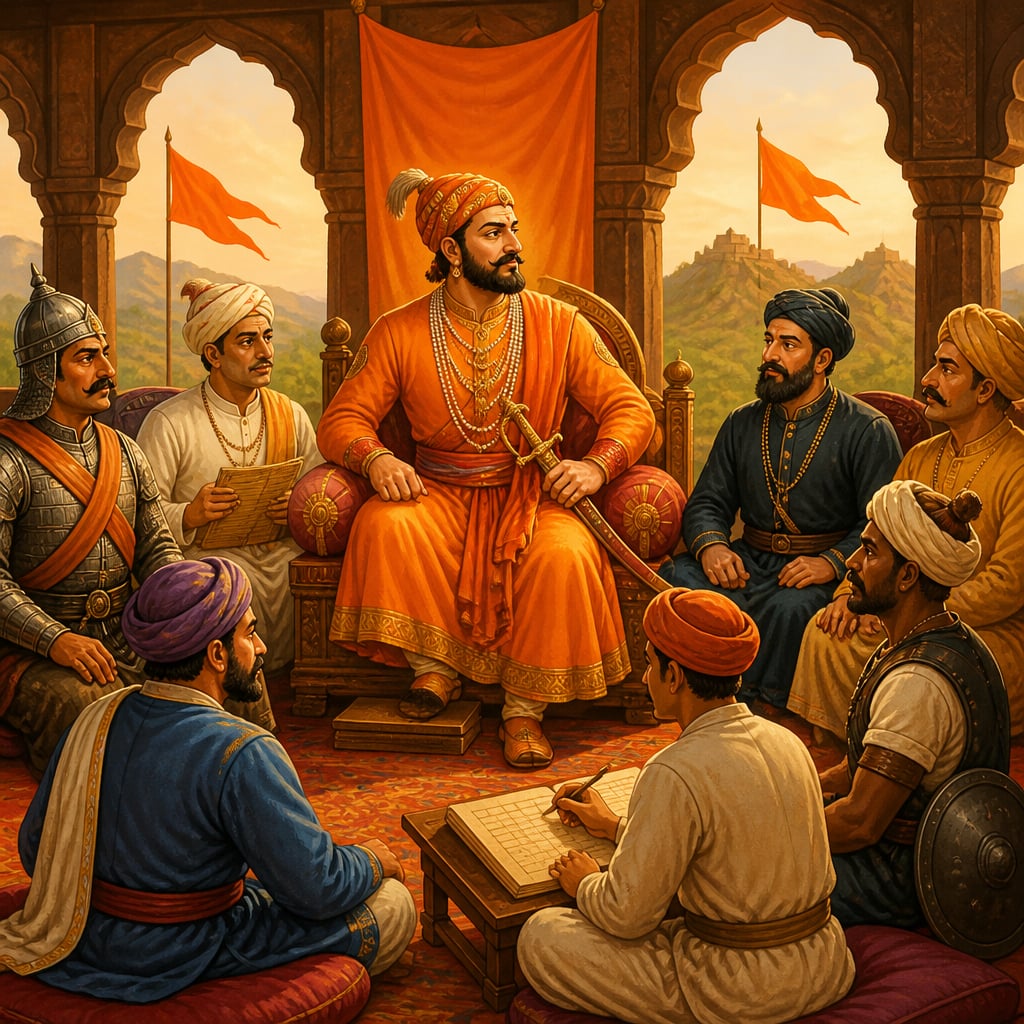
Respect for all communities. Shivaji's treatment of women, prisoners, and religious sites of all faiths was governed by explicit ethical codes. His standing orders prohibited destruction of religious sites and molestation of civilians during military campaigns. These were not pragmatic compromises. They were expressions of raj dharma: the ruler's duty to protect all subjects.
Economic integration. Shivaji's state created economic opportunities that cut across caste. Shipbuilding employed carpenters, rope-makers, sail-makers, and navigators from multiple communities. Fort construction united masons, laborers, engineers, and provisioners. Shared economic enterprise created shared identity more effectively than any proclamation could.
Why It Worked
Shivaji's model worked because it offered something powerful to every community: a stake in a shared civilizational project larger than any single group's interests. The Mahar soldier fighting alongside the Maratha cavalry was not being "tolerated." He was essential. The Prabhu administrator managing the Konkan revenue was not a token appointment. He was the best person for the job.
This is the dharmic model in action. Not erasing difference, but creating a shared identity and purpose large enough to encompass difference. Not demanding that communities abandon their traditions, but demonstrating that shared civilizational defense requires every community's contribution.
The contrast with colonial and post-colonial approaches is sharp. Where the British census froze communities into competitive categories, Shivaji's state offered a shared enterprise that rewarded contribution. Where identity politics organizes society around grievance, Shivaji organized it around shared purpose.
See It Today: Ekal Vidyalaya and Grassroots Bridge-Building
If Shivaji's state demonstrates the principle at the level of governance, the Ekal Vidyalaya movement demonstrates it at the level of civil society, in over 100,000 villages across India.
The Problem It Solves
India's tribal communities, constituting roughly 8.6% of the population (over 100 million people), occupy a critical faultline. As documented in earlier chapters, Breaking India forces have systematically targeted tribal populations with a two-pronged narrative: first, that tribals are not Hindu and never were; second, that their poverty and marginalization can only be addressed through conversion and Western-model activism.
This narrative succeeds wherever the Indian state has failed to provide basic services: education, healthcare, livelihood support. The vacuum created by state absence is filled by well-funded conversion networks, NGOs with separatist agendas, and Naxal recruiters. The tribal faultline is a direct consequence of civilizational neglect.
The Ekal Solution
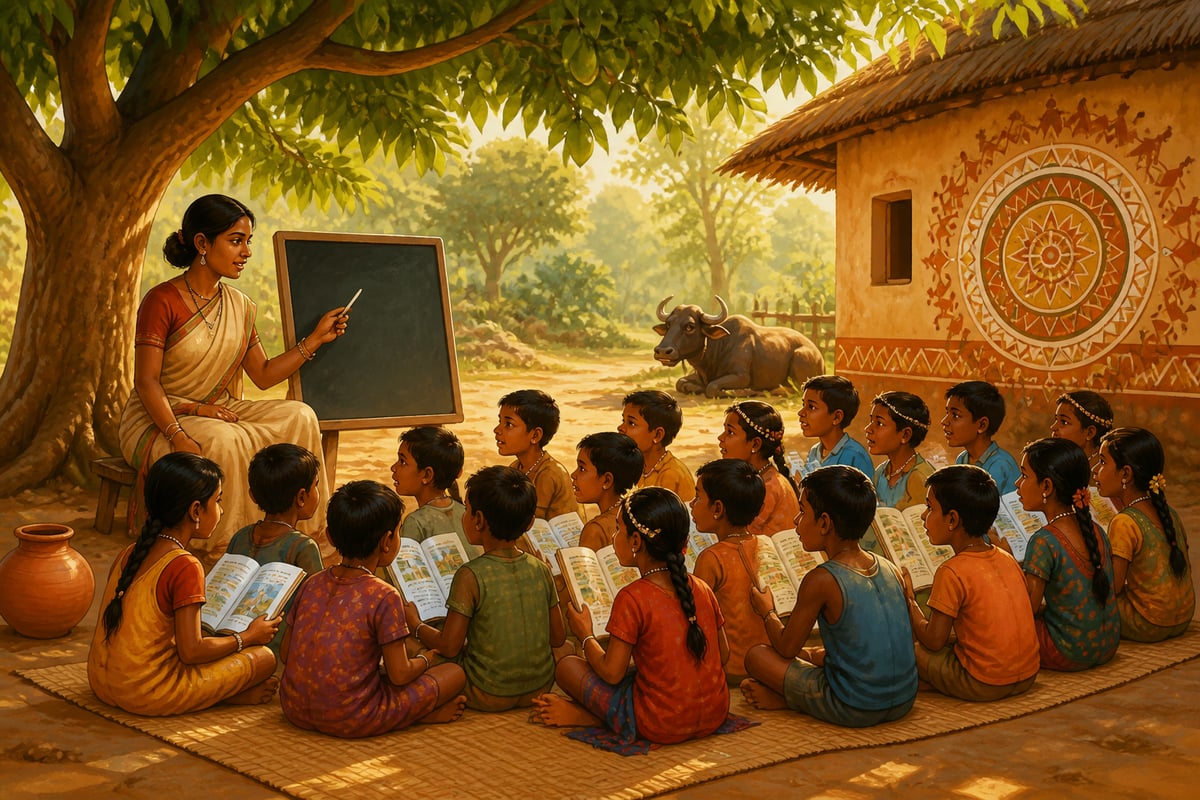
The Ekal Vidyalaya (Single-Teacher School) movement, founded by Shyam Gupt in 1988, represents the most ambitious grassroots response to this civilizational neglect.
The model is deceptively simple. One teacher. One village. Two to three hours of daily instruction. No buildings required: classes meet under trees, in community halls, wherever space exists. The curriculum covers literacy, numeracy, health and hygiene, cultural values, and practical skills. The cost per student is remarkably low: approximately 1,200 rupees ($15) per year.
But the simplicity masks a sophisticated social architecture:
Local ownership. Teachers are drawn from the community itself. They are not outsiders imposing alien values. They are village members who receive training and a modest stipend. This creates employment within the community while ensuring cultural continuity.
Cultural integration, not erasure. The curriculum respects and incorporates local tribal traditions, songs, stories, and practices. It does not demand that tribals become "mainstream." Instead, it builds bridges between local identity and broader Indian civilizational identity, showing how tribal traditions connect to, and enrich, the larger dharmic ecosystem.
Comprehensive community development. Ekal schools are not just educational institutions. They become nodes for health awareness, agricultural innovation, women's empowerment, and community organizing. The school becomes the village's connection point to the broader civilizational network.
Scale through decentralization. With over 100,000 schools serving 2.8 million students annually, Ekal operates in virtually every tribal district in India. The organizational structure mirrors the content philosophy: decentralized, community-owned, locally adapted, but connected to a national network.
The Results
The results are measurable. In districts where Ekal operates, tribal communities show higher literacy rates, better health outcomes, lower rates of religious conversion, and stronger integration with regional and national life, all while maintaining their distinct cultural identities. This is not assimilation. It is integration: the tribal child learns to read and write in the national language while singing songs in her own tongue.
The funding model itself demonstrates inter-community bridge-building. A significant portion of Ekal's funding comes from the Indian diaspora, creating a direct connection between prosperous urban Indians (and NRIs) and the most marginalized rural communities. When a software engineer in Bangalore or Houston sponsors an Ekal school in Jharkhand, both parties become stakeholders in the same civilizational project.
The Mechanism: How Inter-Community Harmony Works
Drawing from both Shivaji's state-building and Ekal's grassroots model, a clear mechanism emerges. Inter-community harmony is not a feeling. It is an engineered outcome that follows specific steps:
Step 1: Shared Purpose Over Shared Identity
The most effective bridge between communities is not telling people they are the same. It is giving them a shared project. Shivaji's state gave every community a stake in Maratha sovereignty. Ekal gives every community a stake in children's education. When a Mahar soldier and a Brahmin administrator both serve the same kingdom, their caste difference becomes less salient than their shared commitment.
The mechanism: Create shared enterprises (defense, education, economic development, cultural revival) that require diverse contributions and distribute benefits widely.
Step 2: Address Material Grievances First
Dharmic social harmony cannot be built on empty stomachs. Every successful model of inter-community bridge-building begins with addressing the material conditions that make communities vulnerable to exploitation. Shivaji's fair revenue system gave cultivators economic security. Ekal's schools provide literacy and health awareness where the state has failed.
The mechanism: Identify the material grievances that make communities vulnerable to Breaking India narratives. Address them through dharmic institutions before expecting shared civilizational identity to take hold.
Step 3: Respect Local Identity While Building Shared Identity
Neither Shivaji's state nor Ekal's schools demand that communities abandon their distinct identities. Instead, they create a larger identity framework that encompasses local identity without erasing it. A Dhangar shepherd in Shivaji's army remained a Dhangar. An Ekal student from a Santal village remains Santal. But both also become participants in something larger.
The mechanism: Build a civilizational identity layer (shared narratives, shared festivals, shared ethical framework) that sits above community identity. Never demand that the lower layer be abandoned.
Step 4: Institutional Infrastructure for Harmony
Good intentions do not survive without institutions. Shivaji created administrative structures (the Ashtapradhan, the revenue system, the military hierarchy) that institutionalized merit-based inclusion. Ekal created an organizational structure that scaled community-level schools to national coverage. Without institutions, harmony remains a personal virtue that dies with its practitioners.
The mechanism: Build institutions: schools, temples, cultural organizations, economic cooperatives, that structurally require inter-community participation and structurally distribute benefits across communities.
Step 5: Create Positive-Sum Outcomes
Inter-community harmony fails when resources are zero-sum, when one community's gain is another's loss. It succeeds when shared enterprise creates new value that benefits all. Shivaji's conquests expanded territory and revenue for everyone, not just one caste. Ekal's schools create literate, healthy communities that contribute to regional and national prosperity.
The mechanism: Design economic, educational, and cultural institutions where inter-community cooperation produces outcomes that no single community could achieve alone.
What Doesn't Work: The Failure of Imported Frameworks
The dharmic mechanism is best understood by contrasting it with approaches that have demonstrably failed.
Identity politics as permanent structure. When social policy is organized permanently around caste, religion, or ethnic categories, with benefits allocated by group and grievances cultivated by political entrepreneurs, the result is not harmony but institutionalized division. Each community maximizes its claims. Each electoral cycle deepens the categories. The reservation system, originally designed as a temporary measure to address historical injustice, has in some cases become a permanent system that incentivizes communities to compete for "backward" status rather than build shared prosperity.
Top-down secularism. The Nehruvian model of state-enforced secularism sought to remove communal identity from public life. But identity does not disappear when the state ignores it. It goes underground, emerges in distorted forms, and becomes vulnerable to manipulation by forces the state cannot control. A dharmic civilization that pretends to have no civilizational identity leaves a vacuum that hostile narratives rush to fill.
NGO-driven "empowerment." Many internationally funded NGOs operating in India's tribal and Dalit communities frame their work as "empowerment" but operationalize it through separatist identity construction: tribal identity as non-Hindu, Dalit identity as anti-Brahmin, regional identity as anti-national. The result is not empowered communities but fragmented ones, ripe for external manipulation.
The dharmic alternative does not ignore injustice. Narayan Guru confronted caste oppression head-on. Shivaji's merit-based appointments directly challenged claims to exclusive governance authority based on birth. But they addressed injustice from within the civilizational framework rather than from outside it. They reformed the tradition rather than rejecting it. And they offered a positive shared identity rather than organizing society permanently around historical wounds.
The Road Ahead
Inter-community harmony in India is not a problem to be solved once and forgotten. It is a civilizational practice that must be actively maintained, like any other infrastructure.
The elements are clear. Shared civilizational identity must be articulated positively: not "we are all the same" but "we all belong to this civilization and it needs all of us." Material grievances must be addressed through dharmic institutions that provide education, healthcare, economic opportunity, and dignity to every community. Local identities must be respected and integrated, not erased. And all of this must be institutionalized so that it survives beyond any single leader or movement.
The greatest advantage India possesses is that this is not a new project. The dharmic framework for inter-community harmony has been articulated by sages, demonstrated by kings, and lived by millions of ordinary people across millennia. It does not need to be imported from any foreign intellectual tradition. It needs to be recovered from India's own civilizational heritage, and put to work at the scale the moment demands.
Case studies
Shivaji's Merit-Based State: Inter-Community Harmony as Statecraft
In the 1640s-1670s, Chhatrapati Shivaji Maharaj faced an extraordinary challenge: building a sovereign Hindu state in Maharashtra against the Mughal Empire, the Bijapur Sultanate, and the Golconda Sultanate simultaneously. The prevailing social order was fragmented by caste. Brahmin elites questioned whether a Maratha of the Bhonsle clan had the standing to claim sovereignty. Mughal administrators dismissed him as a mountain bandit. Shivaji's response was to build something no one expected: a state that systematically prioritized merit over birth. His Maratha navy, India's first significant naval force in centuries, was commanded by Kanhoji Angre and other admirals chosen for seafaring expertise, not lineage. His infantry drew from Marathas, Kunbis, Dhangars, and Mahars, with military rank earned through battlefield performance. His Ashtapradhan council included Brahmins, Prabhus, and members of other communities. His revenue system rotated collectors to prevent caste-based local power consolidation. During campaigns, standing orders prohibited destruction of mosques, churches, and harassment of civilians of any faith.
Shivaji was operationalizing raj dharma as articulated in the Mahabharata's Shanti Parva: the ruler's supreme duty is not to his own community but to all subjects. Bhishma teaches Yudhishthira that a king who favors one group over another is like a charioteer who whips only one horse. The chariot will not move straight. Shivaji also embodied the Bhagavad Gita's samadarshana: he saw capability where others saw caste. His protection of all religious sites during warfare was not secularism in the Western sense. It was the dharmic principle that a righteous ruler is the guardian of all paths to the divine, not the enforcer of one. Kautilya's Arthashastra prescribed exactly this approach: the strongest state is one that mobilizes every community's strength, because a state that excludes talent impoverishes itself strategically.
Shivaji's merit-based model created a Maratha state that expanded from a handful of hill forts to a confederacy spanning much of the Indian subcontinent within a century. The Maratha Empire became the most powerful Indian state of the 18th century precisely because its social architecture drew strength from every community. Mahar soldiers who fought for Shivaji became celebrated figures. The Peshwa period's later narrowing of this inclusive model to Brahmin dominance directly correlates with the Maratha Empire's eventual fragmentation and vulnerability to British conquest.
A civilization that excludes any community's talent weakens itself against external threats. Shivaji proved that inter-community harmony is not idealism. It is the most effective military, administrative, and economic strategy available. When the Maratha state later abandoned this principle, it signed its own death warrant.
Shivaji's merit-based governance model directly challenges the modern narrative that pre-colonial Hindu states were rigidly caste-bound. His example is cited today by organizations working to build cross-caste Hindu solidarity against faultline engineering that exploits caste divisions.
Shivaji built a navy of over 400 vessels manned by communities from across the western coast, making it the first significant Indian naval force in centuries and a direct threat to European maritime powers including the Portuguese and the British East India Company.
Ekal Vidyalaya: 100,000 Schools Bridging India's Tribal Divide
In 1988, Shyam Gupt traveled to the tribal heartlands of Jharkhand and confronted a devastating reality: millions of tribal children had no access to education, healthcare, or connection to the broader Indian civilizational fabric. Government schools were absent or dysfunctional. Into this vacuum poured well-funded missionary organizations offering education bundled with conversion, and Naxal recruiters offering ideology bundled with violence. Gupt's response was radically simple: one teacher per village, two to three hours of daily instruction, no buildings required. Teachers would be recruited from the village itself, trained, and given a modest stipend. The curriculum would teach literacy, numeracy, health, and cultural values while respecting and incorporating local tribal traditions. The cost: approximately 1,200 rupees ($15) per student per year. From that single insight, the Ekal Vidyalaya movement grew to over 100,000 schools across virtually every tribal district in India, serving 2.8 million students annually. A significant portion of funding comes from the Indian diaspora, creating a direct bridge between prosperous NRIs and India's most marginalized communities.
The Ekal model embodies the Rig Vedic principle of sangacchadhvam (come together): it does not lecture tribals about becoming 'mainstream.' It brings the community together around its own children's education, using local teachers who are trusted members of the village. This mirrors the Vedic approach to knowledge transmission: the guru is not an alien authority but a trusted elder within the community. The curriculum's integration of local tribal traditions with broader Indian civilizational identity follows the dharmic principle of unity in diversity. It practices what Vasudhaiva Kutumbakam actually means: not erasing local identity but connecting it to a larger family. The decentralized, community-owned structure mirrors the ancient panchayat model rather than top-down colonial administration.
In districts where Ekal operates, tribal communities show measurably higher literacy rates and better health outcomes. Conversion rates are lower where Ekal schools are present, not because the schools preach anti-conversion messages, but because they fill the vacuum that conversion networks exploit. The movement has expanded beyond basic education to include health awareness, agricultural innovation, women's empowerment programs, and digital literacy. The diaspora funding model has created a stakeholder network spanning India and the world, turning inter-community bridge-building into a global civilizational project.
The tribal faultline exists because of civilizational neglect, not because tribals are inherently separate from Indian civilization. When dharmic institutions fill the vacuum with education, healthcare, and cultural respect, the faultline closes naturally. Ekal proves that inter-community harmony is built one village at a time, through service, not through slogans.
Ekal Vidyalaya's model of grassroots education in tribal areas directly counters the vacuum that conversion networks exploit. Its cost-effective, community-rooted approach is now studied as a replicable template for civilizational outreach in underserved regions across South Asia and Africa.
At approximately 1,200 rupees ($15) per student per year, Ekal Vidyalaya delivers education at roughly 1/50th the per-student cost of a government school, while operating in areas government schools have failed to reach, demonstrating that grassroots dharmic institutions can out-perform the state in bridging social divides.
Living traditions
The dharmic model of inter-community harmony is sustained today through multiple institutional expressions. Ekal Vidyalaya's 100,000+ schools in tribal and rural India represent the largest grassroots education network in the world, bridging the tribal-mainstream divide through community-owned, culturally sensitive education. Vanvasi Kalyan Ashram, founded in 1952, operates in over 50,000 villages across 90% of India's tribal districts, providing schools, hostels, health centers, and livelihood programs that connect tribal communities to their dharmic heritage while addressing material needs. The Rashtriya Swayamsevak Sangh's seva (service) projects operate across caste and community lines in disaster relief, blood donation, and community development. The Akshaya Patra Foundation, rooted in dharmic seva principles, serves over 2 million mid-day meals daily to children in 22,000+ schools without asking about caste or religion. The Kumbh Mela continues to demonstrate civilizational-scale inter-community harmony every three years, drawing hundreds of millions in peaceful shared devotion. Together, these institutions prove that the dharmic framework for inter-community harmony is not historical nostalgia but a living, scaling, and measurably effective civilizational practice.
- Raigad Fort: The capital of Chhatrapati Shivaji Maharaj's Maratha kingdom, perched at 2,700 feet elevation in the Sahyadri range. It was here that Shivaji was crowned Chhatrapati in 1674, establishing Hindu sovereignty after centuries of foreign rule. The coronation platform remains intact. The fort complex includes the Jagadishwar temple, the royal court (Rajya Sabha), granaries, water cisterns, and the samadhi (memorial) of Shivaji Maharaj. Walking through Raigad is walking through the administrative heart of India's most successful experiment in merit-based, inter-community governance. The Ashtapradhan council met here, the multi-community navy was directed from here, and the revenue system that treated cultivators of all castes fairly was administered from these walls.
- Ekal Vidyalaya Model Village, Jashpur: Jashpur is where the Vanvasi Kalyan Ashram was founded in 1952 and where many early Ekal Vidyalaya schools were established. The district, home to Oraon, Munda, and other tribal communities, represents the heartland of India's tribal faultline and the frontline of inter-community bridge-building. Visitors can see Ekal schools in operation: single-teacher classrooms meeting under trees or in community halls, teaching tribal children literacy, numeracy, health awareness, and cultural values in their own language while connecting them to the broader Indian civilizational fabric. The contrast between villages with Ekal presence (higher literacy, stronger community organization, intact cultural identity) and those without is visible and instructive. Several Vanvasi Kalyan Ashram hostels, health centers, and livelihood training centers also operate in the district.
Reflection
- In your daily life, where do you unconsciously sort people into 'mine' and 'theirs,' and how might a shared project or purpose dissolve those boundaries more effectively than any appeal to unity?
- Why does the dharmic framework of samadarshana (equal vision while acknowledging difference) produce more durable social harmony than either Western liberal tolerance ('ignore differences') or identity politics ('organize permanently around differences')?
- At what point does respecting a community's distinct identity cross into enabling the hardening of that identity into a permanent division, and how should a civilization navigate this tension?