Strategic Communication
Framing, Messaging, and Civilizational Storytelling
A civilization that cannot tell its own story will have its story told by others. This lesson traces the strategic communication principles behind India's most successful civilizational messaging moments, from Vivekananda's 1893 Chicago reframe that transformed global perception of Hinduism to the International Day of Yoga campaign that made 190 countries celebrate an ancient Indian practice. It reveals the mechanics of framing, messaging, and narrative construction, and equips every Indian with the tools to become a civilizational storyteller.
Strategic Communication: Framing, Messaging, and Civilizational Storytelling
See It Today: How India Made the World Do Yoga
On September 27, 2014, Prime Minister Narendra Modi stood before the United Nations General Assembly and made a simple proposal: declare June 21 as the International Day of Yoga.
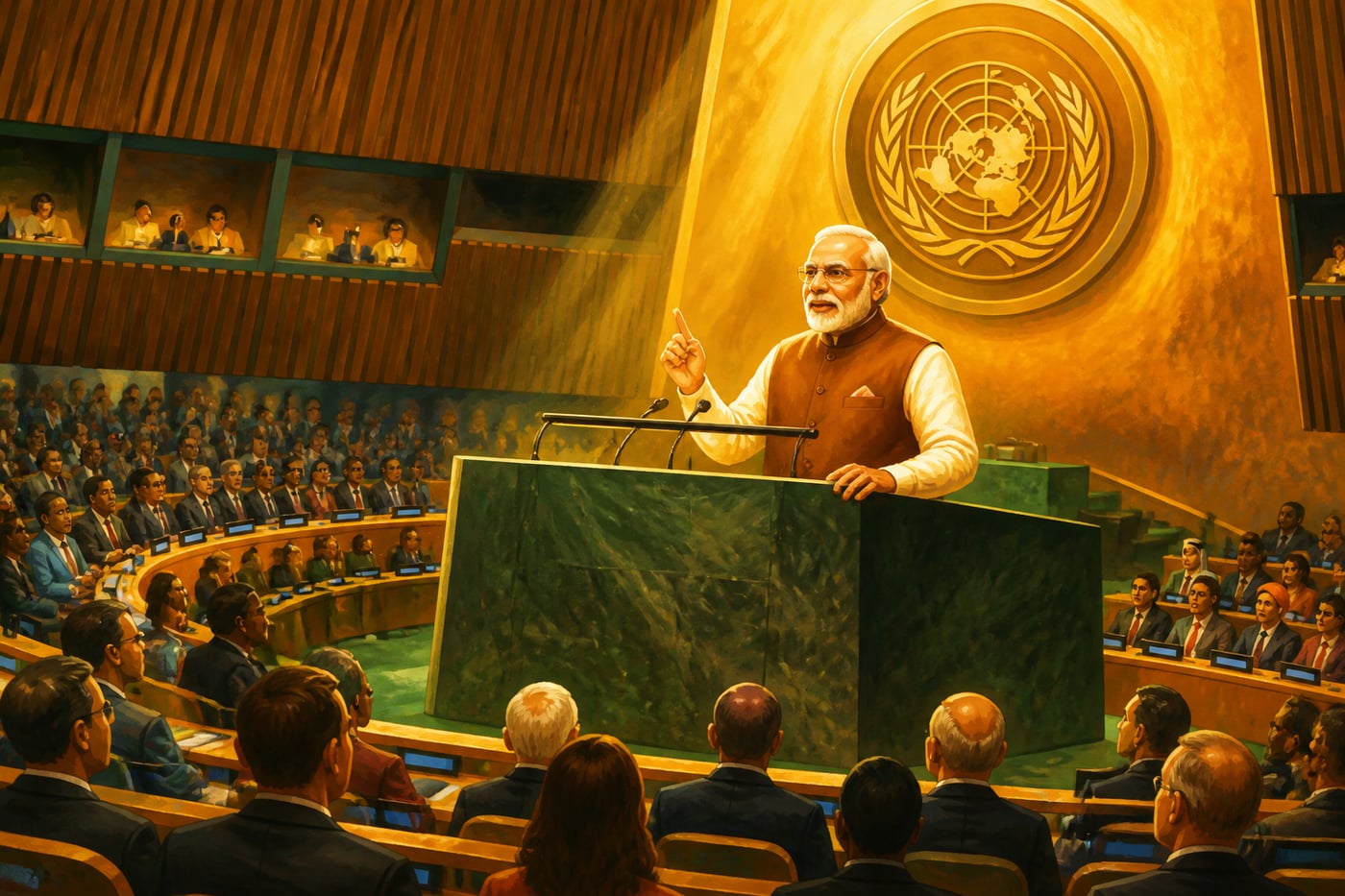
Within 75 days, 177 nations co-sponsored the resolution. No other UNGA resolution had attracted that many co-sponsors in such a short time. On June 21, 2015, the first International Day of Yoga was celebrated across 190 countries. Modi himself led a session of 35,000 people at Rajpath in New Delhi, setting a Guinness World Record.
This was not routine diplomacy. This was civilizational storytelling executed with strategic precision.
The framing was everything. India did not propose a "Hindu practice day." It did not invoke Patanjali's Yoga Sutras or the Vedic origins of the discipline. Instead, yoga was positioned as India's gift to humanity for physical and mental wellness. The resolution text spoke of "holistic health" and "well-being." The word "Hindu" appeared nowhere. The Sanskrit word "yoga" itself was left untranslated, becoming the brand.
The result was remarkable. An ancient dharmic practice, developed over millennia within Hindu, Buddhist, and Jain traditions, was successfully reintroduced to the world on India's terms. Countries that had never engaged with Indian civilization were now hosting yoga sessions in public squares, government buildings, and military bases. The practice itself became the message: India has something the world needs.
This is strategic communication at the civilizational level. India did not argue that its civilization was great. It demonstrated greatness. And in doing so, it reclaimed a piece of narrative sovereignty that no amount of Western academic framing could take away.
The Mechanism: The Architecture of Narrative Power
Why did the Yoga campaign succeed where decades of "Incredible India" tourism advertisements had limited impact? Because it followed the fundamental principles of strategic communication that apply whether you are addressing the United Nations or your neighborhood.
The Art of Framing
Framing determines how people perceive an issue before they even hear the argument. It is the invisible architecture of persuasion.
When Breaking India forces frame Hinduism as "Brahmanical oppression," they have already won half the battle. Any defense from within that frame accepts the premise. The response "Hinduism is not oppressive" still operates within the oppression frame.
The Yoga campaign did something different. It did not defend yoga against charges of being "religious." It reframed the entire conversation around wellness. The frame was not "Hindu practice seeking acceptance" but "ancient science offering solutions." Within this frame, opposition looked anti-health rather than pro-secularism.
This is the first principle of strategic communication: whoever sets the frame controls the conversation.
India has historically been weak at this. The "largest democracy" framing places India in a Western-defined category where it will always be measured against Western standards. The frame "the world's oldest living civilization" does something fundamentally different. It establishes India as the reference point rather than the applicant.
Message Construction
A powerful message has three qualities: it is simple, it is visual, and it carries emotional resonance.
"Vasudhaiva Kutumbakam" succeeded as India's G20 message because it met all three criteria. It is a single phrase. It evokes the image of a family. It resonates emotionally because it speaks to universal human longing for belonging.
Compare this with typical Indian government communication, which tends to be dense, bureaucratic, and defensive. The gap between the G20 messaging success and everyday institutional communication reveals how much ground India still needs to cover.
Effective civilizational messaging follows a pattern. Lead with the gift, not the grievance. "India gave the world yoga, zero, and the concept of universal tolerance" is more powerful than "India was looted by colonizers." Make the audience the beneficiary. The IDY resolution was framed as something India was offering the world, not something India was claiming for itself. Use indigenous vocabulary. "Yoga," "guru," "karma," and "dharma" are already global English words. Each one is a civilizational beachhead in global consciousness.
Narrative Construction
Individual messages are bricks. Narrative is the building. A civilization needs an overarching story that connects its past, present, and future.
India's civilizational narrative has been defined by others for too long. Colonial historians wrote India as a civilization of caste oppression awaiting European liberation. Cold War strategists wrote India as a non-aligned underachiever. Western media writes India as an exotic, chaotic democracy with a "Hindu nationalism" problem.
Reclaiming narrative sovereignty means constructing a counter-narrative that is not merely defensive but genuinely compelling. The most effective civilizational narratives share a structure: a golden past demonstrates capability, a period of disruption explains current challenges, and a renaissance vision provides direction.
India's actual story fits this perfectly. A civilization that produced Panini's grammar, Aryabhata's mathematics, and Charaka's medicine was disrupted by colonial destruction and is now rebuilding on its own terms. This is not propaganda. It is history, told with strategic clarity.
Humor and Art as Strategic Weapons
The most underrated tools of civilizational communication are humor, art, and popular culture. Governments communicate through press releases. Civilizations communicate through stories, songs, films, and memes.
South Korea invested in K-pop and Korean cinema as national strategy. Japan deployed anime and manga. Israel branded itself through its startup ecosystem. Each used cultural products to reshape global perceptions far more effectively than any diplomatic effort could.
India possesses perhaps the world's richest raw material for cultural storytelling. The Mahabharata and Ramayana alone contain more narrative complexity than all of Greek mythology combined. Yet India's cultural exports remain largely Bollywood entertainment rather than civilizational storytelling.
The potential is enormous. When Indian animated films based on dharmic stories succeed at the box office, they demonstrate audience hunger for civilizational narratives told with modern production values. When Indian content creators reach global audiences on YouTube, they normalize Indian perspectives in global discourse. When Indian meme culture reframes media narratives in real-time, it demonstrates the power of decentralized strategic communication.
The Pattern: From Chicago to the United Nations
India's most transformative strategic communication moment occurred on September 11, 1893, in Chicago.
Vivekananda's Civilizational Reframe
When Swami Vivekananda walked to the podium at the World Parliament of Religions, the Western world's perception of Hinduism was shaped almost entirely by colonial missionaries and Orientalist scholars. Hinduism was "heathen idolatry," a primitive collection of superstitions awaiting Christian enlightenment. Indian civilization was a curiosity at best, a cautionary tale at worst.
Vivekananda's opening words demolished this frame in four words.
"Sisters and Brothers of America."
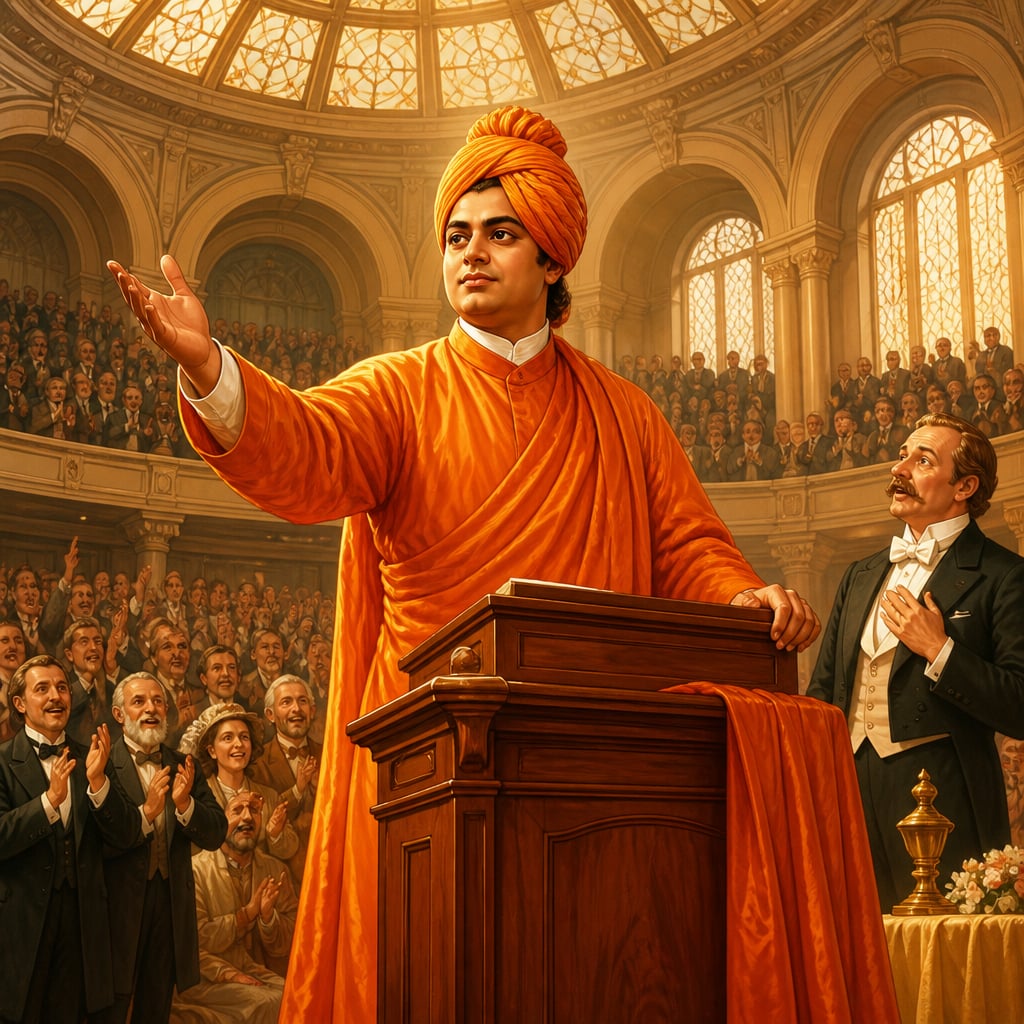
The seven-thousand-strong audience erupted in a standing ovation that lasted two full minutes before he could continue. Why? Because those four words accomplished three strategic objectives simultaneously.
First, he established familial connection rather than supplicant distance. He was not a representative of a lesser civilization seeking approval. He was a brother addressing family.
Second, he led with "sisters" before "brothers," positioning Hindu civilization as one that honored the feminine. This directly contradicted the "oppressive heathenism" narrative.
Third, he used the American idiom of kinship rather than Sanskrit terminology, demonstrating cultural fluency without cultural surrender.
What followed was equally strategic. Vivekananda did not defend Hinduism against Christian charges. He reframed the entire conversation. "I am proud to belong to a religion which has taught the world both tolerance and universal acceptance. We believe not only in universal toleration, but we accept all religions as true."
This was not interfaith politeness. It was a strategic inversion. In a single paragraph, Vivekananda repositioned Hinduism from defendant to judge. The religion accused of narrow idolatry was revealed as the most expansive and tolerant tradition in the room. The Abrahamic traditions, with their exclusive truth claims, suddenly appeared narrow by comparison.
The Strategic Pattern
Vivekananda's approach reveals a pattern that successful Indian civilizational communicators have followed ever since.
First, don't defend, reframe. Vivekananda did not say "Hinduism is not barbaric." He demonstrated that Hinduism's framework of tolerance was more sophisticated than what any other tradition could offer.
Second, speak in the audience's language while carrying your civilization's content. Vivekananda spoke flawless English, used Western rhetorical techniques, and referenced concepts his audience could grasp. But every idea was rooted in Vedantic philosophy.
Third, make your civilization the gift, not the grievance. Vivekananda could have catalogued colonial atrocities. Instead, he offered Vedantic philosophy as India's contribution to human understanding. This made the audience grateful rather than guilty.
This same pattern appears across India's most successful moments of civilizational communication. When Rabindranath Tagore won the Nobel Prize in 1913, his poetry introduced Indian philosophical depth to global literature. When India's space program launches satellites for other nations, it communicates civilizational capability through demonstration. When the International Day of Yoga resolution passes at the UN, it follows Vivekananda's template precisely: lead with the gift, speak the global language, and let the civilization's depth speak for itself.
Dharmic Wisdom: Vak Shakti and the Power of Right Speech
The Vedic tradition recognized speech (Vak) as a cosmic creative force. In the Rig Veda, Vak Devi declares that she pervades heaven and earth, sustains all the gods, and creates reality through utterance. This is not mere mythology. It reflects a sophisticated understanding that language does not merely describe reality. It constructs it.
Kautilya translated this philosophical insight into statecraft. The Arthashastra devotes extensive attention to what we would now call strategic communication: the king's public messaging, the management of public opinion, the use of agents to shape narratives, and the careful calibration of what is said, to whom, when, and how.
His principle of Sama (conciliation through persuasive speech) is listed as the first of the four upayas (strategic tools), before Dana (inducement), Bheda (division), and Danda (force). This ordering is deliberate. In Kautilya's framework, the ability to shape perception through communication is the most refined and cost-effective form of power. Force is the last resort of the strategically inarticulate.
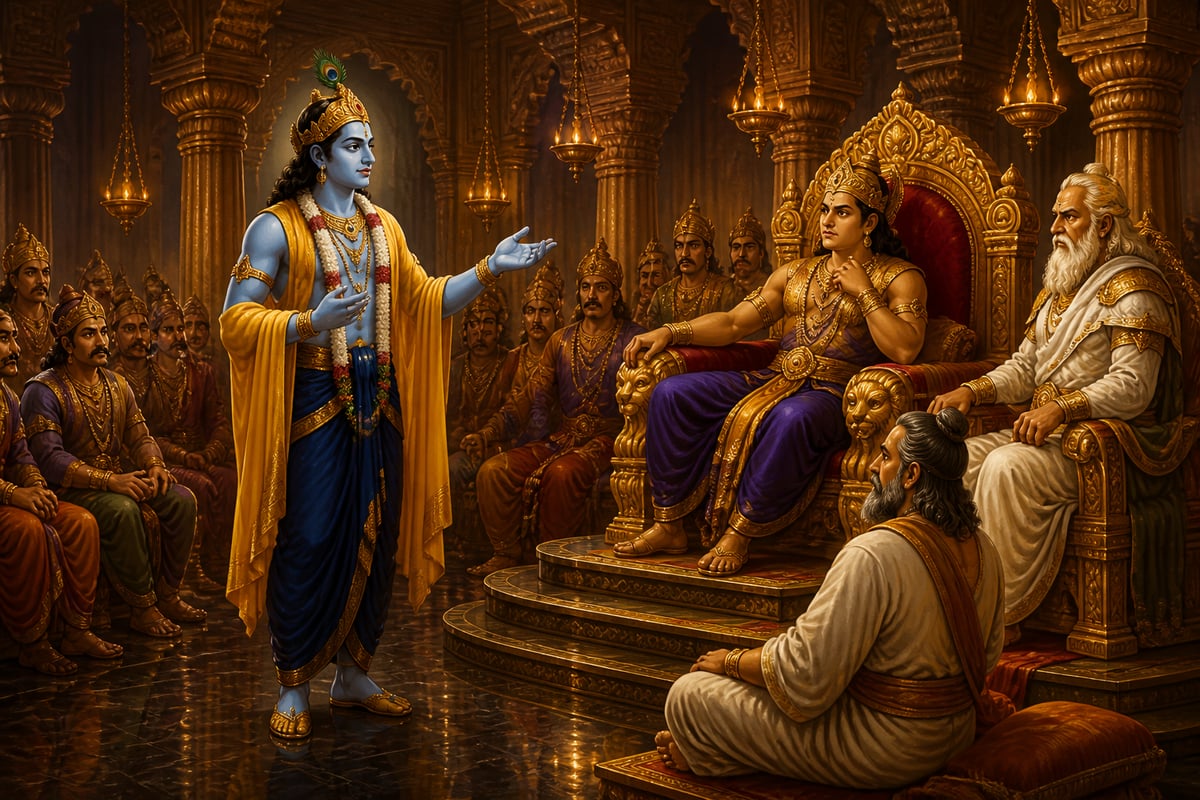
The Mahabharata reinforces this through Krishna's diplomacy before the great war. Krishna attempts every diplomatic avenue, using speech as an instrument of peace. His message to the Kauravas is a masterclass in strategic framing: he offers a reasonable settlement (five villages) that makes refusal look unreasonable, ensuring that when war comes, the moral frame favors the Pandavas. Krishna does not merely speak truth. He speaks truth strategically.
This dharmic tradition of Vak Shakti provides India with a philosophical foundation for strategic communication that most modern nations lack. Communication is not manipulation. It is the skillful deployment of truth in service of dharma.
The Defense: Building Narrative Sovereignty
The civilizational communication battle is not fought in foreign ministries or UN halls alone. It is fought every day, in every conversation, every social media post, every classroom, and every family gathering where India's story is told.
At the individual level, every informed Indian is a potential civilizational communicator. When someone repeats the "caste-oppression-and-poverty" frame about India, the trained communicator does not get defensive. They reframe: "India produced the world's first grammar, the concept of zero, and a philosophical tradition that influenced Schopenhauer, Emerson, and Oppenheimer. Let me tell you what actually happened to this civilization and how it is rebuilding."
Learn the art of reframing. Practice it. When Western media frames Indian festivals as "pollution events," reframe around the cultural significance that the framing deliberately ignores. When activists frame temple traditions as "patriarchal," reframe around the women scholars, saints, and rulers that the framing deliberately erases.
At the community level, support indigenous media and content creation. Subscribe to Indian platforms. Fund Indian filmmakers, writers, and artists who tell civilizational stories. The Breaking India infrastructure is well-funded. The Unbreaking India infrastructure needs conscious investment from every individual.
At the institutional level, India needs civilizational communication institutions at every tier. Universities that train strategic communicators with dharmic grounding. Think tanks that produce research countering anti-India academic narratives. Media houses that tell India's story with production quality matching the best in the world.
At the global level, India's soft power institutions need the same strategic investment that Britain gives the BBC, France gives Alliance Française, and China gives the Confucius Institutes. Cultural diplomacy is not luxury spending. It is civilizational defense spending.
The narrative war will not be won by a single speech or campaign. It will be won by a generation of Indians who understand that how you tell your civilization's story determines whether that civilization survives.
Case studies
The International Day of Yoga: Civilizational Framing at the United Nations
On September 27, 2014, in his first address to the United Nations General Assembly, Prime Minister Narendra Modi proposed declaring June 21 as the International Day of Yoga. The diplomatic challenge was formidable: presenting an ancient Hindu-origin practice to 193 member nations, many of which had no cultural connection to Indian civilization, without triggering religious or political resistance. India's permanent mission undertook an intensive campaign, framing yoga exclusively through the language of universal wellness, holistic health, and stress management. The word 'Hindu' was absent from every diplomatic communication. The Sanskrit word 'yoga' was left untranslated, positioning it as a global brand rather than a religious practice. Within 75 days, 177 nations co-sponsored the resolution, the highest number of co-sponsors for any UNGA resolution of its kind. On June 21, 2015, the first IDY was celebrated in 190 countries. Modi led a session of 35,000 participants at Rajpath, New Delhi.
The IDY campaign is a textbook application of Kautilya's Sama upaya: achieving strategic objectives through persuasive communication alone, without inducement (Dana), division (Bheda), or coercion (Danda). The Manusmriti principle of 'satyam bruyat priyam bruyat' was applied at diplomatic scale. Every claim about yoga was truthful. But the truth was delivered in a frame the audience could receive without resistance. This is precisely what the dharmic tradition teaches: truth is not just about content but about delivery. Vivekananda followed the same principle in Chicago, leading with what his audience could embrace rather than what might trigger defensiveness.
The International Day of Yoga is now celebrated annually in over 190 countries, making it one of the most widely observed UN-designated days. Yoga practitioners worldwide grew from an estimated 200 million in 2014 to over 300 million by 2023. The word 'yoga' became one of the most recognized Sanskrit-origin words in global usage. More importantly, India successfully established itself as the civilizational source of a global wellness movement, creating a permanent association between Indian civilization and human well-being in global consciousness.
The most powerful civilizational communication does not argue for your civilization's greatness. It demonstrates it by offering something the world needs. When you lead with the gift rather than the grievance, resistance dissolves and the world comes to you.
The IDY campaign created a template that India now applies to other civilizational exports, including Ayurveda and millets. The 2023 International Year of Millets followed the same playbook: frame an indigenous Indian practice as a universal benefit, and let the world adopt it voluntarily.
177 nations co-sponsored the IDY resolution within 75 days of Modi's proposal, the fastest and broadest co-sponsorship for any UNGA resolution of its kind, achieved entirely through persuasive framing without any economic or political leverage.
Vivekananda at Chicago: Four Words That Reframed a Civilization
On September 11, 1893, Swami Vivekananda, a 30-year-old Hindu monk with no institutional backing, walked to the podium at the World Parliament of Religions in Chicago. He had arrived in America with little money and no invitation, having to secure a last-minute spot at the Parliament through the intervention of John Henry Wright at Harvard. The Western world's perception of Hinduism was shaped by colonial missionaries and Orientalist scholars who portrayed it as heathen idolatry, caste oppression, and primitive superstition. Vivekananda faced a hostile epistemic environment where every other representative was defending their faith within a Christian-dominated framework. He chose a radically different approach. He opened with 'Sisters and Brothers of America,' establishing familial equality rather than supplicant deference. He then declared: 'I am proud to belong to a religion which has taught the world both tolerance and universal acceptance.' In a single paragraph, he inverted the entire frame, repositioning Hinduism from defendant to the standard against which other traditions' tolerance could be measured.
Vivekananda's speech is the supreme example of Prativada (counter-argument through reframing) in modern Indian history. He did not practice khandana (refutation) by denying that Hinduism was barbaric. He practiced mandana (establishment) by demonstrating that Hinduism's philosophical framework of tolerance was more sophisticated than anything else in the room. This mirrors Krishna's diplomatic strategy before the Mahabharata war: by offering a reasonable settlement (five villages), Krishna ensured that when the Kauravas refused, the moral frame had already shifted to favor the Pandavas. Vivekananda similarly ensured that by presenting Hinduism's universality first, any subsequent narrow claims by other traditions would look limited by comparison.
Vivekananda became an overnight sensation in American media. The New York Herald wrote that he was 'undoubtedly the greatest figure in the Parliament of Religions.' His subsequent lectures across America and Europe catalyzed Western interest in Vedanta, yoga, and Indian philosophy. He founded the Vedanta Society in New York (1894) and the Ramakrishna Mission in India (1897). His reframing created the intellectual foundation upon which every subsequent act of Indian civilizational communication has built, from Tagore's Nobel-winning literature to India's IDY campaign over a century later.
Never argue within the opponent's frame. The moment you say 'we are not what they say we are,' you have already accepted their authority to define you. Instead, establish your own frame so powerfully that the opponent's frame becomes irrelevant. This is the difference between defending and reframing.
Vivekananda's reframing strategy is visible today whenever Indian leaders respond to Western criticism of Hindu practices not by defending within the critic's frame, but by projecting Indian civilizational contributions on their own terms. The principle applies equally to corporate branding and diplomatic communication.
Vivekananda's opening four words, 'Sisters and Brothers of America,' triggered a standing ovation lasting two full minutes from an audience of seven thousand before he could speak a single sentence of his actual address.
Living traditions
Vivekananda's strategic communication template lives on through multiple institutional expressions. The Ramakrishna Mission operates in over 20 countries, continuing his civilizational outreach. India's Ministry of External Affairs runs the Indian Council for Cultural Relations (ICCR) with 40+ cultural centers worldwide, directly inspired by the principle that cultural diplomacy is civilizational defense. The International Day of Yoga has become the most visible annual demonstration of Indian soft power, with participation growing each year. India's G20 presidency in 2023, branded with Vasudhaiva Kutumbakam, applied the same Vivekananda template at the highest level of global governance. Digital platforms have democratized civilizational storytelling: Indian content creators on YouTube, Instagram, and X (formerly Twitter) now reach audiences of millions, making every informed Indian a potential Vivekananda in the digital age.
- Vivekananda Rock Memorial: A monument built on the rock where Swami Vivekananda meditated for three days in December 1892 before departing for the 1893 World Parliament of Religions. The meditation hall (Dhyana Mandapam) allows visitors to sit in silence at the very spot where Vivekananda conceived his vision of presenting Hindu civilization to the world. The memorial combines architectural elements from across India, symbolizing the civilizational unity Vivekananda championed. Adjacent is the massive Thiruvalluvar Statue (133 feet), honoring the Tamil poet-philosopher.
- Belur Math: The global headquarters of the Ramakrishna Math and Ramakrishna Mission, founded by Swami Vivekananda in 1897. The main temple, Sri Ramakrishna Temple, is an architectural embodiment of Vivekananda's message of religious harmony: viewed from different angles, it resembles a church, a mosque, and a temple simultaneously. The campus includes Vivekananda's living quarters (preserved as a museum), the room where Ramakrishna's relics are kept, and temples dedicated to Sarada Devi and Vivekananda himself. The institution continues Vivekananda's civilizational communication mission through education, healthcare, and publishing across 20+ countries.
Reflection
- When someone frames India negatively in conversation or online, do you find yourself defending within their frame or reframing the conversation entirely? What would a Vivekananda-style reframe look like in your most recent such encounter?
- Why did Kautilya list Sama (persuasive communication) as the first upaya before Dana, Bheda, and Danda? What does this ordering reveal about the relationship between communication skill and all other forms of power?
- Is strategic framing of truth the same as manipulation? Where does the dharmic tradition draw the line between skillful communication and deception, and how does the concept of Vak Shakti complicate that boundary?