Digital Civilizational Infrastructure
AI Knowledge Graphs, Digital Archives, and Indigenous Platforms
India's 30 million manuscripts race against decay while civilizational knowledge lives on foreign platforms. This lesson maps how AI knowledge systems, digital archives, indigenous platforms, and data sovereignty can preserve India's heritage on its own terms.
See It Today: India's Digital Independence Day
In October 2023, the Reserve Bank of India announced that Unified Payments Interface had processed over 11 billion transactions in a single month. By early 2024, that number crossed 14 billion. More than 300 million Indians were using a payment system designed, built, and operated entirely within India, on Indian servers, under Indian regulations.
This was not an accident. It was a civilizational choice.
A decade earlier, India's digital payments landscape was dominated by foreign platforms. Visa, Mastercard, and PayPal controlled the rails. Every transaction generated data that flowed to servers in California. India was digitally colonized without a single shot being fired.
Then India built its own stack. Aadhaar provided digital identity for 1.4 billion people. UPI created an open, interoperable payment rail that let any Indian with a phone transact instantly, for free, without intermediaries. DigiLocker digitized government documents. The India Stack, as it came to be known, was not just technology. It was infrastructure for civilizational sovereignty. India now processes more real-time digital payments than the US, UK, China, and Europe combined. Over 46 countries have expressed interest in adopting UPI. India moved from digital dependency to digital export in under a decade.

But payments are only the beginning. The deeper question: can India build the same kind of sovereign digital infrastructure for its civilizational knowledge? Can the manuscripts decaying in temple basements, the Sanskrit texts locked in university vaults, the oral traditions fading with each passing generation be preserved, organized, and made accessible through indigenous digital systems? Can AI do for India's intellectual heritage what UPI did for its financial system?
This lesson argues that it can, it must, and the work has already begun.
The Mechanism: Five Pillars of Digital Civilizational Infrastructure
Digital civilizational infrastructure operates across five interconnected domains. Each addresses a vulnerability that physical infrastructure alone cannot solve.
Pillar 1: AI Knowledge Systems for Indic Texts. India possesses an estimated 30 million manuscripts in Sanskrit, Tamil, Pali, Prakrit, and dozens of other languages. The vast majority have never been translated, indexed, or made searchable. Traditional scholarship cannot solve this at scale. Perhaps a few thousand scholars worldwide can read classical Sanskrit fluently. At the current pace of manual processing, covering even a fraction of this corpus would take centuries.
AI changes the equation. Computational linguistics teams at IIT Bombay, University of Hyderabad, and institutions worldwide have built models specifically designed for Sanskrit and Indic languages. Panini's grammar, formalized over 2,500 years ago, turns out to be remarkably well-suited to computational processing because it was already a formal system: arguably the world's first. The Sanskrit Heritage Engine provides morphological analysis. Platforms like Samsaadhani offer automated grammatical breakdowns of Sanskrit sentences. These tools make it possible to photograph a palm-leaf manuscript, perform optical character recognition on the script, parse the text computationally, generate translations, and link the content to knowledge graphs.

Imagine an AI-powered system connecting every concept in the Arthashastra to related ideas in the Mahabharata, cross-referenced with Ayurvedic and astronomical texts, navigable by anyone with a smartphone. The technologies exist. What is needed is the institutional will to deploy them at civilizational scale.
Pillar 2: Digital Archives and Manuscript Preservation. India's National Mission for Manuscripts has surveyed over 4.2 million manuscripts across 10,000 repositories since 2003. This is the largest manuscript preservation initiative in human history. Projects like BORI's digitized critical edition of the Mahabharata and the French Institute of Pondicherry's Shaivite manuscript collection demonstrate what is possible. The gap remains coordination: fragmented efforts, inconsistent metadata standards, and limited interoperability between institutions.
Pillar 3: Civilizational Knowledge Platforms. Archives preserve knowledge. Platforms transmit it. A digitized manuscript in an institutional database reaches only specialists. Knowledge platforms translate scholarly content into structured learning, contextualize ancient wisdom for modern challenges, and build communities around civilizational education. The traditional guru-shishya parampara was exactly this: a structured system for transmitting civilizational knowledge across generations. Digital platforms can scale this model to millions while preserving depth and rigor.
The need is urgent because the alternative is already here. Without indigenous knowledge platforms, India's civilizational heritage will continue to be interpreted through Western academic frameworks on Coursera, Khan Academy, and YouTube, platforms that often distort, diminish, or decontextualize dharmic concepts. When a Western-designed algorithm decides what content about Indian civilization gets recommended to Indian users, that is not neutral technology. It is epistemic colonization through infrastructure.
Pillar 4: Indigenous Communication Infrastructure. Social media is not neutral technology. It is an epistemic environment that shapes what people think and what they consider thinkable. When a nation's public discourse runs on platforms designed in Menlo Park, governed by Silicon Valley's cultural assumptions, that nation's civilizational conversation is hosted on foreign territory. Twitter, Facebook, and YouTube have repeatedly demonstrated that content moderation policies reflect Western liberal norms. Content celebrating Hindu festivals has been flagged as "hate speech." Algorithms trained on Western datasets systematically under-promote Indic content. India needs its own communication infrastructure: built on Indian servers, governed by Indian values, designed for Indian languages and cultural contexts.
Pillar 5: Data Sovereignty. Every digital interaction generates data. Who owns it, where it is stored, and who can access it are civilizational questions. When Indian citizens' health records, financial data, and communication metadata flow to foreign servers, India's informational sovereignty is compromised. The Digital Personal Data Protection Act (2023) and the RBI's data localization mandate are necessary first steps. True data sovereignty requires indigenous cloud infrastructure, Indian-built AI models trained on Indian data, and frameworks that treat civilizational data as a strategic asset rather than a commodity to be harvested by foreign corporations.
The Pattern: When Libraries Burn, Civilizations Forget
The urgency of digital preservation becomes viscerally clear when you examine what happens when knowledge infrastructure is destroyed.
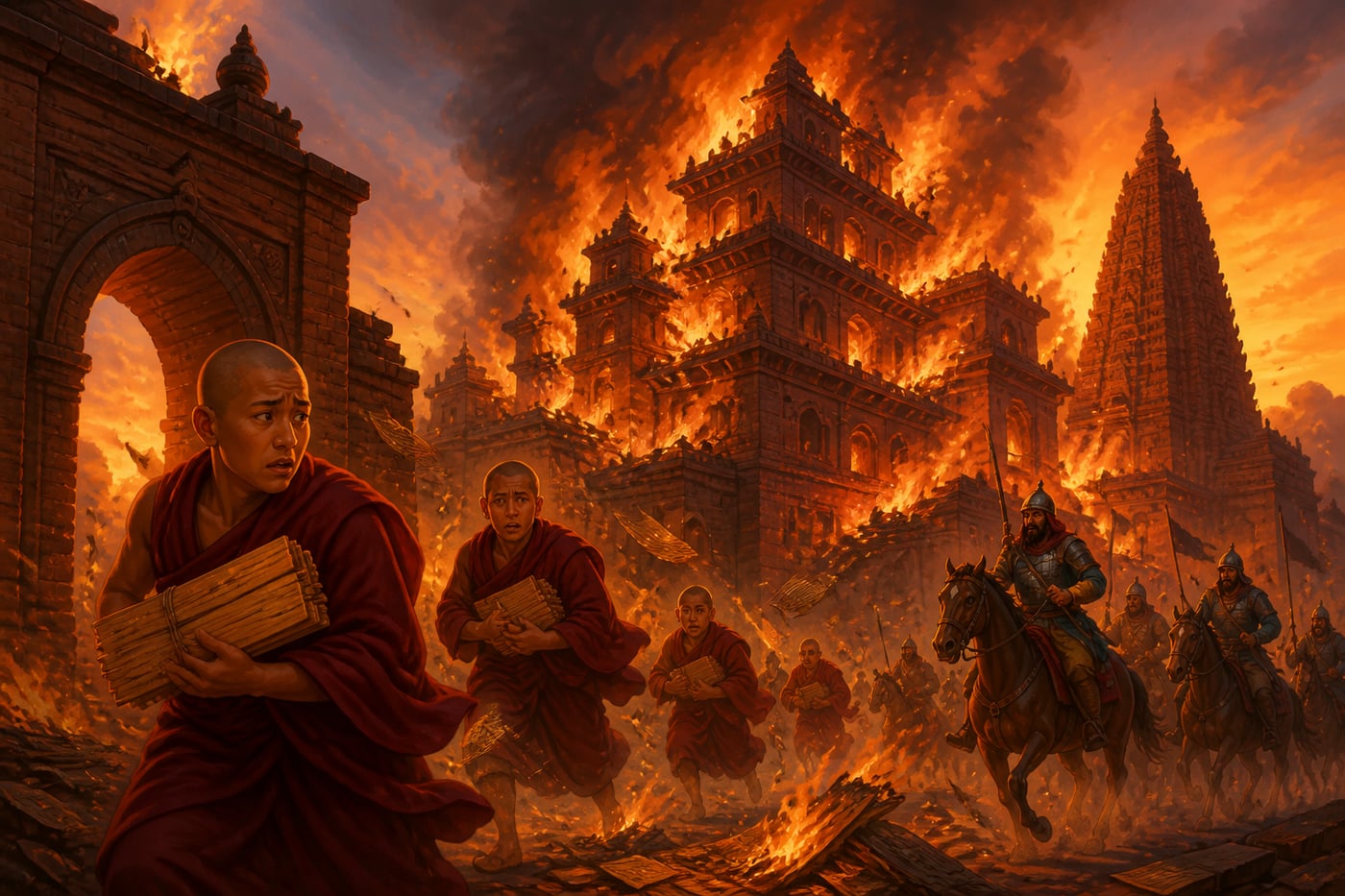
In 1193, Bakhtiyar Khilji's forces reached Nalanda. What they found was not merely a university but the greatest knowledge institution the ancient world had ever produced. For over 700 years, Nalanda had housed up to 10,000 students and 2,000 teachers from across Asia. Its library, the Dharmaganja ("Treasury of Truth"), consisted of three massive multi-story buildings. When Khilji's troops set it ablaze, it burned for three months.
The scale of loss defies comprehension. Nalanda's collection included works on mathematics, astronomy, medicine, logic, philosophy, grammar, and statecraft accumulated over centuries. When the library burned, it did not merely destroy manuscripts. It severed transmission lines of knowledge that had been maintained across generations. Entire disciplines vanished.
The monks who survived carried what they could. Many fled to Tibet, bearing Sanskrit manuscripts that would be translated and preserved in Tibetan monasteries. Centuries later, scholars would use these Tibetan translations to reconstruct Indian originals that had otherwise been completely lost. Knowledge survived precisely because it had been copied, distributed, and stored in multiple locations. The fragments that reached Tibet proved the principle that would define digital preservation millennia later: redundancy is the only defense against catastrophic loss.
The colonial era added a different but equally devastating mode of destruction: not burning but systematic extraction. British, French, and German scholars removed manuscripts from Indian repositories throughout the 18th and 19th centuries, often under the guise of scholarly preservation. The Boden Professorship of Sanskrit at Oxford was explicitly funded by Colonel Boden's will to aid the conversion of Indians. India's own intellectual heritage was shipped to the Bodleian Library, the Bibliotheque nationale de France, and the Staatsbibliothek in Berlin. Indians who wished to study their own civilizational texts had to seek permission from foreign institutions.
Digital infrastructure inverts this dynamic entirely. A digitized manuscript exists simultaneously in a hundred locations. It cannot be burned, looted, or locked away. AI tools can index, translate, and cross-reference it instantly. What took Khilji's troops three months to destroy, digital preservation can make indestructible in three hours.
The pattern is unmistakable: civilizations that store knowledge only in physical, centralized repositories are civilizations waiting for the next catastrophe. Digital infrastructure is not a convenience. It is an existential necessity.
Dharmic Wisdom: The Imperative to Protect Vidya
The concept of Vidya-Raksha, the protection of knowledge, runs through Indian civilizational thought like a deep current. Vidya is not mere information. In the dharmic framework, it is the accumulated insight of the civilization: the distilled understanding of reality that enables each generation to live wisely rather than stumble blindly.
The Arthashastra treats knowledge infrastructure with the same seriousness as military infrastructure. Kautilya classified all knowledge into four systematic disciplines and insisted that the state invest in education, archives, and scholarly training. This was not generosity. It was strategic necessity. A state that loses its knowledge loses its ability to govern wisely, defend effectively, and adapt to new challenges.
The Guru-Shishya Parampara was India's original distributed knowledge system. By transmitting knowledge through living teachers spread across the subcontinent rather than centralizing it in a single institution, Indian civilization created natural redundancy. When Nalanda fell, knowledge survived in thousands of gurukuls. When gurukuls were suppressed, knowledge survived in family traditions, temple practices, and oral recitation.
Digital infrastructure is the modern expression of this ancient principle. Distribute knowledge so widely that no single act of destruction can erase it. The medium has changed from palm leaf to pixel, from oral recitation to AI-indexed database. The civilizational imperative remains identical: make vidya akshara, imperishable.
Vidura's teaching rings across the centuries with startling relevance: the one who plans for the unseen future prospers, while the procrastinator perishes. India's manuscripts are decaying. Oral traditions are dying with their last practitioners. Foreign platforms are mediating access to Indian knowledge. The time for digital civilizational infrastructure is not tomorrow. It is now.
The Defense: Building the Digital Backbone
The Indian Renaissance cannot be built on someone else's digital infrastructure. Every layer of the digital stack must have an indigenous option. Not because foreign technology is inherently bad, but because civilizational sovereignty requires the capability to operate independently.
For Individuals. Contribute to manuscript digitization projects. The NMM and university-led initiatives actively seek volunteers who can photograph, catalogue, and transcribe manuscripts from local temples, mathas, and private collections. Use and support indigenous platforms. Every user who chooses an Indian-built platform strengthens its economic viability. Network effects work both ways. Learn digital skills in civilizational contexts. India needs thousands of young engineers who understand both Sanskrit computational linguistics and modern AI. This intersection is where the civilizational knowledge graph will be built.
For Communities. Temple trusts and mathas must digitize their manuscript collections systematically. Many of India's most important manuscripts sit in private religious collections that have never been surveyed, let alone digitized. Community-led digitization using smartphones and standardized protocols can capture this knowledge before it deteriorates beyond recovery. Support civilizational knowledge platforms through content creation, expert review, and financial backing.
For Institutions. Universities should integrate Sanskrit computational linguistics into computer science curricula. India should produce the world's leading AI models for Indic languages, not import Western models trained on Western data. Government policy should treat civilizational data as strategic infrastructure. Manuscript archives, temple records, and oral tradition recordings deserve the same investment and protection as defense installations. Fund the creation of an integrated civilizational knowledge graph: a searchable, AI-powered platform connecting every digitized manuscript, translated text, and indexed concept across all of India's knowledge traditions.
The India Stack proved that a civilization can build its own digital rails in under a decade. The same energy, the same institutional will, the same refusal to accept dependency must now be directed at India's civilizational knowledge. The technology exists. The manuscripts exist, for now. The knowledge exists, for now. What is needed is the civilizational will to connect these dots before time, neglect, and foreign platforms render the task impossible.
Case studies
Sanskrit Meets Silicon: India's Computational Linguistics Revolution
Starting in the early 2000s, research teams at IIT Bombay, University of Hyderabad, JNU, and international institutions began applying computational methods to Sanskrit. The Sanskrit Heritage Engine, developed at INRIA (France), provided morphological analysis tools. The University of Hyderabad built the Samsaadhani platform for automated grammatical analysis of Sanskrit sentences. IIT Bombay's Sanskrit NLP lab developed dependency parsers and machine translation models. The breakthrough insight was that Panini's Ashtadhyayi, with its 3,959 formal rules for Sanskrit morphology, was already a computational grammar. Researchers did not need to impose Western linguistic frameworks on Sanskrit. They could build directly on Panini's architecture, creating AI systems that process Sanskrit with a sophistication impossible for languages lacking such a systematic grammatical tradition.
Panini's Ashtadhyayi was itself an extraordinary work of knowledge compression: 3,959 sutras encoding the complete morphology of Sanskrit in a system so compact and rigorous that it functions like a programming language. The sutra tradition of expressing maximum meaning in minimum words (alpaksharam asandigdham) is the dharmic ancestor of data compression. What modern computational linguists have done is recognize that Indian tradition had already solved the formalization problem 2,500 years ago. The AI is not replacing the tradition. It is amplifying its reach across time and scale.
By the 2020s, these tools can process Sanskrit at speeds no human scholar can match. OCR systems read damaged manuscripts. Morphological analyzers identify word forms in complex compound expressions. Knowledge graphs link concepts across texts. While still primarily research tools, they have demonstrated the feasibility of AI-powered civilizational knowledge systems that could eventually make India's entire manuscript heritage searchable and accessible.
The most effective AI for Indian knowledge systems works best when built on Indian intellectual traditions, not imported Western frameworks. Panini's grammar is proof that India's past holds the key to India's digital future.
As large language models dominate AI, they are trained overwhelmingly on English-language data reflecting Western knowledge frameworks. Without indigenous AI systems trained on Sanskrit and Indic language corpora, India's civilizational knowledge will be interpreted through foreign computational models. Sanskrit computational linguistics is not an academic curiosity. It is a strategic necessity.
India's estimated 30 million manuscripts represent the largest undigitized knowledge corpus in human history. At current rates of manual scholarly processing, it would take over 5,000 years to translate and index them all. AI tools could reduce this timeline from millennia to decades.
The Burning of Nalanda: When Knowledge Had No Backup
In 1193 CE, Bakhtiyar Khilji's cavalry reached the great university complex at Nalanda in Bihar. Nalanda had operated continuously for over 700 years, housing up to 10,000 students and 2,000 teachers from across Asia. The Chinese pilgrim Xuanzang, who studied there in the 7th century, described a library complex called the Dharmaganja ("Treasury of Truth") spanning three massive multi-story buildings: Ratnasagara ("Ocean of Jewels"), Ratnodadhi ("Sea of Jewels"), and Ratnaranjaka ("Jewel-Adorned"). When Khilji's forces set the library ablaze, the fires reportedly burned for three months. The complete works of centuries of scholarship in mathematics, astronomy, medicine, logic, and philosophy were destroyed. Monks who survived fled in all directions, many carrying manuscripts to Tibet, Nepal, and Southeast Asia.
The Arthashastra teaches that a wise ruler protects knowledge infrastructure as carefully as military installations, recognizing that the loss of accumulated wisdom weakens a kingdom more permanently than the loss of territory. Nalanda's destruction violated every principle of civilizational stewardship. Yet the monks who fled with manuscripts instinctively followed the dharmic principle of distributed preservation: the guru-shishya parampara had always ensured that knowledge existed in multiple human repositories simultaneously. The fragments saved to Tibet proved this principle's power, as Tibetan translations later helped reconstruct lost Indian originals.
The destruction of Nalanda was one of the greatest intellectual catastrophes in human history. Entire disciplines of Indian scholarship vanished permanently. Some knowledge survived only because Tibetan monks had previously translated Sanskrit texts, enabling partial reconstruction centuries later. The archaeological site was designated a UNESCO World Heritage Site in 2016, but the knowledge that once filled its halls can never be fully recovered.
Nalanda proves that centralized, physical-only knowledge storage is a civilizational risk of the highest order. Digital infrastructure creates distributed, redundant copies that cannot be burned, making civilizational knowledge genuinely indestructible.
Today, an estimated 30 million Indian manuscripts face a slow-motion Nalanda: degradation through humidity, insects, neglect, and institutional apathy. Without urgent digitization, India faces a second great knowledge loss, this time not through invasion but through indifference.
Xuanzang's records indicate Nalanda's library may have contained millions of manuscripts accumulated over seven centuries. If accurate, the burning of Nalanda destroyed more individual texts than the ancient Library of Alexandria.
Koo and India's Quest for Indigenous Social Media
In early 2020, Aprameya Radhakrishna and Mayank Bidawatka launched Koo, a micro-blogging platform designed as an Indian alternative to Twitter. The timing seemed ideal. Growing concerns about Twitter's content moderation bias against Indian cultural content and broader debates about digital sovereignty created an opening. Koo supported over 10 Indian languages and quickly attracted government ministers, celebrities, and millions of users. By mid-2021, the platform crossed 15 million users. Yet by 2024, Koo had shut down. User retention proved difficult as Twitter's (later X's) network effects remained dominant. Monetization was challenging with a user base accustomed to free services. Meanwhile, ShareChat, which took a fundamentally different approach by building a vernacular-first content creation platform rather than replicating Twitter's format, sustained over 180 million users across 15 Indian languages.
Kautilya's Arthashastra teaches that new enterprises must identify genuine strategic advantages rather than simply replicating existing power structures. Koo attempted to compete on the incumbent's terms by replicating Twitter's format for an Indian audience. The Arthashastra's approach emphasizes asymmetric strategy: identify what the adversary cannot provide, and build from that foundation rather than from imitation. ShareChat's relative success followed this asymmetric logic more closely, building for India's unique linguistic and cultural landscape from the ground up rather than adapting a Western template.
Koo's closure demonstrated that digital sovereignty in social media cannot be achieved through imitation alone. Building an alternative to a global platform requires either massive capital reserves to outlast the incumbent, a fundamentally different value proposition, or both. ShareChat's survival with 180+ million users suggests that platforms succeeding in India must be built from Indian needs and languages outward, not from Western templates adapted inward.
Digital civilizational sovereignty in communication requires platforms rooted in Indian languages, cultural contexts, and user behaviors from the ground up. Imitation is not sovereignty. Innovation shaped by civilizational context is.
As AI-powered content recommendation becomes more sophisticated, the algorithms shaping what Indians see, share, and discuss online are trained on Western cultural datasets and governed by Silicon Valley's editorial assumptions. Without indigenous alternatives built on different foundations, India's public discourse will increasingly be filtered through foreign cultural frameworks.
Despite Koo's closure, India's broader indigenous platform ecosystem shows resilience. ShareChat serves 180+ million users. Kuku FM has 50+ million downloads. The total indigenous platform user base exceeds 300 million, suggesting strong demand for platforms designed for Indian contexts.
Reflection
- What knowledge from your own family, community, or local temple has been preserved only in physical form or oral tradition? What single step could you take this week to document or digitize it before it is lost?
- If Nalanda's library had been digitized and distributed across multiple locations before Khilji's invasion, how might the course of Indian intellectual history have been different? What knowledge in your own community is currently as vulnerable as Nalanda's manuscripts were in 1193?
- When a civilization's knowledge is stored, indexed, and interpreted on platforms owned by another civilization, who truly controls the meaning of that knowledge? Can epistemic sovereignty exist without digital sovereignty?