The Triumphant Leap
Hanuman Returns Across the Ocean
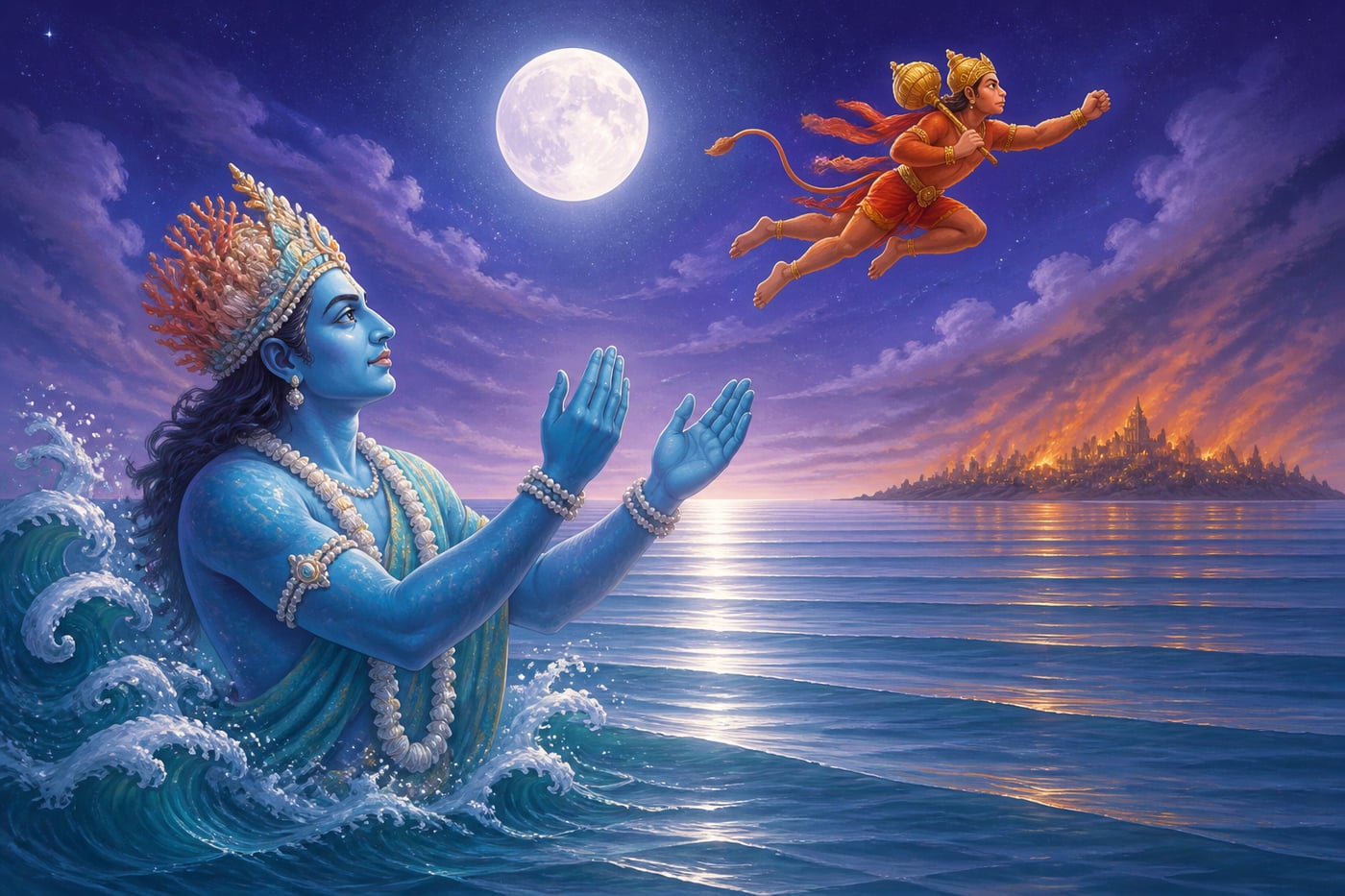
With Lanka burning behind him, Hanuman leaps across the ocean toward home. The sea god Sagara honors his passage, acknowledging the feat. On the far shore, his anxious companions - Jambavan, Angada, and the vanara search party - have waited through agonizing days. The moment of reunion brings joy that shakes the mountains.
The Leap Home
Hanuman stands on Lanka's southern shore, his mission complete.
Behind him, columns of smoke rise from the burning city. The golden towers that had gleamed with arrogance now glow with destruction. Somewhere in that chaos, Ravana rages. Somewhere in a protected grove, Sita waits with renewed hope.
But Hanuman's work in Lanka is done. Now comes the return. He grows to his ocean-crossing form, his body expanding until he towers over the palm trees. His muscles coil with gathered power. The ground trembles beneath his weight.
With a roar that echoes across the water, Hanuman leaps.
Sagara's Blessing
The ocean spreads below like a dark mirror, reflecting stars.
As Hanuman soars above the waves, something stirs in the depths. The sea itself seems to bow, waves parting beneath his passage. A presence rises - not threatening like Surasa or Simhika, but reverent.
It is Sagara, lord of the ocean, ancient deity of the deep.
"Son of Vayu," the sea god's voice rises like tide. "You crossed my domain to serve dharma. You return having accomplished what none thought possible. The ocean honors you."
The waves smooth before Hanuman, winds shift to speed his passage. Where the journey to Lanka had been a battle against obstacles, the return becomes a triumphal procession. Even the elements recognize success.
"Lord Sagara," Hanuman calls back, "remember this path. Soon an army will need to cross. Dharma will ask more of you."
The ocean's response is a rumble that might be acknowledgment or might be concern. That conversation will come later. But Sagara's blessing on the return journey is unmistakable - the ancient deity of the deep has chosen his side in the coming conflict.
The Waiting Party
On the far shore, the vanara search party has endured days of anguish.
Jambavan, wise old bear among monkeys, has kept the group together through doubt and despair. Angada, young prince of Kishkindha, has paced the shore until his path is worn into the sand. The other vanaras have alternated between hope and fear.
"He has been gone too long," some muttered. "The ocean took him."
"No," Jambavan insisted each time. "Hanuman will return. Have faith."
But even Jambavan's faith was tested. The smoke rising from Lanka could be seen on clear days - what did it mean? Victory? Defeat? They could not know.
Then Angada sees it. A shape against the stars, growing larger. Moving with impossible speed across the water. The sound reaches them next - a rushing like a great wind, growing into a roar.
"Look! LOOK!" The vanaras rush to the water's edge, staring into the darkness. The shape resolves into familiar form - massive, airborne, unmistakable.
"HANUMAN!" The cry spreads through the group like fire through dry grass. Vanaras leap and howl, their whoops of joy echoing off the mountainside. Days of tension break in an explosion of celebration.
The Triumphant Return
Hanuman descends like a god returning to earth.
His massive form touches down on Mount Mahendra, the same peak from which he launched days ago. The mountain shakes with his landing. Trees bend away from the impact. A cloud of dust rises and settles.

He shrinks to normal size, and immediately his friends surround him. Jambavan reaches him first, the old bear's eyes wet with tears he doesn't bother hiding. "My boy," he says, gripping Hanuman's arms. "My brave, brilliant boy. You did it."
Angada is next, the young prince embracing Hanuman with the desperate relief of one who had feared the worst. "We saw the smoke! We didn't know if it meant, "
"It meant victory," Hanuman says, smiling. "Lanka burns. And I bring news."
The vanaras gather close, their celebration quieting into urgent attention.
"I found her," Hanuman says simply. Two words. But they change everything.
"Sita lives. She is held in a grove called Ashoka Vatika, guarded by rakshasis but unbroken in spirit. I spoke with her. She gave me a token for Lord Rama - proof that I reached her, proof that she remains faithful, proof that she waits for rescue."
He produces the Chudamani from the cloth where he has kept it safe. The gem catches starlight and seems to glow with its own radiance. "This jewel was given to Sita by her father on her wedding day. She has worn it through every trial. Now she sends it to Rama so he will know without doubt that his messenger succeeded."
The Intelligence Report
Jambavan, ever strategic, moves past the initial joy to gather intelligence.
"Tell us everything, Hanuman. What did you learn of Lanka? How strong is Ravana? What defenses must we overcome?"
Hanuman's report is thorough. He describes Lanka's layout, its defensive positions, the quality of its troops. He speaks of Ravana's power and Indrajit's skill. He explains how he was captured by the Brahmastra and brought before the demon king.
"But I also learned their weaknesses," he continues. "Ravana is proud beyond reason. His advisors fear to counsel him. His brother Vibhishana spoke dharma in the court - there is dissent even in his inner circle."
"And the fire?" Angada asks.
"They wrapped my tail in oil-soaked cloth and set it ablaze," Hanuman says. "They meant it as punishment. I used it to burn their city. By now, half of Lanka is ash."
The full weight of the achievement settles over the group. They had been sent on a search that most thought hopeless. The ocean was too wide, Lanka too dangerous, the mission too impossible. And now - success beyond imagining. Not only had Sita been found, but Lanka had been wounded, its defenses assessed, its king defied to his face.
The Journey North
"We must return to Kishkindha immediately," Jambavan declares. "Sugriva needs this news. Rama needs this news. Every moment we delay is a moment of unnecessary suffering for the Lady Sita."
The vanara party sets out at once, exhaustion forgotten in the rush of triumph. They travel through the night, their pace fueled by excitement. Hanuman runs at their center, answering the endless questions that pour from his companions. What did Sita look like? What did Ravana say? How did it feel to burn the city?
He tells them of Surasa's test and Simhika's attack. He describes Lanka's impossible beauty and Ravana's terrible magnificence. He recounts his conversation with Sita - her initial suspicion, her testing questions, her tears when she recognized Rama's ring.
And he tells them of her message: "Tell my lord to come quickly, but not to compromise dharma for speed."
"That," Jambavan says quietly, "is the voice of a true queen."
The group travels on through dawn and into the day, bringing hope northward with every step. The mission that began with a desperate leap into the unknown now concludes with a triumphant march toward reunion and war.
Living traditions
The image of Hanuman's return leap has become iconic in Indian popular culture. It represents the moment when impossible missions succeed, when hope is vindicated. Sports teams and achievement programs often invoke this imagery. The phrase 'Jai Hanuman' (Victory to Hanuman) is commonly used when embarking on difficult tasks, connecting modern efforts to this ancient triumph.
- Sundara Kanda Parayana: Complete recitation of Sundara Kanda, often done over multiple days. The return journey portions are particularly emphasized as they represent hope fulfilled. Families organize these recitations during times of separation or when awaiting news.
- Mahendragiri: Traditional site of Hanuman's leap. The mountain is sacred to both Hindu and tribal traditions. A Hanuman temple at the summit commemorates the Sundara Kanda events. Local festivals celebrate the ocean crossing.
Reflection
- Hanuman's first words were 'I found her' - simple, direct, transformative. What makes simple communication of truth so powerful? When do we complicate messages that should be clear?
- Angada, son of Vali whom Rama killed, serves Rama faithfully. How do we reconcile personal grief with larger duty? When should we set aside personal grievance for greater purpose?
- Jambavan kept the group together through days of uncertainty, insisting Hanuman would return. What does it take to maintain faith when evidence is absent? How is this different from denial or wishful thinking?