The Chudamani's Journey
Rama Receives Sita's Token
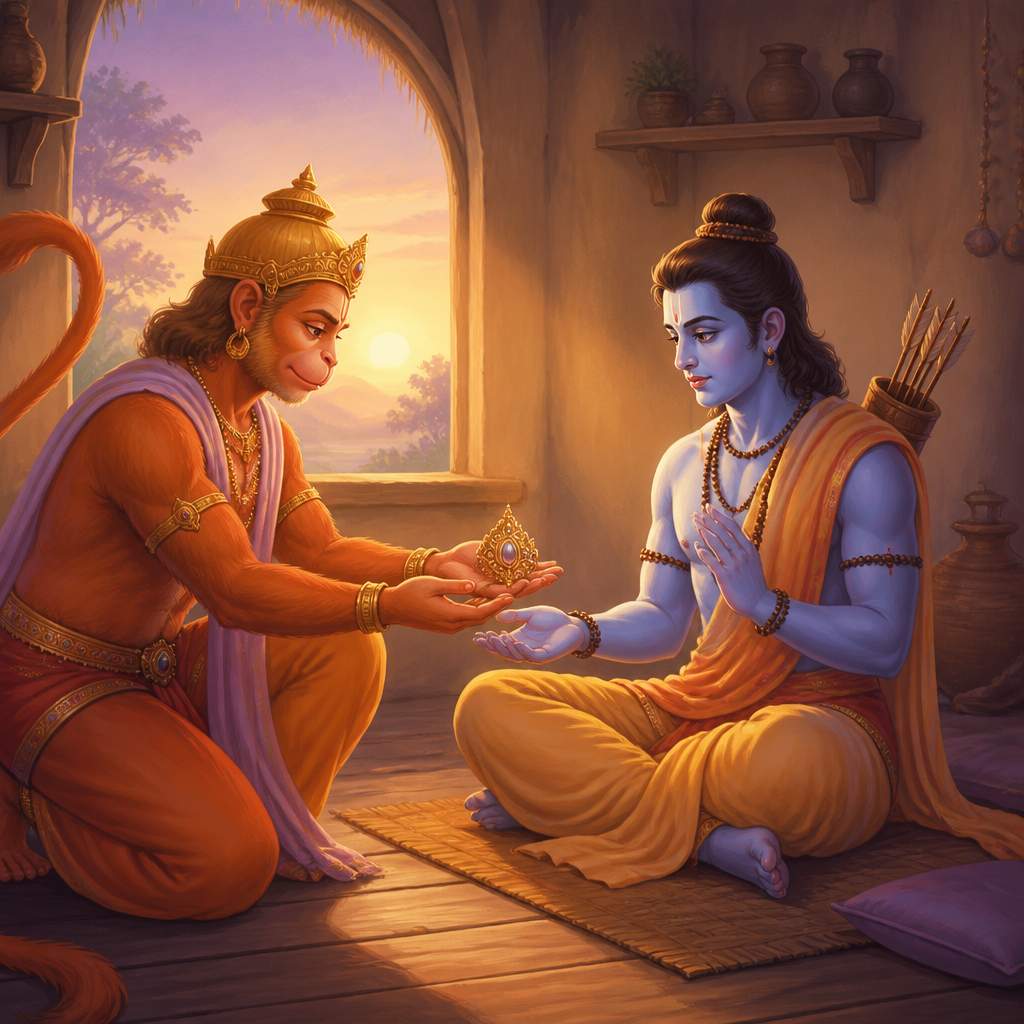
Hanuman enters Rama's quarters with the Chudamani - Sita's crest jewel sent as proof of their meeting. Rama's reaction to seeing the jewel of his beloved wife is one of the epic's most emotional moments. As Hanuman recounts his journey, including his moment of self-doubt before finding Sita, Rama moves from grief to hope to determination.
The Door Opens
Hanuman enters Rama's quarters and finds his lord seated on a simple mat.
Rama has not slept. His eyes are red with exhaustion and unshed tears. Around him, the room is bare - no ornaments, no comforts, nothing that would distract from his vigil of grief. This is where he has waited, day after day, as search parties returned with nothing.
When he sees Hanuman, Rama's face transforms. Hope battles with the fear of disappointment. He has lived too long on hope to trust it easily.
"Hanuman," he says. His voice is steady, but his hands tremble. "What news?"
Hanuman prostrates himself fully, touching Rama's feet.
"My lord," he says, "I bring news of the Lady Sita. She lives. I found her. I spoke with her. She sends this token so you will know beyond doubt."
He places the Chudamani in Rama's palm.
The Jewel Recognized
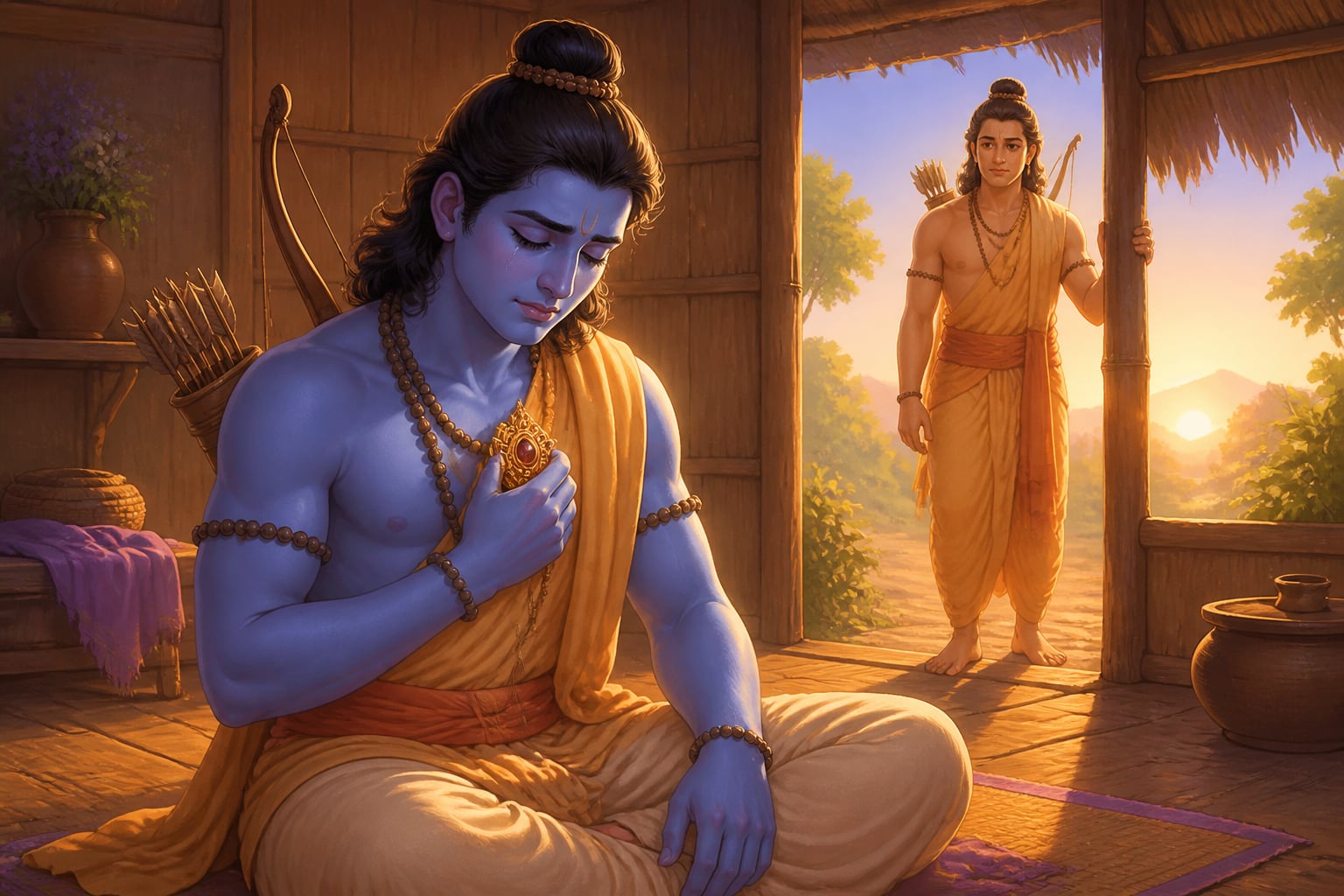
Rama stares at the gem.
For a long moment, he cannot speak. His fingers close around the jewel that Sita has worn since their wedding day - the jewel her father gave her, the jewel he has seen in her hair through every joy and trial of their life together.
The recognition is instant and total.
"This is hers," he whispers. "This is truly hers."
He lifts the Chudamani to his lips, then presses it against his heart. His eyes close. Tears stream down his face - not tears of grief but of overwhelming relief.
"She lives," he says, wonder in his voice. "My Sita lives."
Rama holds the jewel and speaks to it as if Sita herself could hear.
"This gem witnessed everything. My father-in-law placed it in Sita's hair on our wedding day. She wore it when we walked the sacred fire. She wore it through our years in Ayodhya, through the exile into the forest, through our time in Chitrakuta."
His voice breaks.
"She was wearing it the day Ravana took her. And she kept it - through all these months of captivity, she kept this piece of our life. For this moment. To send it to me."
He looks at Hanuman with gratitude beyond expression.
"You have brought me my wife's heart, Hanuman. In this jewel, I feel her love reaching across the ocean."
The Full Account
Rama composes himself. The warrior in him knows that emotion must yield to information.
"Tell me everything, Hanuman. Do not spare me any detail. I must know all of it - the good and the painful alike."
Hanuman begins his narrative.
He speaks of the ocean crossing, minimizing the obstacles but acknowledging them. He describes Lanka's forbidding beauty and his night of searching. He recounts the moment of finding Sita, her appearance, her condition.
Rama listens with fierce attention, absorbing every word.
"Was she... did they..." He cannot finish the question.
"She is thin, my lord. She is worn by grief and the cruelty of her guards. But she is unharmed in the way you fear. Ravana desires her but has not touched her. Her virtue and her faith have been a shield that even he could not penetrate."
Relief floods Rama's features.
Hanuman's Confession
Hanuman continues his account, and now he reveals something he has not told others.
"My lord, I must confess something. Before I found her, I nearly despaired."
Rama looks at him with surprise.
"I had searched the entire city - every palace, every garden, every corner of Lanka. She was nowhere. I began to fear the worst. Had she died of grief? Had Ravana killed her in rage? Had she taken her own life rather than submit?"
Hanuman's voice thickens with remembered anguish.
"I sat on a wall of Lanka and wept. I thought of returning to you with nothing - with the news that I had failed. I wondered if I should simply end my own life rather than deliver such pain."
"What restored you?" Rama asks quietly.
Hanuman meets his lord's eyes.
"I remembered your face. I remembered your confidence when you sent me. I thought: 'Rama would not give up. Rama would search until there was nowhere left to search.' So I looked for places I had not yet been."
He describes spotting the Ashoka grove - separate from the palace, heavily guarded, a place that suggested something precious was hidden within.
"And there she was. Beneath a tree, surrounded by demons, worn but not broken. The moment I saw her, I knew everything would be different."
Rama reaches out and grips Hanuman's shoulder.
"Your doubt was not weakness, my friend. It was the honest acknowledgment of difficulty. But you pushed through. That is all that matters. That is everything."
The Crow Incident
Hanuman takes a breath and continues.
"My lord, the Lady Sita gave me a private message for you. She said to remind you of the crow in Chitrakuta."
Rama's expression changes. The memory is private, intimate - something only he and Sita share.
"Tell me what she said."
"She said: 'Remember when a crow attacked me and drew blood. For that small wound, my lord invoked the Brahmastra on a blade of grass. The arrow chased the crow across three worlds until it surrendered. My husband did all that for a drop of my blood.'"
Hanuman hesitates.
"She said to tell you she knows why you have not come yet - that you did not know where she was. She said she has never doubted you. But she also wanted you to remember... that you once moved heaven and earth for her over far less than this."
Rama's Vow
Rama stands. The grief that had bent him is transforming into something else - not rage exactly, but determination absolute and terrible.
"I remember the crow," he says quietly. "I remember what I did for a scratch. Does Ravana imagine I will do less for this?"
He looks at the Chudamani, then tucks it carefully into his garment, against his heart.
"She was right to remind me. Not because I needed reminding of my love - that has never wavered. But because I needed reminding of my capability. I have the power to end this. I have always had it."
He turns to Hanuman.
"You have done more than any servant has ever done for a master. You have returned my heart to me. Now help me return it to her."
Hanuman bows.
"My lord, Sugriva mobilizes the army even now. Within days, the vanara forces will be assembled. Lanka will burn - not from my small fire, but from your righteous wrath."
Rama nods.
"Then let us begin. The time for waiting is over. The time for war has come."
Living traditions
The Chudamani scene has influenced Indian jewelry traditions. Wedding jewelry given by the bride's family is considered especially precious, echoing Janaka's gift to Sita. In South Indian weddings, the 'maang tikka' (head ornament) is presented with special ceremony, often referenced to Sita's Chudamani. The concept of tokens carrying loved ones' presence appears in modern long-distance relationship advice.
- Chitrakoot: The site where Rama, Sita, and Lakshmana spent eleven years of exile, and where the crow incident occurred. Multiple temples mark specific sites from the epic, including Kamadgiri hill and Ramghat on the Mandakini river.
- Sita Samahit Sthal: Traditional site of Sita's birthplace and later return to earth. The temple houses representations of Sita's jewelry, including the Chudamani, recreated based on textual descriptions.
Reflection
- Sita's crow message was simultaneously reassurance ('I haven't doubted you') and gentle challenge ('remember what you did for less'). How do we deliver messages that comfort and motivate at the same time?
- Hanuman's confession of despair was not required - he could have told a simpler story of unbroken confidence. Why did he choose to reveal his weakness? What does this teach about authenticity in reporting?
- Rama spoke to the Chudamani as if speaking to Sita herself. What does it mean for objects to become representatives of people? How do material things carry immaterial meaning?