The Messenger Revealed
Hanuman Approaches Sita
With Ravana gone and the rakshasi guards drowsy, Hanuman finally has his chance to approach Sita. But how can a strange monkey convince a traumatized captive that he is truly Rama's messenger? Through careful words, familiar stories, and finally the proof of Rama's signet ring, Hanuman bridges the gap between hope and despair.
The Moment Arrives
After Ravana's departure, the Ashoka grove falls quiet.
The rakshasi guards, exhausted from their vigilance, begin to drowse. Even the most alert among them lets her attention wander. The pre-dawn hours are heavy with sleep. Hanuman watches from the Shimshupa tree, waiting for the right moment.
Sita sits alone beneath an Ashoka tree, lost in her grief. The moonlight catches her tears. She seems utterly abandoned, utterly without hope.
"Now," Hanuman decides. "It must be now."
But Hanuman faces a delicate problem. Sita is a captive in a demon kingdom, surrounded by shapeshifters and illusionists. How many times might rakshasas have tried to trick her by taking friendly forms? How can she possibly trust a strange talking monkey who appears from nowhere?
Hanuman needs to establish trust before revealing himself.
The Song of Rama
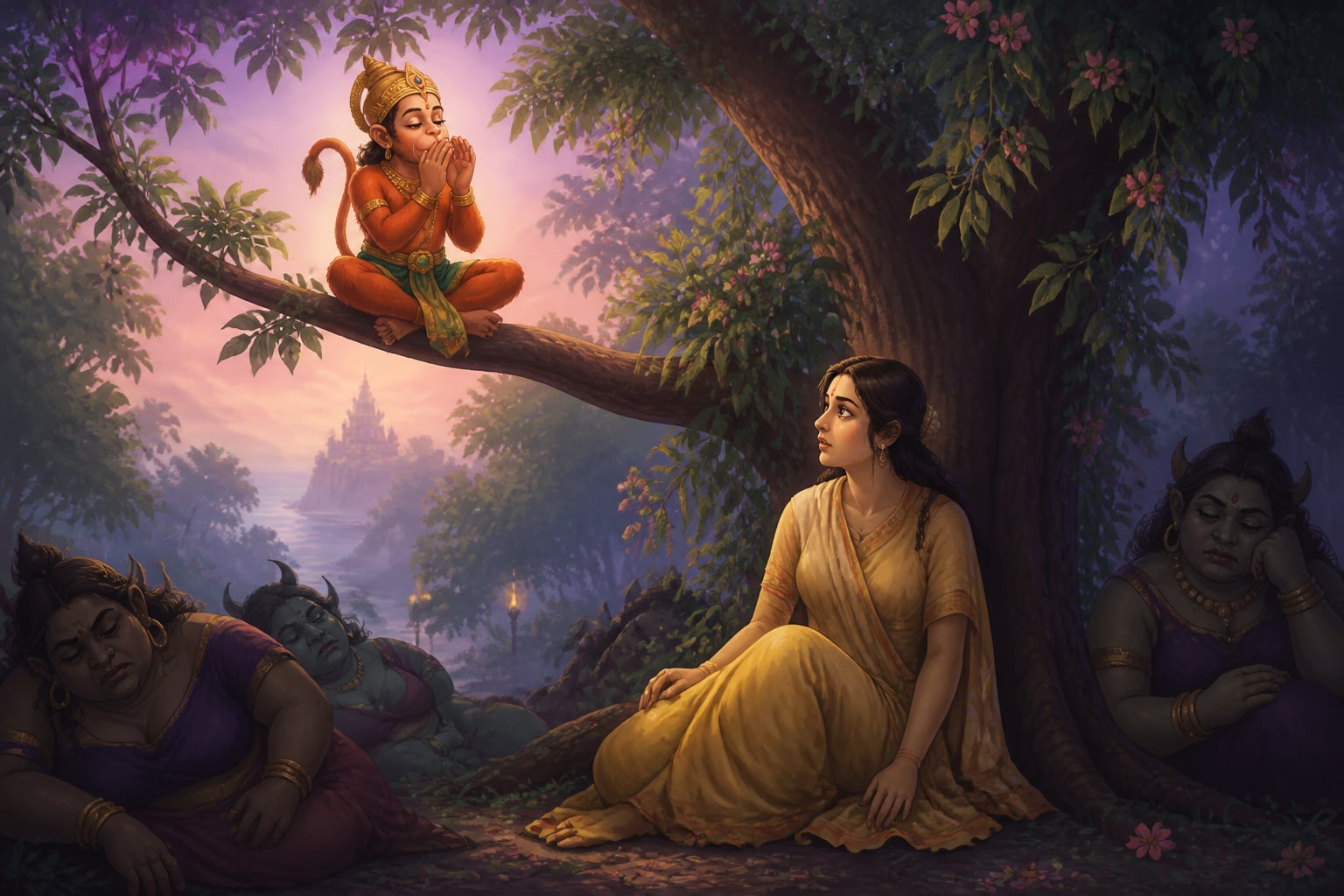
From his hidden position, Hanuman begins to sing - softly, barely audible, but clear.
He sings of Ayodhya. He sings of King Dasharatha and his longing for sons. He sings of the princes' birth, their training, their youthful victories. He sings of Vishwamitra's arrival and the journey to protect the sage's sacrifice.
Sita's head lifts slightly.
Hanuman continues. He sings of the bow of Shiva, shattered by young Rama's strength. He sings of a princess found in a furrow, raised by a philosopher-king. He sings of a wedding that joined two noble houses.
Sita turns toward the sound, her eyes searching the darkness. Something in the song stirs memories long held close to her heart.
Hanuman descends from the tree, still singing softly, approaching slowly. When Sita finally sees him - a small monkey with intelligent eyes - she draws back in alarm.
"Do not fear, noble lady," Hanuman says, his voice humble and clear. "I am not what you might fear. I am Hanuman, son of the Wind god, servant of Lord Rama. He has sent me across the ocean to find you."
Sita stares at him, disbelief and desperate hope warring in her eyes. "Another trick," she whispers. "The rakshasas have sent another trick. They torment me with false hopes."
Proving Truth
Hanuman expected this response.
"Mother Sita," he says gently, "what proof would convince you? Ask me anything about Lord Rama - things only his true messenger would know."
Sita's eyes narrow, testing him. "Tell me of Chitrakuta," she demands, naming the place where she and Rama spent peaceful months during their exile. "What happened there?"
Hanuman describes the hermitage, the river, the sages who visited. He recounts conversations Rama had shared with Sugriva, details no demon could know. Sita's resistance begins to crumble.
"Tell me of the crow," she says - referring to an incident only she and Rama witnessed.
Hanuman tells the story: a crow - actually a divine being - had pecked at Sita, and Rama had shot an arrow that pursued the crow across the three worlds until it begged for mercy.
Sita begins to weep.
Then Hanuman reaches into the cloth he carries and withdraws something small and golden. "Lord Rama sent this for you," he says. "So you would know, beyond all doubt, that his messenger has truly come."
It is Rama's signet ring - the ring she had seen on his hand every day of their marriage, engraved with symbols of the Raghu dynasty. Sita takes the ring with trembling hands. She presses it to her forehead, to her heart, to her lips. Tears flow freely now - not tears of grief but of overwhelming relief.

"He is alive," she breathes. "He has not forgotten me. He is coming."
The News of Rama
Now that Sita believes, questions pour from her. "Is he well? Is he eating? Is he sleeping? Has grief consumed him? Where is he now? How did he find allies? When will he come?"
Hanuman answers everything. He describes Rama's alliance with Sugriva and the vanara army. He tells of the search parties sent in all directions. He recounts his own journey - Sampati's guidance, the leap across the ocean, the challenges he faced.
"A great army is preparing," Hanuman assures her. "The vanaras number in millions. They will build a bridge across the sea or drain the ocean itself if necessary. Nothing will stop Lord Rama from reaching you."
Sita listens, hope reviving with each word. But then she grows thoughtful. "Hanuman, you must tell me truly - how is my lord? Does he still hold his strength? Or has separation worn him down?"
"He grieves," Hanuman admits. "No one could lose such a wife and not grieve. When I left him, he held himself together for duty's sake, but I could see the pain beneath."
Sita nods, understanding. "Tell him this: tell him that I live, that I have been faithful, that I wait for him alone. Tell him that Ravana's threats cannot shake me - I would die a thousand deaths before accepting another. But tell him also to come quickly, for my time grows short. Ravana has given me only two months."
The Offer Refused
Hanuman makes a bold suggestion:
"Mother, I have the power to carry you. Climb upon my back, and I will return you to Lord Rama this very day. You need not wait for armies or bridges - I can end your captivity now."
Sita considers this. The temptation must be overwhelming - freedom within reach, reunion with her beloved just hours away. But she shakes her head.
"No, Hanuman. If you carry me away secretly, people will say Rama could not rescue his own wife - that a monkey had to do it. His honor requires that he come himself, defeat Ravana in righteous battle, and reclaim me through his own strength."
She smiles sadly. "Also, I will not touch another male, not even you who are so faithful. My body has touched only Rama. Let it remain so until he takes my hand again."
Hanuman bows, humbled by her reasoning. Her refusal speaks not of weakness but of profound strength - the strength to wait, to trust, to preserve honor even when escape beckons.
The Farewell
As they speak, the eastern sky begins to lighten. The rakshasi guards will wake soon. The opportunity for private conversation is ending.
"I must go," Hanuman says reluctantly. "But before I leave Lanka, I will do something to show Ravana that his doom approaches. He should know that Rama's reach has already touched his kingdom."
Sita looks alarmed. "Be careful, Hanuman. You have already succeeded - do not throw away your life on pride."
"It is not pride, Mother," Hanuman replies. "It is strategy. Ravana must know the enemy he faces. Let him see a small taste of vanara power - and tremble at what the full army will bring."
He touches Sita's feet in farewell. "Tell Lord Rama that you are well, that you love him, that you wait. And tell him - Hanuman kept his word."
With that, he leaps back into the Shimshupa tree, preparing for the next phase of his mission. The messenger's task is nearly complete. Now it is time to deliver a different kind of message - one written in fire and destruction.
Living traditions
The Hanuman Chalisa is India's most-streamed devotional song on digital platforms. 'Jai Hanuman' is a common encouragement phrase in Indian sports and military contexts. The image of Hanuman carrying Rama's message has become a symbol of faithful service in Indian organizational culture.
- Hanuman Chalisa Recitation: The 40-verse hymn by Tulsidas, recited millions of times daily across India. Verses 17-20 specifically describe Hanuman bringing Rama's ring to Sita, as narrated in this lesson.
- Seetha Amman Temple: Marks the sacred spot where Hanuman is believed to have revealed himself to Sita. The temple depicts the moment of their meeting - hope entering a place of despair.
- Sankat Mochan Hanuman Temple: Founded by Tulsidas, who composed the Hanuman Chalisa. The temple celebrates Hanuman as 'remover of difficulties' - exactly the role he plays for Sita in this lesson.
Reflection
- The signet ring carried Rama's identity across the ocean. What objects or symbols carry your identity and relationships? What would you send if you needed to prove 'this really comes from me'?
- Sita refused Hanuman's offer to carry her to freedom, prioritizing Rama's honor over her immediate escape. When have you chosen a harder path because the easier one would have compromised something important?
- Hanuman patiently proved his identity through knowledge and the ring. In a world full of deception, how do you determine who to trust? What 'rings' do you look for as proof of authenticity?