The Token of Faith
Sita's Chudamani
Before Hanuman departs, Sita entrusts him with her Chudamani - the crest jewel from her wedding day. This precious ornament will prove to Rama that his messenger truly found her. But along with the jewel, Sita sends a message that only Rama will understand, a memory that proves her identity beyond doubt.
The Precious Gift
Dawn is breaking over Lanka. Hanuman must leave soon, but first, there is an exchange to complete.
"Hanuman," Sita says, "you carry Rama's ring to prove you came from him. But what will prove to Rama that you truly found me? Any spy could return with a description."
She reaches up to her hair - disheveled, unwashed for months, yet still adorned with one precious item. "Take this."
She presses into Hanuman's palm a jewel of extraordinary beauty - a crest ornament set with a brilliant gem that catches the first rays of sunlight.
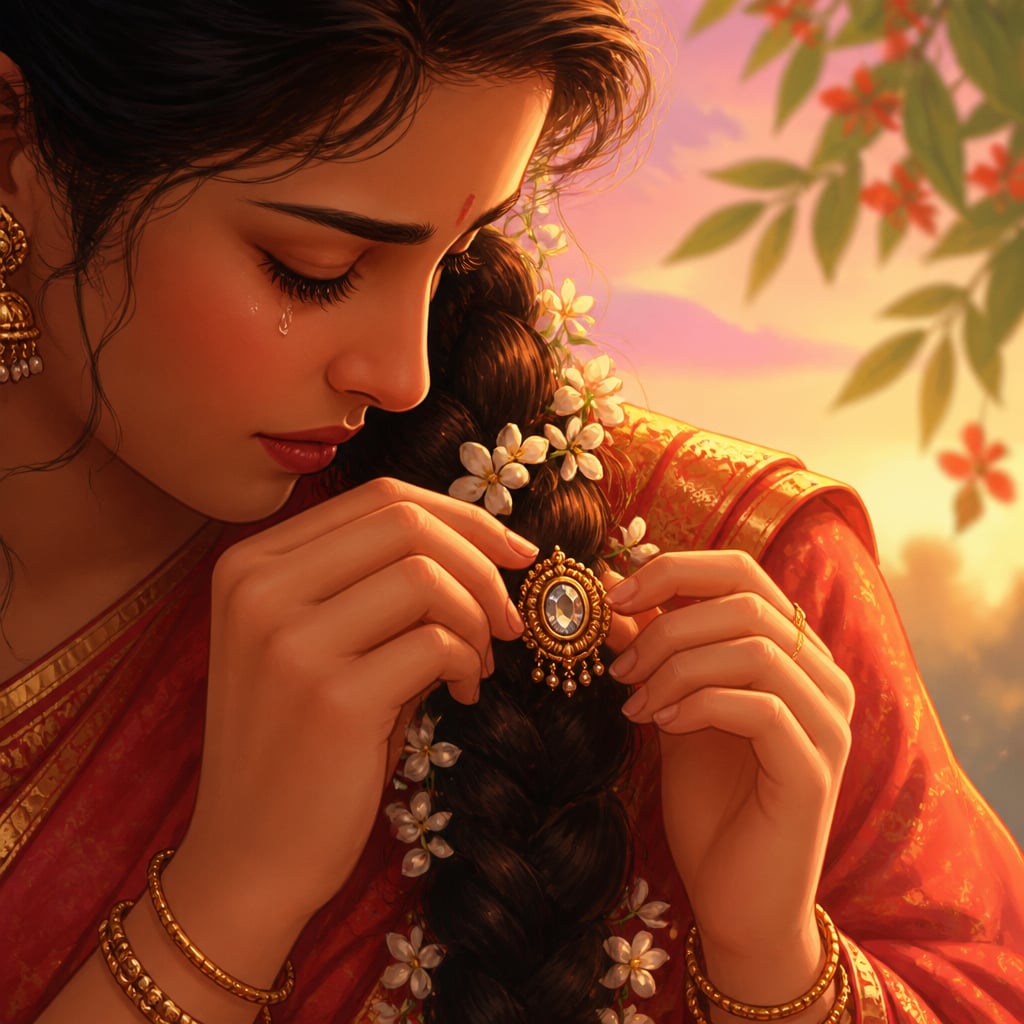
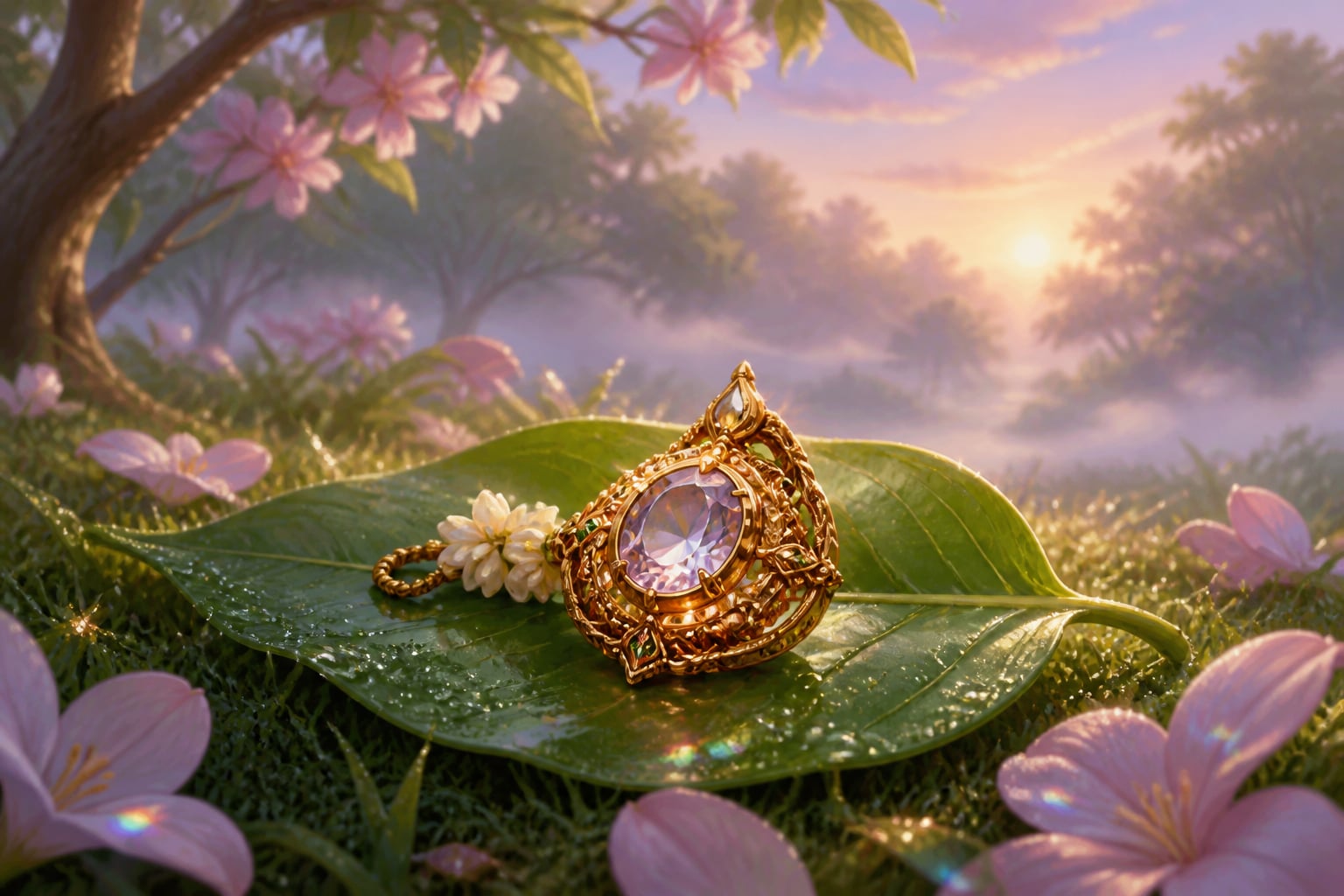
"This is my Chudamani," Sita explains. "My father gave it to me on my wedding day. I have worn it ever since - through the years in Ayodhya, through the exile, through everything. Rama will recognize it instantly."
She pauses, her voice trembling. "When Ravana took me, I kept it hidden. It was the last piece of my former life I possessed. I have touched it every day, remembering. Now I give it to you, so that Rama will know without doubt that you found me."
Hanuman accepts the jewel with both hands, understanding its weight is far more than physical. This ornament carries years of marriage, years of devotion, years of waiting compressed into a single gleaming object.
A Private Memory
But Sita offers something else - something no jewel could carry.
"Tell Rama this," she says, leaning close. "Remind him of the time a crow attacked me in Chitrakuta. I was resting, and a crow - a divine being in disguise - pecked at my chest, drawing blood. Rama saw and grew furious."
Her eyes grow distant with memory. "He took a blade of grass and invoked the Brahmastra upon it. That grass-arrow pursued the crow across the three worlds. The crow fled to Brahma himself, but even Brahma could not give sanctuary against Rama's arrow. Finally, the crow surrendered, and Rama spared its life, taking only one eye as punishment."
She looks at Hanuman intently. "Only Rama and I witnessed this. No demon could know it. When you tell him, he will know beyond doubt that you spoke with me."
Sita's voice grows bitter. "Ask Rama this for me: That day, for a drop of my blood from a crow's beak, he unleashed the Brahmastra. Now Ravana has tormented me for months. Where is that arrow now?"
She catches herself. "No, do not speak those words. I know why he waits - he does not know where I am, and he cannot strike blindly. Tell him instead that I understand. Tell him I know he is coming."
Hanuman sees the conflict in her - the wife who trusts absolutely, and the suffering woman who has moments of doubt. "Mother," he says gently, "Lord Rama has not rested since the day you were taken. When he learns you are found, nothing will stop him. Lanka's walls will fall. Ravana's armies will scatter. You will be in his arms before the next full moon."
Sita's Message
Sita composes herself and dictates the message she wants Hanuman to deliver.
"Tell my lord that I am alive. Tell him I am faithful - no word of Ravana's, no threat, no temptation has touched my heart. Tell him I think of him every moment, and that thought alone sustains me."
She pauses. "Tell him to come quickly, for Ravana has set a deadline. But tell him also not to compromise dharma for speed. I would rather die faithful than be rescued through unrighteous means."
Hanuman asks about the enemy they will face. "Mother, what can you tell me of Ravana's strength? What should Lord Rama know before battle?"
Sita's face hardens. "Ravana is powerful - truly powerful. I have seen gods flee from him. His army is vast, his magic is great, and his pride is boundless. Do not underestimate him."
But then her expression changes. "Yet I have seen his weakness too. He fears righteousness. When he stands before me, something in him shrinks. He conquered the gods, but he cannot meet the eyes of a faithful wife. That fear will destroy him."
The Final Instructions
Sita has one last instruction. "Hanuman, when you return to Rama, observe his state carefully. If grief has weakened him, speak gently. If anger has made him reckless, counsel patience. You have seen me - you can describe my condition and help him understand."
She smiles sadly. "Be the bridge between us. Carry not just my words but my spirit. Let him feel through you that I am still his Sita, unchanged in heart if worn in body."
Hanuman bows deeply. "I will carry everything, Mother. Not one word will be lost. I will convey not just your message but your courage, your faithfulness, your unbroken spirit. He will know exactly who waits for him in this garden of sorrows."
The Departure
The sun is fully risen now. Rakshasis are stirring. Hanuman must go.
He tucks the Chudamani safely away, memorizes every detail of Sita's condition and words, and prepares to leave. The jewel rests against his heart, warm from Sita's touch, carrying her love across the ocean to the one who waits.
"Wait," Sita says suddenly. "You spoke of showing Ravana a taste of vanara power. What do you intend?"
Hanuman's eyes gleam. "I intend to create some chaos, Mother. To destroy a portion of this grove, to announce to Ravana that his enemy has breached his walls. He should know fear before the real army arrives."
Sita looks concerned but does not forbid it. "Be careful, Hanuman. You have already succeeded. Do not let pride lead you into danger you need not face."
"It is not pride," Hanuman assures her. "It is strategy. And perhaps a little righteous anger at what they have done to you. Let Ravana see what one vanara can accomplish. Let him imagine what millions can do."
With a final salute, he leaps into the trees. The next phase of his mission is about to begin - a message not of hope but of coming destruction.
Living traditions
The Chudamani's role as authentication has parallels in modern cryptography - a personal token that proves identity without revealing secrets. Jewelry authentication certificates in India sometimes reference the Chudamani tradition. The phrase 'chudamani' (crown jewel) is used metaphorically for the most precious element of any collection.
- Exchange of Tokens in Weddings: In Hindu marriages, the exchange of items between bride's and groom's families echoes the token-bearing tradition. Sita's Chudamani as proof of identity has influenced how tokens convey trust and authenticity.
- Janaki Mandir: Grand temple marking Sita's birthplace, where King Janaka found her in a furrow. Displays replicas of wedding jewelry similar to the Chudamani Sita sent with Hanuman. A major pilgrimage site for Ramayana devotees.
- Sita Kund: Ancient tank believed to mark Sita's birth site. Part of the Sita circuit that connects her life story. The jewelry and tokens exchanged between Sita and Hanuman are commemorated in local traditions.
Reflection
- Sita asked Hanuman to observe Rama's state and adjust his delivery accordingly - comforting if grieving, calming if angry. How do we tailor difficult messages to the recipient's emotional state? Is this manipulation or wisdom?
- Sita sent the Chudamani - an object imbued with years of love and memory. What objects in your life carry such weight? What stories would they tell if they could speak?
- Sita briefly expressed bitterness about Rama's delayed rescue before taking it back. How do we honor authentic emotions while maintaining faithfulness? Is it disloyal to feel doubt or frustration?