Council of War
Planning the Invasion of Lanka
Rama joins his generals - Sugriva, Hanuman, Angada, Jambavan, and others - to plan the invasion of Lanka. The council debates how to cross the ocean, how to organize forces, and how to face Ravana's formidable army. Hanuman's intelligence from Lanka proves crucial as strategy takes shape.
The War Council Assembles
Sugriva's great hall fills with the commanders of the vanara army.
They come from every corner of the alliance: bear-kings from the mountains, monkey chiefs from the forests, commanders who trace their lineage back to the dawn of time. The air hums with suppressed energy - these warriors have waited for this moment.
Rama takes his place beside Sugriva, Lakshmana at his left hand. Before them spreads a cloth map of the known world, marking Kishkindha in the north and Lanka in the south, separated by the vast blue expanse of ocean.
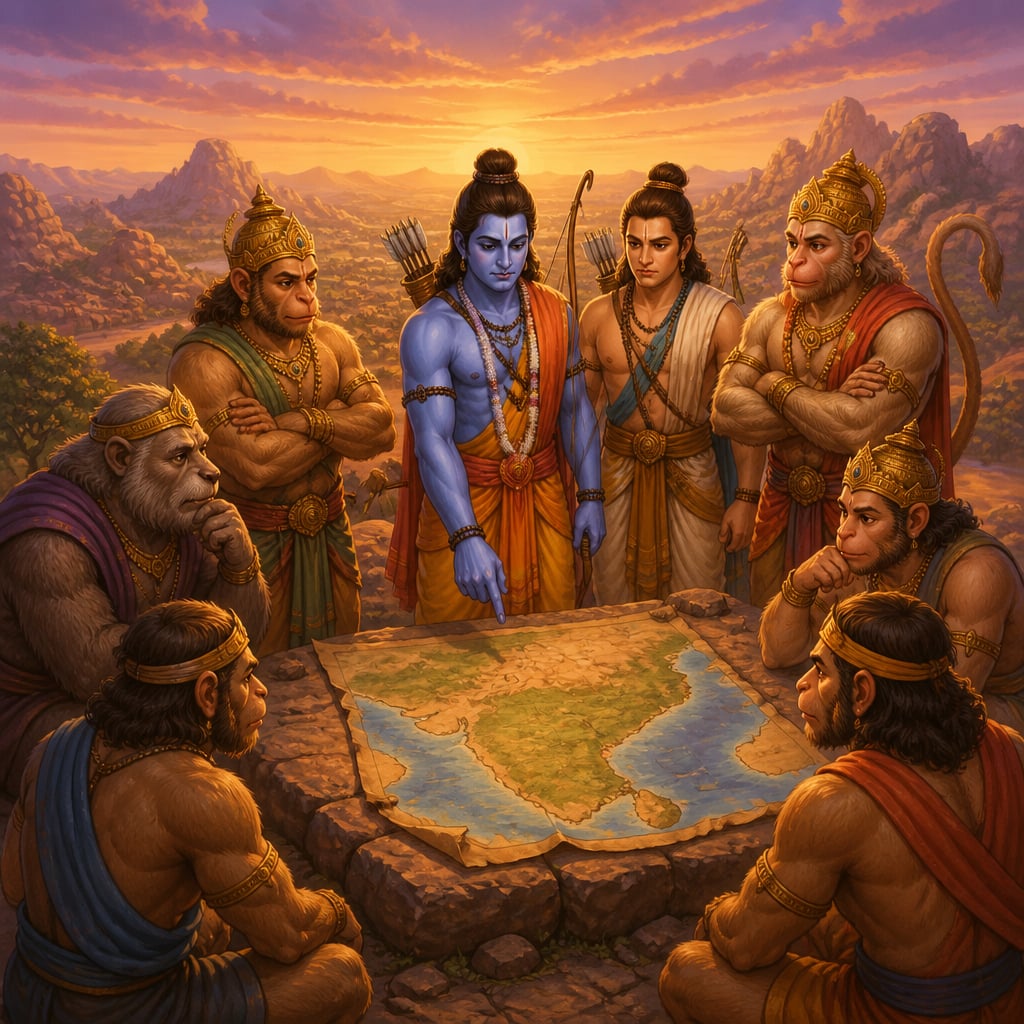
"Commanders," Sugriva begins, "the Lady Sita has been found. She waits in Lanka. We have perhaps six weeks before Ravana's deadline. Today we plan how to reach her, how to defeat her captor, and how to bring her home."
The Ocean Problem
The first challenge dominates all others.
"A hundred yojanas of sea," says Nila, commander of Sugriva's main force. "Some of us can swim, but not all, and not that far carrying weapons. Hanuman can leap it, but he cannot carry an army on his back."
Jambavan strokes his ancient beard.
"In my youth, I could have leaped it myself. But those days are past. I can swim a great distance, but even I would be exhausted before reaching Lanka. And exhausted warriors are defeated warriors."
Angada speaks: "Could we build boats? We have forests of timber."
"Time," Hanuman responds. "To build enough boats for our forces would take months we don't have. And the ocean is not calm - storms would scatter any fleet."
Rama listens to the debate, his expression thoughtful.
Hanuman's Intelligence
"Before we solve the crossing," Rama says, "let us understand what we cross to face. Hanuman, tell us of Lanka's defenses."
Hanuman stands and moves to the map.
"Lanka sits atop a mountain within the sea. The approaches are narrow and heavily guarded. The walls are massive - I estimate twenty elephants high and five thick. The city itself is built on multiple levels, with defensive positions at each elevation."
He traces routes on the map as he speaks.
"Ravana's army numbers in the hundreds of thousands. His regular troops are fierce but not exceptional. His elite guard, however, are veterans of wars against the gods themselves. They know magic and carry divine weapons."
"Commanders to watch?" Lakshmana asks.
"His son Indrajit is the most dangerous - master of illusion warfare and divine weapons. His brother Kumbhakarna sleeps but when awakened is nearly invincible. The generals Prahasta and Mahodara are experienced and skilled."
The Strategic Debate
The commanders discuss approaches.
"Direct assault," suggests Nala. "Overwhelm them with numbers. Our forces exceed theirs if we gather the full alliance."
"Against those walls?" Jambavan shakes his head. "We'd lose half our force before breaching them. And fighting uphill against entrenched defenders..."
"Siege, then," offers another. "Surround the city, cut their supplies, wait them out."
"The Lady Sita doesn't have time for a siege," Angada reminds them. "Six weeks. We need quick victory."
Rama speaks: "We need all three - the numbers to threaten, the siege capability to contain, and a strike force for quick decision. But first, we need to cross the water."
A voice speaks from the back of the hall.

"My lord, I am Nala, son of Vishwakarma the divine architect. I have inherited some of my father's gift for building."
Rama nods for him to continue.
"A bridge. Not of boats but of stone and mountain. If the vanaras were to bring rocks from the mountains, trees from the forests - vast quantities, all thrown into the sea - we could build a causeway to Lanka."
The hall buzzes. A bridge across the ocean?
"Is this possible?" Sugriva asks.
"With enough labor, anything is possible. We have millions of vanaras. If each carries stones to the shore and throws them in, day after day, the causeway would grow. My knowledge can direct the construction - which stones to place where, how to create a foundation that holds."
"How long?" Rama asks.
"If we work without rest... perhaps five days. Perhaps seven. It depends on how quickly we can move materials."
Rama's Decision
Rama stands, and the hall falls silent.
"We will build the bridge. Nala will direct construction. Every vanara who can lift a stone will contribute. We begin the moment we reach the sea."
He looks around the council.
"For the battle itself: we will organize into five divisions. Sugriva commands the center. Angada the vanguard. Nila and Nala the flanks. Jambavan the reserve."
"And yourself, my lord?" Sugriva asks.
"Lakshmana and I will go where we are needed. But our primary target is Ravana himself. Kill the demon king and his army loses heart. We must create the conditions for me to face him."
The council moves to specifics.
"Hanuman," Rama says, "you have already proven yourself beyond measure. In the battle to come, you will be my special instrument. Where the fighting is hardest, where the need is greatest, that is where you go."
Hanuman bows. "I am yours to command, my lord."
"Angada, your vanguard will test their defenses first. Probe for weaknesses. Draw out their formations so we can observe their tactics."
The young prince nods fiercely.
"Jambavan, your experience is irreplaceable. You command the reserve, but more than that, you counsel. If you see opportunity or danger that others miss, speak."
The old bear places his hand over his heart. "My wisdom, such as it is, is yours."
The Wider Picture
"One more matter," Rama adds. "Hanuman mentioned dissent in Ravana's court. His brother Vibhishana spoke dharma. If Vibhishana were to defect, his knowledge of Lanka's inner workings would be invaluable."
"Can we rely on a demon's loyalty?" someone asks.
"We can rely on dharma's pull," Rama replies. "If Vibhishana is truly righteous, he will find serving Ravana increasingly impossible. We should be prepared to receive him if he comes."
The council absorbs this.
"Are there further questions? Further concerns?"
Silence. The commanders are resolved.
"Then we march tomorrow. By the time we reach the sea, supplies should be in place to begin bridge construction. May dharma guide our hands and steady our hearts."
The council rises. The plan is set. The war is about to begin.
Living traditions
The Rama Setu has become a symbol of Indian engineering achievement and is proposed for UNESCO World Heritage status. Environmental and archaeological surveys continue to study the formation. The council scene is frequently referenced in Indian management literature as an example of participatory leadership and strategic planning.
- Panchayat Decision-Making: Traditional Indian village councils (panchayats) use deliberative processes similar to Rama's war council. Decisions emerge from discussion rather than decree. This practice, while ancient, was formally recognized in India's constitution and continues today.
- Dhanushkodi: The traditional starting point of Rama Setu. The town was destroyed by a cyclone in 1964 and remains a ghost town, but pilgrims still visit to see where the bridge construction began. The shallow waters toward Sri Lanka are visible on clear days.
Reflection
- Nala proposed building a bridge across the ocean - an idea that must have seemed absurd until he explained it. How do we create environments where seemingly absurd ideas can be voiced and evaluated fairly?
- Rama mentioned preparing to receive Vibhishana if he defected. How do we prepare to receive help from unexpected quarters? What prevents us from accepting assistance from those we might not expect to ally with?
- The council included diverse voices - young Angada, ancient Jambavan, builder Nala, warrior Nila. How does diversity of perspective improve decision-making? What voices might be missing from councils you participate in?