Before the Demon King
Hanuman Delivers Rama's Ultimatum
Bound by Indrajit's Brahmastra, Hanuman is dragged before Ravana's throne. But the prisoner shows no fear - instead, he delivers Rama's message directly to the demon king. Meanwhile, Hanuman reflects on what Sita told him about Trijata, the rakshasi who defended her with a prophetic dream of Lanka's doom.
The Captive's Journey
Rakshasa soldiers drag Hanuman through the golden streets of Lanka.
His arms are bound with ropes layered over the Brahmastra's invisible chains. His fur is matted with dust from the destroyed grove. But his eyes - his eyes blaze with a fire that makes even his captors uneasy.
"This is no ordinary prisoner," they mutter among themselves. "He killed Prince Akshay. He destroyed the sacred grove. And look at him - he shows no fear."
Hanuman allows himself to be led. Every step brings him closer to his true objective: Ravana himself.
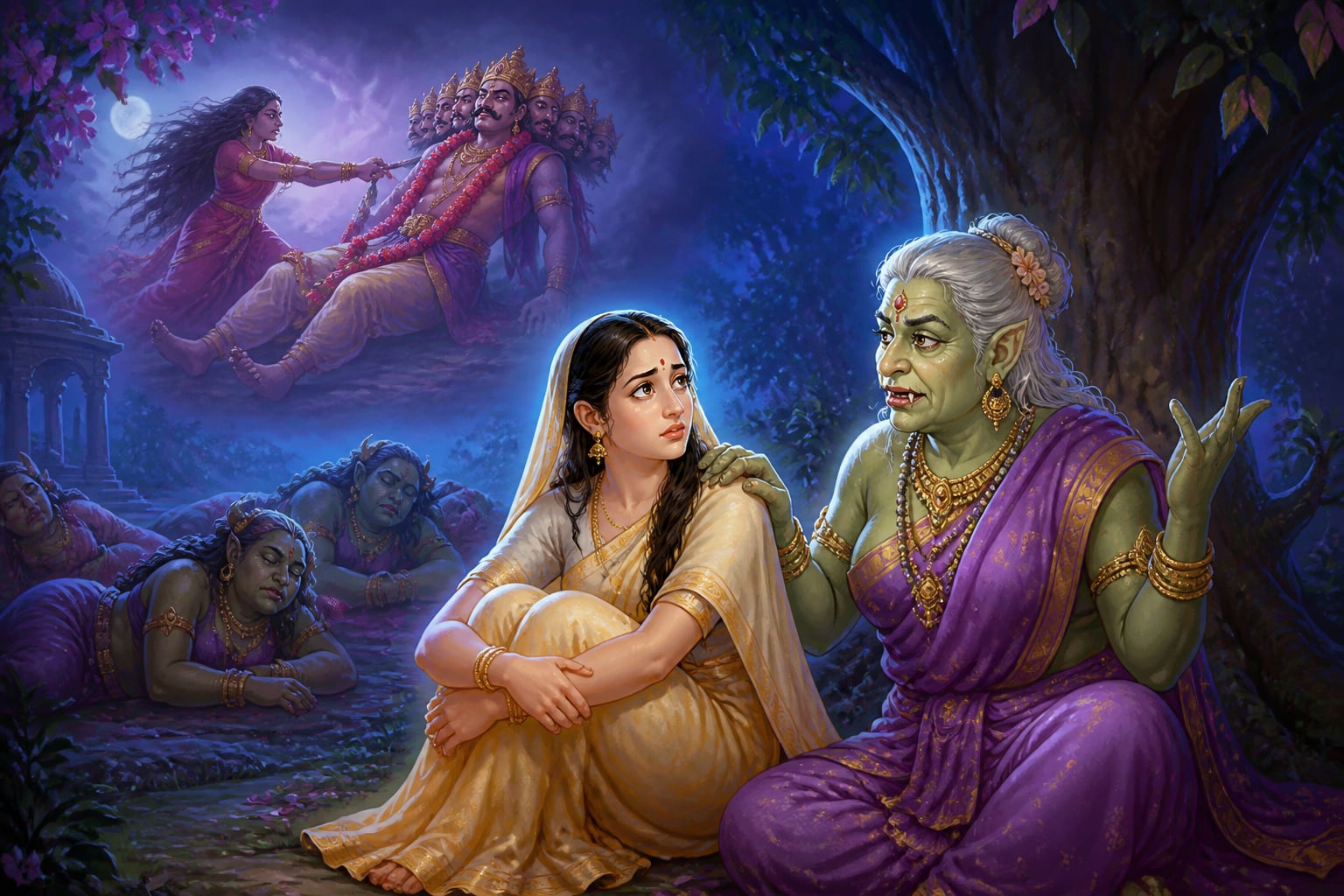
As Hanuman is paraded through the city, his mind turns to something Sita had whispered during their conversation - the story of Trijata.
"There is one rakshasi who is different," Sita had said. "Her name is Trijata. When the other guards threatened to devour me, she stopped them. She told them of a dream - a vision of Lanka's destruction."
The dream had been vivid: Ravana dressed in red, covered in oil, garlanded with oleander flowers, dragged by a woman toward the southern direction of death. Lanka sinking into the ocean. And Rama - magnificent Rama - riding a white elephant with Lakshmana, reuniting with Sita on a mountain peak.
"She warned the rakshasis to seek my forgiveness," Sita had continued. "She said my husband would destroy them all. Some laughed at her. But I saw fear in their eyes."
Hanuman smiles inwardly. Even among demons, truth finds its voice.
Before the Throne
The great doors of Ravana's audience hall swing open. Hanuman has seen wealth and power before - in Kishkindha, in the celestial realms his father Vayu has shown him. But Ravana's throne room is designed to overwhelm even those who have witnessed divine splendor.
A thousand pillars of gold support a ceiling so high it disappears into shadow. Gems embedded in the walls create patterns that shift with the lamplight. Ministers and generals fill the hall, their forms ranging from merely intimidating to genuinely monstrous.
And at the center, on a throne carved from a single massive ruby, sits Ravana. His presence fills the room like a physical force. His ten heads turn toward Hanuman, twenty eyes blazing with cold fury. Each face wears a different expression - rage, contempt, curiosity, calculation - as if separate minds are evaluating the prisoner from different angles.
"This is the monkey?" Ravana's voice echoes from all ten mouths simultaneously. "This insignificant creature killed my son? Destroyed my garden?"
The court murmurs. Hanuman sees ministers exchanging glances, warriors gripping their weapons.
"Speak, monkey," Ravana commands. "Who sent you? What madness drove you to enter my city and commit these outrages?"
The Message of Rama
Hanuman draws himself up to his full height, despite his bonds.

"I am Hanuman, son of Vayu the Wind God, minister to King Sugriva of Kishkindha. But I come not as Sugriva's servant today. I come as the messenger of Lord Rama, son of Dasharatha, heir to the throne of Ayodhya."
The name Rama sends a ripple through the court. Ravana's faces darken.
"Rama sends you this message," Hanuman continues, his voice carrying to every corner of the vast hall. "Return Sita. Return her unharmed, with honor, and beg her forgiveness. Do this, and you may yet live. Refuse, and no power in the three worlds will save you from his wrath."
For a moment, silence. Then Ravana laughs - a terrible sound that seems to shake the pillars themselves.
"A threat? A mortal prince sends a monkey to threaten ME? I, who conquered Indra? Who made the gods themselves tremble? Who holds the three worlds in my power?"
He leans forward on his throne, all ten faces now unified in menace. "Your Rama is a fool, and you are a fool's messenger. He lost his wife because he was too weak to protect her. He will lose his life when he dares to face me."
Hanuman Speaks of Weakness
Hanuman meets those twenty eyes without flinching.
"Great king, I have seen your power. Your city is magnificent. Your soldiers are fierce. Your magic is strong." He pauses. "But I have also seen your weakness."
Ravana's faces twist with anger, but something - curiosity? concern? - keeps him silent.
"Your power is borrowed," Hanuman continues. "Your boons came from gods you now despise. Your city was stolen from your brother. Your women were taken by force. And the woman you want most - Sita - you cannot have. Not because you lack strength, but because her will is stronger than all your might."
The court gasps. No one speaks to Ravana this way.
"I saw her place a blade of grass between herself and you," Hanuman adds quietly. "The lord of the three worlds, reduced to less than a straw in the eyes of a captive woman. That is your weakness, Ravana. That is why you will fall."
Vibhishana's Intervention

Ravana's rage explodes. "KILL HIM! Kill this insolent creature! Tear him apart! Let his master know what happens to those who insult Ravana!"
Soldiers surge forward. But before they can reach Hanuman, a voice cuts through the chaos. "Brother, wait."
The speaker is a rakshasa who has been standing quietly in the shadows - tall, dignified, his bearing somehow different from the others. His name is Vibhishana, youngest brother of Ravana.
"To kill a messenger is against dharma," Vibhishana says calmly. "Every tradition, every law of civilized warfare, protects those who carry messages between enemies. Kill him, and you brand yourself a barbarian before the world."
Ravana's faces contort with conflicting impulses. His fury demands blood. But some vestige of pride - of wanting to be seen as a noble king rather than a mere demon - gives him pause. "Then what do you suggest?" he snarls.
Vibhishana glances at Hanuman's tail, still massive despite the monkey's bound state. "For a monkey, the tail is pride and identity. Set it aflame. Send him back to his master as a living message - burned, humiliated, but alive. Let Rama see what awaits those who challenge Lanka."
Ravana considers. Then a cruel smile spreads across his primary face. "Yes. Wrap his tail in cloth. Soak it in oil. And set it ablaze. Let the monkey messenger carry fire back to his master - if he survives the burning."
The court roars approval. Hanuman is dragged away, his fate sealed. But in his heart, he is already planning. Fire, after all, can serve many purposes.
Living traditions
The story of Vibhishana choosing dharma over family loyalty is frequently cited in discussions of whistleblowing and ethical dissent. Business ethics courses in India reference his example when discussing how to maintain integrity within corrupt organizations. The concept of duta-dharma influenced the development of diplomatic immunity in Indian foreign policy.
- Messenger Protocol in Hindu Rituals: The concept of duta-dharma continues in wedding ceremonies where the groom's family sends a messenger (often the priest) to the bride's family. This messenger is treated with special honor, echoing ancient protocols.
- Vibhishana Temple, Kelaniya: One of the few temples dedicated to Vibhishana, honoring his dharmic counsel. The temple complex also has Buddhist significance, reflecting Sri Lanka's syncretic traditions.
Reflection
- Ravana hesitated to kill a messenger because it would make him look bad. When is caring about reputation a constraint on evil, and when does it just create more sophisticated forms of wrongdoing?
- Trijata and Vibhishana both chose dharma while living among those who rejected it. How does one maintain righteousness in an unrighteous environment without becoming isolated or destroyed?
- Hanuman identified Ravana's weakness as Sita's rejection - that he couldn't win what he most wanted. What does it mean when someone has power over everything except the one thing they truly desire?