The Palace of Sin
Hanuman Beholds Ravana
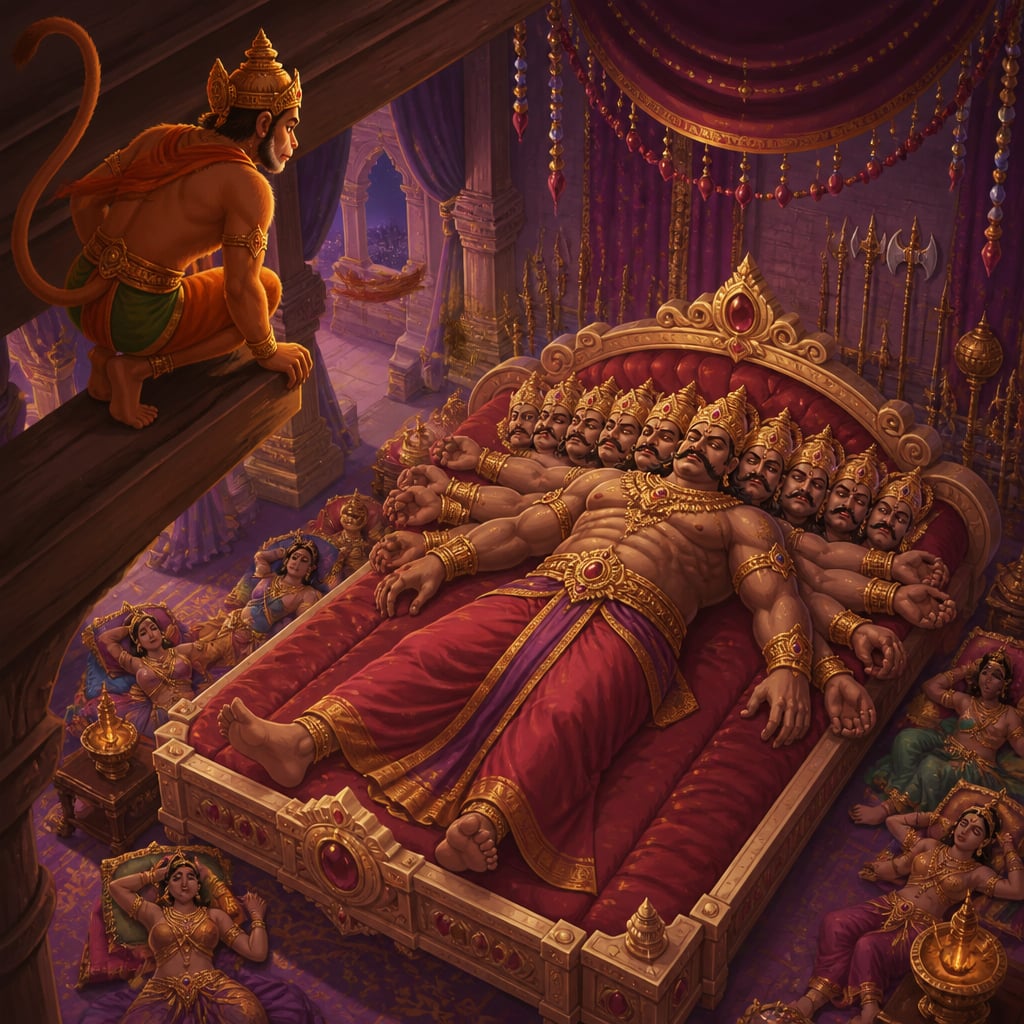
In the depths of Lanka's palace, Hanuman discovers Ravana himself - the demon king asleep among his women, surrounded by unimaginable luxury. This first glimpse of his lord's enemy reveals a being of tremendous power and equally tremendous corruption. The sight fills Hanuman with both revulsion and strategic understanding.
The Inner Chamber
Before reaching the Ashoka grove, Hanuman's search leads him to the most forbidden place in Lanka - Ravana's personal sleeping chamber.
He enters in his tiny form, slipping through a gap no wider than a finger. What he sees inside makes him freeze. This is no ordinary bedroom. This is a hall of such magnificence that it seems to belong to Indra himself. Crystal pillars support a ceiling painted with stars that seem to move. Lamps of eternal flame illuminate golden walls. The air is heavy with incense that costs more than kingdoms.
And in the center, on a bed that could hold an army, lies Ravana.
Hanuman has heard of Ravana. Every being in the three worlds has heard of Ravana. But hearing is not seeing. The demon king's body is massive - even in sleep, he dominates the vast chamber. His ten heads rest on pillows of silk, each face bearing a different expression. His twenty arms are draped with women who cling to him even in slumber. And the power emanating from him is almost visible - a dark radiance that speaks of conquered gods and humiliated celestials.
"So this is he," Hanuman thinks. "This is the being who dared to steal Sita. Who challenged the gods themselves. Who holds the three worlds in terror."
A Moment of Awe
Despite himself, Hanuman feels a flash of admiration.
Ravana's form is terrible but magnificent. His shoulders are those of a warrior who has never known defeat. His faces - even in sleep - carry the pride of one who bowed to none save Shiva himself. His ornaments speak of victories beyond counting.
"If this being had not turned to evil," Hanuman thinks, "what a champion of dharma he might have been. What devotion, what power, what learning - all twisted toward darkness."
The admiration fades quickly, replaced by resolve. "But he did turn to evil. And for that, he will fall."
The Women Around Him
Ravana does not sleep alone. Dozens of women surround him - apsaras captured from heaven, princesses stolen from their kingdoms, rakshasis who serve him willingly. They lie draped across him, entangled with each other, their sleep the heavy slumber of exhausted revelry.
Hanuman scans their faces carefully, still hoping Sita might be among them. But even as he looks, he knows she will not be here. These women - whatever their origins - have made their peace with Ravana. Some were forced, some came willingly, but all have surrendered in some way. Their sleep is peaceful, not tormented. Sita would never surrender. She would never sleep peacefully in this place.
Hanuman suddenly realizes what he is doing. He is looking at women who are not fully clothed, whose privacy has been invaded. His mission requires searching, but he is a brahmachari - one sworn to celibate purity. Is he sinning by observing these women in their vulnerable state?
He considers this seriously. "My purpose is pure," he reasons. "I look not with desire but with the need to find Sita. A doctor examining a patient does not sin by seeing what modesty would normally hide. My eyes serve my mission, not my pleasure." This reasoning satisfies him. Intent matters. The same action can be sin or duty depending on the heart behind it.
Studying the Enemy
Having resolved his moral dilemma, Hanuman takes the opportunity to study Ravana carefully. He notes the demon king's weapons, stacked carelessly beside the bed - weapons that have defeated gods. He observes the magical protections woven into the chamber walls. He memorizes the layout, the exits, the positions of guards beyond the doors.
"When Lord Rama faces this being," Hanuman thinks, "he must know everything. I will remember every detail."
He also notes Ravana's vulnerabilities. The demon king sleeps deeply, confident in his invincibility. His guards are outside, not within. His arrogance has made him careless. "Pride," Hanuman realizes. "That is his weakness. He believes no one can touch him, so he leaves himself unguarded."

Near Ravana's chamber, Hanuman discovers another marvel - the Pushpaka Vimana, the flying chariot of the gods. This celestial vehicle was originally Kubera's - the god of wealth, Ravana's own half-brother. Ravana conquered Kubera and took the Vimana as spoil of war. The Pushpaka is no ordinary chariot - it can fly at the speed of thought, carry any number of passengers, and expand or contract according to need. "Even this," Hanuman notes, "is stolen. Everything Ravana possesses was taken from others."
The Nature of Ravana's Power
As Hanuman observes, he begins to understand something crucial about Ravana's nature.
The demon king's power is vast but borrowed. His invulnerability came from a boon - protection from gods and demons. His flying chariot was stolen. His women were mostly captured. Even Lanka itself was originally Kubera's city.
Ravana is less a creator than a collector - hoarding power, possessions, and people without ever truly earning them. He conquered rather than built, took rather than made, seized rather than deserved.
"Lord Rama's power is different," Hanuman realizes. "It comes from within - from dharma, from virtue, from truth itself. What Rama has, no one gave him and no one can take away."
This realization strengthens Hanuman's faith. Ravana may seem invincible, but his power has foundations of sand. True strength cannot be stolen; it must be cultivated. And stolen strength will eventually return to its rightful owners or crumble into nothing.
Departure
Having learned what he can, Hanuman slips out of Ravana's chamber.
The demon king sleeps on, unaware that an enemy has been mere feet from his heads. Unaware that his palace has been penetrated. Unaware that his doom draws closer with each passing hour.
Hanuman moves toward the Ashoka grove, his mind full of what he has seen. He has observed the enemy, studied his weaknesses, and confirmed his conviction.
"Sita is not with Ravana," he confirms. "She has resisted him so completely that he keeps her separate, still hoping to change her mind. Her faithfulness is her prison - but also her honor."
The grove awaits. And somewhere within it, the faithful queen of Rama waits too. Hanuman's heart quickens with anticipation. The search nears its end.
Living traditions
Ravana is increasingly studied as a complex figure - not merely a villain but a scholar, musician, and devotee. Tamil Nadu and Sri Lanka have movements rehabilitating Ravana's image. Management literature references Ravana's downfall as a cautionary tale about how arrogance destroys even the most capable leaders.
- Ravana Falls: A 25-meter waterfall named after the demon king. Local legend says Ravana bathed here. The surrounding area is associated with Ravana's palace complex, where Hanuman witnessed the sleeping king.
- Weragantota (Ravana's Airport): Flat terrain that local tradition identifies as Ravana's airfield for his Pushpaka Vimana. The vast open space evokes the grandeur of Ravana's kingdom that Hanuman witnessed.
- Munneswaram Temple: One of the Pancha Ishwarams (five ancient Shiva temples) of Sri Lanka, believed to have been established by Ravana himself as a devout Shiva worshipper. Represents Ravana's spiritual complexity.
Reflection
- Much of Ravana's power was taken from others - his city, his chariot, his women. What in your own life is truly yours versus borrowed or taken? How does this distinction matter?
- Hanuman felt a moment of admiration for Ravana's power despite knowing his enemy was evil. Is it possible to acknowledge someone's abilities while condemning their choices? How do we hold both truths?
- Hanuman justified viewing the women by examining his intent. How do we honestly assess our own motivations? What prevents us from deceiving ourselves about why we do things?