Havoc in the Grove
Hanuman Announces Rama's Wrath
Having found Sita and received her token, Hanuman could leave Lanka quietly. Instead, he chooses to send Ravana a message. He systematically destroys the Ashoka Vatika, defeats the guards sent against him, and announces to all Lanka that Rama's reach has already touched their kingdom. This deliberate provocation serves a strategic purpose beyond mere satisfaction.
The Decision to Act
Hanuman has accomplished his mission. Sita is found, her condition is known, and he carries her precious token back to Rama. He could leave now, slipping out of Lanka as silently as he entered. The stealthy approach would be safe, prudent, and expected.
But something stops him.
"If I leave quietly," he reasons, "Ravana learns nothing. He continues in his arrogance, believing his kingdom impregnable. But if I leave a mark - if I show him that an enemy has penetrated his innermost defenses and struck at his very heart - perhaps fear will begin to work on him. Let him know that Rama's reach extends even here."
There is another consideration. Hanuman needs to assess Ravana's military strength. What better way than to provoke a response and observe what forces the demon king commands? A wise general knows his enemy before battle.
The Destruction of the Grove
Hanuman expands to his full, massive size. In the Ashoka grove where Sita has been imprisoned, where she has suffered for months, the son of the Wind begins his devastation.
He uproots trees by the dozen, their roots tearing from the earth like screams. He smashes pavilions and scatters ornamental pools. He crushes fountains and demolishes walkways. The beautiful prison becomes a ruin.
"Let this place that held Mother Sita captive be destroyed," Hanuman declares. "Let nothing remain of the cage where she wept."
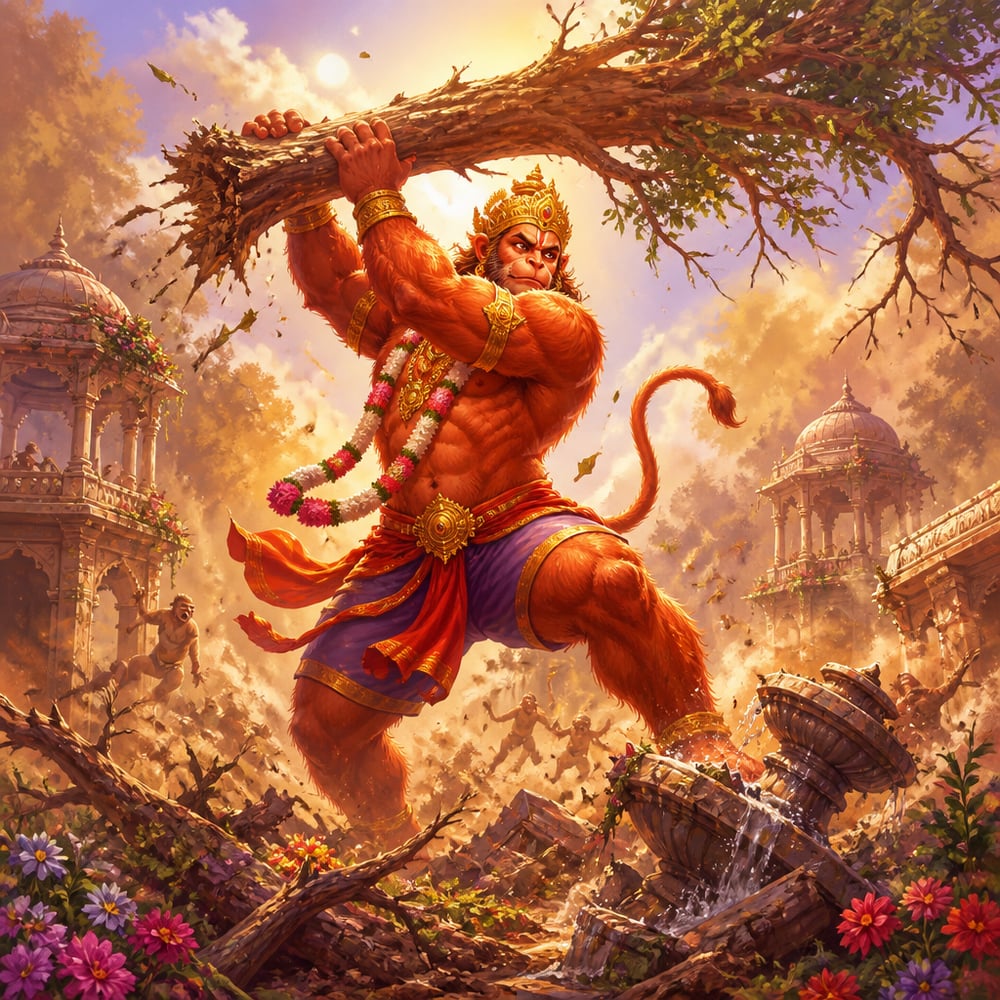
The noise of destruction cannot be hidden. Rakshasis flee screaming. Guards rush toward the commotion, only to be swatted aside like insects. The alarm spreads through Lanka - something is attacking the Ashoka grove, something massive and unstoppable. Sita watches from a safe distance, both amazed and concerned, praying for his safety even as she thrills at seeing her captors' terror.
The Battle Begins
Ravana sends his guards - elite rakshasa warriors, fearsome in battle. They come with weapons and magic, confident in their numbers and skill. Hanuman meets them with the joy of righteous battle.
He fights not with weapons but with an iron bar torn from a ruined gate - simple, brutal, effective. Rakshasas fall before him like grass before a scythe. Their magic fails against his divine power. Their weapons shatter against his vajra-like body.
"Go back to your master!" Hanuman roars. "Tell him that Rama's servant has visited his kingdom! Tell him this is merely the beginning!"
Even as he fights, Hanuman observes. He notes the rakshasa formations, their fighting styles, their weapons. He marks which commanders show skill and which are merely fierce. He estimates numbers, evaluates tactics, catalogs strengths and weaknesses.
"This information will be invaluable to Lord Rama," he thinks. "Now I know what we face. Now I can advise on how to defeat them." The destruction is not random rage - it is military reconnaissance disguised as chaos.
Akshay Kumar Falls

Ravana, finally alerted to the scale of the attack, sends one of his own sons - Akshay Kumar, a young but powerful prince.
Akshay arrives in a magnificent chariot, firing arrows with the speed and power of a thunderstorm. For a moment, even Hanuman feels the pressure of the assault. But only for a moment.
Hanuman leaps into the sky, evading the arrow-storm. He descends onto the chariot, crushes it with his weight, and confronts the prince directly. The battle is brief. Akshay Kumar, for all his power, is outmatched. Hanuman strikes him down.
A prince of Lanka lies dead. The message could not be clearer.
When Ravana learns of his son's death, his fury shakes the palace. "A MONKEY! A MONKEY killed my son! Destroyed my garden! Entered my city!"
His advisors cower, but one - the aged rakshasa Prahasta - dares to speak. "My lord, this is no ordinary monkey. The power he displays is divine. We should be cautious."
Ravana's rage shifts into something colder and more dangerous. "I want him alive. Not dead - alive. I want to know who sent him. I want to know everything about this Rama who thinks he can challenge me. Send my son Indrajit. He will not fail."
The Battle with Indrajit
Indrajit - also called Meghanada, "Thunder-voiced" - is Ravana's most formidable son. Unlike Akshay Kumar, Indrajit is a battle-hardened warrior who has defeated Indra himself. He possesses divine weapons, mastery of illusion, and a tactical mind that matches his martial prowess.
As Indrajit flies toward the ruined grove, Hanuman senses the difference immediately. "This one is dangerous. This one fights with thought as well as strength."
The clash between Hanuman and Indrajit is epic. Indrajit does not rely on brute force. He uses illusion to confuse, divine weapons to constrain, and strategy to corner. He recognizes that he cannot match Hanuman's physical power and fights accordingly. Hanuman adapts, matching cunning with cunning. The battle rages across the sky above Lanka, witnessed by thousands. Neither can decisively defeat the other.

The Brahmastra Binding
Finally, Indrajit makes a choice. He invokes the Brahmastra - the weapon of Brahma himself, irresistible even to gods.
Hanuman sees the weapon forming and makes his own choice. "I could escape," he realizes. "I am not fully vulnerable to the Brahmastra - my father's blessing gives me protection. But if I resist, Indrajit might invoke something more destructive. And I have not yet seen Ravana himself."
He makes a strategic decision to accept the capture. "Let the Brahmastra bind me. I will be taken before Ravana. This is another opportunity, not a defeat."
The Brahmastra strikes, and Hanuman allows himself to fall. He crashes to the ground, bound by divine power. Rakshasas rush to secure him with additional ropes, not realizing that the Brahmastra alone holds him and their ropes are meaningless.
As they drag him toward Ravana's court, Hanuman smiles inwardly. "Now I will meet the demon king face to face. I will deliver my lord's message directly. Let Ravana learn what awaits him - not from a rumor, but from the mouth of Rama's messenger."
The destruction of the grove was phase one. What comes next will shake Lanka even more.
Living traditions
Military strategists study Hanuman's Ashoka Vatika raid as an early example of psychological warfare - sending a message to demoralize the enemy before main battle. Corporate contexts use 'destroying the garden' as a metaphor for disrupting competitors' comfortable positions. The lesson that showing strength can prevent larger conflicts echoes in modern deterrence theory.
- Ussangoda National Park: A unique red-earth plateau that local legend attributes to Hanuman's destruction. According to tradition, Hanuman scorched this area during his rampage through Lanka. The barren, Mars-like landscape stands in contrast to surrounding greenery.
- Rumassala Hill: Local tradition holds this hill is a piece of the Sanjeevani mountain dropped by Hanuman. The area is rich in medicinal plants. Represents Hanuman's dual nature - capable of both destruction and healing.
Reflection
- The death of Akshay Kumar showed Ravana that his own family was vulnerable. How do consequences to loved ones change someone's calculation? What role should such consequences play in deterrence and justice?
- Hanuman chose to create chaos rather than leave quietly after finding Sita. When is it right to make a statement versus achieving a goal and withdrawing? How do we decide when additional action serves purpose versus pride?
- Hanuman allowed himself to be captured rather than continue fighting. When is strategic surrender wiser than continued resistance? How do we know the difference between necessary yielding and cowardly retreat?