Return to Kishkindha

Hanuman Reports to the King

The search party arrives at Sugriva's capital with news that will change everything. Before going to Rama, Hanuman reports to King Sugriva, fulfilling the proper chain of command. His detailed account of Lanka's defenses transforms celebration into military planning. The time for joy is ending; the time for war is beginning.

The Arrival

Kishkindha's gates open to heroes.

Word has spread ahead of them. Dadhimukha's complaint has transformed into announcement, and the vanara capital buzzes with anticipation. Streets fill with citizens hoping to glimpse the search party. Names pass from lip to lip: Hanuman, Angada, Jambavan.

And one name above all: Sita. Found.

The vanaras march through streets lined with cheering crowds. Mothers lift children to see. Old warriors who remember the search parties sent before - the ones that returned with nothing - stand with tears in their eyes. This time is different. This time, they succeeded.

Sugriva waits in his audience hall, surrounded by his generals and counselors. Lakshmana stands at his side, the prince's usual composure cracked by barely contained hope. Beside them both is an empty space where Rama would normally stand.

"He wouldn't come," Lakshmana had explained earlier that day. "He said he couldn't bear to hear bad news in public. He waits in his quarters. Bring him word when we know for certain."

The weight of those words hangs in the air. Rama has lived on the knife's edge between hope and despair for so long that he cannot trust himself to receive news before witnesses.

The Formal Report

Hanuman enters with his companions and bows before Sugriva.
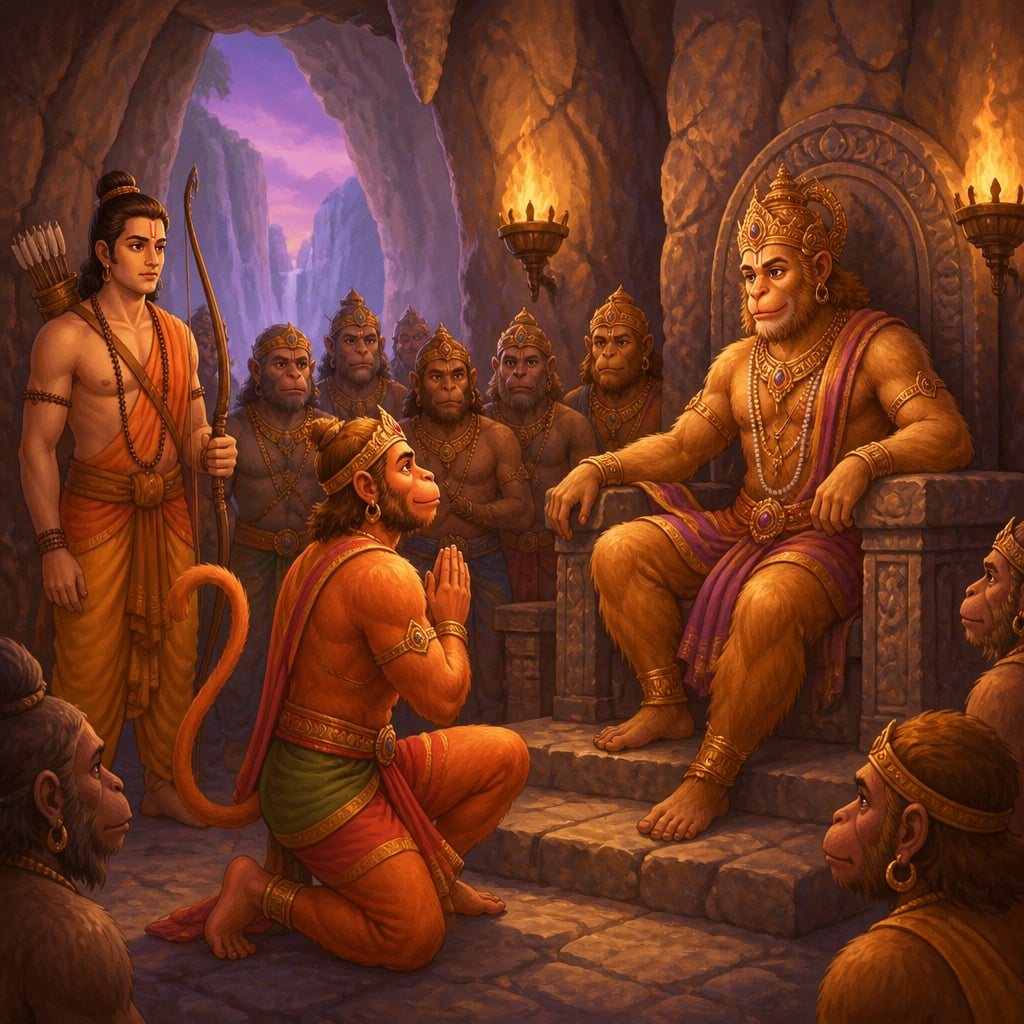
Hanuman kneeling formally on one knee before King Sugriva on his rocky throne in the Kishkindha cave palace, Lakshmana alert at the side.

Despite the celebration at Madhuvana, this moment requires formality. Hanuman is a minister reporting to his king. The protocols of Kishkindha's court must be observed - only then will the news carry official weight.

Jambavan and Angada take positions behind him. The other search party members fill the hall, standing in ranks as befits warriors returned from campaign. The air thrums with barely suppressed excitement.

"Your Majesty," Hanuman begins, his voice carrying clearly through the great hall, "the southern search party reports success. The Lady Sita, wife of Prince Rama, has been found. She is held captive in a grove called Ashoka Vatika within the fortress city of Lanka, domain of the rakshasa king Ravana."

The court erupts in cheers. Sugriva raises a hand for silence, but even he cannot fully suppress his smile.

"Tell us everything, Hanuman. From the beginning."

The Complete Account

Hanuman recounts his journey.

He speaks of the ocean crossing, of Mainaka's offer and Surasa's test and Simhika's attack. He describes Lanka's golden walls and his night of searching through that magnificent, terrible city. He tells of finding Sita beneath her ashoka tree, of her appearance, of their conversation, of her unwavering faithfulness despite every temptation and threat Ravana could devise.

The hall grows silent as he describes Sita's suffering - the cruel rakshasis, the threats of death and consumption, the endless pressure to surrender to Ravana. He tells of Trijata's protective kindness, a spot of light in that darkness.

He tells of his decision to reveal himself to Ravana, of the ultimatum delivered in open court, of Vibhishana's intervention that saved his life when the demon king would have killed him. He describes the burning tail turned weapon, the conflagration that consumed half the city, his final flight to reassure Sita that help was coming.

Throughout, Sugriva listens intently. His generals take mental notes. Lakshmana's eyes never leave Hanuman's face, drinking in every word about his brother's wife.

"And the Lady Sita's condition?" Sugriva asks when Hanuman pauses.

"She is thin, worn by captivity and grief. Her royal garments are old and worn. But her spirit is unbroken. Her faithfulness to Lord Rama is absolute - she has never wavered, not for a moment. She gave me this token to prove my meeting with her."

Hanuman produces the Chudamani. It catches the light of the audience hall, glowing like a captured star. A murmur runs through the court - everyone recognizes what this means.

The Intelligence

Hanuman sketching Lanka's defenses in cave dust

Sugriva's generals move from celebration to strategy.

"What did you observe of Lanka's defenses?" asks Nila, the vanara commander.

Hanuman's report transforms. Now he speaks as a military scout, not just a messenger.

"Lanka is well-fortified. The city sits on a mountain within the sea, approachable only from specific directions. The walls are high and thick - I estimate twenty elephants high and five thick - guarded day and night by rotating patrols. Ravana's army is vast. I estimate hundreds of thousands of rakshasas, many with magical abilities that let them change size and shape at will."

He continues: "But there are weaknesses. Ravana's pride makes him inflexible - he could not conceive that a single vanara could damage his city, and was caught unprepared. His advisors fear to counsel him honestly; they tell him what he wants to hear. His brother Vibhishana spoke dharma in open court and was dismissed for it - there is dissent within his own family. And the fire I set has damaged their infrastructure significantly. Half the city was burning when I departed."

"What of their commanders?" Lakshmana asks.

"Ravana himself is formidable - I felt his power even without fighting him directly. His presence alone inspires terror. His son Indrajit, called Meghanada, is perhaps more dangerous. He fights with illusion and divine weapons. It was his Brahmastra that captured me - I could not resist it. There are also generals named Prahasta and Mahodara, veterans of many battles. We should not underestimate them."

Sugriva's Decision

Sugriva absorbs the intelligence and makes his decision.

"We have what we came for - knowledge of Sita's location and status. Now we must act." He turns to his commanders. "Begin mobilizing the army. Send word to all vanara tribes under our alliance - to the bears of the northern mountains, to our cousins in the eastern forests, to every warrior who owes allegiance to Kishkindha. I want every fighter who can lift a weapon assembled here within the week."

The generals bow and begin to move, their minds already racing with logistics.

"Wait," Lakshmana says. All eyes turn to him. "Before military matters, there is another duty. Rama must be told. He has waited months in agony. He should not wait another moment."

Sugriva nods gravely, chastened by the reminder.

"You are right, Prince Lakshmana. In our excitement over strategy, we nearly forgot the suffering heart that started all this." He turns to Hanuman. "You alone should deliver this news. You found her. You spoke with her. You carry her token. Go to Rama now."

The Walk to Rama

Hanuman leaves the audience hall and walks toward Rama's quarters.

The corridors of Kishkindha palace stretch before him. Each step brings him closer to the moment he has anticipated since leaving Lanka. He carries in his hand the Chudamani, in his heart the message, in his mind every detail of Sita's words and the way her face changed when hope entered her eyes.

Behind him, he can hear the hall erupting into activity - generals giving orders, messengers being dispatched, the machinery of war beginning to turn. But ahead is something more important: a man in a darkened room, waiting for news that would either save him or destroy him.

"What will he do?" Hanuman wonders. "When he hears she lives? When he sees her jewel? When he learns of her suffering?"

He passes through courtyards and galleries, past guards who bow low. Word is spreading even here - he can see it in their faces. But they know to let him pass without delay.

He reaches Rama's door. Guards step aside - they have been told to expect him.

Hanuman pauses. Takes a breath. Thinks of Sita beneath her tree, weeping, hoping, waiting for this very moment.

He enters.

Living traditions

The Indian military's emphasis on 'sitreps' (situation reports) follows protocols that parallel Hanuman's structured debriefing. Military academies in India sometimes reference the Sundara Kanda report sequence as an early example of intelligence gathering and reporting. Corporate strategy consultants have drawn parallels between Hanuman's assessment of Lanka and modern competitive analysis frameworks.

Reflection

More in Sundara Kanda

All lessons in Sundara Kanda ยท The Ramayana course