Searching Through the Night

Hanuman Explores Ravana's Kingdom

Inside Lanka's walls, Hanuman begins his search for Sita. Moving through moonlit streets and shadowed gardens, he witnesses the opulence of Ravana's kingdom - mansions of gold, streets of crystal, and the mighty palace that dominates everything. But where among all this grandeur is the captive queen?

Into the Golden Maze

Hanuman slips through Lanka's gates, shrinking himself to the size of a cat.

The city that seemed overwhelming from the mountain's base is even more staggering from within. Streets paved with precious stones stretch in every direction. Mansions rise like mountains of gold and silver. Gardens bloom with flowers that seem to glow with inner light.

"How will I find one woman in all of this?" Hanuman wonders. "Lanka is vast, and I dare not ask for directions."

He needs a strategy. Pausing in the shadow of a fountain to think, Hanuman reasons: "Ravana is obsessed with Sita. He stole her not merely to possess her but because he desires her. He would not throw such a prize into some distant corner of his kingdom. She would be near him - close enough for him to visit, to pressure, to try to win her love. She would be somewhere special - not a common prison but a place fit for a queen he wishes to make his own."

Hanuman's eyes turn toward the massive structure dominating Lanka's skyline - Ravana's palace.

The Palace of the Demon King
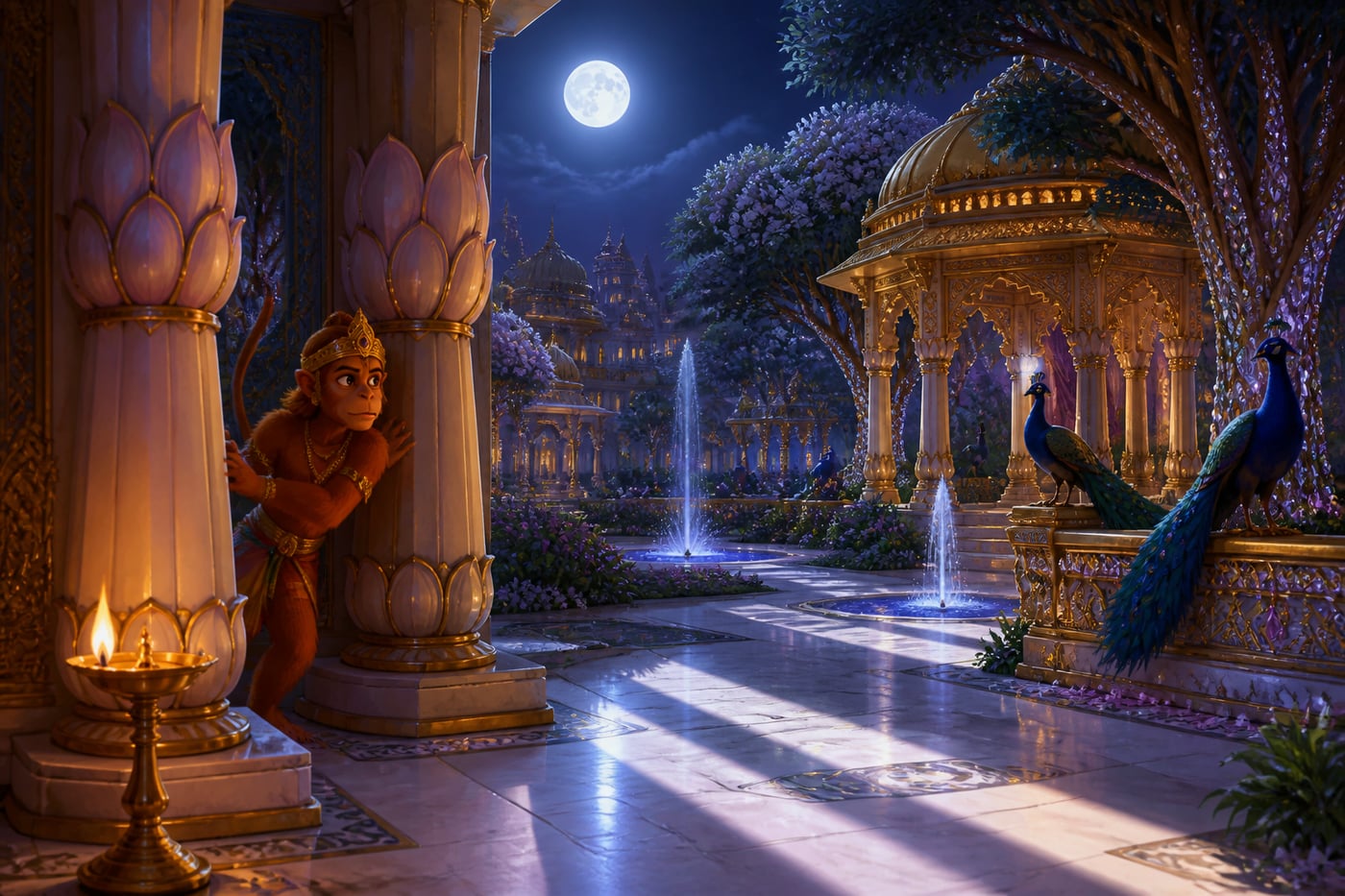
Jeweled palace garden of Lanka under moonlight

Ravana's palace rises at the center of Lanka like a mountain of gold. It is not a single building but a complex of structures - halls, gardens, towers, and courtyards spreading across the city's heart. Even among Lanka's opulence, the palace stands apart. Its walls are studded with gems that catch the moonlight. Its towers pierce the clouds. Its gates are guarded by rakshasas of fearsome power.

Hanuman approaches carefully, staying in shadows, observing the patrol patterns. "The guards change every half-hour," he notes. "There is a gap of moments between shifts when the eastern wall is unwatched." He waits. He watches. When the gap appears, he moves.
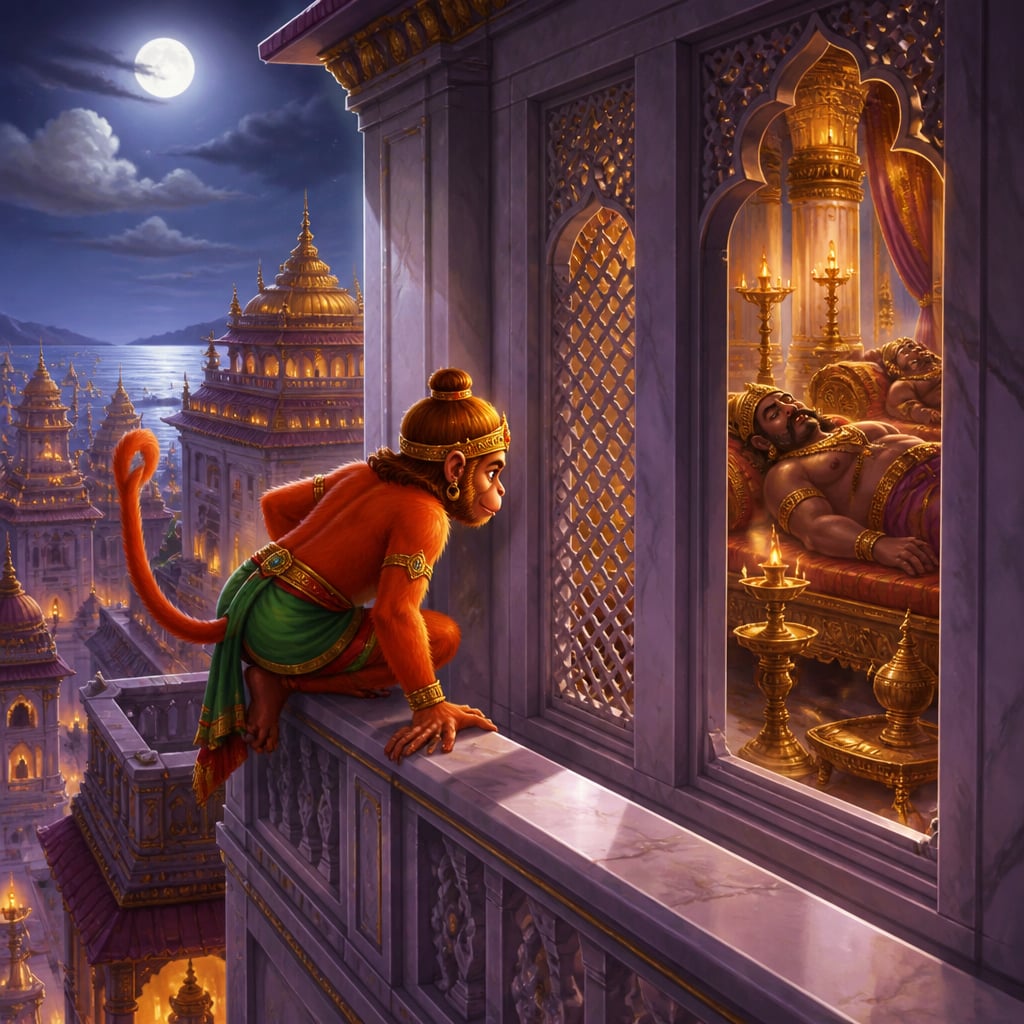
Cat-sized Hanuman on a moonlit balcony of a Lankan mansion, peering through carved lattice into the sleeping chamber within.

The interior of Ravana's palace defies description. Halls stretch so long that their ends fade into darkness despite hundreds of lamps. Pillars carved from single pieces of crystal support ceilings painted with scenes of Ravana's conquests. Everywhere there is gold, silver, precious stones - wealth enough to buy kingdoms scattered about like common decorations.

Hanuman moves through these halls in wonder and disgust. "All this," he thinks, "and still he wanted more. Still he had to steal another man's wife."

The Women's Quarters

Hanuman's search takes him to the inner palace - the antahpura, where Ravana's queens and consorts reside. This is dangerous territory. A male intruder in the women's quarters would cause immediate alarm. Hanuman shrinks even smaller, becoming barely visible, and moves with extreme caution.

He sees rakshasa women of stunning beauty, sleeping on couches of ivory and gold. He sees human women too - captives from Ravana's conquests, some resigned to their fate, others still bearing traces of tears on their sleeping faces. But none of them is Sita.

"How do I recognize her?" Hanuman suddenly realizes. "I have never seen Mother Sita. I know only Rama's description - beautiful beyond measure, virtuous beyond compare. But many women here might seem beautiful to unknowing eyes."

Then he remembers Rama's words, spoken before his departure: "You will know her by her sorrow, Hanuman. She will not have the look of one who has accepted captivity. She will seem like a flame in darkness - pure, bright, unconquered. And she will be alone, for she would never mix with Ravana's women."

Alone. Sorrowful. Unconquered. Hanuman continues his search with renewed purpose.

Mandodari's Chamber

Hanuman briefly mistaking sleeping Mandodari for Sita

In the grandest chamber of the women's quarters, Hanuman finds someone remarkable. A woman of extraordinary beauty sleeps on a bed of gold and silk. Her face is peaceful, her ornaments are fit for the highest queen, and her bearing - even in sleep - speaks of dignity and grace.

"Is this... could this be...?"

For a moment, Hanuman's heart leaps. But then he looks more carefully. This woman sleeps peacefully, without a trace of sorrow. Her surroundings show she is honored, not captive. And she wears ornaments that speak of a willing queen, not a stolen bride.

"This must be Mandodari," Hanuman realizes. "Ravana's chief queen. She is beautiful, but she is not Sita."

The difference is not in beauty but in circumstance. Mandodari belongs here; Sita never could.

Despair and Determination

Hanuman searches through the night. He explores every chamber of the inner palace, checks gardens, courtyards, towers. He finds many women - rakshasis, apsaras, human captives - but not the one he seeks.

As the night deepens, a terrible thought begins to form. "What if she is not here? What if Ravana has hidden her somewhere else entirely? What if..." - the thought is almost unbearable - "what if she is already dead?"

Hanuman pauses in a moonlit garden, fighting his rising despair. "I have searched everywhere," he thinks. "The palace, the women's quarters, every building I could find. She is not here."

He considers returning to Rama with failure. He imagines the faces of Sugriva and the vanara army. He pictures Rama's grief at hearing that his beloved could not be found.

"No," Hanuman tells himself firmly. "I have not searched everywhere. I have searched only where I thought to look. There is more of Lanka. There must be."

He raises his eyes and scans the moonlit city. And there, beyond the palace, past the gardens of the inner court, he sees something he had overlooked - a grove of trees surrounded by high walls, separate from the rest of the palace complex. The Ashoka Vatika.

A Grove Apart

The Ashoka grove stands alone, walled off from the rest of Lanka. Why would Ravana maintain such a place?

The Ashoka tree is sacred - its very name means "without sorrow." It is associated with Sita's patron goddess, associated with faithful wives, associated with everything Ravana despises and desires. The irony is profound and cruel.

"A cage fit for a captured goddess," Hanuman realizes. "A garden of irony - trees of 'no sorrow' for a prisoner of infinite grief."

He moves toward the grove, hope rekindling in his chest. The walls are high, the entrance guarded, but Hanuman has overcome greater obstacles this night. Where there is will, there is a way.

The search is not over. In fact, Hanuman now believes it is about to reach its culmination. Somewhere within those walls, beneath those sacred trees, Sita waits - alone, sorrowful, but unconquered.

Living traditions

Investigation agencies in India sometimes begin difficult cases with Sundara Kanda recitation, seeking Hanuman's guidance in 'searching.' Missing persons organizations reference Hanuman's methodical search as a model. The systematic approach Hanuman used - searching every building, every garden - prefigures modern search protocols.

Reflection

More in Sundara Kanda

All lessons in Sundara Kanda ยท The Ramayana course