Visitors from Ayodhya

Shadows Gathering in Paradise

After Bharata's departure, Rama's peaceful life at Chitrakoot continues, but not for long. Sages begin visiting with troubling news: demons are harassing hermitages throughout the forest, killing holy men, disrupting sacred rituals. The protectors of dharma need protection themselves. This lesson marks the transition from Ayodhya Kanda's focus on family and duty to the gathering darkness that will define Aranya Kanda.

The Weeks After Bharata's Departure

After the vast procession returned to Ayodhya bearing Rama's sandals, a strange quiet settled over Chitrakoot. The thousands who had come and gone left their footprints in the earth, their campfires' ash circles, their memory in the transformed landscape.

Rama, Sita, and Lakshmana resumed their forest life, but something had changed. The meeting with Bharata had brought news of their father's death, had reminded them of all they had left behind. The grief that Rama had so carefully contained now surfaced in quiet moments, a distant look while watching the river, a pause in conversation when Dasharatha's name arose.

"Brother," Lakshmana ventured one morning, "should we not move to a new location? Bharata's procession brought thousands here. Our hermitage is known throughout Ayodhya. Visitors may continue to come, and perhaps..."

"And perhaps I prefer it that way?" Rama smiled sadly. "You think I stay here hoping for more messengers from home. Perhaps you are right, brother. Perhaps it is time to move deeper into the forest, to find a place truly apart from the world we knew."

But before they could act on this thought, a different kind of visitor arrived.

The Sages' Warning

A group of rishis, forest sages who had established their hermitages throughout the Dandaka forest to the south, arrived at Chitrakoot seeking Rama. Their faces bore the marks of hardship, their eyes the weight of fear that holy men should never carry.

"Prince Rama," spoke Sharabhanga, the eldest among them, "we come not for your blessing but for your protection. A darkness is spreading through the forest. The demons who had long left us in peace have grown bold."
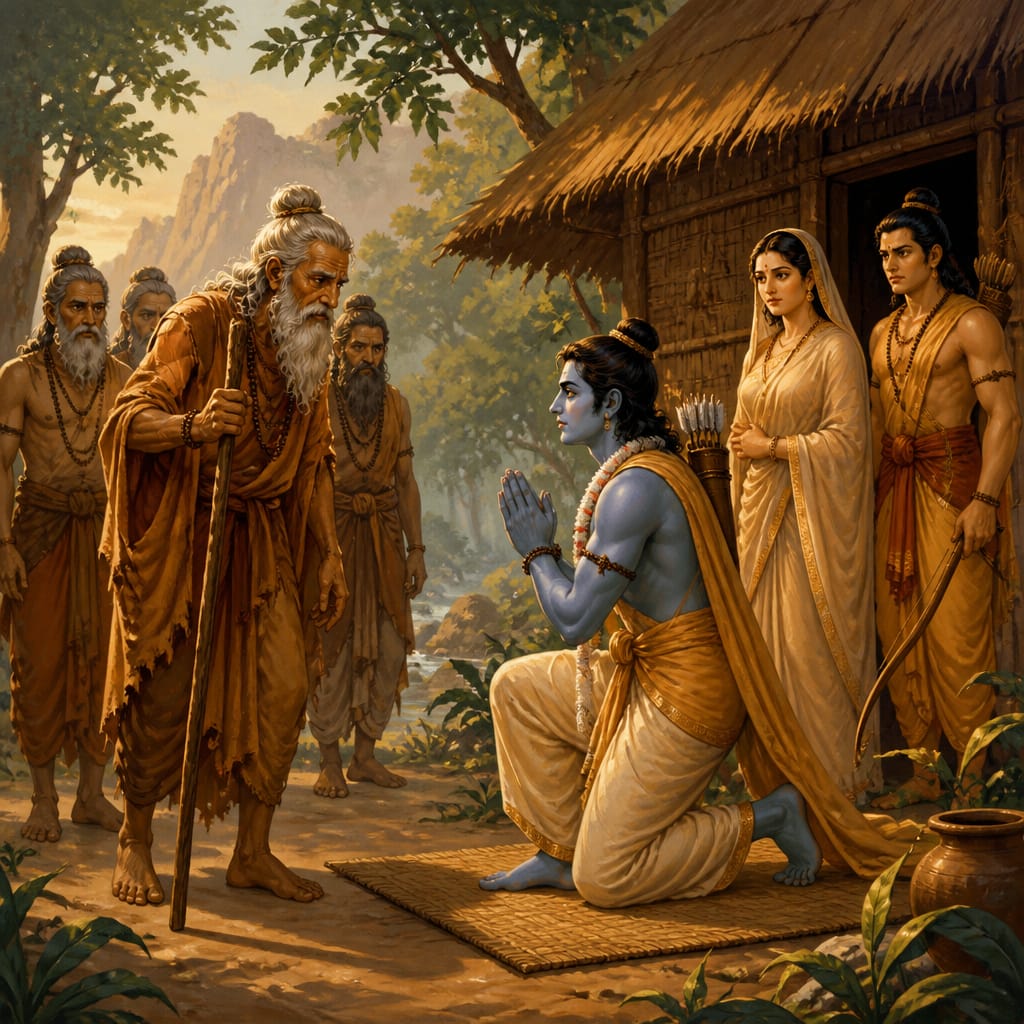
Sage Sharabhanga arrives at Chitrakoot leaning on his staff, bringing warning of demons in the Dandaka forest.

The story they told was grim. Rakshasas, demonic beings serving the distant king Ravana of Lanka, had begun systematic attacks on hermitages. They disrupted sacred fires, polluted water sources, killed cattle kept for milk offerings. Most terrible of all, they had begun killing the sages themselves.

"We are men of peace," Sharabhanga continued. "We carry no weapons; we train in no combat. When the rakshasas come, we can only flee or die. Already many of our brothers have been slaughtered. Their blood cries out from the earth."

Rama listened in silence, his face grave. When the sages finished, he spoke carefully:

"Holy ones, your suffering moves me deeply. To hear that those dedicated to dharma are being murdered by those who despise it, this cannot stand."

"But I must be honest with you: I am here in exile, not on a mission of conquest. I came to fulfill my father's word, not to wage war. I am one man, two, with my brother, against forces that harass an entire forest."

Atri, another sage in the group, responded: "Prince, you are not just 'one man.' You are Rama, the prince whom Vishwamitra chose to protect his yajna, who slew Tataka, who broke the bow of Shiva. You have been trained by the greatest sages; you carry weapons blessed by gods. If you cannot help us, no one can."

Sita, who had been listening from inside the hermitage, now came forward. "My lord, may I speak?"

Rama nodded.

"When we left Ayodhya, I chose to follow you into exile. I did not expect that exile would be a retreat from dharma, only a retreat from palace life. If dharma calls you to protect those who cannot protect themselves, how can exile excuse that duty?"

The Decision

That night, Rama sat by the river in meditation. The decision before him was not simple.

If he took up the sages' cause, he would be waging war against Ravana's forces, even if indirectly. This could draw greater attention, greater danger. Sita would be exposed to risks that peaceful forest life avoided.

If he refused, innocent people would continue to die. His training, his strength, his very nature as a Kshatriya demanded that he protect the weak. To hide behind the technicality of exile while dharma was being violated felt wrong at the deepest level.

By dawn, he had decided.

"Lakshmana, we will not stay at Chitrakoot. The procession from Ayodhya has made this place too known, and it holds too many memories of what we have lost."

"We will journey south, into the Dandaka forest where the sages dwell. There, we will do what Kshatriyas are meant to do: protect those who need protection. Our exile does not exempt us from dharma, it gives us opportunity to practice it more fully."

Lakshmana's eyes lit up. The warrior in him had chafed at months of peaceful hermitage life. "Finally, brother! I have kept my bow strung and my arrows sharp, waiting for such a call."

Sita understood what this decision meant. Moving deeper into demon-infested forests, taking up active combat against rakshasas, these were far more dangerous than life at Chitrakoot.

"Sita," Rama said gently, "the path ahead will be difficult. The sages spoke of demons who delight in causing harm. Perhaps you should consider, "

"Consider what?" Sita's voice was firm. "Returning to Ayodhya without you? Staying here alone while you face danger? I chose exile with you, my lord. I choose danger with you. Where you go, I go. That vow has not changed."

Rama looked at his wife, the princess who had adapted to forest life with such grace, who had created gardens in wilderness, who had never complained about their circumstances. He saw in her eyes the same steel that had made her follow him from the palace gates.

"Then we go together," he said. "As we have done everything, together."

Preparations for departure were simple, there was little to prepare. They said farewell to Chitrakoot, to the Mandakini River that had sustained them, to the hermitage Lakshmana had built with such care.

The sages who had brought the warning served as guides, leading them south toward the Dandaka forest, a vast wilderness stretching across much of central India, home to countless hermitages, countless wild creatures, and increasingly, countless demons.

As they walked, the landscape changed. The gentle beauty of Chitrakoot gave way to denser, darker forests. The trees grew larger, their canopy blocking more of the sun. The sounds of the forest shifted, fewer birds singing, more predators calling.

"This is the edge of the Dandaka," Sharabhanga announced. "From here, you enter territory where no ordinary human ventures. Be prepared, Prince. The beauty you will see is matched by the danger."

Atri's Blessing

Before the sages dispersed to their various hermitages, they brought Rama to visit Sage Atri and his wife Anasuya, two of the most revered practitioners in the forest. Atri was ancient, his austerities spanning centuries. Anasuya was famous for her devotion to her husband and the spiritual powers she had gained through it.

Sita receiving Anasuya's blessing

Anasuya took particular interest in Sita. She gave her celestial garments and ornaments that would not fade or soil, practical gifts for a life in the forest, but also symbols of blessing.

"Daughter," Anasuya said, "you have followed your husband into exile when you could have remained in comfort. This is pativrata dharma, the sacred duty of a devoted wife, practiced at its highest. The gods themselves honor such devotion."

"I do not think of it as sacrifice," Sita replied. "Where would comfort be without my husband? What would palace walls mean if he were not within them? Following Rama is not duty, it is nature. A river does not sacrifice by flowing to the sea."

Anasuya smiled. "And this is why you will be remembered when queens who stayed in palaces are forgotten."

This moment, the departure from Chitrakoot, the entry into Dandaka, the blessing of Atri and Anasuya, marks the transition between two phases of Rama's exile.

The first phase had been about family: the exile from Ayodhya, Dasharatha's death, Bharata's visit, the resolution of the succession crisis. It was tragedy within a noble family, dharma practiced through sacrifice and devotion.

The second phase, beginning now, would be about combat: protecting sages, destroying demons, and ultimately confronting the great enemy who lurked beyond the forest. It was dharma practiced through warrior action.

Both were exile. Both were dharma. But their nature was fundamentally different.

The Deeper Teaching

This transition offers important lessons:

Circumstances Evolve, Dharma Adapts: When Rama accepted exile, he expected forest life to be peaceful renunciation. Circumstances changed. The sages' plight demanded response. Dharma is not a fixed script but an ongoing engagement with what is actually before us.

Retreat Is Not Escape from Duty: Rama could have argued that exile exempted him from other obligations. Instead, he recognized that exile created NEW obligations, to those he now lived among. Physical location changes; fundamental dharma does not.

Partners Grow Together Through Challenge: Sita's choice to accompany Rama into greater danger deepened their partnership. The relationship forged through shared challenge became stronger than any palace marriage could have been. Adversity, embraced together, creates bonds that prosperity cannot.

Transitions Are Rarely Clean: The shift from peaceful hermitage to demon-fighting warrior did not happen in a single moment. It unfolded through visitors' warnings, night-long meditation, conversations with sages, blessings from holy ones. Major life transitions rarely announce themselves clearly; they emerge through accumulated incidents until suddenly we find ourselves in a new chapter.

As Rama, Sita, and Lakshmana crossed into the Dandaka forest, they left one story and entered another. The tale of exile and family was yielding to the tale of conflict and cosmos. Ahead lay dangers they could not imagine, and destinies they could not escape.

Living traditions

The transition from Ayodhya Kanda to Aranya Kanda at this point marks a major shift in the Ramayana - from domestic tragedy to adventure narrative. Medieval commentators describe this as moving from shringara rasa (sentiment of love) to vira rasa (heroic sentiment). Anasuya's legendary powers - transforming the Trimurti into infants - make her blessing of Sita particularly significant. The Dandaka forest region of central India contains numerous pilgrimage sites connected to Rama's journey, creating a sacred geography that pilgrims can follow. Sita's choice to accompany Rama into danger rather than stay safe continues to be discussed in the context of partnership and devotion.

Reflection

More in Ayodhya Kanda

All lessons in Ayodhya Kanda · The Ramayana course