The Two Boons

Ancient Promise, Dasharatha's Anguish

The day after the grand coronation announcement, King Dasharatha awakens to find Ayodhya transformed - but something is terribly wrong. Queen Kaikeyi has withdrawn to the kopa bhavan, the chamber of displeasure, and her two long-dormant boons are about to shatter a kingdom and test the very foundations of dharma.

The Morning After

The dawn that rose over Ayodhya should have been the most glorious in the kingdom's history. Just yesterday, King Dasharatha had announced Rama's coronation. The city had erupted in celebration - banners unfurled from every rooftop, citizens danced in the streets, and preparations for the abhisheka had begun with unprecedented enthusiasm.

But as the sun's first rays touched the royal palace, they illuminated a scene of mounting dread.

King Dasharatha, ruler of the mighty Kosala kingdom, found himself facing the most terrifying morning of his life. His heart light with anticipation, he had awakened early to share his joy with his youngest queen, Kaikeyi - the woman who had saved his life on the battlefield, the queen whose chambers he visited more frequently than those of his other wives.

When he arrived at her apartments, she was not there. The attending maidservants exchanged nervous glances before one whispered: "Your Majesty... the Queen has retired to the kopa bhavan."

With growing unease, the aged king made his way to the chamber of displeasure. What he found there stopped his heart.

Kaikeyi lay on the bare floor, stripped of her jewels, her hair disheveled, her face a mask of fury. She had removed every ornament - the mark of a woman in deep distress.
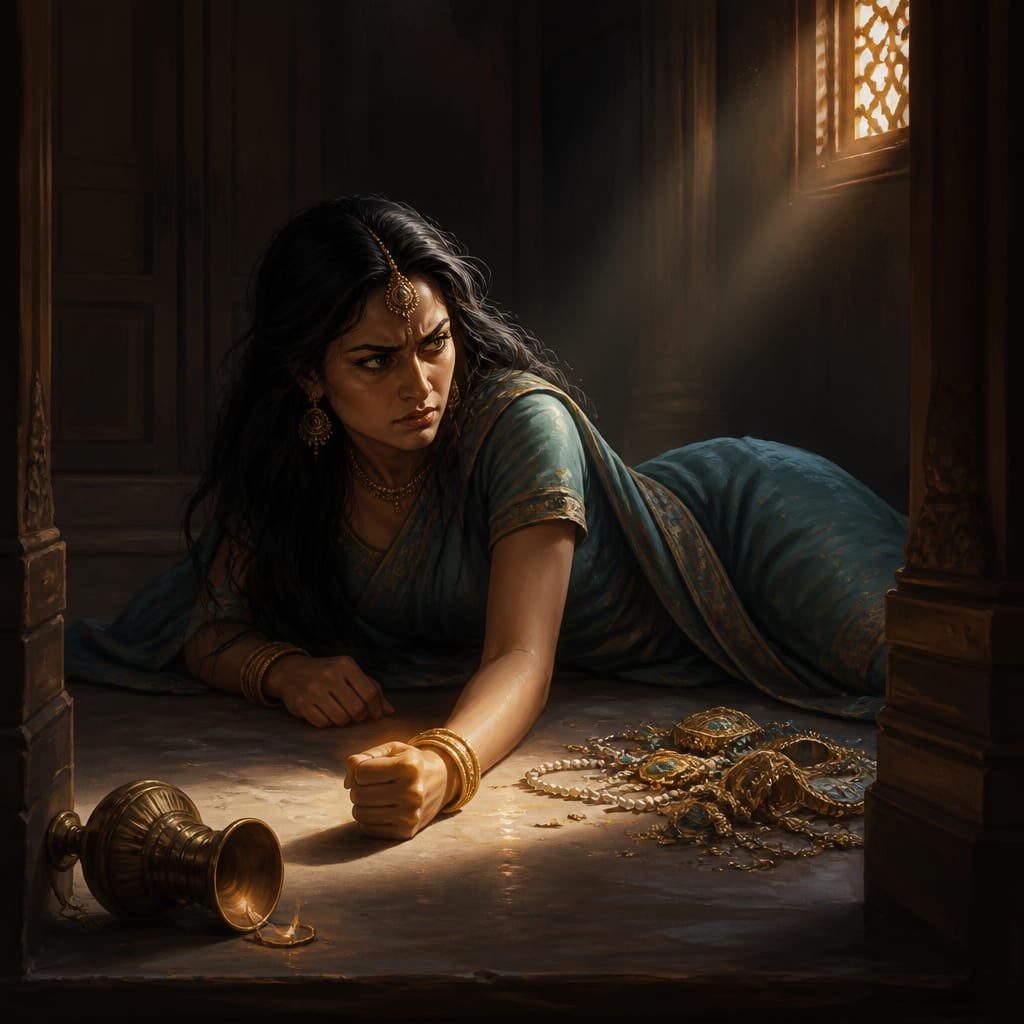
Queen Kaikeyi lies stripped of her jewels on the bare floor of the kopa bhavan, her face set in fury.

"Kaikeyi! My beloved, what is this? Why do you lie here like one abandoned? Who has wronged you? Tell me what troubles you - I would move mountains for you. I would give up my kingdom for you. Only rise, my queen. Only speak."

The Ancient Debt

Kaikeyi's voice emerged cold, determined, terrible in its finality:

"You ask what I want? Long ago, you granted me two boons - two varas - promises made on the battlefield when I saved your life. Do you remember?"

Dasharatha's blood chilled. He remembered.

Young Kaikeyi steadying the chariot wheel for Dasharatha

Years ago, in the war against the demon Sambarasura, his chariot wheel had loosened in the thick of battle. If it fell among the demonic horde, both king and queen would have been slaughtered. But Kaikeyi - then a warrior princess serving as his charioteer - had noticed the danger. While steering the horses with one hand, she thrust her own arm into the axle hole, holding the wheel in place with her bare flesh while Dasharatha fought on.

Blood had run down her arm. Her bones had ground against the wheel's weight. But she had not cried out. Only when the battle was won did Dasharatha see her arm - mangled, broken, still holding the chariot together.

"Kaikeyi! You have saved my life! I grant you two boons, two wishes to be fulfilled whenever you desire them!"

She had smiled through her pain: "I will ask when the time is right, my lord."

And now - decades later - the time had come.

The Terrible Demands

"I remember the boons," Dasharatha whispered. "Ask, Kaikeyi. I am bound by satya. Whatever you desire shall be yours."

"Then hear my first boon: Let Bharata be consecrated as crown prince. Let him receive the throne promised to Rama."

Dasharatha staggered as if struck.

"The first boon is granted by your own word," Kaikeyi continued. "Now hear the second: Let Rama be sent into vanavasa - forest exile - for fourteen years. Let him live as an ascetic in the Dandaka forest, wearing bark cloth and matted hair. Let him depart today."

The words fell like hammer blows. Fourteen years. Forest exile. Rama - his perfect son, the joy of the kingdom - banished to live among wild beasts and demons.

The King's Anguish

King Dasharatha collapsed in anguish

Dasharatha collapsed. His mind refused to accept what his ears had heard.

"No. You cannot mean this. Take the kingdom yourself! Crown Bharata today! But do not send Rama away..."

His voice broke. The great king - who had led armies, who had counseled gods - began to weep.

"Kaikeyi, I beg you. I who have never begged anyone - I beg you now. Take my life if you wish! But Rama is innocent. He loves Bharata as his own soul! How can you do this?"

Kaikeyi stood unmoved, her heart hardened by Manthara's poison.

"You gave your word. You granted the boons freely. Are you Dasharatha the Truth-Speaker, or Dasharatha the Promise-Breaker? Choose."

The trap was perfect. Dasharatha's entire life, his reputation, his very dharma rested on satya and pratigya - truthfulness and keeping promises. To break these boons would be to destroy everything he stood for.

He tried everything. He reasoned. He pleaded. He offered treasures, territories, his own remaining years of life. He warned her that Bharata would hate her forever, that the people would revolt.

"Bharata will be king. That is what matters."

On and on through the long hours, Dasharatha fought against the inevitable. But Kaikeyi remained adamant.

The Longest Night

As evening darkened into night, Dasharatha's resistance crumbled into pure grief. He lay on the floor, his body racked with sobs. The mighty king was reduced to a broken old man, confronting the terrible mathematics of dharma.

His pratigya demanded fulfillment. But fulfilling it would destroy his heart, his kingdom, everything he loved.

Through that terrible night, Dasharatha wrestled with himself. Several times he reached for the bell to summon guards, ready to imprison Kaikeyi, to nullify the boons by royal decree. But each time, his hand fell. That path led to adharma. The boons had been freely given, witnessed by the gods themselves. To break them would tear the fabric of truth itself.

"Rama," he whispered into the darkness. "My son, my soul... forgive me."

As dawn approached - the dawn that should have seen Rama's consecration - Dasharatha came to terrible clarity. He would honor the boons. Not because he wanted to. Not because Kaikeyi deserved it. But because he was Dasharatha, descendant of the Solar Dynasty, upholder of truth, and his word was unbreakable.

Even if it killed him.

The old king rose from the floor, aged a dozen years in a single night. His face was gray, his eyes hollow.

"Summon Rama. Tell him his father requires his presence."

The stage was set for what would follow - when Rama himself would learn of his exile, and the entire kingdom would witness how the truly noble respond to injustice.

The Deeper Teaching

This episode represents one of the most psychologically complex moments in all of literature - not a simple story of good versus evil, but a profound exploration of how dharma operates when conflicting duties collide.

The Tragedy of Promises: Dasharatha's boons were given freely, in gratitude and love. But even good promises, carelessly given without limits, can become instruments of destruction. Our words have power, and we must guard them carefully.

The Corruption of Fear: Kaikeyi was not inherently evil. She was transformed by fear - fear for her son's future, skillfully manipulated by Manthara. This teaches us how fear, once it takes root, can corrupt even good hearts.

The Weight of Truth: Dasharatha could have broken the boons. He had the power. But he recognized that a king who breaks his word - even for good reasons - destroys the foundation of trust upon which society rests. Sometimes dharma demands we bear unbearable costs.

Living traditions

The scene of Dasharatha's collapse remains one of the most performed episodes in Bharatanatyam, Kathakali, and Kuchipudi dance traditions. Dancers are judged by their ability to convey karuna rasa (pathos) in this scene. The ethical dilemma of Dasharatha - bound by his word yet knowing its consequences - is studied in Indian philosophy courses as a classic example of dharma-sankata (moral crisis). The phrase 'caught between two boons' is used in Indian legal and ethical discussions to describe impossible choices.

Reflection

More in Ayodhya Kanda

All lessons in Ayodhya Kanda ยท The Ramayana course