Arrival at Chitrakoot
Building a Home in the Wilderness
Following Bharadvaja's guidance, Rama, Sita, and Lakshmana reach the enchanting mountain of Chitrakoot. Here, amidst pristine forests and flowing streams, they build their hermitage and begin their forest life. What was intended as punishment transforms into an unexpected idyll, demonstrating how peace can be found in simplicity and how three royal souls adapt to life as forest dwellers.
The First Sight of Chitrakoot
As Rama, Sita, and Lakshmana climbed the gentle slopes toward the mountain Bharadvaja had described, the landscape transformed around them. The dense, tangled forest gave way to open groves where sunlight filtered through like blessings from the sky. Waterfalls cascaded down mossy rocks, their music filling the air. Flowers of every imaginable color carpeted the meadows.
"Look," Sita breathed, her eyes wide with wonder. "It is exactly as the sage described, a hill of many wonders."
And indeed, Chitrakoot lived up to its name. The Sanskrit word means "the multicolored peak" or "the hill of many wonders," and the mountain seemed to shimmer with a thousand hues, green forests, blue streams, white waterfalls, red and yellow and purple flowers blooming in abundance.
Rama stood at the edge of a clearing, surveying the view before them. The Mandakini River flowed nearby, its waters pure and sweet. Birds sang from every tree. Deer grazed without fear of hunters. The very air seemed lighter here, charged with a peace that the royal palace had never offered.
"Here," Rama said quietly, "we will build our home."
The Construction of the Hermitage
With Lakshmana's skill and determination, the work of building a parnashala (leaf-hut) began. Though he was a prince trained in the arts of war, Lakshmana proved equally skilled in the arts of survival. He selected bamboo poles of the right thickness, gathered leaves from the sal and palm trees, collected vines for binding.
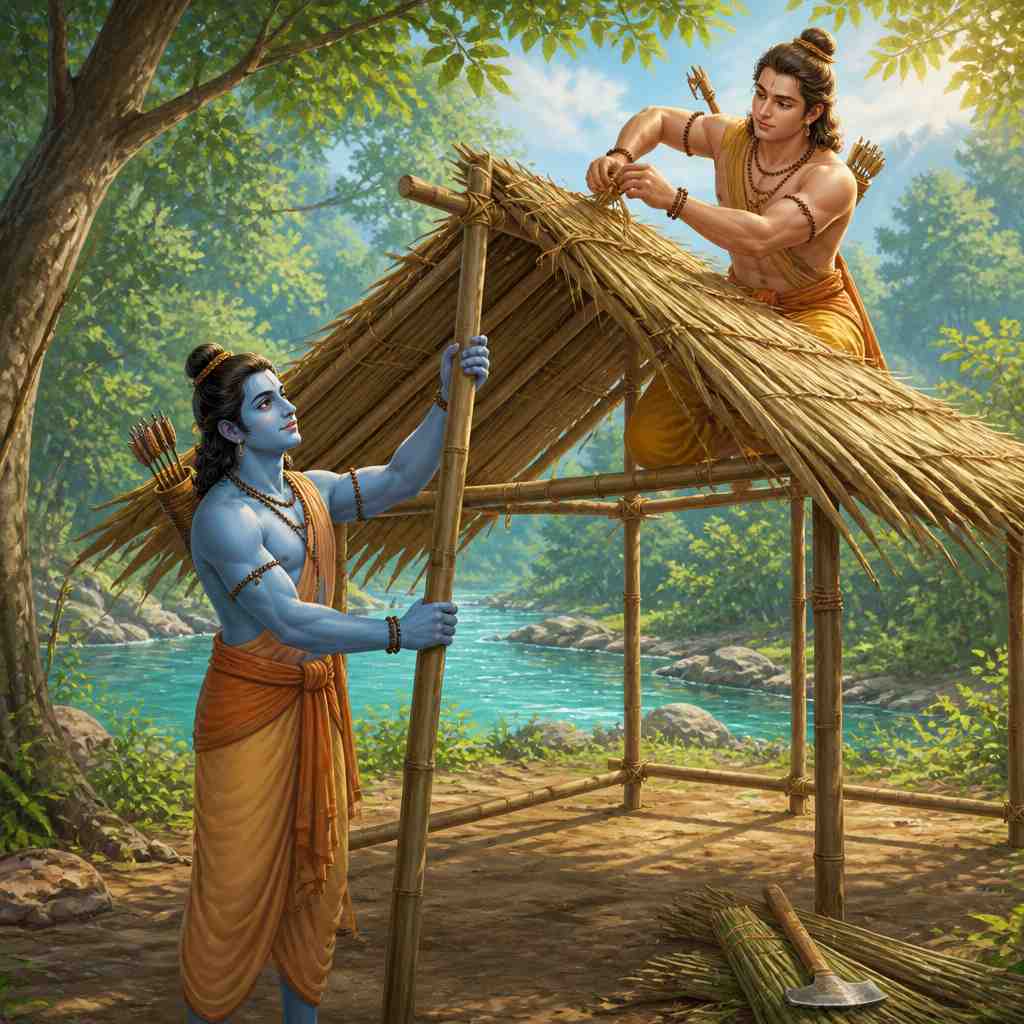
Within days, a beautiful hermitage took shape, simple but complete. There was a raised platform for sleeping, protected from rain and ground insects. A separate space for the sacred fire. A small outdoor area where Sita could prepare their forest meals. An overhang where water from the nearby stream could be stored in hollowed gourds.
"Brother," Rama said, surveying Lakshmana's work with admiration, "you have built us a palace that no artisan in Ayodhya could match. For this palace is built with love, not wages, and it sits in a kingdom that no politics can corrupt."
Sita added her touches, arranging flowers at the entrance, creating a small altar for their daily worship, organizing their few possessions with the efficiency of a princess who had learned to manage a royal household.
The Daily Rhythm
As days turned to weeks, a gentle rhythm established itself in the hermitage. Each morning began before dawn with prayers and ablutions in the Mandakini. Rama and Lakshmana would then gather fruits, roots, and edible plants while Sita prepared the cooking fire.
The forest provided abundantly. Wild rice grew along the riverbanks. Fruits hung heavy on branches, mangoes, berries, figs. Honey could be gathered from hives in the ancient trees. Tubers and roots offered sustenance. The vana (forest) became their kingdom, its bounty their treasury.
Yet this was not mere survival. Rama used these quiet hours for spiritual practice, meditation beside the river, recitation of sacred texts, contemplation of dharma. Lakshmana trained daily, keeping his warrior skills sharp, for he never forgot that danger could emerge from the forest at any moment.
And Sita? The princess who had been raised in marble palaces with a hundred servants found unexpected joy in simple tasks. She learned to identify which plants were edible, which had medicinal properties. She discovered beauty in arranging wildflowers. She found peace in the quiet hours when she could simply sit beside Rama, watching the sun set over their small kingdom of peace.
What had been intended as punishment became something else entirely, not exile but liberation. Free from the intrigues of court, free from the endless duties of royalty, free from the expectations that had defined their lives since birth, Rama, Sita, and Lakshmana discovered a different kind of life.
"I find," Sita confided to Rama one evening as they sat watching fireflies dance over the Mandakini, "that I do not miss the palace. I thought I would pine for my gardens, my friends, my comforts. But here, with you, in this simple place, I have never been more content."
Rama smiled, that gentle smile that had conquered hearts throughout Ayodhya. "This is the secret the sages have known for ages. Happiness does not come from what surrounds us but from what is within us. A palace with a troubled heart is a prison. A forest hut with peace is paradise."
"And yet," Lakshmana interjected from where he sat sharpening arrows, "we should not forget that this paradise was purchased with our parents' tears. While we find peace, Ayodhya mourns."
The reminder cast a shadow over the moment. However beautiful their life here, it came at a cost paid by others, by Dasharatha, by Kausalya, by the citizens who had wept at their departure.
Life at the Hermitage
Word spread through the forest that Rama, the virtuous prince of Ayodhya, had made his home at Chitrakoot. Sages and ascetics began to visit, drawn by his reputation and his presence.
Valmiki, the great sage who would one day compose the Ramayana itself, was said to have his ashram not far from here. Other rishis came from their solitary practices to spend time in Rama's company, to debate philosophy, to share in the peace of his hermitage.
Rama welcomed all visitors with the same humility, whether they were great sages with miraculous powers or simple forest dwellers seeking blessing. He asked each visitor about their practice, their understanding, their journey. He listened more than he spoke, learned more than he taught.
"See how he treats the humblest and the greatest alike," one sage remarked to another. "This is no ordinary prince. In him, I see something of the divine."

One of the small joys that marked Sita's time at Chitrakoot was the garden she created near their hermitage. Though forest flowers bloomed everywhere, she gathered seeds and transplanted bulbs, creating a small patch of cultivated beauty amidst the wilderness.
"Why do you work so hard on this garden?" Lakshmana asked one day, watching her tend the plants with care. "The forest provides flowers in abundance."
Sita paused, her hands in the earth. "The forest provides what it chooses. But a garden is a conversation, between the gardener and the soil, between human intention and nature's response. When I tend these plants, I am not just growing flowers. I am creating something that would not exist without my care. In a life where we have lost so much control, this small patch is mine to shape."
Her words revealed a profound truth about exile, and about life. We cannot control the larger circumstances that shape our existence, but we can create meaning within them. We can plant gardens in wilderness, build homes in exile, find purpose in displacement.
The Mandakini River

The Mandakini became central to their life at Chitrakoot. Each morning they bathed in her waters. Her banks provided the clay for their cooking vessels. Her fish supplemented their vegetarian diet on certain days. Her song was the constant background music of their forest existence.
Rama spoke often of the river as a teacher: "See how she flows around obstacles rather than fighting them. See how she nurtures all who come to her, human, animal, plant, without discrimination. See how she is always giving, always moving, never hoarding. She teaches us the nature of dharma itself."
The river also reminded them of home, of the Sarayu that flowed through Ayodhya, of the Ganga they had crossed with Guha. Rivers, in the Hindu tradition, are not just geographical features but goddesses, teachers, pathways to liberation. Living beside the Mandakini meant living in the presence of the divine.
For several months, life at Chitrakoot unfolded with unexpected sweetness. But none of them could forget that this idyll existed within a larger tragedy. Somewhere to the north, Ayodhya suffered. A father grieved unto death. A kingdom waited for its rightful king.
Rama never complained, never expressed bitterness about his exile. But sometimes, in quiet moments, Sita caught him gazing northward with an expression that spoke of depths he never voiced. Whatever peace they found here, it was purchased with pain.
And always, in the back of all their minds, was the knowledge that fourteen years stretched ahead, an eternity of days to be lived, of seasons to be survived, of challenges yet unknown. Chitrakoot was beautiful, but it was also a beginning, not an ending. The full story of their exile was just beginning to unfold.
The Deeper Teaching
The Chitrakoot episode offers profound wisdom:
Circumstance Does Not Determine Experience: Rama was in exile, stripped of kingdom and crown. Yet at Chitrakoot, he found peace that many kings never achieve. This teaches us that happiness is not about where we are but how we are, not circumstance but consciousness.
Simplicity Reveals What Complexity Hides: In the palace, surrounded by luxury, essential truths can be obscured by distractions. In the forest, with nothing but necessity, what matters becomes clear. Sometimes life simplifies us against our will, job loss, illness, displacement, and in that simplicity, we discover what we truly value.
Creating Meaning in Imposed Circumstances: Rama did not choose exile, but he chose how to live within it. He built a home, established routines, welcomed visitors, practiced his dharma. We cannot always choose our circumstances, but we always choose our response.
The Partnership of Marriage: Notice how Sita and Rama face exile together, she tending her garden while he welcomes sages, she preparing meals while he meditates, their partnership seamlessly adapting from palace to forest. True marriage is not about sharing luxuries but sharing life, whatever form it takes.
As the first chapter of their forest life closed, Rama, Sita, and Lakshmana had proven something important: they could not only survive in the wilderness but thrive. Whatever challenges lay ahead, they had found their footing.
But far to the north, a tragedy was unfolding that would soon reach even this paradise. The consequences of Kaikeyi's demands were about to claim their highest price.
Living traditions
Chitrakoot remains one of India's most visited pilgrimage destinations, with over 600 temples and ashrams. The Kamadgiri parikrama draws millions annually. The Mandakini River, which sustained Rama's hermitage, still flows and is considered sacred. Tulsidas's association with Chitrakoot made it central to Hindi devotional literature. The town has become a hub for Sanskrit learning and Ramayana scholarship. The concept of finding peace in nature, as Rama did, continues to draw spiritual seekers away from urban life.
- Kamadgiri Parikrama: Pilgrims circumambulate Kamadgiri hill (5 km), believed to be where Rama lived. The parikrama is said to fulfill all wishes and is performed barefoot by the devout
- Kamadgiri Hill: The 'Hill of Desires' where Rama, Sita, and Lakshmana are believed to have lived. Millions perform the 5 km parikrama (circumambulation) annually
- Ramghat: The sacred bathing ghat where Rama, Sita, and Lakshmana are believed to have bathed. Evening aarti ceremonies create a magical atmosphere
- Sphatik Shila: A crystal rock said to bear the footprints of Sita. According to tradition, Rama and Sita would sit here watching the river
- Tulsidas Smarak: Memorial at the site where Tulsidas is believed to have composed portions of the Ramcharitmanas after a vision of Rama and Lakshmana
Reflection
- Rama found "supreme happiness" in a forest hut after losing a kingdom. Have you ever discovered unexpected contentment in circumstances you initially dreaded? What does this teach you about the relationship between circumstances and inner peace?
- Sita created a garden in exile, something beautiful within difficult circumstances. What is your "garden"? What small acts of creation or beauty do you cultivate in the midst of life's challenges? Why might this matter for psychological and spiritual wellbeing?
- Lakshmana reminded Rama that their paradise was "purchased with our parents' tears." Sometimes our peace exists within a context of others' suffering. How do you hold both gratitude for what you have and awareness of others' pain? Can these coexist without contradiction?