Life at Nandigram

Fourteen Years of Faithful Waiting

With Rama in the forest and the sandals on the throne, Bharata establishes himself at Nandigram, a village outside Ayodhya. Here he lives like an ascetic while governing a kingdom, wearing bark cloth like his exiled brother, counting the days until reunion. This lesson explores the extraordinary devotion that sustained both brothers through fourteen years of separation.

The Regent in Exile

When Bharata returned from Chitrakoot, he did not enter Ayodhya in triumph. He did not proceed to the palace. He did not even pass through the city gates.

Instead, he stopped at Nandigram, a small village on the outskirts, close enough to administer the kingdom's affairs, far enough to share something of Rama's exile.

"I will not enjoy what my brother cannot," Bharata declared. "I will not sleep in beds he does not have, eat delicacies he cannot taste, wear garments he has renounced. Until Rama returns, I am also in exile, an exile from comfort, from pleasure, from the life that should have been his."

And so began fourteen years of extraordinary waiting.

The Austere Life

Bharata's life at Nandigram mirrored Rama's forest existence as closely as a kingdom's demands would allow.

He wore bark cloth instead of royal silks, the same rough garments of renunciation that Rama wore. His hair grew matted like an ascetic's. He ate only once a day, the simple fare of forest dwellers: fruits, roots, grains cooked without elaborate preparation.

He slept not on beds but on the ground, often on a bed of kusha grass such as sages used. The prince who had grown up with every comfort now lived with deliberate discomfort, not from punishment but from love.

Each morning, before conducting any business of state, Bharata would perform puja (worship) to Rama's sandals. He would wash them, garland them with fresh flowers, bow before them, and mentally report to them on the kingdom's affairs.

"Lord," he would whisper to the wooden footwear, "the eastern provinces report good harvests. The treasury remains sound. A dispute in the merchant quarter was resolved according to dharma. I have done nothing today that I believe would displease you."
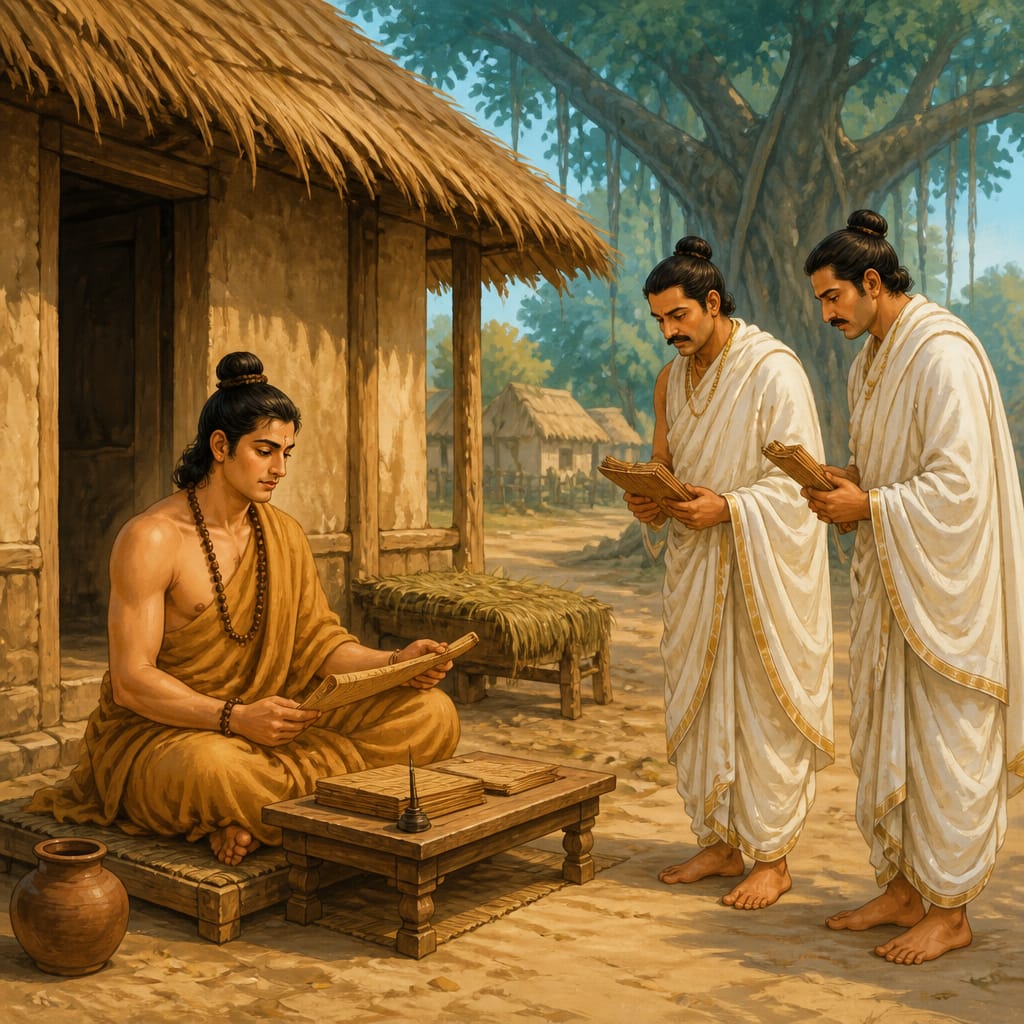
Bharata sits in ascetic's bark cloth outside his hut at Nandigrama, conducting the affairs of state before Rama's sandals.

The practicalities of governing Ayodhya from Nandigram required innovation. Bharata could not be physically present in the throne room, yet decisions needed to be made, disputes settled, ambassadors received.

He established a system where ministers would travel daily between Ayodhya and Nandigram, bringing matters requiring attention. Major decisions would be made at Nandigram, formally attributed to the sandals. Minor matters were delegated to trusted advisors.

When ambassadors from other kingdoms arrived, they were brought to Nandigram rather than received in Ayodhya's grand audience hall. They found not a king on a throne but a prince in ascetic's garb, seated below a simple altar holding wooden sandals.

Many were confused. Some were impressed. A few tried to take advantage of what they perceived as weakness. All discovered that the kingdom of the sandals was governed with wisdom and strength despite its unusual arrangement.

The Counting of Days

In Bharata's quarters at Nandigram, there was a simple practice that captured the essence of his fourteen-year vigil: the counting of days.

Bharata counting days of Rama's exile

Each morning, after his worship of the sandals, Bharata would mark a small line on a wooden tablet, one day closer to Rama's return. The tablet filled; new tablets replaced it. Seasons changed, marked by different colored inks. Years accumulated, measured in thousands of small marks.

"This is how I stay sane," Bharata once told Shatrughna, who stayed by his side throughout the exile. "Each line is a step toward reunion. Each day survived is a day less of separation. I do not count what remains, I count what has passed."

Shatrughna, devoted brother of the devoted brother, shared Bharata's austere life. He could have lived in the palace, could have enjoyed comforts Bharata denied himself. Instead, he chose to stand with Bharata as Bharata stood with Rama, devotion reflected and multiplied.

The Kingdom's Life

Remarkably, Ayodhya prospered during these fourteen years. The kingdom governed by sandals, administered by an ascetic regent, flourished as it never had before.

Trade expanded along the rivers and roads. Harvests came abundantly, as if the gods blessed the land in recognition of its righteous governance. Peace prevailed on all borders, neighboring kingdoms, watching Bharata's devotion, hesitated to attack a land protected by such dharma.

Even justice improved. When citizens knew that their disputes would be resolved by reference to what Rama would want, they brought only genuine grievances. The knowledge that decisions were made with Rama's sandals in mind elevated the entire discourse.

Some said the sandals were blessed. Others said Bharata's devotion had earned divine protection. Perhaps it was simply that a kingdom governed without ego, without self-interest, without the usual corruptions of power, naturally thrived.

While Bharata lived at Nandigram, the queens of Ayodhya lived their own version of exile.

Kausalya, Rama's mother, spent her days in prayer and penance. She had lost husband and son; what remained was faith and waiting. Each morning she performed rituals for Rama's safety; each evening she asked travelers for news from the forest.

Sumitra, mother of Lakshmana and Shatrughna, found purpose in supporting Kausalya. Her son Lakshmana was with Rama; her son Shatrughna was with Bharata. She held the household together through quiet strength.

Kaikeyi, what of Kaikeyi?

The queen who had demanded Rama's exile lived in a private hell of her own making. She had achieved everything she asked for: her son was regent, her rival's son was gone. Yet she had lost everything that mattered: her husband was dead, her son despised her, the kingdom blamed her.

She lived in her chambers, seeing almost no one. When Bharata visited Ayodhya for necessary ceremonies, he performed his filial duties, touching her feet, inquiring after her health, but there was a distance now that could not be crossed. She had not been formally condemned, but she had been quietly set aside, her punishment being to live with the knowledge of what she had done.

The Parallel Lives

Throughout these fourteen years, two pairs of brothers lived mirror lives:

In the forest, Rama and Lakshmana moved from hermitage to hermitage, protecting sages, destroying demons, deepening their spiritual practice. Lakshmana served Rama with single-minded devotion, never complaining, never regretting his choice to follow his brother into exile.

At Nandigram, Bharata and Shatrughna governed a kingdom while living like renunciants, protecting dharma, deepening their own practice of devotion. Shatrughna served Bharata with similar single-mindedness, standing by the brother who stood by Rama.

The four brothers, raised together, inseparable in childhood, now lived their dharma in parallel, two pairs bound by love, separated by circumstance, united in their devotion to what was right.

As the years accumulated and the fourteenth began to unfold, a new energy entered Bharata's vigil. The marks on his tablet were approaching their completion. The day of reunion, or the day of fire, drew near.

Bharata began preparing for Rama's return: the roads to Chitrakoot were cleared, messengers were stationed along the route, the city was made ready for celebration. At the same time, he prepared a funeral pyre outside Nandigram, for if Rama did not return, Bharata had vowed not to outlive his brother's broken word.

"I do not believe the fire will be needed," Bharata told Shatrughna. "Rama will keep his word as I have kept my vigil. But if somehow he cannot, if fate has taken him, I will not live to see a world where Rama is not."

Shatrughna nodded. "And I will follow you, as I have followed you these fourteen years. If you enter the fire, I will be beside you."

But neither expected it would come to that. The fourteen-year count was almost complete. Somewhere in the forest, Rama was surely preparing his own return.

The Deeper Teaching

Life at Nandigram offers profound lessons:

Devotion Transforms Circumstance: Bharata's external circumstances were difficult, living in austerity, governing without authority, waiting without certainty. Yet his devotion transformed these circumstances into spiritual practice. What could have been misery became worship.

Consistency Over Time Creates Character: Fourteen years is a long time. Bharata's devotion was not a single dramatic act but thousands of daily choices, each morning's worship, each decision made in Rama's name, each day's marking on the tablet. Character is built through sustained practice, not sudden transformation.

Parallel Fulfillment: Both brothers, Rama in exile and Bharata in Nandigram, were living their dharma simultaneously. Neither was waiting for life to begin; both were fully engaged with what was before them. Sometimes we must pursue different paths to serve the same ultimate purpose.

The End Is Always Near: Bharata counted days because each day brought reunion closer. When we face long waits, for healing, for reunion, for resolution, the practice of acknowledging progress, however small, sustains us. The end is always one day nearer than yesterday.

As the final days of exile approached, two brothers prepared to meet again, one emerging from forest wanderings, one emerging from fourteen years of devoted service. The sandals would be returned. The count would be complete. Ayodhya would have its king.

Living traditions

Bharata's fourteen-year vigil at Nandigram - living as an ascetic while governing a prosperous kingdom through sandals - has become a touchstone for selfless leadership. Mahatma Gandhi explicitly referenced this episode when developing his concept of trusteeship. Southeast Asian Ramayana traditions (Thailand, Indonesia) expand this period, showing Bharata managing crises while consulting the sandals. The image of Shatrughna choosing solidarity with his brother's austerity demonstrates how devotion can be contagious. Kaikeyi's ultimate tragedy - achieving her goals but losing everything that mattered - is cited as a lesson in the nature of desire and unintended consequences.

Reflection

More in Ayodhya Kanda

All lessons in Ayodhya Kanda ยท The Ramayana course