Lakshmana's Devotion
The Sacred Bond of Brotherhood and Selfless Service
When Rama was ordered into exile, his younger brother Lakshmana chose to abandon everything - his wife, his comforts, his future as a prince - to serve his elder brother in the forest. This is the story of the greatest seva, the purest devotion, and a love so complete that it transformed duty into worship.
The Storm Breaks
The news shattered Ayodhya like thunder splitting the sky. Rama, the beloved crown prince who was to be coronated at dawn, would instead be banished to the forest for fourteen years. Queen Kaikeyi had invoked her two boons from King Dasharatha, and the righteous king, bound by his word, had no choice but to honor them.
The palace that had been decorated for celebration now felt like a house of mourning. But nowhere was the shock more profound than in the quarters of Lakshmana, Rama's younger brother.
When Lakshmana heard the news, the world went dark. Then came not sorrow, but a blazing, righteous fury.
Lakshmana's Fury and Rama's Wisdom
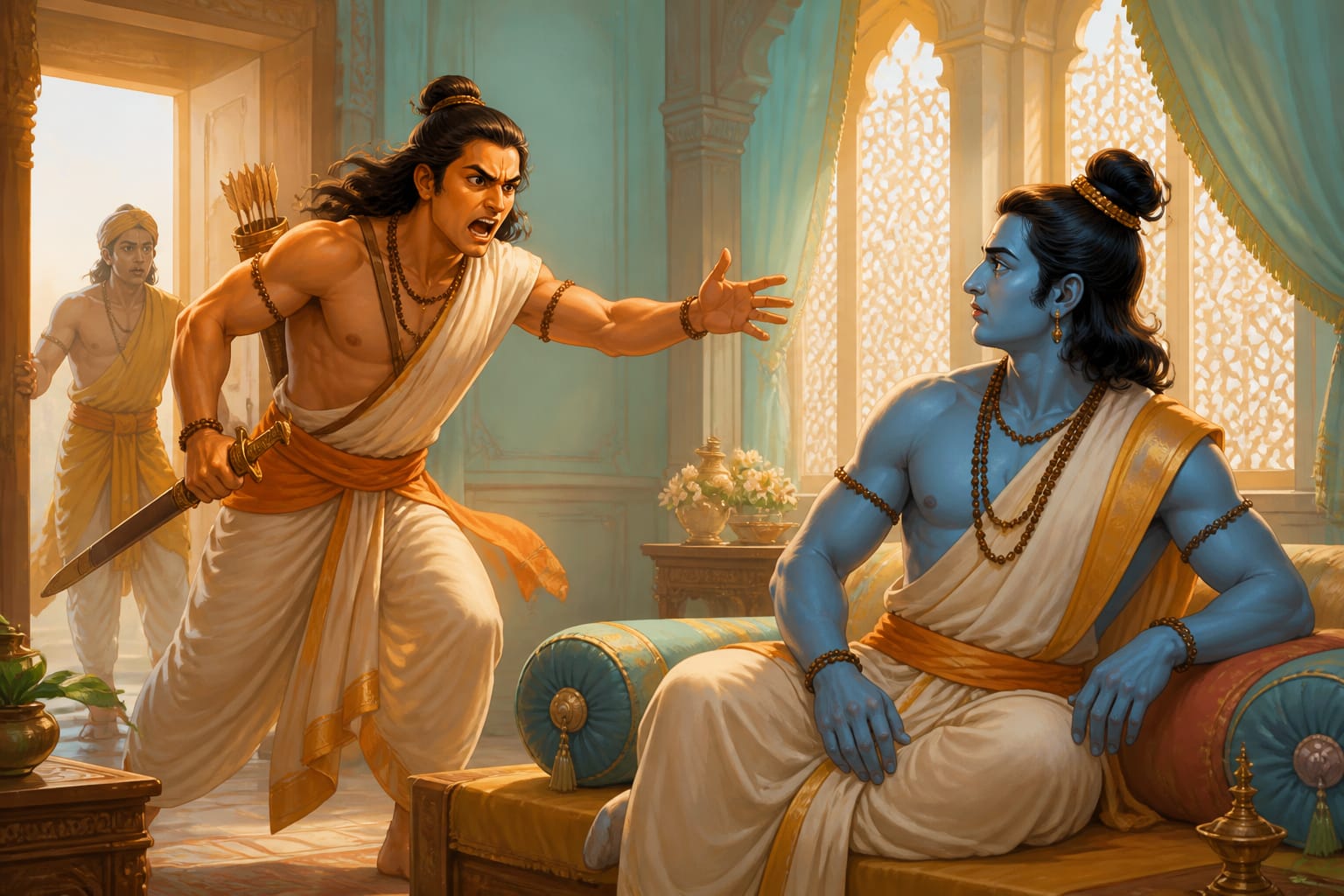
Lakshmana stormed to Rama's chambers, his eyes ablaze with anger. Where Rama was cool water, Lakshmana was fire. Where Rama was the calm moon, Lakshmana was the scorching sun.
"This is outrageous!" Lakshmana burst out, his voice trembling with emotion. "You, who deserve the throne more than anyone in the three worlds, are being sent to the forest like a common criminal? Elder brother, say the word and I will overthrow this travesty! The army loves you, the people worship you! Who in Ayodhya would dare stand against us if we claimed what is rightfully yours?"
He paced like a caged lion, his hand moving instinctively to his sword. "I alone am sufficient to establish you as emperor. My bow can subdue any rebellion. Why should dharma mean accepting injustice? Why should righteousness require surrender to wickedness?"
Rama watched his beloved younger brother with infinite compassion. He recognized this fury, not as Lakshmana's flaw but as the other face of his love. The same intensity that made Lakshmana angry at injustice would make him the most devoted servant.
Gently, like a father calming an overwrought child, Rama placed his hand on Lakshmana's shoulder.
"Beloved Lakshmana," Rama said, his voice like cool sandalwood paste on burning skin, "your love for me makes you speak this way, and I cherish that love. But listen to what you are proposing, you would have me break my father's promise, dishonor my mother Kaikeyi, seize power through force, and throw the kingdom into civil war. Would such a throne bring peace to anyone?"
Rama's wisdom flowed like a river putting out a forest fire. He explained the nature of dharma, that it is not always convenient, not always comfortable, but always right. That a promise given must be a promise kept, especially by those who would be king. That personal loss means nothing compared to the sanctity of truth.
"What is exile, Lakshmana? Merely a change of location. I will be the same Rama in the forest as in the palace. And what is a throne? Merely a seat of responsibility. I will serve dharma equally well under the canopy of trees as under the canopy of the royal umbrella."
Slowly, the fire in Lakshmana's eyes began to dim, not into coldness, but into the steady glow of a lamp. His anger was not defeated; it was transformed.
"Then I Come With You"
When Lakshmana finally spoke again, his voice had changed completely. The fury was gone, replaced by something even more powerful, absolute determination born of absolute love.
"Then I come with you."
Three words. Simple, direct, irrevocable.
Rama tried to dissuade him. "Lakshmana, you have a young wife, Urmila. Your place is here, caring for our mothers in my absence. The forest is harsh, filled with danger, discomfort, and sorrow."
But Lakshmana's decision was like a mountain, immovable. "Where you are, elder brother, is heaven itself. Where you are not is hell, even if it be a palace. You speak of hardship in the forest? The only hardship I know is separation from you. You speak of danger? The only danger I fear is failing in my duty to serve you."
This was no longer the hot-headed prince who had wanted to overthrow the kingdom. This was seva in its purest form, the transformation of anger into action, of fury into devotion, of fire into light.
"I will walk ahead of you, clearing the path of thorns," Lakshmana declared. "I will stand guard while you sleep. I will hunt for food, build shelter, and face any danger that approaches. This exile you speak of is not a burden but a blessing, for it gives me the opportunity to serve you as I have always wished to."
Rama's eyes filled with tears. In Lakshmana, he saw something more precious than any kingdom, bhratri bhakti, the devotion of one brother for another, elevated to the level of worship.
Sumitra's Profound Blessing
But there was one more person Lakshmana had to face before he could leave, his mother, Sumitra.
Unlike Kaikeyi who had demanded exile, or Kausalya who was drowning in grief, Sumitra was different. The youngest of the three queens, often overlooked, she possessed a wisdom that perhaps exceeded them all. She had raised her twin sons with one teaching above all: serve Rama as you would serve God, for in him dharma itself walks the earth.
When Lakshmana came to seek her permission to accompany Rama, Sumitra was waiting. She had known, a mother always knows, what choice her son would make.
"Mother," Lakshmana began, "I seek your blessing to accompany elder brother Rama to the forest."
Sumitra's face, which might have shown the sorrow any mother would feel at her son's departure, instead shone with pride.
"My son," she said, her voice steady and clear, "you ask for my blessing to serve Rama? You already have it, you have always had it. For I have not raised a son; I have raised a sevaka, a servant of dharma."
She placed her hands on his head, and the words she spoke next became one of the most famous benedictions in the entire Ramayana:
"Where Rama is, there is Ayodhya. Where Rama is, there is your father Dasharatha. Where Rama is, there am I, your mother. So go, Lakshmana, not to the forest but to your true home. Serve Rama as you would serve me. Protect him as you would protect me. In serving him, you serve all of us."

Then she added words that revealed her spiritual understanding: "I do not have two sons, Lakshmana. I have four, for I consider Rama and Sita as much my children as you and Shatrughna. When you go to serve Rama, you are not leaving your mother; you are going to serve your other mother, for Sita is as much my daughter as she is Kausalya's."
This was not the sorrow of separation but the joy of purpose fulfilled. Sumitra understood what perhaps no one else in the palace grasped, that this exile was not a tragedy but a dharma yatra, a sacred journey where her son would have the privilege of serving the divine directly.
Urmila's Silent Sacrifice
While Lakshmana's decision to accompany Rama is celebrated in every telling of the Ramayana, there is another figure in this story whose sacrifice is even greater, though quieter, Urmila, Lakshmana's young wife.
Married only recently, Urmila was Sita's younger sister. Like Sita, she was devoted to her husband. But unlike Sita, she would not be accompanying him to the forest.
When Lakshmana came to bid her farewell, Urmila faced a choice. She could have insisted on going, as Sita had. She could have wept and pleaded, making his departure harder. Instead, she chose a different path, the path of tyaga, supreme sacrifice.

"Go, my lord," she said, her voice steady despite her breaking heart. "Serve Rama with all your being. Do not let any thought of me distract you from your duty. I will serve your mothers in your absence. I will perform penances for your safe return. And I will wait."
Fourteen years. She would wait fourteen years, the entirety of her youth, the years when she should have been building a life with her husband. Later, the sage Agastya would reveal that Urmila performed such severe tapas during these years that she earned spiritual merit equal to Lakshmana's service in the forest. While Lakshmana bore physical hardships, Urmila bore the hardship of absence, and some say hers was the greater sacrifice.
As Lakshmana prepared for the forest, the people of Ayodhya witnessed a prince giving up everything, comfort, status, wife, future, not for his own exile but to serve another's. This is the essence of seva bhava, selfless service that is its own fulfillment.
The Eternal Bond of Brotherhood
The Sanskrit word for younger brother is anuja, literally "one born after." But in Hindu tradition, the younger brother is not merely one who comes after but one who completes the elder. As the shadow follows the body, so does the anuja serve and support.
Throughout the Ramayana, Lakshmana exemplifies perfect anuja dharma, the duty of the younger brother. When Rama must rest, Lakshmana stands guard. When harsh action is required, Lakshmana's hand holds the bow. He is Rama's shield, sword, and voice.
But this is not servitude, it is divine partnership. Rama never commands Lakshmana; Lakshmana offers his service freely. Rama never takes him for granted; he treasures every sacrifice. In their relationship, we see not master and servant but two halves of a perfect whole.
Ancient texts would later reveal that Lakshmana was the incarnation of Shesha, the cosmic serpent on whose coils Lord Vishnu rests. Just as Shesha serves Vishnu by providing him rest and support, so Lakshmana serves Rama in his earthly incarnation. The devotion is eternal; only the form changes.
As the three, Rama, Sita, and Lakshmana, prepared to leave Ayodhya, the entire city turned out to watch. King Dasharatha, broken by grief, tried to follow but collapsed. Queen Kausalya cried out in anguish. The citizens wept openly in the streets.
But Lakshmana walked with his head high. In his eyes was not sorrow but purpose. He carried the weapons, he managed the logistics, he supported both Rama and Sita. Already, he had shifted into his role, not as prince but as sevaka, the devoted servant.
As they passed through the gates of Ayodhya, Lakshmana looked back only once, not at the palace but at his mother Sumitra, standing on the battlements. She raised her hand in blessing, and he bowed his head in acknowledgment.
That gesture contained everything, a mother's wisdom, a son's devotion, and the understanding that true greatness lies in what we are willing to give up for dharma.
In Hindu households across India, the relationship between Rama and Lakshmana is held up as the ideal of brotherhood, but the teaching goes beyond blood ties. We all have opportunities to be Lakshmana: to serve causes larger than ourselves, to support those doing good work, to put collective welfare ahead of personal comfort. As the three disappeared into the forest, they carried with them the treasure of dharmic relationship that no exile could diminish.
Living traditions
Lakshmana remains the archetype of devoted brotherly love in Indian culture. The phrase 'like Lakshmana' describes anyone who selflessly serves a family member or leader. His sleepless vigil protecting Rama (with Urmila bearing his sleep) is a popular story teaching the hidden sacrifices behind visible service. Temple iconography across India and Southeast Asia - particularly Cambodia's Angkor Wat and Thailand's royal temples - consistently depicts Lakshmana standing protectively beside Rama, bow in hand. The concept of Lakshmana Rekha (the protective boundary he drew for Sita) has become a metaphor for necessary limits in Hindi/Indian languages.
- Bhai Dooj Celebrations: The festival celebrating brother-sister bonds often invokes the ideal of Lakshmana's protective devotion. Sisters pray for brothers who embody Lakshmana's selfless service
- Lakshman Ghat: Sacred ghat on the Sarayu River associated with Lakshmana. Pilgrims visit to honor the ideal of devoted service that Lakshmana embodied
- Angkor Wat Ramayana Gallery: The world's largest religious monument features extensive bas-reliefs depicting the Ramayana, with Lakshmana consistently shown beside Rama - demonstrating how the ideal of devoted brotherhood spread across Southeast Asia
- Lakshman Temple: One of the finest examples of medieval Indian temple architecture, dedicated to Vishnu but named after Lakshmana who is said to have established the Chandela dynasty
Reflection
- Think of a time when you served someone or something you deeply cared about. Did it feel like a burden or a privilege? What made the difference in how you experienced it?
- Lakshmana's anger transformed into devotion, while Sumitra's wisdom turned potential sorrow into blessing. Between Lakshmana's passionate intensity and Sumitra's calm wisdom, which quality do you relate to more? How might you develop the other?
- Urmila's silent sacrifice earned as much merit as Lakshmana's active service. In your understanding, why would patient waiting and internal discipline be considered equal to external action and visible service?