Dasharatha's Death

A Father's Grief and an Ancient Curse

While Rama finds peace at Chitrakoot, tragedy unfolds in Ayodhya. King Dasharatha, consumed by grief over sending his beloved son into exile, lies dying. In his final hours, he reveals to Queen Kausalya an ancient curse that has now come due, a sin from his youth that destined him to die separated from his son. The great king's passing marks the end of an era and leaves Ayodhya without a ruler.

The Dying King

Six days after Rama's departure, King Dasharatha lay on his bed in the royal chambers, a shadow of the mighty warrior he had been. The king who had once made the heavens tremble with his bow, who had commanded armies and defeated demons, could barely lift his hand.

He had refused food since Rama left. Water passed his lips only when Kausalya pressed it upon him. Sleep brought no rest, for his dreams were filled with Rama's face, Rama as an infant, Rama as a boy, Rama as the young prince he had proudly presented to the world.
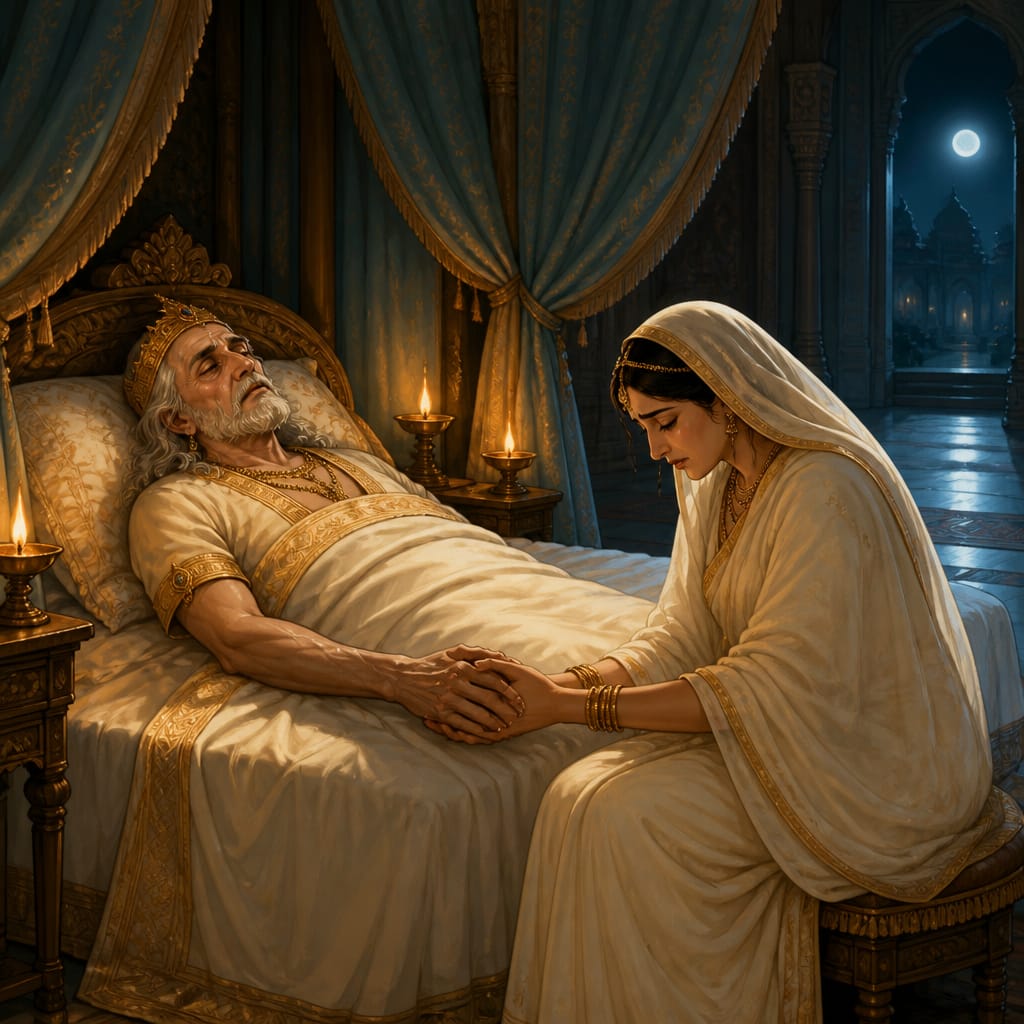
King Dasharatha lies dying on his canopied bed while Queen Kausalya sits at his side holding his hand.

"What have I done?" he moaned, his constant refrain. "What have I done?"

The royal physicians found no disease, no injury, no poison. The king was dying of something medicine could not treat, a broken heart, the unbearable weight of having destroyed what he loved most.

The Confession

Queen Kausalya, Rama's mother, sat beside her husband's bed with emotions that shifted between grief and fury. She loved Dasharatha, had loved him for decades, but she could not forget that it was his promise to Kaikeyi that had sent her son into exile.

"My lord," she said, her voice trembling with suppressed emotion, "you gave Kaikeyi two boons on that battlefield years ago. Did you know then that those boons would cost us our son? Did you know that your promise to her would destroy our family?"

Dasharatha turned his face to the wall. He had no defense, no explanation that could ease her pain, or his own.

"I was a fool," he whispered. "I was blind with love for her beauty, her courage. I gave those boons without thinking what they might cost. And now..." His voice broke. "Now I pay with everything I have."

Kausalya wanted to rage at him, to blame him for every moment of suffering. But looking at his wasted frame, his hollow eyes, she found she could not. He was being punished far more severely than any words she could speak.

"Tell me," she said more gently, "why does this grief strike you so hard? You are a king, a warrior. You have faced death many times. Why does Rama's absence kill you when all of Ravana's demons could not?"

Dasharatha was silent for a long moment. Then, in a voice barely above a whisper, he began to speak of something he had never revealed, a secret from his youth that had haunted him for decades.

"Listen, Kausalya, to a tale of sin and consequence. What kills me now is not merely Rama's exile. It is an ancient curse coming due, karma from my youth that now demands its payment."

He told her of a night long ago, before he was king, when he was a young prince known for his mastery of shabdabhedi vidya, the skill of shooting arrows at targets identified only by sound. He had gone hunting alone by the banks of the Sarayu River.

Young Dasharatha at the riverbank with Shravana

"It was evening," he recounted, "and I heard a sound in the darkness, a gurgling sound, like an elephant drinking from the river. I was eager to prove my skill. Without seeing my target, I released an arrow toward the sound."

"But it was not an elephant."

The arrow had struck Shravana Kumar, a young man who had been filling a water pot for his elderly, blind parents who waited nearby in the forest. The gurgling sound had been water entering his vessel, not an elephant drinking.

Young Dasharatha rushed to the riverbank to find a young man lying wounded, the arrow through his chest, the water pot shattered beside him.

"Who are you?" Dasharatha had cried, horrified by what he had done. "What have I done?"

Shravana, dying, had spoken with remarkable calm: "I am Shravana, prince. I was fetching water for my blind, aged parents who wait in the forest. They cannot see, cannot walk without help. I was their eyes, their legs, their only support in the world. Now... now you must bring them water. You must tell them what has happened. They will die without someone to care for them."

Dasharatha had begged forgiveness, had offered to do anything to make amends. But Shravana died with his parents' names on his lips.

With trembling hands, young Dasharatha carried water to the blind couple. He found them sitting in the darkness, calling for their son.

"Shravana? Is that you, my boy? Why did you take so long? We were worried."

Dasharatha fell at their feet, weeping, and confessed what he had done. The old couple's wails of grief pierced the night sky. The father, Rishi Shravana, gathered his dying son's body in his arms, the child they had raised with such love, their only support in blindness and old age.

Then the old man spoke words that would echo through decades:

"Prince Dasharatha, you have killed our only son through carelessness, through the arrogance of youth and skill. We do not curse you to die, that would be too easy. Instead, hear this: As we die of grief for our son, so shall you die of grief for yours. You will not be killed by enemy or disease. You will die of separation from the child you love most, as we die of separation from ours."

"Putra shoka, the grief of separation from your son, that is what will end your life."

The blind couple ascending Shravana's pyre

The blind couple then prepared their own funeral pyre beside their son's body, and as Dasharatha watched in horror, they committed themselves to the flames, preferring death to life without Shravana.

Karma Comes Due

"I buried that memory," Dasharatha told Kausalya. "I told myself it was an accident, that I had not intended harm. I performed penances, gave charity, tried to earn merit that might cancel the curse. When Rama was born, I thought perhaps my atonement had been accepted."

"But karma is not so easily escaped."

"Now I understand, the curse was not cancelled but delayed. Shravana's parents did not curse me to lose my son. They cursed me to love my son so much that losing him would destroy me. And that is what has happened. I love Rama more than my own life. And losing him, even to exile, not death, is killing me just as surely as those blind parents knew it would."

Kausalya listened in silence. The story explained so much, why Dasharatha had been so desperate to make Rama king, why the exile had struck him with such mortal force, why no medicine could cure what ailed him.

"So this is karma," she said finally. "Not punishment but consequence. Not revenge but balance."

"Yes," Dasharatha whispered. "What we do returns to us. Not always immediately, not always in ways we expect. But it returns."

The Final Night

As midnight approached, Dasharatha's condition worsened. His breathing grew labored, his eyes unfocused. Kausalya held his hand while Sumitra sat nearby, both queens united in grief.

Kaikeyi had been summoned but remained in her chambers. Whether from guilt, shame, or denial, she could not bring herself to face what her demands had wrought.

"Kausalya," Dasharatha murmured, "do not blame Kaikeyi entirely. She was my weakness given voice. I could have refused her boons. I could have chosen exile myself rather than send Rama. Every king must face moments when he must choose between his word and his wisdom. I chose wrong."

"And Rama?" Kausalya asked. "What message shall I give him if... when..." She could not finish.

"Tell him that his father loved him beyond all telling. Tell him that my last thoughts were of his face. Tell him that he was the best of sons, the best of men, and that whatever happens, he must hold to dharma as he has always done."

In the darkest hour before dawn, with Kausalya's hand in his, King Dasharatha of Ayodhya breathed his last. His final word, witnesses later reported, was a name:

"Rama..."

The king who had ruled for sixty thousand years (a mythological span suggesting a vast reign), who had conquered in all directions, died not on a battlefield but in his bed, not of wounds but of grief, not surrounded by enemies but emptied by loss.

When the sun rose, Ayodhya woke to a kingdom without a king. The throne sat empty. The eldest prince was in exile. The next in line, Bharata, was visiting his grandfather's kingdom, unaware of all that had transpired.

The Kingdom in Crisis

The ministers and priests gathered in urgent council. A kingdom cannot function without a king, there are decisions to be made, disputes to be settled, borders to be protected. Yet the rightful heir was exiled, the next heir absent, and the king whose word had caused all this was dead.

Sage Vasishta, the royal guru who had guided the Ikshvaku dynasty for generations, took temporary charge. He dispatched swift messengers to Kekaya, where Bharata was staying, with urgent summons.

"Tell him nothing of Rama's exile or the king's death," Vasishta said. "Such news must be delivered in person, by those who can support him through the shock. Tell him only that his presence is urgently required in Ayodhya."

The messengers departed at speed, covering the distance of many days in mere nights through relay horses and sheer determination.

Meanwhile, the royal funeral had to wait. Without a living king or crown prince to perform the last rites, Dasharatha's body was preserved through priestly arts.

In the days that followed, Kausalya walked through the palace like a ghost, visiting Dasharatha's untouched chambers, Rama's empty rooms, the dusty throne.

"Once," she whispered to Sumitra, "this palace held everything I could want. Now my husband is dead, my son is exiled, and comfort mocks me. How quickly everything can change."

Sumitra replied: "Sister, we still have our sons. Lakshmana is with Rama; Bharata will return."

But hope felt far away in those grief-soaked days.

The Deeper Teaching

Dasharatha's death offers profound teachings about karma, consequence, and the nature of love:

Karma Is Consequence, Not Punishment: The blind parents' curse was not revenge but prophecy, actions create results, often delayed but inevitable. Dasharatha's careless arrow eventually returned as Kaikeyi's careless demand.

Love Is Both Gift and Vulnerability: Dasharatha's love for Rama was his highest quality and his fatal weakness. The curse worked precisely because he loved so deeply. Love opens us to joy but also to grief.

The Interconnection of All Things: A prince shooting an arrow decades ago connects to a father dying of grief in the present. Nothing exists in isolation; every action ripples outward.

Words Have Power: Both the boons Dasharatha gave Kaikeyi and the curse Shravana's parents spoke were mere words, yet they shaped destinies across decades.

As Ayodhya grieved, the stage was set for the next chapter, Bharata's return to a kingdom in chaos and the revelation of all that had transpired.

Living traditions

Dasharatha's death scene remains one of the most emotionally performed episodes in Ramlila and classical dance traditions. The concept of dying with the divine name on one's lips (as Dasharatha died saying 'Rama') became central to bhakti traditions and is referenced in texts like the Bhagavata Purana. The Shravana Kumar story is independently taught in Indian schools as a moral lesson about filial duty. The curse that Dasharatha received - that he would die of grief for his son - explores the karmic consequences of unintended harm, a theme that resonates in Hindu ethical philosophy.

Reflection

More in Ayodhya Kanda

All lessons in Ayodhya Kanda · The Ramayana course