Into the Dandaka
Where Exile Becomes Adventure
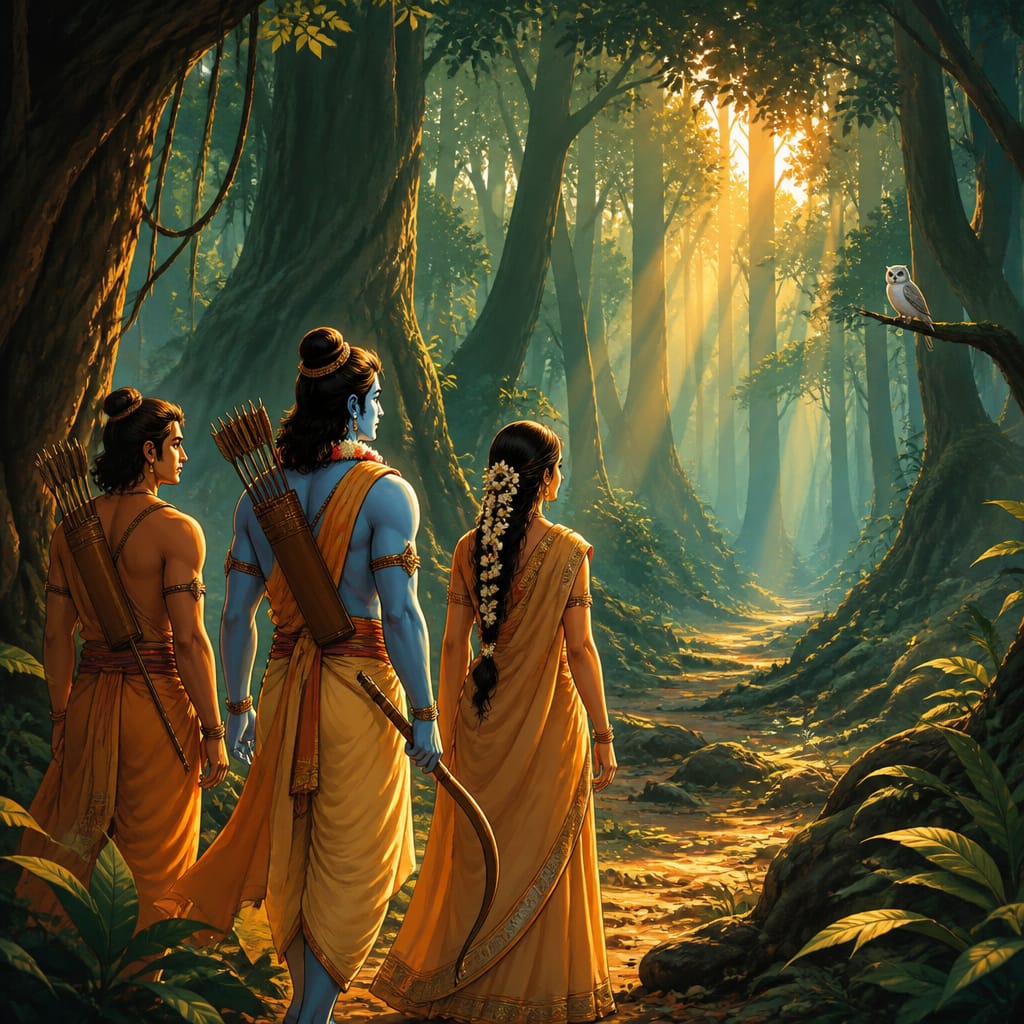
With blessings from the sages and resolve in their hearts, Rama, Sita, and Lakshmana enter the vast Dandaka forest. This final lesson of Ayodhya Kanda marks the transition from family drama to epic adventure. The themes of duty, sacrifice, and brotherly love that defined this kanda now yield to new challenges: demons to defeat, sages to protect, and a destiny waiting in the forest's depths.
Crossing the Threshold
The boundary between ordinary forest and the Dandaka was not marked by sign or wall, yet Rama knew when they had crossed it. The very air seemed different, thicker, older, charged with something both sacred and dangerous.
"We are within the Dandaka now," he said quietly to Sita and Lakshmana. "Everything changes from this point forward."
Lakshmana gripped his bow more tightly. "I feel it, brother. The forest watches us. It knows we have entered."
Sita walked between the brothers, her eyes taking in the towering trees, the filtered light, the ancient presence of a wilderness that predated human memory. "It is beautiful," she said softly. "And terrible. Both at once."
They walked forward, into the unknown.

The Forest's Nature
The Dandaka was unlike any forest they had known. At Chitrakoot, nature had been gentle, a companion to their exile. Here, nature was something else entirely, not hostile, perhaps, but indifferent to human needs, vast beyond comprehension, operating on scales of time and space that made individual lives seem momentary.
Trees grew to heights that disappeared into the canopy above. Rivers cut through gorges so deep that sunlight never reached their beds. Creatures moved in the shadows, some familiar, some never seen before, some that existed in twilight between animal and something else.
"The sages say that this forest was cursed long ago," Lakshmana observed, "by King Dandaka's sins. Whether truth or legend, something here is different. The rules are different."
Rama nodded. "Which is why we must hold to dharma more firmly than ever. In ordinary places, society reinforces righteousness. Here, we have only ourselves. Our discipline must be internal, unwavering."
The First Hermitage

After several days of travel, they reached the first of the forest hermitages, the dwelling of sages who had chosen the Dandaka precisely for its isolation, its challenge, its distance from the distractions of civilization.
The hermitage was modest: a few huts of leaves and branches, a sacred fire pit, a space cleared for yajna. But the welcome was warm.
"Prince Rama!" The sages had been expecting them. Word travels fast through the forest's network of hermitages. "We have heard of your coming. The protection of a Kshatriya, at last!"

That night, gathered around the sacred fire, the sages told stories that made the danger concrete:
A demon named Viradha haunted the paths, carrying off wayfarers to devour at leisure.
A rakshasa king named Khara commanded a vast army from a fortress called Janasthana.
And behind them all, mentioned in whispers, was Ravana, the ten-headed king of Lanka whose reach extended even into these distant forests.
"We do not ask you to fight Ravana," the eldest sage said. "That would be beyond even your power. But Khara's forces terrorize us daily. If you could challenge them, contain them, give us space to practice our dharma in peace..."
"I will do what I can," Rama replied. "That is all any of us can promise. But I did not survive exile from Ayodhya to hide from demons in the wilderness."
Even in the Dandaka, Sita found ways to create beauty. At each hermitage where they stayed, she would plant something, a flower from the previous location, seeds gathered along the path, cuttings from plants that caught her eye.
"What is the use?" Lakshmana asked once, not unkindly. "We will move on. No one will tend your plantings."
"That is true," Sita replied. "But the forest will tend them. And someday, perhaps, a traveler will come upon a flower blooming where it should not grow, and wonder at the world's unexpected gifts. That is use enough."
This was Sita's dharma in the darkness, creating small moments of beauty, leaving traces of care throughout a forest that knew mostly danger. It was not warrior dharma; it was her own.
Lakshmana's Vigilance
For Lakshmana, the Dandaka became a proving ground for the vigilance he had always felt.
He slept little, keeping watch through the night hours. He marked the paths they traveled, noting which were safe and which showed signs of demon passage. He kept his weapons always ready, bow strung, arrows sorted, sword within reach even during meals.
"Brother," Rama said gently one evening, "you exhaust yourself. We cannot survive fourteen years if you never rest."
"I will rest when you and Sita are safe," Lakshmana replied. "I followed you into exile to serve and protect. The forest has many dangers; my duty is to ensure none of them reach you."
It was not healthy, this constant vigilance. But it was Lakshmana, the brother who had made himself into living armor for those he loved.
As they moved deeper into the Dandaka, Rama encountered a question that would define his forest years: When is violence dharmic?
The sages' answer was clear: violence against demons who attack the innocent is not only permitted but required. The Kshatriya who refuses to fight evil is failing his dharma as surely as the Brahmin who refuses to teach.
But Rama sensed complexity:
"What of demons who have not yet attacked? Are we to hunt them preemptively, or wait until they strike?"
"What of demons who might be redeemed? The texts speak of rakshasas who turned toward dharma. How do we distinguish?"
"And what of the violence's effect on us? Every being killed, even justly, leaves a mark. How do we fight without becoming fighters only?"
These questions would occupy Rama throughout his forest years. He would never resolve them fully, they are not the kind of questions that resolve. But he would engage them honestly, acting when action was needed while never losing sight of the complexity beneath the action.
The Forest's Teaching
As the weeks became months, the Dandaka began to teach the exiles its own lessons:
Impermanence: Nothing in the forest stayed the same. Paths that were clear became overgrown. Streams shifted their courses. What seemed permanent proved temporary. The forest taught that all things pass.
Interdependence: Every creature depended on others. The tree fed insects that fed birds that spread seeds that grew trees. Nothing existed alone. The forest taught that connection is fundamental.
Presence: Unlike the palace, where past and future dominated consciousness, the forest demanded attention to now. A moment's distraction could mean missing a danger or a beauty. The forest taught the power of attention.
"I begin to understand," Rama said one day, "why sages choose to live here. The forest is a teacher. Every challenge is a lesson, every danger an opportunity for practice. We could spend a lifetime here and not exhaust its wisdom."
This lesson marks the end of Ayodhya Kanda and the beginning of what comes next. The transition is not abrupt but gradual, a shift in emphasis rather than a sudden change.
Ayodhya Kanda was about:
- Family and its complications
- Duty and its demands
- Sacrifice and its forms
- Love between parents and children, brothers and brothers, husband and wife
Aranya Kanda, the Forest Book, will be about:
- Adventure and danger
- Combat and consequence
- Protection and its costs
- The forces of good and evil in direct confrontation
Both are part of Rama's story. Both are necessary for what comes after. The dharma of family and the dharma of war are not opposites but complements, different aspects of living rightly in a complex world.
As this kanda closes, let us look back at what has been covered:
From Lesson 1 (the announcement of Rama's coronation) through Lesson 18 (entry into the Dandaka), we have witnessed:
- The joy of anticipated coronation
- The shock of Kaikeyi's demands
- Rama's acceptance of exile
- The departure from Ayodhya
- The journey through the forest
- The crossing of the Ganga
- Life at Chitrakoot
- Dasharatha's death
- Bharata's grief and refusal of the throne
- The brothers' reunion and debate
- The gift of the sandals
- Bharata's vigil at Nandigram
- The sages' call for protection
- Entry into the Dandaka
Throughout all of this, the themes have been consistent: dharma is difficult, love is costly, sacrifice is real, and righteousness is a path, not a destination.
As we close Ayodhya Kanda, these lessons remain:
Dharma Is Lived, Not Just Understood: Rama did not merely know dharma; he embodied it through every choice. Dharma becomes real only in practice, only when tested, only when it costs something.
Family Is Both Foundation and Complication: The family relationships of the Ramayana, parents and children, brothers, husband and wife, are sources of both deepest love and most painful conflict. Family is not simple; family is everything.
Exile Can Become Opportunity: What began as punishment became preparation. The forest years would forge Rama into the king who could eventually rule Ayodhya wisely. Sometimes our worst circumstances become our best teachers.
The Story Continues: Ayodhya Kanda ends not with resolution but with transition. The story is not complete; the exile is not over; the greatest challenges lie ahead. We close one chapter knowing that another opens.
As Rama, Sita, and Lakshmana walk deeper into the Dandaka, they carry with them everything this kanda has given them: the grief of loss, the strength of sacrifice, the bonds of brotherhood, the commitment to dharma. What awaits them in the forest, adventure, danger, and eventually the central tragedy of the epic, will test all they have become.
The next kanda will begin where this one ends: deep in the forest, far from home, moving toward a destiny none of them can yet imagine.
Living traditions
Ayodhya Kanda is considered by scholars and performers alike to be the most emotionally powerful section of the Ramayana. Performance traditions reserve their most elaborate staging for its scenes - the exile announcement, Dasharatha's death, the Bharat Milap reunion. The geographical shift from North India (Ayodhya, Chitrakoot) to Central and South India (Dandaka forest) traces a map of the subcontinent that pilgrims can follow. The themes of exile, brotherly devotion, and the conflict between duty and desire have influenced literature far beyond India, with scholars noting parallels in Shakespeare and modern novels about family sacrifice.
- Ayodhya Kanda Recitation: The complete recitation of Ayodhya Kanda is performed in temples and homes, particularly during auspicious occasions. It is considered the most emotionally powerful section of the Ramayana
- Dandaka Forest Entry Points: Sites marking where Rama, Sita, and Lakshmana entered the vast Dandaka forest at the conclusion of Ayodhya Kanda. Pilgrims can follow the traditional route southward
- Panchavati: Traditional site where Rama, Sita, and Lakshmana established their hermitage in the Dandaka. The transition point from Ayodhya Kanda's conclusion to Aranya Kanda's adventures
Reflection
- As Ayodhya Kanda closes, what themes or moments have stayed with you most powerfully? What has this kanda taught you about family, duty, sacrifice, or love that you will carry forward?
- The Ramayana presents dharma as complex, family duty conflicted with individual integrity, acceptance conflicted with action. How do you navigate when different dharmas seem to conflict? Is there a hierarchy, or must each situation be assessed uniquely?
- Rama's exile transformed from punishment to purpose, from loss to opportunity. Have you experienced similar transformations in difficult circumstances? What made the shift possible?