The Great Debate
When Dharma Argues with Dharma
After the emotional reunion, Bharata presents his case: Rama must return to rule Ayodhya. He marshals every argument, the kingdom's need, the citizens' suffering, the injustice of exile, the love of his brother. Rama responds with equal conviction, defending his commitment to his father's word. This debate between two righteous brothers, each certain of his position, explores the deepest questions of duty, promise, and kingship.
The Morning After
Dawn broke over Chitrakoot to reveal a transformed landscape. Where yesterday there had been a simple hermitage beside a peaceful river, now there sprawled an entire camp, tents of silk, elephants tethered to trees, thousands of people who had traveled from Ayodhya to bring their prince home.
But Rama had not slept in any tent. He had remained in his leaf-hut, and when he emerged at dawn for his prayers, he looked exactly as he had the day before, an ascetic in bark cloth, undisturbed by the army that had arrived to reclaim him.
Bharata had also barely slept. He had spent the night preparing his arguments, rehearsing his pleas, marshaling every reason why Rama must return. Now, as the sun rose, he prepared for the most important persuasion of his life.
The Assembly
At mid-morning, the entire assembly gathered in a great clearing near the Mandakini River. This was not a casual conversation but a formal debate, the future of the Ikshvaku dynasty hung in the balance.
On one side sat Bharata, supported by the ministers, priests, and queens of Ayodhya. Behind him spread the evidence of the kingdom's need, thousands of citizens who had followed their prince into the wilderness, the empty throne represented by its absence.
On the other side sat Rama, with only Sita and Lakshmana beside him. He had no army, no ministers, no symbols of power. He had only his conviction.
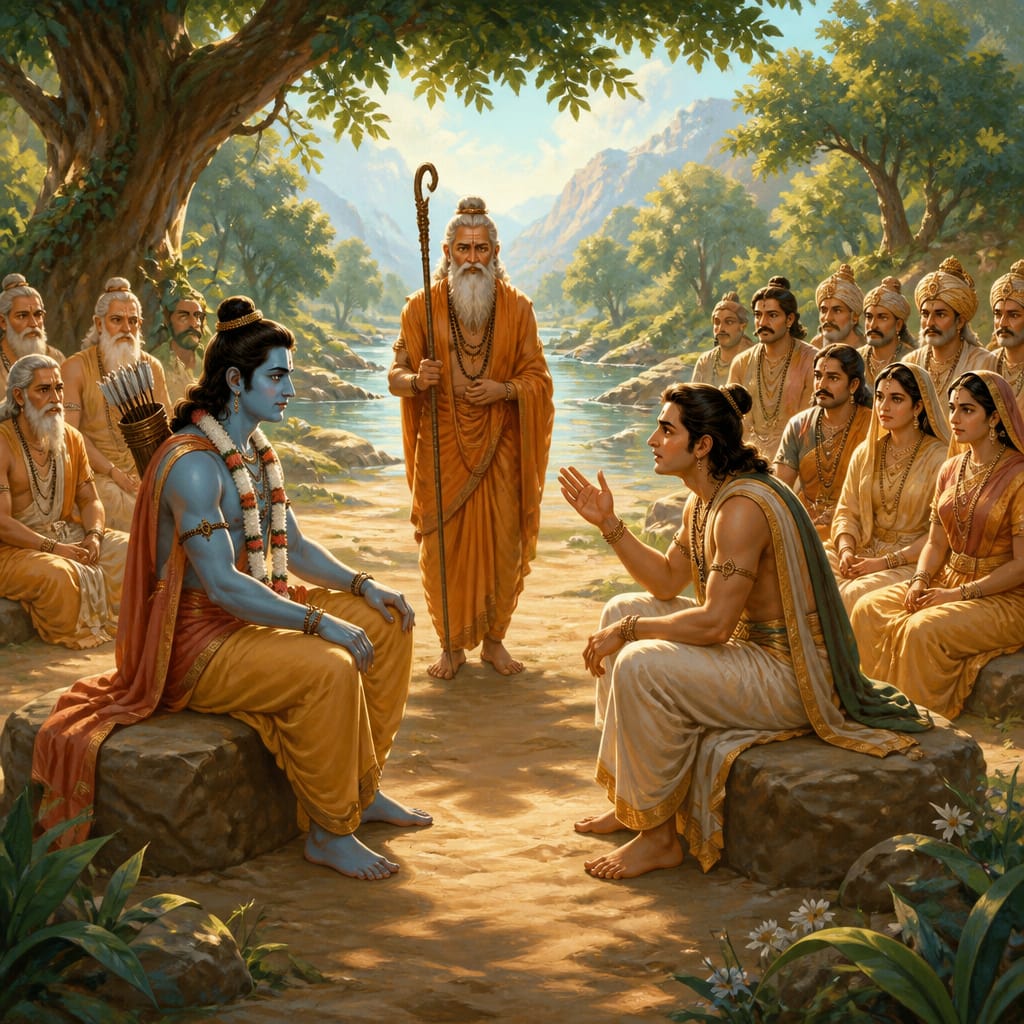
Sage Vasishta, the royal guru, presided over the assembly. "We gather to resolve a question that divides this noble family," he intoned. "Bharata, prince of Ayodhya, you may speak."
Bharata rose, and for a moment could not speak, the sight of his brother in ascetic's garb, surrounded by the luxury he had refused, overwhelmed him. Then he found his voice.
"Brother, beloved brother, I come not to command but to plead. I come not as a prince but as a devotee. Hear my words, weigh them against dharma, and then decide."
He took a breath and began his case:
"First, the PRACTICAL argument. Ayodhya needs a king. Since your departure, the kingdom has been paralyzed. Decisions go unmade, disputes unsettled, borders undefended. A kingdom without a king is like a body without a soul, it may twitch, but it does not live. Every day you remain here, Ayodhya suffers."
"Second, the LEGAL argument. Our father's promise to Kaikeyi was made under duress, extracted through manipulation. Such promises, the shastras teach, are not binding. Moreover, you are the rightful heir by birth. The law of primogeniture precedes any personal promise. You have not just a right but a DUTY to take the throne."
"Third, the MORAL argument. Our mother, " his voice hardened, "my mother, acted from greed and jealousy. To allow her scheme to succeed is to reward evil. If you remain in exile, you validate her manipulation. If you return, you demonstrate that righteousness cannot be stolen by cunning."
"Fourth, the EMOTIONAL argument." Here his composure cracked. "Brother, I CANNOT rule Ayodhya. I cannot sit on a throne you should occupy. Every day I would be reminded of the wrong done to you. Every decision I make would be shadowed by the knowledge that these should be YOUR decisions. Do not condemn me to a lifetime of sitting in your seat."
Bharata's arguments were immediately supported by the sages and ministers who had accompanied him.
Sage Vasishta spoke: "Rama, your father made many promises in his life. To his people, he promised protection. To his kingdom, he promised good governance. To dharma itself, he promised a worthy successor. The promise to Kaikeyi was ONE promise among many, and it conflicts with all the others. When promises conflict, we must choose the higher dharma."
Jabali, a minister known for his philosophical bent, took a more radical approach: "Prince Rama, let me speak plainly. What is this 'promise' but words spoken by a man now dead? The dead cannot enforce their demands. Your father is beyond caring what happens. It is the living who suffer from your absence. Why sacrifice the real wellbeing of thousands to honor the empty words of one who can no longer speak?"
This argument drew shocked gasps from many in the assembly. To speak so dismissively of dharma, of a father's word, was shocking even in this desperate context.
Rama's Response
When all had spoken, Rama rose. His voice was calm, his manner untroubled by the weight of argument marshaled against him.
"Honored brother, beloved teachers, I have heard your words with an open heart. Now hear mine."
"First, to the PRACTICAL argument. You say Ayodhya needs a king. But what Ayodhya needs more than a king is a kingdom that honors its word. If I return because exile is inconvenient, I teach that convenience trumps promise. What kind of king breaks his word for his own comfort? What respect would such a king command?"
"Second, to the LEGAL argument. You say Father's promise was made under duress. Perhaps. But Father did not break that promise. He kept it, even unto death. Shall I dishonor his sacrifice by undoing what he died to uphold? The promise may have been extracted unfairly, but once given, it was sacredly kept. I will not desecrate his integrity."
"Third, to the MORAL argument. You say that returning would punish Kaikeyi's scheme. But dharma is not about winning against others, it is about becoming who we should be. My dharma is not to defeat Kaikeyi but to fulfill my word. Her karma will find her in its own time. I need not be its instrument."
"Fourth, to the EMOTIONAL argument." Rama's voice softened as he looked at Bharata. "Brother, you say you cannot rule. But you have already proven otherwise. Your rejection of the throne, your journey here, your love for me, these are the qualities of a true king. Rule Ayodhya. Rule it well. And when fourteen years have passed, I will return to find a kingdom more prosperous than ever."
Then Rama turned to Jabali, and his voice took on a rare edge:
"Minister, you speak of my father's words as 'empty' because he is dead. Let me tell you plainly: Such thinking is the path to chaos. If promises end with death, why should anyone keep them while living? If the words of the dead mean nothing, why should the words of the living mean anything? We are all future dead."
"The REASON promises matter is precisely because they outlast us. Dharma exists to create a world where we can trust beyond the moment, where a father's word binds even when the father is gone, where society coheres not through force but through faith in each other's commitments."
"I do not keep my word because my father will punish me if I break it. I keep my word because breaking it would unmake me, would make me someone I do not wish to be, would destroy the very foundation of righteous action."
Jabali fell silent, chastened. Rama's argument had gone beyond practical calculation to touch the foundations of dharmic society itself.
The Impasse
As the debate continued, it became clear that no argument would move Rama. This was not stubbornness but something deeper, a settled conviction that honoring his word was not one value among many but the foundation on which all other values rested.
Bharata, equally convinced, refused to accept this position. "Brother, surely dharma cannot require you to abandon your people? Surely the greater good outweighs the literal keeping of one promise?"
"Bharata," Rama replied gently, "there IS no greater good than being true to one's word. A king who breaks his promises 'for the greater good' will find that greater goods multiply endlessly, each broken promise justified by the next calculation of benefit. Soon, no promise means anything, and the kingdom rests not on trust but on force."
"I would rather live as an honest exile than rule as a king who broke his word to gain his throne."

Finally, Queen Kausalya rose to speak. Her voice was thick with grief, but her words were clear:
"My sons, my beautiful sons, both of you are right, and both of you are caught in a web not of your weaving."
"Bharata is right that Ayodhya needs its king, that the people suffer, that legal and practical considerations favor Rama's return."
"Rama is right that a king's word is sacred, that dharma cannot be calculated by outcomes alone, that breaking this vow would undermine all vows."
"But hear a mother's heart: I have lost my husband. I cannot lose my son for fourteen years. Is there no middle way? No resolution that honors both the letter of the promise and the spirit of kingship?"
The debate had reached an impasse. Two forms of dharma stood opposed:
Bharata's dharma: A king's first duty is to his people. Promises that harm the kingdom should yield to the kingdom's welfare. The spirit of dharma is more important than its letter.
Rama's dharma: A king's word is his bond. If a king cannot keep a personal promise, how can the people trust any of his promises? The letter of dharma creates the foundation for its spirit.
Neither was wrong. Both were deeply, unavoidably right from their own perspective.
As the sun moved past its zenith, the assembly sat in silence. Rama would not return. Bharata could not accept this. And the kingdom that had sent its prince to bring his brother home began to realize that brother would not come.
The Deeper Teaching
This great debate offers timeless wisdom:
Dharma Is Not Simple: Both brothers were committed to dharma, yet they reached opposite conclusions. This teaches that righteous people can genuinely disagree, that dharma is not a formula but a wrestling with competing goods.
Promises Create Social Fabric: Rama's defense of promise-keeping went beyond personal honor to social necessity. Promises are not just individual commitments but the threads that weave society together. Pull too many threads, and the fabric unravels.
There Is More Than One Way to Serve: Bharata wanted to serve Rama by bringing him home. Rama wanted Bharata to serve by ruling well. Both were acts of love, expressed differently. Sometimes the greatest service is not giving others what they want but what is truly needed.
Some Dilemmas Have No Clean Solution: The debate ended in stalemate because there WAS no solution that satisfied everyone. Life presents such dilemmas, moments when every choice involves loss, when wisdom lies not in finding perfect answers but in choosing among imperfect ones with integrity.
The assembly dispersed as evening fell, but the question remained unresolved. Tomorrow, Bharata would make one final attempt, not through argument but through action. And Rama would offer a solution that honored both their positions, transforming deadlock into devotion.
Living traditions
The Rama-Bharata debate has been analyzed by philosophers for millennia. Medieval commentators like Govindaraja wrote extensive analyses concluding both brothers were right within their dharmic frameworks. The debate's parallels to Greek tragedy (particularly Antigone vs. Creon) are studied in comparative literature courses. Jabali's materialist arguments may represent ancient Charvaka philosophy, showing that the Ramayana engaged with skeptical viewpoints even while advocating for dharma. The scene is frequently referenced in discussions of ethics, duty, and the complexity of moral choice.
- Dharma-Sankata Study: The debate at Chitrakoot is studied in Hindu philosophical traditions as a classic case study in dharma-sankata (moral dilemma). Both brothers are considered right within their frameworks
- Janaki Kund: Sacred water body where Sita is believed to have bathed during the exile. Associated with the period when the great debates between Rama and Bharata took place nearby
- Gupt Godavari Caves: Caves where Rama and Lakshmana are said to have held court during the exile period, including receiving Bharata and the citizens of Ayodhya
Reflection
- Bharata argued that the welfare of thousands outweighs one promise. Rama argued that keeping promises is what makes welfare possible. Who do you think was right? Is there a way to honor both perspectives, or must we sometimes choose between them?
- Rama said breaking his word would "unmake" him, would destroy who he was. Have you ever felt that a commitment was so central to your identity that breaking it was unthinkable, regardless of the consequences? What makes certain commitments constitutive of self?
- Jabali suggested that obligations to the dead don't bind the living. Many people would agree, why should the promises of deceased people constrain us? Yet Rama argued that treating death as the end of obligation unravels all obligation. Where do you stand on this question?