Rama Accepts Exile

Supreme Dharma, Unshaken Resolve

Rama learns of the two boons that demand his exile and Bharata's coronation. His response - calm acceptance without anger or complaint - establishes him as Maryada Purushottam, the supreme upholder of dharma.

The Morning After

The sun rose over Ayodhya, but it brought no light to the palace. The city that had slept dreaming of coronation woke to an eerie silence. The decorations hung like abandoned hopes. The citizens sensed something terribly wrong.

In the inner palace, King Dasharatha had not slept. He had spent the night trapped in Kaikeyi's chambers, bound not by chains but by his own word given decades ago. As dawn broke, Kaikeyi spoke: "It is time. Summon Rama. Let him know his fate."

Rama woke that morning as he always did - with prayers and gratitude. He bathed, performed his worship, and prepared himself mentally for the coronation. When the messenger arrived asking him to come immediately, Rama noticed something odd - the messenger would not meet his eyes. The palace corridors were strangely empty.

The Silence of the King

When Rama entered Kaikeyi's chambers, he saw a sight that froze his heart. His father, the great King Dasharatha, sat slumped in a chair, his face buried in his hands. He looked like he had aged twenty years overnight. When Rama approached and touched his feet, Dasharatha could not speak - only moan in profound anguish.
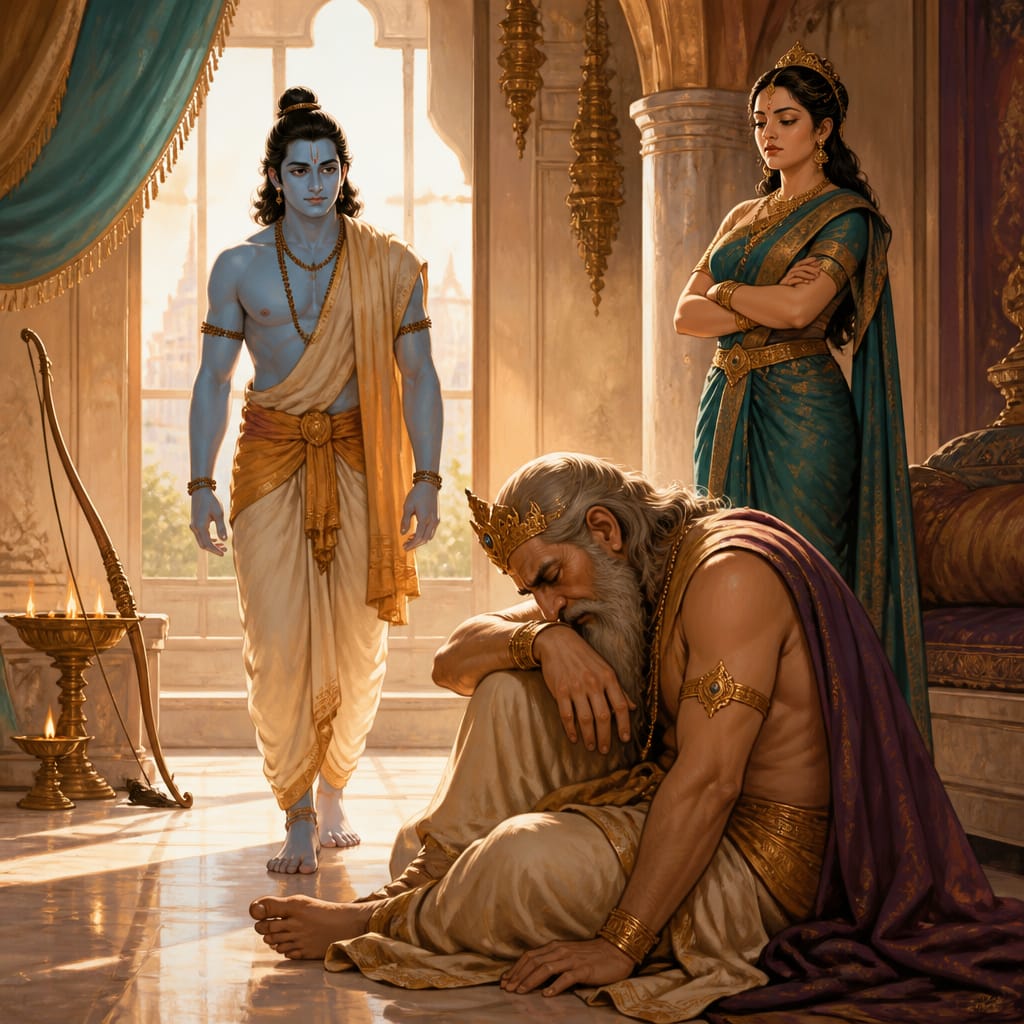
Rama enters Kaikeyi's chamber and finds his father Dasharatha slumped in mourning silks while Kaikeyi stands impassive.

"Father! What has happened? Are you ill? Has some calamity befallen the kingdom?"

Dasharatha tried to speak, but no words came. He looked at his beloved son and could not bear to destroy his world. Tears streamed down his face.

Rama turned to Kaikeyi, who stood watching with an expression that betrayed nothing.

"Mother Kaikeyi, what has happened to my father? Please, tell me what troubles him."

Kaikeyi's voice was steady, almost matter-of-fact: "Your father is merely distressed. He has made certain promises to me, and he fears to tell you."

She told the story - the battle against Sambarasura, the falling chariot wheel, her heroism, Dasharatha's gratitude, the two varas granted. Then:

"Yesterday I claimed those boons. The first: that Bharata be crowned king instead of you. The second: that you be exiled to Dandaka forest for fourteen years, to live as an ascetic."

The Supreme Response

Rama stood absolutely still. His face showed no change. He did not gasp. He did not pale. For a long moment, he simply absorbed the information as one might absorb news of changing weather.

Then he turned to his father:

"Father, please do not grieve. If you have given your word, then of course it must be honored. There is no question in this matter."

What happened next would be discussed for thousands of years. Rama's response defined not just his character but set a standard for dharmic conduct that would echo through history.

"Mother Kaikeyi, I thank you for telling me. Now my father need not suffer the pain of speaking these words himself. As for the boons - they are absolutely just. You saved my father's life. You earned these boons through your courage."

Dasharatha looked up, stunned. Kaikeyi had expected anger, argument, perhaps rage. But not this.

"Fourteen years in the forest? This is not a punishment but an opportunity. I have always wished to live simply, to practice austerities. As for the kingdom - it was never mine to begin with. It belongs to dharma, and dharma now decrees it should go to Bharata."

He knelt before his father:

"Father, please stop grieving. You have done nothing wrong. What kind of son would I be if I caused you to break your sacred promise? What kind of king would I make if I taught the kingdom that words can be broken when convenient?"

The Acceptance

Rama stood and spoke the words that would define him for eternity:

"Let me be clear so there is no confusion. I accept these terms completely. I shall leave for the forest this very day. I will not wait until tomorrow. I will not seek to delay or negotiate."

"Why this very day?" Kaikeyi asked, surprised despite herself.

"Because my father gave his word unconditionally. The boons did not say 'Rama shall go when convenient.' Therefore, exile begins now."

He turned to his father:

"You should feel no guilt. Your word, given in gratitude to a brave queen, will be honored by your son. The kingdom will go to my worthy brother Bharata. Everything happens exactly as it should."

Rama explained his reasoning with such clarity that even Kaikeyi found herself listening with something like awe:

"If I were to refuse exile, I would show the kingdom that a son need not obey his father when obedience is inconvenient. The father's word - pitru vakya - is the foundation of dharma. If I can dismiss it when it costs me a kingdom, then anyone can dismiss any duty when it costs them anything."

The Meaning of Maryada Purushottam

This moment revealed the true meaning of Maryada Purushottam - the supreme upholder of proper conduct. Not someone who follows rules blindly, but someone who understands the deeper purpose of dharma and aligns with it completely, regardless of personal cost.

What Kaikeyi meant as punishment became, in Rama's framing, an honor - a chance to uphold his father's word, to serve his family, to deepen his own character.

Later, sages would marvel: "He made dharma look easy." But it was not easy. What Rama had was not the absence of feeling but complete mastery of it. He felt the loss - of kingdom, of the life he had prepared for. But he did not let feeling determine action. He let dharma determine action.

"Now I shall go inform my mother Kausalya and my wife Sita. I will take leave of them and depart before sunset."

Kaikeyi, for the first time, seemed at a loss. She had prepared for anger, defiance. She had not prepared for this cheerful cooperation.

Rama touching his father's feet in farewell

Rama touched Dasharatha's feet once more. The king, unable to speak, could only place a trembling hand on his son's head - blessing or farewell?

Rama rose and left the chamber with the same graceful dignity with which he had entered. Only now, instead of preparing for coronation, he was preparing for exile. And he walked with exactly the same calm acceptance.

The Deeper Teaching

This moment became the cornerstone example of how a truly evolved soul responds to sudden reversal. Not with complaint: "Why me?" Not with anger: "This is unjust!" Not with bargaining: "Let me delay."

But with understanding: "This is dharma." With acceptance: "I embrace it." With action: "I begin immediately."

There are moments when the only response to duty is immediate, total acceptance. Not passive resignation, but active embrace. Not merely submitting to fate, but transforming it through the quality of one's response.

Rama did not just accept exile. He accepted it so completely, so gracefully, that he turned defeat into victory, loss into gain, exile into opportunity.

This was not superhuman. It was supremely human - humanity at its finest. And it established Rama forever as the one who shows us what is possible when we align completely with dharma, regardless of cost.

Living traditions

Rama's equanimous response to exile is formally taught in Indian management institutes as a model for crisis leadership. The phrase 'Maryada Purushottam' has entered everyday Indian vocabulary to describe anyone who maintains integrity under pressure. Classical musicians continue to compose and perform ragas depicting this scene, with Todi raga's 'compassionate sorrow' considered the musical embodiment of Rama's inner state. The scene is performed in Ramlila traditions across North India, with audiences responding to Rama's acceptance with reverent silence.

Reflection

More in Ayodhya Kanda

All lessons in Ayodhya Kanda ยท The Ramayana course