Manthara's Poison
The Hunchback's Scheme
While Ayodhya celebrates Rama's upcoming coronation, Manthara, the hunchbacked maidservant of Queen Kaikeyi, watches with growing horror. Through masterful manipulation, she transforms Kaikeyi's joy into fear and plants the seeds of a tragedy that will change the course of history.
The Shadow Falls on Joy
While all of Ayodhya celebrated the news of Rama's coronation, one person watched the festivities with growing horror. High on the terrace of Queen Kaikeyi's chambers stood Manthara, the hunchbacked maidservant who had served Kaikeyi since childhood. As she looked down at the city ablaze with lamps and heard the drums announcing Rama's upcoming coronation, her twisted mind began to work its dark magic.
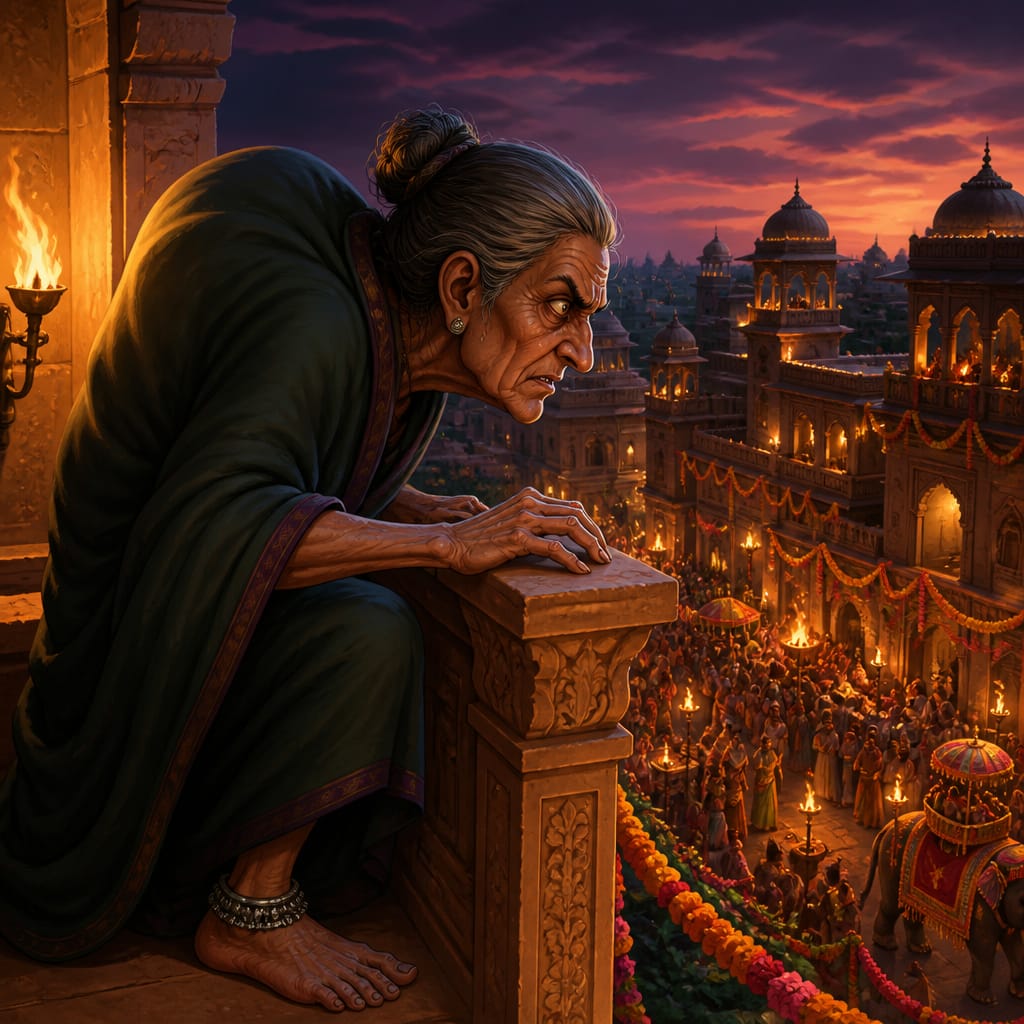
Manthara had always been more than a servant to Kaikeyi. She had been her confidante, her nurse from youth, and had accompanied her from her father's kingdom of Kekaya when Kaikeyi married Dasharatha. But beneath her devoted service lay a heart consumed by jealousy. She had long nursed resentment toward Kausalya, Rama's mother, seeing her as a rival for supremacy in the palace hierarchy.
If Rama becomes king, she thought bitterly, Kausalya will reign supreme as queen mother. My beloved Kaikeyi will be reduced to a lesser queen, and my own position will crumble to dust.
The Seed of Poison
Manthara descended and entered Kaikeyi's chambers, where she found the queen reclining on her couch, adorned in beautiful ornaments, her face glowing with happiness. Kaikeyi was genuinely joyful - she loved Rama as her own son, perhaps even more dearly than her biological son Bharata.
"Oh Manthara!" Kaikeyi exclaimed. "Have you heard? Tomorrow, Rama will be crowned prince regent! Is this not wonderful? I am as happy as if it were my own Bharata being crowned!"
Manthara recoiled as if struck. "You foolish woman! You celebrate your own destruction! You rejoice at news that should fill you with dread!"
Kaikeyi sat up, confused. "How can Rama's coronation be anything but good for our family?"
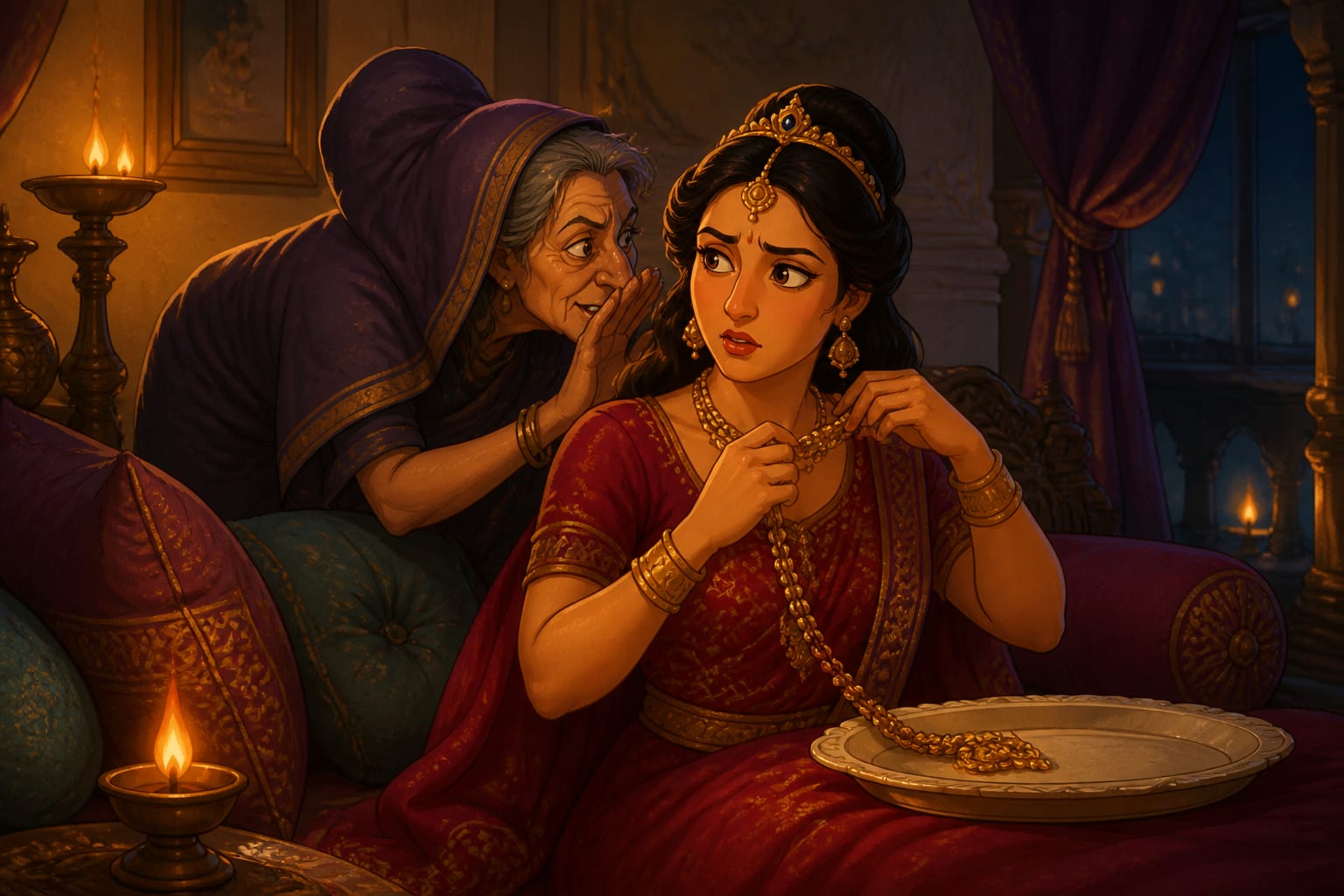
"Listen carefully," Manthara said, settling beside her. "Once Rama becomes king, Kausalya will enjoy the supreme position. You will become a servant to her. But more importantly - your son Bharata. Once Rama is king, he will see Bharata as a threat. Your beloved son will be reduced to a dependent, living on Rama's mercy, or worse - exiled or eliminated!"
This struck deep into Kaikeyi's heart. Whatever else might sway her, the safety of Bharata was paramount. Seeing the first crack in Kaikeyi's armor, Manthara pressed on.
"Consider this - Bharata is away, visiting his maternal grandfather. Do you think it coincidence that Dasharatha chooses this moment to crown Rama? He acts in your son's absence to rob him of his inheritance!"
The Two Boons
Manthara then reminded Kaikeyi of the great battle when Dasharatha fought the demon forces and his chariot wheel broke. It was Kaikeyi who had served as his charioteer, keeping the chariot steady while pulling an arrow from his side, driving the horses through enemy lines to save his life.
"For that supreme act of valor, Dasharatha granted you two boons - any two wishes to be fulfilled at your choosing. Have you forgotten? Here lies your power!"
The memory stirred something in Kaikeyi. She had indeed saved the king's life, and he had sworn to grant her any two wishes. She had kept them in reserve like precious gems, never finding occasion to use them.
"What should I do?" Kaikeyi asked - and in that question lay her fall.
Manthara's eyes gleamed. "Go to the kopa bhavan, the anger chamber. Remove your ornaments and lie upon the bare ground in your oldest garments. When the king comes, refuse to speak. Make him desperate to please you. Then remind him of those boons. Demand that Bharata be crowned instead of Rama, and that Rama be sent into exile for fourteen years. By the time he returns, Bharata will be firmly established."
"Send Rama into exile?" Kaikeyi's voice trembled. "But I love Rama. He is like my own son."
"Exactly - like your son, but he is not your son. When the time comes to choose, you must choose your own blood. This is not cruelty; this is a mother's duty."
The Psychology of Corruption
What we witness here is the terrible power of manipulation. Manthara's jealousy was the deep, festering kind of one who feels perpetually slighted. Her hunchback, her position as a servant, her lack of children - all fed into a resentment that had grown over decades into poisonous hatred.
But Manthara was skilled in the art of projection. She took her own fears and made them seem like Kaikeyi's own. She painted pictures of future humiliations so vivid that Kaikeyi began to see them as inevitable. She transformed a joyous occasion into a threat, a beloved stepson into a danger, and a mother's pride into a mother's fear.
This is how manipulation works. It finds the vulnerable points in a person's armor - in Kaikeyi's case, her love for her son and her pride - and exploits them ruthlessly. It takes legitimate feelings and twists them toward illegitimate ends.
Kaikeyi was not evil. She was weak. She allowed fear to overcome love, wounded pride to overcome reason, and the counsel of a bitter servant to overcome her own better judgment.
The Transformation Complete
By the time Manthara finished speaking, Kaikeyi was no longer the joyful queen who had greeted her servant earlier. She had been transformed - anxious, angry, fearful, and determined. She removed her jewelry piece by piece, letting the precious ornaments fall to the floor. She loosened her beautiful hair and changed from fine silk garments into a plain, worn dress.
Then, with Manthara watching in satisfaction, Kaikeyi went to the kopa bhavan - the small room designated for queens to express displeasure with the king. It was a custom of the time, a formalized space for marital conflict where the king would come to placate his wife. But this time, it would be used for something far more sinister.
Kaikeyi lay down on the bare floor, her hair in disarray, her face set in stony anger. She was ready to play the part Manthara had scripted. When Dasharatha came that evening, seeking to share his joy about Rama's coronation, he would instead find a trap carefully laid.
The poison had been administered. The innocent heart corrupted. The wheels had been set in motion for one of the greatest tragedies in the Ramayana - not through demons or fate, but through the very human vices of jealousy, manipulation, and weak-mindedness.
The Deeper Teaching
This episode reveals profound truths. First, evil often works not through direct action but through manipulation of others. Manthara could not herself stop Rama's coronation, but by corrupting Kaikeyi, she accomplished her design.
Second, it demonstrates the power of words. Manthara used no weapons, no magic, no force - only words, carefully chosen and skillfully deployed, to transform a loving mother into an agent of destruction.
Third, it warns about the danger of isolation from truth. Had Kaikeyi spoken to Rama, to Kausalya, or to any other person, she might have received different counsel. By listening to only one voice - the wrong voice - she sealed her doom and that of many others.
Finally, the path to evil is often paved with legitimate concerns. Kaikeyi genuinely loved her son and wanted to protect him. But this good impulse, twisted by fear and manipulation, became the instrument of great harm. As we will see, Kaikeyi's corruption will test every character in the Ramayana, bringing out both the worst and best in human nature.
Living traditions
The Kaikeyi-Manthara episode is extensively analyzed in psychology and management courses as a case study in manipulation tactics. Terms like 'Manthara effect' are used in Indian media to describe advisors who poison relationships through misinformation. Classical dance forms continue to depict this pivotal scene, with Bharatanatyam and Kathakali performers considered masters only when they can convincingly portray the psychological complexity of Kaikeyi's transformation from loving queen to instrument of fate.
- Kaikeyi Mahal (Queen's Palace): Traditional site associated with Queen Kaikeyi's chambers, including the location of the kopa bhavan (anger chamber) where this fateful scene unfolded
- Hampi Royal Enclosure: UNESCO World Heritage site with archaeological remains of Vijayanagara palace complex, including rooms identified as kopa bhavans - demonstrating the reality of these 'anger chambers' in historical Indian palaces
Reflection
- Think of a time when you were given advice that later proved harmful. What warning signs did you miss, and how can you better evaluate counsel in the future?
- Kaikeyi loved Rama but allowed fear for Bharata to override that love. How can legitimate love for one person lead us to harm another? What does dharma teach about navigating such conflicts?
- If you had been present and witnessed Manthara's manipulation of Kaikeyi, how could you have intervened? What responsibility do we have to protect others from manipulative influences?