Talapatram

The Minister Who Foresaw the Fall

At the very peak of his king's triumph, a loyal minister's heart breaks and he dies. Was it envy, thwarted ambition, or something no one else could see?

King Yashahketu neglects his kingdom for pleasure while his wise minister Dirghadarshin carries the whole realm. When the king abandons everything to win a celestial maiden and returns in triumph, the minister dies of a broken heart that very night. Why? You judge first, then the king does.

The Burning Ground

For the last time the corpse hung waiting in the tree, and the king climbed to bring it down. He set it on his shoulder and walked. The Vetala settled behind his ear and told the final tale of the chapter, a quiet and bitter one.

The Minister Who Saw Too Far

King Yashahketu of Anga was young and beautiful, and in love with his own youth. He left the whole running of his kingdom to his wise minister, a man named Dirghadarshin, whose name means the far-seeing, and spent his own days shut inside the palace, gazing out through latticed windows, caring nothing for the affairs of the realm. The minister carried all of it, quietly, and alone.

One day, returning from a pilgrimage, the minister told the king of a wonder he had heard of: a celestial maiden named Mrgankavati, who rose from the sea. The moment the king heard it, he was lost. He decided that his kingdom and his very life were worthless to him without her, and he resolved to go and find her. Take care of my kingdom while I am gone, he ordered the minister, and if you fail, my death will be on your head. And he left.

King Yashahketu plunges into the moonlit sea

Disguised as an ascetic, the king came to the sea, plunged in after the vision that drew him, found a hidden city beneath the waves, and there he won Mrgankavati, who was a Vidyadhara king's daughter. He brought her home in triumph. The whole city poured out to meet him; there was music and rejoicing, garlands and lamps. The king had, at last, everything he had ever wanted.
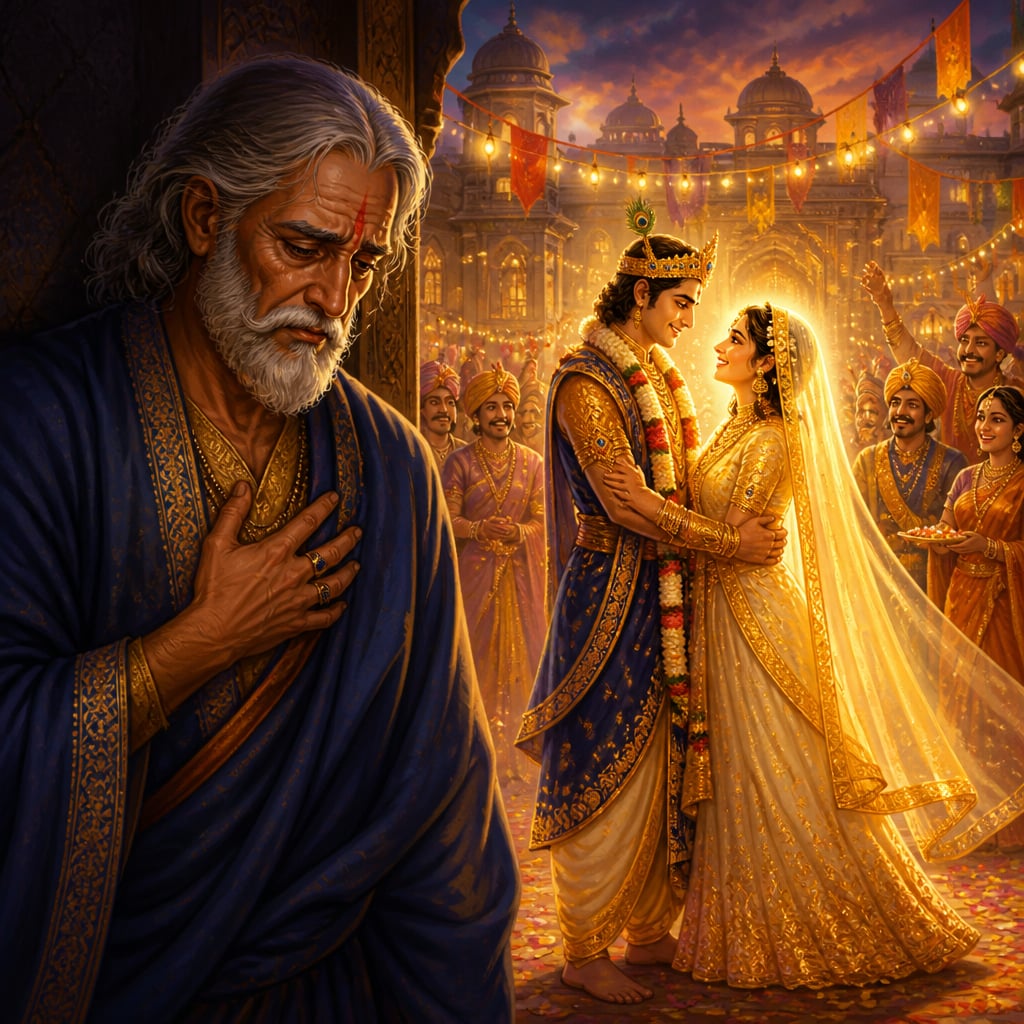
Minister Dirghadarshin stands alone amid the triumph

And that night, at the very height of his master's joy, the minister Dirghadarshin lay down upon his bed, and his heart broke, and he died.

The Betaal's Riddle

"So, king," said the Vetala. "The minister had held the kingdom together for years while his master chased a dream. Now the master had come home victorious and happy, the long danger past, the story ended well. And in that very hour the minister died of a broken heart. Tell me why. Was it grief that he had not won the celestial maiden for himself? Was it that he had secretly hoped to keep the throne, and was crushed to see the king return? What broke his heart?

Answer, if you know. You know the rules."

You Be the Judge

Stay here a moment, before the king speaks. A loyal minister dies of grief at the exact moment his master succeeds. The easy guesses are the ugly ones: envy, or thwarted ambition. But this was a man who had faithfully held a whole kingdom together for years. What, in his master's triumph, could possibly have killed him?

Vikram's Verdict

"Neither envy nor ambition," said Vikramaditya. "Those are small men's reasons, and Dirghadarshin was not a small man. His heart broke from what he could see coming.

"Think of what he knew. For years this king had neglected his kingdom for the sake of ordinary pleasures: the harem, the latticed window, his own reflection. The minister had carried the entire weight of the realm alone, and borne it, because he could still tell himself that it might pass, that the king might one day tire of his indulgence and turn back to his duty. That hope was what kept the minister standing.

"And now the king had returned, not cured, but bound a thousand times tighter, enslaved no longer to mortal women but to a bride out of heaven itself. The minister saw in a single instant that the king was lost to his kingdom forever, that everything he had suffered to hold together would now certainly fall, and that nothing in his power could prevent it. He had endured years of hardship hoping to cure the disease, and the disease had only deepened past all healing. That is what broke his heart. Not that his master had failed, but that his master had succeeded, and that the success sealed the kingdom's doom. He died of seeing too clearly, and too far."

The corpse was gone once more, back to the branch.

The Dharma

This is a tale about the loneliest gift a person can carry: foresight. The minister's very name, Dirghadarshin, means the one who sees far, and the tradition honours that gift above almost any other; the old teaching of the three fishes gives long life to those who see trouble coming and death to the one who drifts into it.

But this tale gives the gift its tragic edge. Foresight in a person who has no power to act on it is not a shield; it is a wound. The minister could see the ruin coming with perfect clarity, and he had no way to turn his king from it. Everyone around him was celebrating, and he alone stood watching the seed of the disaster being planted in the very soil of the triumph. To see what others cannot, while they rejoice at the thing that will destroy them, and to be unable to make them see it, is a particular and terrible loneliness. It broke a strong man's heart.

And notice where his loyalty truly lay. He did not grieve for the king's happiness, nor for his own position. He grieved for the kingdom, the thing his master was responsible for and had abandoned. The truest servant is loyal not to his master's desires but to his master's duty, and will suffer, and here even die, for the good his master has forgotten to guard.

In Your World

Somewhere near you there is a Dirghadarshin: the person who sees the cost that everyone else is too happy, or too hurried, to see. The engineer who knows the shortcut the room is cheering will collapse within a year. The one uneasy voice about the deal everyone else is celebrating. The friend who can see, quietly, where a path is leading long before anyone else does. They are rarely thanked. Usually they are the ones told not to spoil the mood.

Learn two things from the minister. First, if you are the one who sees far, understand that it is a burden as much as a gift, and that being right is not the same as being heard. Find ways to help others see, and guard your own heart against the grief of watching alone. And second, if you are the one being celebrated, look for the person at the edge of the room who is not celebrating, and go and ask them what they see. They may be the most loyal person you have, and the only one telling you the truth. Triumph is often exactly when things start to go wrong, and the far-seeing are usually the first to notice.

Reflection

  • You judged why the minister's heart broke. Did you first reach for a small motive, envy or ambition, before you considered that he might have died of seeing too clearly?
  • When have you been the only one in the room who saw the cost of a decision everyone else was celebrating? What did you do with that lonely knowledge?
  • Whose quiet, far-sighted labour holds up something you enjoy, without thanks or notice? Who is your Dirghadarshin?

More in Who Gave the Most?

All lessons in Who Gave the Most? ยท Vikram & Betaal ebook course