Talapatram

Madanasena's Rash Promise

In one night, three men hold a woman in their power, and each lets her go. The husband, the admirer, and the thief. Which of them was truly generous?

Trapped into a rash oath, Madanasena marries, then honours her word by setting out to visit the man she promised. Her husband lets her go to keep her word, a thief on the road robs her but waits, and the admirer, moved by her truthfulness, sends her home untouched. Returning, she is freed by the thief too, jewels and all. Which of the three men was the truly generous one? You judge first, then the king does.

The Burning Ground

Once more the corpse had slipped back to its branch. The king brought it down, shouldered it, and set off over the ash. As he walked, the Vetala told a tale of three men and one long night.

The Woman Who Kept Her Word

In the city of Anangapura there was a merchant's daughter named Madanasena, betrothed to a merchant named Samudradatta. Before the wedding, a young merchant named Dharmadatta, a friend of her brother, saw her in a garden and was overcome with love for her. He caught her alone and pressed his heart on her. Frightened, and only to get free of him, she made a rash promise and sealed it with an oath: let my marriage be celebrated first, she said, and then, before I go to my husband, I will come to you once.
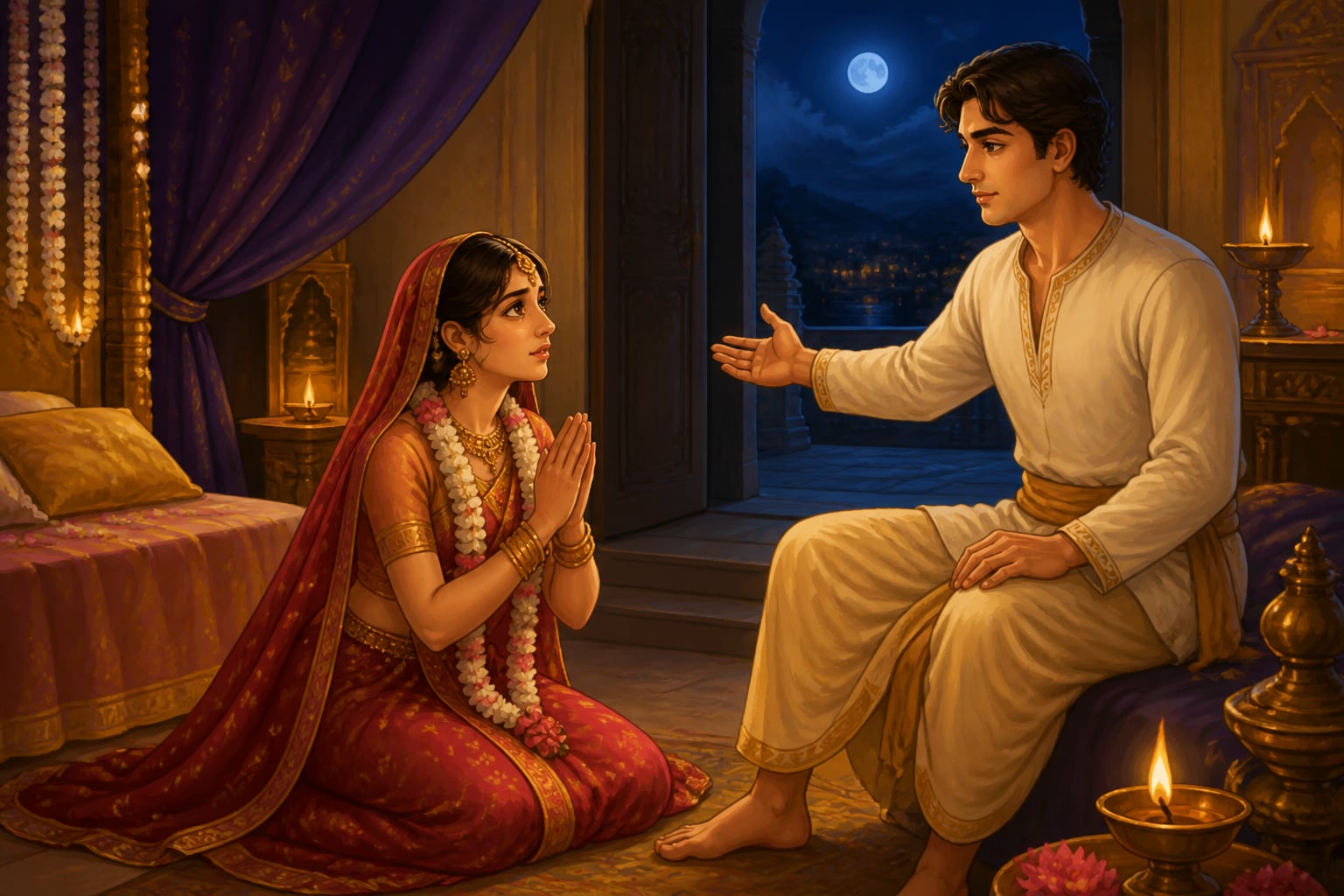
Madanasena confesses her oath to her husband

So she was married to Samudradatta. And on her wedding night, rather than break her word by hiding it, she told her husband everything: the young man, the promise, the oath. Her husband was stunned. But he honoured truth above his own claim on her. Let her go, he said. Why should I be the cause of her breaking her word? And he sent her out into the night to keep it.

On the dark road a thief seized her and stripped her of her ornaments. She told him her story and begged leave to keep her promise first, and then return. The thief, struck by something in her, agreed to wait, and let her go on.

She came at last to Dharmadatta. But when he saw her actually arrive, keeping so costly and dangerous a promise, something turned in him. His old passion had cooled with the long waiting, and he thought too of the danger he stood in. I am delighted by your faithfulness, he said. What have I to do with you, another man's wife? Go home. And he sent her back untouched.

The thief returns Madanasena's jewels on the road

She returned to the thief on the road, as she had promised she would. And the thief, hearing that even Dharmadatta had let her go for the sake of her word, was so taken with her truth that he gave her back all her ornaments and released her, untouched, to go home to her husband.

Three men, in a single night, had held this woman entirely in their power. And every one of them had let her go.

The Betaal's Riddle

"So, king," said the Vetala. "Three men, and each let her go. Her husband, who sent her to keep her word. Her admirer, who would not touch another man's wife. And the thief, who gave back the woman and her jewels both. Of these three, which was the truly generous man?

Answer, if you know. You know the rules."

You Be the Judge

Pause here, before the king gives his answer. All three released her; on the surface all three were noble, and the easy answer is to call them equal, or to trust the two respectable merchants over the robber in the dark. But look closer at each man's letting-go. Which was real generosity, and which was something else wearing its clothes?

Vikram's Verdict

"The thief," said Vikramaditya. "Only the thief was truly generous.

"Take the husband first. He did a good thing, but it was his duty. A husband is bound to truth and to his wife's honour, and letting her keep a solemn oath was the right and expected thing for a man in his place. He gave up little that was not already asked of him.

"Now the admirer, Dharmadatta. Why did he really let her go? Not out of pure nobility. His passion had cooled with the waiting, and, more to the point, he was afraid. He knew that if he touched her, her husband would learn of it and might go to the king in the morning. He released her to keep himself safe. That is prudence, not generosity.

"But consider the thief. A robber in the dark, with a beautiful woman wholly at his mercy and her gold already in his hands. No duty bound him, for he had thrown duty away long ago. No fear checked him, for what had a thief in the night to dread from a merchant's complaint? He had everything to gain by keeping her and the jewels, and nothing at all to lose. And he gave it all back, the woman and the gold, moved by nothing but admiration for her truth. He alone surrendered what was fully his to take, with nothing compelling him and nothing to gain. That is generosity, and he was the only one of the three who showed it."

The corpse slipped away, back to the tree.

The Dharma

See how the king cut through appearances. Three men did the same outward thing, and it would have been easy to call them equally good, or to rank them by station and set the honest merchants above the thief. The king did the opposite, and he did it by asking one question of each act: was the man free not to do it, and did he expect anything back?

The husband was moved by duty; the admirer by fear and by desire gone cold. Both had something pushing them toward the good act. Only the thief acted from a free heart, with every reason to do otherwise and none to do right, and gave anyway. That is true tyaga, real letting-go: the surrender of what is genuinely yours to keep, uncompelled by duty, unforced by fear, unbought by any hope of gain. And the largeness of heart behind it is audarya, generosity in its truest sense, which the tradition prizes precisely because it is free.

And do not miss the tale's quiet defiance. It set a common thief above two respectable merchants and declared him the better man, on the strength of a single act. Station did not decide it. Birth did not decide it. Conduct decided it. In the dharmic reckoning, a person is measured by what they do when they are free to do anything at all, and by that measure the thief stood highest of the three.

In Your World

Much of what passes for generosity in our own lives is something quieter and less flattering underneath. We give because it is expected of us, and call it kindness. We give because we would look bad if we did not, and call it charity. We give because we hope, half-consciously, to be repaid in favours or gratitude or good name, and call it a gift. None of this is bad. But none of it is quite the real thing either.

The real thing is rarer, and you will know it by two marks: you were free to keep what you gave, and you expect nothing at all in return. The help no one will ever hear about. The forgiveness the other person will never know they were granted. The gift given to someone who can do nothing for you. When you want to measure how generous you truly are, do not count what you give when the giving is watched, or repaid, or required of you. Count what you give when you are the thief in the dark, with everything to gain by keeping it, and no one to know if you do.

Reflection

  • You judged the three men before the king spoke. Did you reflexively credit the respectable husband or admirer over the thief, before weighing what each act actually cost and expected?
  • Think of your own most generous acts. How many were truly free, and how many were duty, fear of looking bad, or the quiet hope of being repaid?
  • When have you given something with nothing to gain and no one to know, purely because it was right? How did that feel different from giving that was noticed or repaid?

More in Who Gave the Most?

All lessons in Who Gave the Most? ยท Vikram & Betaal ebook course