Talapatram

The Loyalty of Viravara

A whole family gives everything for the king. Of them all, who was the bravest?

A warrior in the king's service loses his son, his daughter, his wife, and finally himself in a single night, all to keep the king alive. The king, who watched it in secret, cannot bear to be worth so much and raises the sword against himself. Of everyone in the tale, who was the bravest? You judge first, then the king does.

The Burning Ground

The corpse hung in its tree, and the king climbed for it once more. He had stopped counting the trips. He tied the body fast, settled it on his shoulder, and walked into the dark. Behind his ear the Vetala, warm and talkative, began again.

Viravara's Watch

A warrior named Viravara came to the court of King Sudraka and asked to enter his service. He asked an enormous wage, so large the ministers laughed. But the king watched the man's bearing and paid it in full.

What Viravara did with that wealth was strange. He kept only a little to feed his family, gave the rest away to the poor and to the temples, and every single night, in every weather, he stood guard at the king's door and never once failed.

One night the king heard a woman weeping somewhere beyond the palace wall, and sent Viravara to find her. He found a woman of unearthly beauty, weeping: she was the goddess of the king's own fortune, and she wept because the king would die in three days.

"Is there no way to save him?" Viravara asked.

"One," she said. "Let a father offer his own son before the goddess Chandi, freely, and the king will live a hundred years." And she was gone.

The king had followed in secret, and heard every word.

Viravara went home and told his wife and his son what he had heard. The boy did not hesitate. "To give my life so the king may live is the finest thing I could do with it," he said. "Take me."
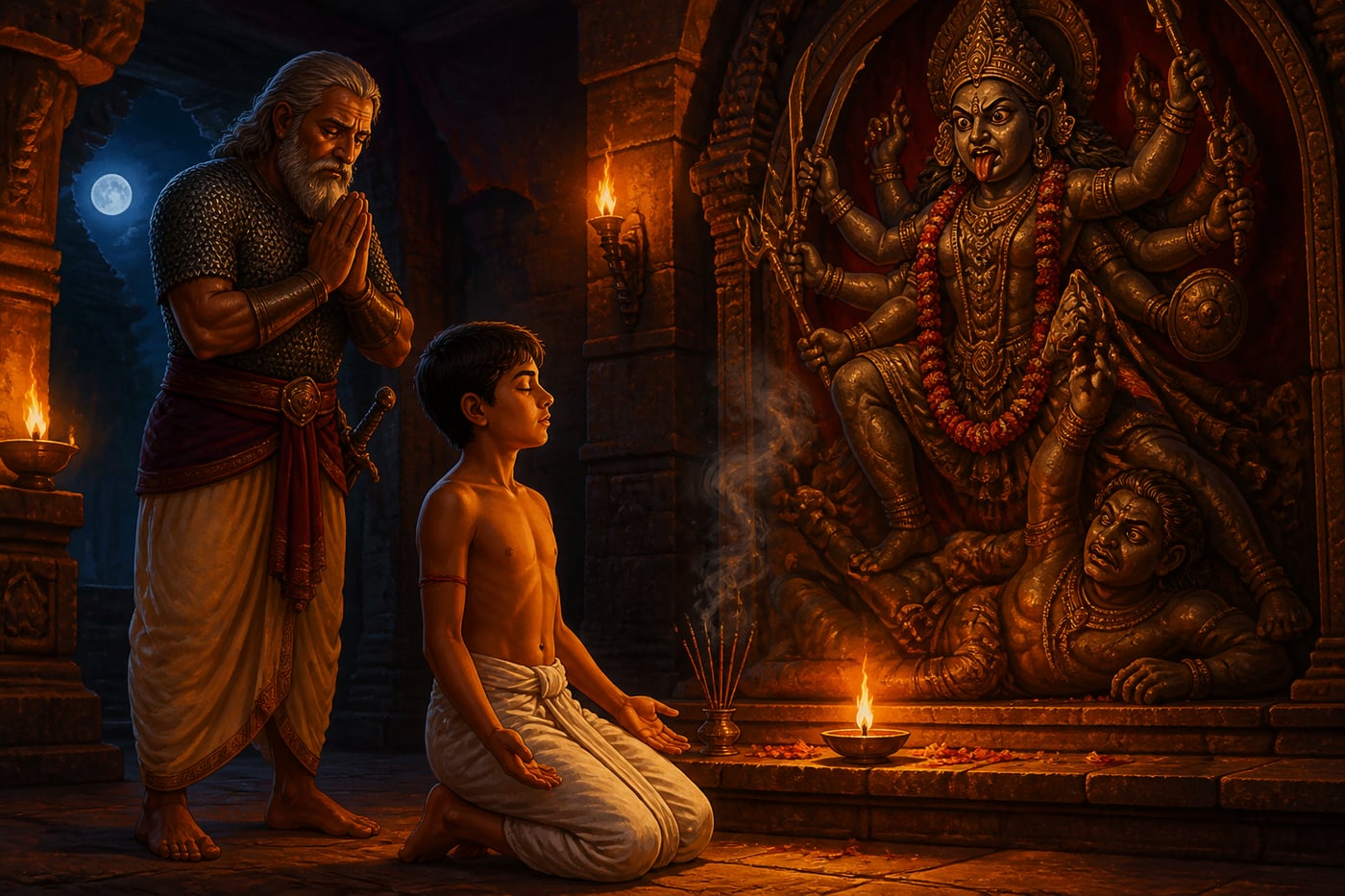
Viravara's son kneels before the goddess Chandi

At the temple, the son gave himself to the goddess. His young sister, seeing her brother fall, died on the spot of pure grief. Their mother, Dharmavati, having lost both her children in a breath, walked into the funeral fire after them.

And Viravara stood alone in the temple with his whole family gone. "The king is saved," he said. "My son bought a hundred years for him. There is nothing left in the world for me now." And he lifted the sword to offer his own head to the goddess.

King Sudraka raises the sword against himself

The king, watching from the shadows, could bear no more. He stepped out. "What is my one life worth," he cried, "that a good man should lose his children, his wife, and himself to buy it? I will not live at such a price." And he raised the sword against his own throat.

Goddess Chandi restores Viravara's family to life

Then the goddess Chandi herself stayed his hand. "Enough," she said. "Your worth is proven, and so is his." And she gave them all back, the son, the daughter, the wife, and Viravara, alive and whole, as if the terrible night had never come.

The Betaal's Riddle

"So, king," said the Vetala. "Weigh them all. The son who gave his life without a word. The daughter who died of grief. The mother who walked into the fire. The servant who lost everything and reached for his own death. And the king who would not outlive the man who saved him. Of all of them, who was the bravest?

Answer, if you know. You know the rules by now."

You Be the Judge

Stop before the king speaks. It is tempting to say the son, who gave his life first and without flinching. Or Viravara, who lost the most and still reached for the sword.

But sit with the whole scene. Of every person in it, who did the bravest thing?

Vikram's Verdict

"The king, Sudraka," said Vikramaditya, and did not slow.

"The son gave his life, but a son is raised from birth to honour his king, and he did what he was raised to do. The daughter and the mother followed their love and their grief into death, as their hearts moved them. Viravara did what a warrior in sworn service does: he paid the price he had promised with his life. Each of them acted true to what they were. That is high, but it is not the highest.

"The king owed nothing. Kings spend servants to save themselves; that is the ordinary way of power, and no one would have blamed Sudraka for taking the hundred years the boy bought him. Instead he watched a poor man lose everything for his sake, and found he could not bear to be worth so little and take so much. To turn the sword on himself, he had to break the deepest instinct a living thing has, and the strongest one a king has: to survive. No one is raised to that. He reached it alone. He was the bravest."

The words were barely out when the corpse was gone, laughing, back to its branch. The king turned and began the long walk again.

The Dharma

Notice where the king looked for bravery. Not at the biggest loss, and not at the first to act. He asked a stranger question: who acted most against their own nature?

The son, the wife, the servant were all moving with the current of who they were, their training, their love, their oath. Courage that flows with your nature is real, but it is the easier kind. Sudraka went against his. He was a king, built to survive and to let others fall for him, and he refused it. This is nyaya: the highest courage is not being true to your nature but being free of it.

In Your World

Admiration usually goes to whoever suffered most, or acted first. The king's measure is harder and truer: who went against their own strongest pull?

It is easy to be generous when generosity is your habit, brave when you were raised bold, loyal when loyalty costs you nothing. The real thing shows when it runs uphill against your own advantage: the manager who takes the blame down instead of passing it down, the powerful person who spends their power on someone who can never repay it, the winner who gives up the win. When you look for courage, in others or in yourself, do not measure the deed. Measure what it had to overcome.

Reflection

  • You judged before the king spoke. Did you choose the son, or Viravara, or the king, and did the king's answer change your mind?
  • When have you seen someone with power take a cost onto themselves rather than pass it down to someone weaker?
  • Courage here means acting against your own strongest pull. Where in your life would real courage mean going against your own advantage?

More in Who Gave the Most?

All lessons in Who Gave the Most? ยท Vikram & Betaal ebook course