The Brahman Boy Who Gave His Life
A boy of seven, adorned for his own killing, laughs in the instant the sword is raised. Why would a child laugh at his own death?
To save his kingdom, a king must give a demon a willing boy as a victim. A poor brahman's seven-year-old son offers himself, reasoning that the body perishes anyway. At the moment of the killing, with the sword lifted over him, the boy laughs, and everyone present is struck silent. Why did he laugh? You judge first, then the king does.
The Burning Ground
Back in its tree the corpse waited. The king climbed, freed it, and settled it on his shoulder. Close behind his ear, the Vetala began a tale of a child braver than kings.
The Boy Who Was Not Afraid
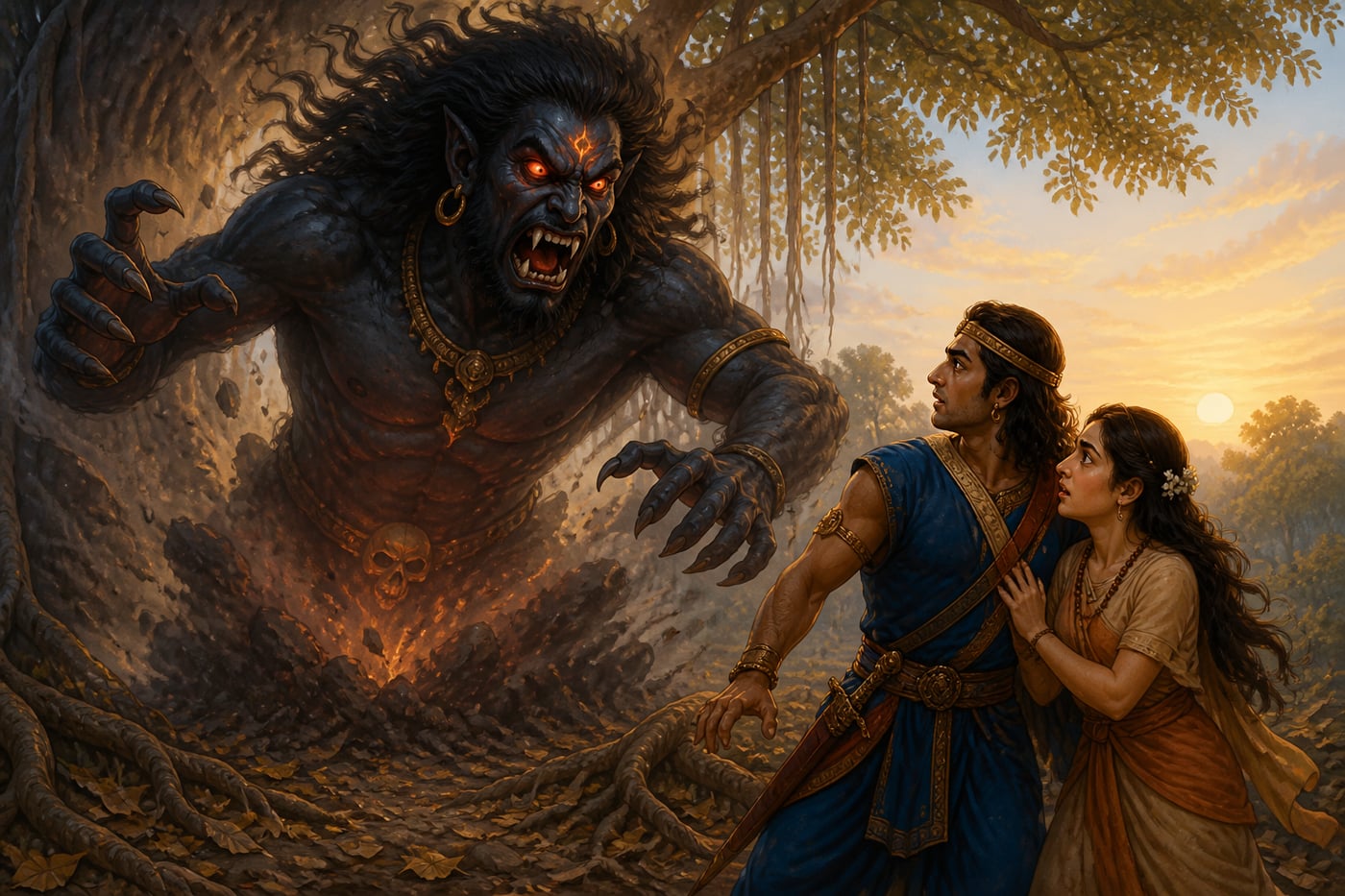
King Chandravaloka of Chitrakuta, out hunting, took as his bride a hermit's daughter named Indivaraprabha, and rested with her beneath a great ashvattha tree. At dawn a demon named Jvalamukha appeared, enraged that they had trespassed on his ground, and he named a price. Either the king's own heart, or else a rare and terrible victim: a brahman boy of seven, wise and noble beyond his years, willing to offer himself, and held for the killing by his own parents' hands. Seven days, said the demon, or your kingdom is destroyed.
The king's minister rode through the land with a proclamation. To the boy who would give himself, and to his family, an image of gold and jewels and a hundred villages. In a poor brahman's house, a seven-year-old heard it. And it was the child who went to his frightened parents and reasoned with them. This body will perish soon enough, he said, whatever we do with it. The one lasting thing in a passing world is the good that is won through it. Let mine buy your rescue from want, and the king's rescue from death.
His parents, in grief and in need, at last consented. The boy saw the gold and the villages delivered into their hands, and then he walked to the king.
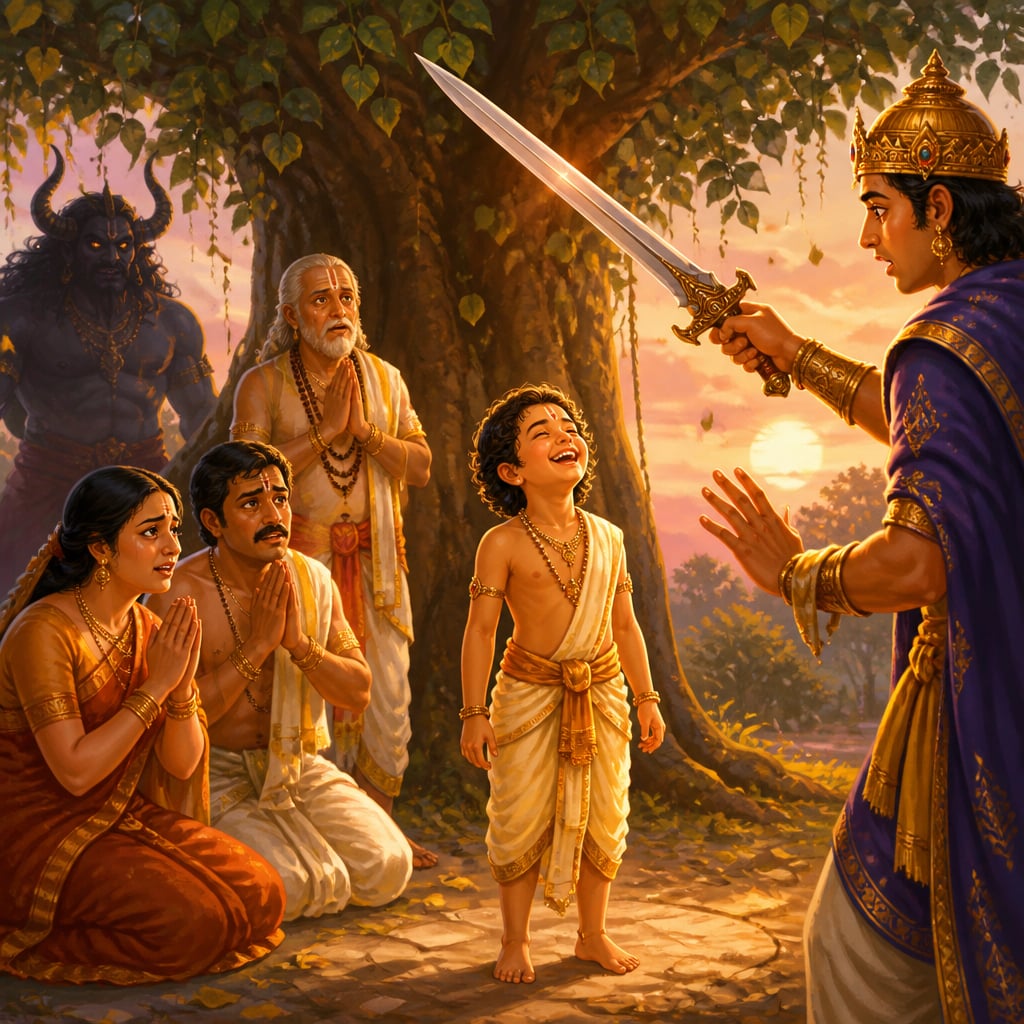
They adorned him, and set him on an elephant, and brought him to the ashvattha tree, his parents beside him. The rites were spoken. The demon appeared, terrible to see. And as the king raised his sword to strike, the boy, in that last instant, laughed. He laughed so freely and so loud that every person there, the king, the parents, the priests, even the demon, stopped where they stood, and pressed their palms together, and stared at his face.
The Betaal's Riddle
"So, king," said the Vetala. "A child of seven, adorned for his own killing, the sword already lifted over him. And in that moment, of all moments, he laughs. Not a scream, not a plea. Laughter. Tell me why. Why did the boy laugh as he was about to die?
Answer, if you know. You know the rules."
You Be the Judge
Wait here, before the king speaks. Set aside the horror of the scene and sit with the strangeness at its centre. A small boy, about to be killed, laughs. It is not the laugh of madness; everyone who heard it fell silent and bowed. What could a child possibly see, in that instant, that would make him laugh?
Vikram's Verdict
"He laughed from wonder, and from joy," said Vikramaditya. "Think of who stands around a helpless creature in this world, the ones meant to keep it safe. Its mother and father. Its king. Its god. Those four are a child's whole shelter.
"And this boy looked around him and saw every one of those shelters turned the other way. His parents were holding him for the knife, for gold. His king stood ready to kill him, to save his own life. The very deity of the place had come to devour him. Every protector the world gives had failed him at once, and completely. And so the boy saw the truth plainly, as few grown men ever do: that not one of them could touch what he actually was. They could take the body, this small perishable thing, and nothing more. He alone, by giving it up freely, held the only real power in the whole scene.
"That was his joy: that he, the smallest and weakest one there, had done the single thing worth doing, and saved himself in the only way a person truly can. And his wonder was at all of them, at how each one, parent and king and god alike, was so lost in clinging to a body that must perish anyway. He laughed at the strangeness of that delusion, seeing so clearly what they could not."
The corpse was gone from his shoulder.
The Dharma
Everything in this tale hangs on one distinction, the oldest and deepest in all of Indian thought: that you are not your body. The body is born, and grows, and perishes. But what looks out through it, the Self, the atman, is not born and does not die. The Gita says it in the plainest words: it is not slain when the body is slain.
The boy knew this, not as a saying he had memorised but as a fact he could feel, and so the thing that terrifies everyone else could not terrify him. And watch what that knowledge did to him. It did not make him cold, or careless of life; it made him free, and even light. Death, to one who knows what in him cannot die, is the setting down of a garment, not the ending of himself. That freedom is what the tradition calls abhaya, fearlessness, and it is not a matter of being brave against death. It is the natural state of one who has understood that the thing he feared to lose was never the whole of him.
And see the mirror the boy held up to everyone else. His parents, his king, the demon, each of them frantic, grasping, willing to do a terrible thing, and all of it was one thing underneath: the fear of the body's ending, wearing different masks. The child alone was unafraid, and so the child alone was free.
In Your World
You will not meet a demon under a tree. But the fear the boy was free of runs quietly beneath a great deal of your life. So much of our grasping, our hurry, our need to win and to hold on, our willingness to bend ourselves out of shape, is at the bottom the fear of ending, dressed in a hundred everyday disguises. We cling to status, to comfort, to being right, to being safe, as though the whole of us were at stake, when it is only ever the garment.
You do not have to conquer death to loosen its grip on you. You only have to remember, now and then, that the part of you most worth protecting, your character, your love, the good you put into the world, is not the part that time can take. Hold on to that, and the fear that drives so much needless grasping begins to quiet. You will not laugh at a lifted sword. But you may find you can meet the ordinary losses you so dread, of face, of comfort, of certainty, with a lighter hand, because you have remembered what in you they were never able to touch.
Reflection
- You judged why the boy laughed. Did you first assume madness or despair, before you considered that he might have seen something the grown-ups around him could not?
- How much of your daily grasping, fear, and hurry is, underneath, the fear of ending? What might loosen if you held that fear more lightly?
- The boy saw his parents, his king, and even a god all deluded by clinging. Where are you holding to something perishable as though it were the whole of you?